
In This Article
Haven Tent Review: Is a Lay-Flat Hammock Finally Worth It?
If you’ve ever woken up in a regular camping hammock with a stiff neck, a numb shoulder, and the distinct feeling of being a banana, you already understand why this haven tent review exists. Traditional gathered-end hammocks are fantastic for lounging. For sleeping eight hours as a side sleeper? Not so much.
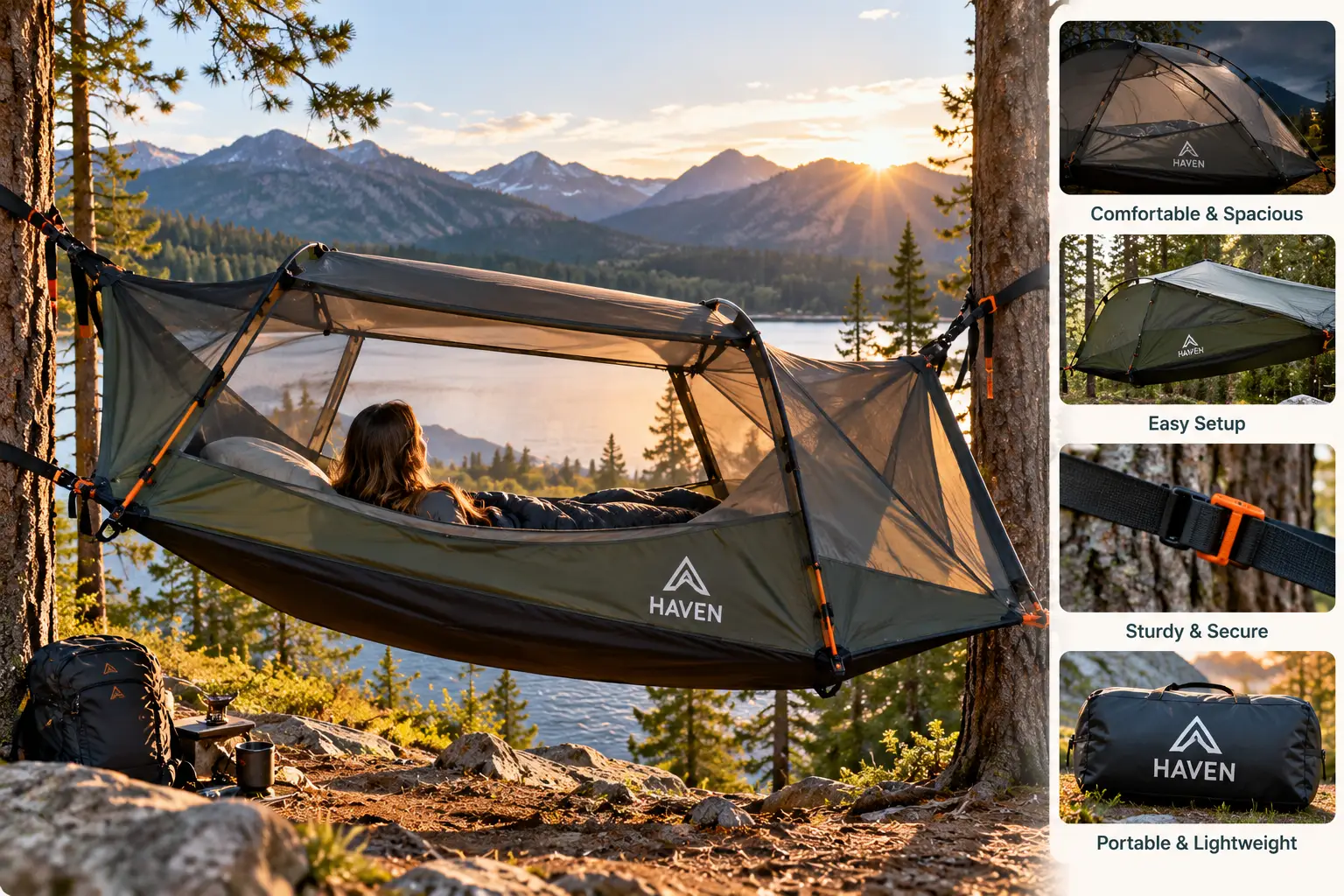
The Haven Tent was built to fix exactly that. Created by Utah-based founder Derek Tillotson and launched through a 2019 crowdfunding campaign, it borrows its geometry from suspension bridges: support arcs, a structural ridgeline, and internal spreader bars pull the fabric into a flat, rectangular bed instead of a curved cocoon. Add a fitted insulated air pad, a bug net, and a rainfly, and you’ve got a shelter that hangs between trees like a hammock but sleeps more like a cot.
That promise is bold, so this haven tent review takes it apart honestly. We compared official spec sheets, aggregated customer feedback from Amazon and the brand’s own review platform, and hands-on reports from outdoor publications such as GearJunkie’s long-term Haven XL review. We didn’t stop at Haven’s own lineup, either. You’ll see how the original Haven Tent, the roomier Haven XL, and the canvas Haven Safari stack up against four serious alternatives: the Lawson Blue Ridge, the Night Cat Flat Lay, the Kammok Mantis, and the Hennessy Hammock Expedition Asym Zip.
By the end, you’ll know which lay flat hammock tent fits your body, your budget, and the way you actually camp, whether that’s car camping at a state park or hauling gear into the backcountry. ⛺
What Is a Haven Tent?
A Haven Tent is a lay-flat hammock tent: a suspended, one-person shelter that uses spreader bars, tensioned arcs, and a ridgeline to create a flat sleeping surface. It includes a bug net, a waterproof rainfly, and a fitted air pad, and it can also be pitched on the ground as a bivy-style tent.
In practice, that ground mode matters more than it sounds. Desert campsites, alpine tree lines, and crowded campgrounds with no suitable trees are where conventional hammocks simply quit. The Haven keeps working there, which makes it a genuine tent replacement rather than a fair-weather toy.
Haven Tent vs. Rivals: Quick Comparison Table
Before we dig into each model, here’s the 30-second version. Weights and capacities come from manufacturer specs and retailer listings; prices are approximate ranges at the time of writing and change often, so always check the current price.
| Model | Design | Approx. Weight | Max Capacity | Price Range | Best for |
|---|---|---|---|---|---|
| Haven Tent | True lay-flat, 78″ x 24″ bed | ~6 lb 15 oz (with insulated pad) | 285 lb | $300–$400 | Back and side sleepers up to ~6 ft |
| Haven XL | True lay-flat, 80″ x 30″ bed | ~7.7 lb (kit) | Built for larger campers | $350–$450 | Tall or broad campers |
| Haven Safari | Lay-flat, 300D polyester canvas | ~12.4 lb (kit) | 350 lb | $400–$500+ | Car camping and glamping |
| Lawson Blue Ridge | Spreader bar + arch pole hybrid | ~4.25 lb (no straps) | 275 lb | $200–$250 | Budget tent-hammock versatility |
| Night Cat Flat Lay | Lay-flat with under-bed pad storage | Varies by version (check listing) | 330 lb | $150–$300 | Budget-conscious flat sleepers |
| Kammok Mantis | Gathered-end all-in-one | ~2 lb 4 oz (packed) | 300 lb | $200–$330 | Weight-conscious backpackers |
| Hennessy Expedition Asym Zip | Asymmetric hammock | ~2 lb 12 oz (packed) | 250 lb, up to 6 ft | $170–$300 | First-time hammock campers |
Looking at the table, the trade-off is stark: the three Haven models and the Night Cat Flat Lay buy you a genuinely flat bed at the cost of roughly 5 to 10 extra pounds compared with the Kammok Mantis or Hennessy Expedition Asym Zip. The Lawson Blue Ridge sits in the middle, flatter than a gathered-end hammock but lighter than any Haven. If you mostly drive to camp, weight barely matters and comfort wins; if you’re counting ounces on a 15-mile day, the lighter options earn a serious look.
💬 One click helps other shoppers make an informed choice too! 😊
Top 7 Lay-Flat and Hybrid Hammock Tents: Expert Analysis
Each pick below was chosen for a specific type of camper. We lead with Haven’s three models, since they’re the heart of this review, then show you where the competition genuinely beats them.
1. Haven Tent — the original flat-lay benchmark
The Haven Tent is the model that proved a hammock could sleep flat, and it remains the reference point every rival gets measured against. Its 78″ x 24″ bed is tensioned by internal spreader bars and support arcs, so the floor stays taut rather than wrapping around your shoulders. In practice, that means you can sleep on your side with your hips and spine roughly level, something gathered-end hammocks only approximate with a diagonal lay. The fitted R4 insulated pad does double duty: it keeps your back warm and adds horizontal rigidity, which is why Haven recommends using it rather than a random pad.
Who should buy it? Back and side sleepers up to about 6 feet who mostly car camp, paddle, or motorcycle tour. At roughly 7 pounds with the pad, it’s carryable, but ultralight hikers will feel every ounce.
Reviews consistently report two themes: unusually comfortable sleep, and a “tippy” feeling during the first few nights until you learn to center your weight. A minority of buyers mention seam or zipper concerns, so inspect stitching on arrival.
Pros:
- ✅ Genuinely flat bed for side and back sleepers
- ✅ Complete kit with fly, bug net, and pad
- ✅ Pitches on the ground when trees are scarce
Cons:
- ❌ Heavy for a one-person backpacking shelter
- ❌ Feels tippy until you master entry technique
In the $300–$400 range, the Haven Tent is pricey but fair value if flat sleep is your top priority.
2. Haven XL — roomiest bed for big and tall campers
The Haven XL keeps the same suspension-bridge architecture but widens the bed to 80″ x 30″, giving broader shoulders and restless sleepers noticeably more room. Those six extra inches of width sound modest on paper; in reality, they’re the difference between sleeping with your arms tucked and being able to roll from back to side without brushing the bug net. The whole kit lands around 7.7 pounds, so the size upgrade costs surprisingly little weight.
Here’s a detail many buyers overlook: Haven’s own sizing guidance says the XL’s geometry relies partly on the occupant’s body weight to stay open, and the brand suggests the standard Haven Tent for campers under about 160 pounds. Lighter sleepers in the XL can feel the sides relax inward. That makes the Haven XL a clear pick for people over 6 feet or over 200 pounds, not an automatic “bigger is better” upgrade. If you’re comparing a haven tent xl review against the original, that weight threshold is the single most useful fact.
Aggregated reviews from larger campers are especially positive, with many describing it as the most comfortable hammock they’ve owned. Recurring complaints echo the original: bulk on long hikes and limited interior storage.
Pros:
- ✅ Spacious 80″ x 30″ bed for tall sleepers
- ✅ Minimal weight penalty over the standard model
- ✅ Strong comfort feedback from heavier campers
Cons:
- ❌ Less supportive for campers under ~160 pounds
- ❌ Interior gear storage is fairly limited
Typically between $350 and $450, the Haven XL is the best-value Haven for anyone over 6 feet.
3. Haven Safari — heavy-duty canvas for glamping
The Haven Safari trades portability for toughness, swapping the original’s ripstop polyester for a 300-denier polyester canvas body and fly. That heavier fabric feels more like a quality wall tent than a backpacking shelter, and it shrugs off abrasion, campfire sparks, and years of truck-bed storage far better than thin nylon. Haven rates it for 350 pounds, and press coverage reports the company load-tested it past 2,000 pounds during development, which tells you the 350-pound figure carries a substantial safety margin.
The catch is weight: roughly 12.4 pounds for the kit, which Haven itself says isn’t meant for backpacking. Think overlanding, campground stays, backyard sleepovers, or a semi-permanent hunting camp. It also adds a lounge strap that converts the hammock into a hanging chair, a genuinely useful feature when you’re hanging out around camp for days at a time.
Customer feedback praises the build quality and the “glamping” feel, while at least one detailed review describes the floor stretching and sagging under a heavier occupant over a multi-night trip, so check strap tension each evening.
Pros:
- ✅ Rugged 300D canvas resists wear and sparks
- ✅ Highest weight rating in the Haven lineup
- ✅ Converts into a comfortable lounge chair
Cons:
- ❌ Around 12 pounds, far too heavy to backpack
- ❌ Canvas takes longer to dry after rain
Usually in the $400–$500+ range, the Haven Safari is worth it only if you drive to camp.
4. Lawson Blue Ridge — best-value tent-hammock hybrid
The Lawson Blue Ridge is the veteran of this category, and it delivers a flatter-than-normal lay for considerably less money than any Haven. Lawson’s patented system pairs a spreader bar with an arch pole, which pulls the bed taut and largely eliminates the “cocoon” squeeze of a gathered-end hammock. It’s not as perfectly flat as a Haven Tent, but most back sleepers will find it a big step up from a standard hammock. At roughly 4.25 pounds without straps, it’s also about three pounds lighter than the Haven kit.
Based on comparing the specs, the Lawson Blue Ridge suits campers who want versatility on a budget and already own tree straps, since the base package typically omits them. The integrated no-see-um netting and a rainfly that attaches directly to the hammock mean no extra tarp lines to rig.
Customer reviews generally praise easy setup and the absence of cocooning. Common complaints: limited airflow on hot summer nights because of the snug bug net, and a cramped feel when it’s pitched as a ground tent.
Pros:
- ✅ Flatter lay than gathered-end hammocks
- ✅ Lighter than every Haven model
- ✅ Rainfly attaches directly to the hammock
Cons:
- ❌ Stuffy in hot, humid weather
- ❌ Tight and cramped in ground-tent mode
Typically in the $200–$250 range, the Lawson Blue Ridge is the smartest buy for budget-minded hybrid campers.
5. Night Cat Flat Lay — budget path to flat sleep
The Night Cat Flat Lay is the most affordable true lay-flat design we found on Amazon, and it attacks the problem a little differently than Haven. Instead of relying only on an internal pad, it adds a storage compartment beneath the bed to hold the sleeping pad, which helps keep the platform stable and stops the pad from sliding out from under you. Listings rate it for 330 pounds and describe a setup size of about 87″ x 28″, which is longer than both Haven models.
Here’s what to weigh honestly: specifications vary noticeably between Night Cat listings and fabric versions, with published weights ranging from roughly 5 pounds to over 10 pounds depending on the kit. Read the exact listing you’re buying from, and confirm whether a pad is included. On paper, though, the Night Cat Flat Lay gives budget-conscious side sleepers a credible taste of flat-lay comfort without a $300+ commitment.
We could not verify a large volume of detailed long-term reviews for this model, so treat it as a promising value pick rather than a proven heirloom. Available feedback highlights comfort for side sleepers and the clever under-bed storage.
Pros:
- ✅ Lowest-cost route to a genuinely flat lay
- ✅ Under-bed storage keeps the pad in place
- ✅ Generous length and 330-pound rating
Cons:
- ❌ Specs differ between listings and versions
- ❌ Limited long-term durability data available
Roughly $150–$300 depending on version, the Night Cat Flat Lay offers strong value if you verify the listing first.
6. Kammok Mantis — lightest all-in-one for backpackers
The Kammok Mantis isn’t a lay-flat hammock at all, and that’s exactly why it belongs here: it shows what you gain by giving up the flat bed. Total packed weight is about 2 pounds 4 ounces, roughly a third of the Haven Tent, yet you still get a bug net, structural ridgeline, rainfly, and knotless suspension that Kammok says sets up in about 60 seconds. Its 20D diamond ripstop body is rated for 300 pounds.
The trade-off is shape. As a symmetrical gathered-end hammock, it requires a diagonal lay for a flat-ish position, and strict side sleepers may never feel fully comfortable. For thru-hikers, though, saving four to five pounds over a Haven is a massive deal, and the modular design lets you strip the bug net or add a winter barrier.
Reviews frequently describe it as an excellent first hammock-tent system, praising pack size and setup speed. Some owners note that the rainfly wings need to be staked out properly for real weather protection.
Pros:
- ✅ About 2 pounds 4 ounces fully packed
- ✅ Fast, knotless setup in about a minute
- ✅ Modular bug net and weather options
Cons:
- ❌ Not flat; side sleepers may struggle
- ❌ Needs underquilt for cold nights
Typically between $200 and $330, the Kammok Mantis is the best buy when every ounce counts.
7. Hennessy Expedition Asym Zip — proven entry-level classic
The Hennessy Expedition Asym Zip comes from the brand that helped popularize asymmetric hammocks, and it remains one of the most affordable complete kits on the market. The asymmetrical cut lets you lie at an offset angle, which flattens your body more than a symmetrical hammock, while the side-entry #10 zipper and integrated no-see-um mesh make it easy to get in and out. Packed weight sits around 2 pounds 12 ounces.
Who’s it for? Beginners who want a do-everything starter kit for well under Haven money. But take the limits seriously: Hennessy designs it for campers up to 250 pounds and 6 feet tall, and independent testers describe the body as narrower and shorter than many competitors. The included diamond-shaped fly covers the hammock but not much else.
Aggregated reviews call it comfortable and durable once dialed in, with the most common complaint being a learning curve on the first few pitches.
Pros:
- ✅ Affordable complete kit with fly and straps
- ✅ Asymmetric cut flattens your sleeping angle
- ✅ Lightweight and compact for backpacking
Cons:
- ❌ Capped at 250 pounds and 6 feet
- ❌ Small fly offers limited storm coverage
Usually around $170–$300 depending on retailer, the Hennessy Expedition Asym Zip is a solid, budget-friendly starter.
✨ Don’t miss these top-rated hammock tents!
🔍 Take your camping sleep to the next level with this carefully curated lineup. Click a highlighted model to check current pricing and availability. These picks will help you wake up rested, warm, and ready for the trail!
How to Set Up a Haven Hammock Tent: Your First-Night Guide
Most negative first impressions of a haven hammock tent come from a rushed first pitch, not from the design itself. Practice once in the backyard and your first real night will go far smoother. 🌲
Step-by-step setup
- Pick your trees. Look for two healthy, living trees at least 6 inches in diameter, spaced so the straps can hang at a moderate angle. Check overhead for dead branches.
- Hang the straps low. Mount them at roughly chest height; the bed should end up about sitting height off the ground, so a tumble is a non-event.
- Clip in and insert the spreader bars. The bars are what create the flat geometry, so seat them fully before you climb in.
- Level the bed. Use the adjustable suspension (many owners add Haven’s whoopie slings) to get both ends even. A tilted bed is the number-one cause of the “sliding” feeling.
- Inflate the pad inside the hammock. A firm pad adds rigidity; a soft one lets the sides sag.
- Pitch the rainfly last, guyed out tight, with one side angled toward the prevailing wind.
Common mistakes in the first 30 days
- Entering off-center. Sit in the middle first, then swing your legs in. Reviewers who call the Haven “tippy” usually describe edge entries.
- Under-inflating the pad. It’s structural, not just insulation.
- Ignoring condensation. Crack the fly vents on humid nights.
- Packing it wet. Dry the fly and body within 24 hours to prevent mildew and coating damage.
Real-World Scenarios: Which Model Fits Your Trips?
Specs only matter when they map onto how you camp. Here are four common buyer profiles and the reasoning behind each match.
🚗 The weekend car camper (budget $300–$450)
You drive to state parks two or three times a season, sleep on your side, and hate waking up sore. Weight is irrelevant because the gear rides in your trunk. The Haven Tent (or the Haven XL if you’re over 6 feet) is the natural pick: flat sleep, full weather protection, and ground mode for campsites with no usable trees.
🎒 The backpacker covering 12+ miles a day (budget $200–$330)
Every pound shows up on the climbs. A 7-pound Haven kit would weigh more than many full two-person tents. The Kammok Mantis saves four to five pounds, and if you can sleep on your back with a diagonal lay, the comfort gap shrinks dramatically.
🏕️ The family glamper or hunting-camp regular (budget $400+)
You set up once and stay for days, often in mixed weather. The canvas Haven Safari shines here: it’s durable, comfortable as a lounge chair during the day, and rated for 350 pounds.
💰 The curious first-timer (budget under $250)
You’re not sure hammock camping is for you yet. The Hennessy Expedition Asym Zip or the Lawson Blue Ridge lets you test the lifestyle without a $400 bet; if you then find you crave a truly flat bed, a Haven upgrade will make complete sense.
Common Haven Tent Problems (and How to Fix Them)
Even well-loved gear has quirks. These are the issues that show up most often in customer reviews, paired with practical fixes.
Problem 1: “It feels tippy”
The flat bed raises your center of gravity compared with a deep, curved hammock. Fix: hang lower, keep both ends level, and always enter from the center. Grabbing the ridgeline to reposition yourself, rather than pushing off the side, helps a lot.
Problem 2: Cold back at night
Air under a hammock steals heat fast, even in summer. Fix: keep the insulated pad firmly inflated and, below roughly 50°F, consider adding an underquilt or a pad cover.
Problem 3: Sides feel saggy in the XL
This usually affects lighter campers. Fix: increase pad pressure, re-tension the suspension, or size down to the standard Haven Tent if you’re under about 160 pounds.
Problem 4: Nowhere to put gear
Interior pockets are limited, and under-hammock storage is exposed to weather. Fix: stash boots on the spreader bars under the fly, as some reviewers do, and use a small dry bag hung from the ridgeline for electronics.
Problem 5: Water wicking down the straps
Fix: tie a short drip line (a piece of cord) on each strap just outside the fly so rain drips off before reaching the bed.
How to Choose a Lay-Flat Hammock Tent
Use these seven criteria, in order, to narrow the field quickly.
- Sleeping position. Strict side or stomach sleepers should prioritize a true lay-flat design like the Haven Tent or Night Cat Flat Lay; back sleepers can be happy in an asymmetric or diagonal-lay hammock.
- Body size. Match the bed to your frame: under ~6 feet and ~160–220 pounds suits the standard Haven, while taller or heavier campers belong in the Haven XL or Haven Safari.
- Carry distance. If you’ll hike more than a couple of miles, every pound matters; the Kammok Mantis and Hennessy Expedition Asym Zip win here.
- Insulation plan. Check what’s included. A fitted insulated pad (Haven) is simpler than buying an underquilt separately.
- Terrain. Sparse trees? Ground-pitch capability, as on Haven and Lawson models, prevents a sleepless night.
- Weather exposure. Look at rainfly size and fabric waterproofing; small asymmetric flies trade coverage for weight.
- Total budget. Add straps, underquilts, and stakes to the sticker price before comparing.
Independent editors reach similar conclusions: Outside’s guide to lay-flat hammocks rates the Haven among the coziest all-in-one options while noting that it feels tippier than a typical hammock, which is exactly why criteria 1 and 2 come first.
Haven Tent vs. Haven XL: Which Size Should You Buy?
This is the most common question buyers ask, and the answer is refreshingly concrete. The standard Haven Tent has a 78″ x 24″ bed with a 285-pound rating; the Haven XL stretches to 80″ x 30″. That extra width is the headline, but the hidden variable is your weight.
Because the bed’s geometry is partly held open by the person lying in it, Haven recommends the standard model for campers under about 160 pounds. Lighter sleepers in an XL may feel the walls lean inward. Heavier and taller campers, on the other hand, consistently report that the XL feels dramatically roomier, especially for side sleeping with knees bent.
A simple rule of thumb from comparing the specs and owner feedback:
- Under 5’10” and under ~180 lb: standard Haven Tent.
- Over 6′ or over ~200 lb: Haven XL.
- In between: go XL if you’re a restless side sleeper; standard if you value a snug, cocooned-but-flat feel.
The weight difference between them is under a pound, so size, not portability, should drive this decision.
Lay-Flat Hammock Tent vs. Traditional Hammock vs. Ground Tent
Why pay Haven prices at all? This comparison shows what each shelter type actually delivers.
| Factor | Lay-Flat Hammock Tent (e.g., Haven Tent) | Gathered-End Hammock (e.g., Kammok Mantis) | Backpacking Ground Tent |
|---|---|---|---|
| Sleep position | Flat; side and stomach friendly | Diagonal; best for back sleepers | Flat on ground |
| Uneven or rocky terrain | Excellent when hung | Excellent | Poor |
| No trees available | Pitches on ground | Usually unusable | Excellent |
| Typical solo weight | 6–8 lb | 2–3 lb | 2–4 lb |
| Learning curve | Moderate | Moderate | Low |
| Best for | Comfort-first campers | Ultralight hikers | All-around use |
The table makes the value proposition clear: a lay-flat hammock tent is the only option that delivers flat, side-friendly sleep both above rough ground and on it when trees run out. You pay for that flexibility in weight, roughly double a light ground tent. For car campers, paddlers, and motorcyclists, that’s an easy trade; for long-distance hikers, it rarely is.
💬 One click helps other shoppers make an informed choice too! 😊
Features That Actually Matter (and Ones That Don’t)
Marketing pages love long feature lists. Here’s what genuinely changes your night.
Features that matter ✅
- A fitted, insulated pad. In lay-flat designs, the pad is part of the structure. Haven’s insulated pad is rated R4, which is warm enough for most three-season nights.
- Waterproof rating of the fly. Haven lists its fly fabric at 3,000–4,000 mm depending on model; that’s a solid storm-worthy range.
- Adjustable suspension. Leveling the bed precisely is what kills the “sliding” feeling.
- Ground-pitch capability. It turns a hammock into a true tent replacement.
Features that matter less ❌
- Integrated lights and accessory bundles. Nice touches, but a headlamp does the same job.
- Color options. Fun, but irrelevant to sleep quality.
- “Lightweight” claims without context. Always ask what’s included in the stated trail weight; pads and flies change the number dramatically.
Long-Term Cost and Maintenance
The sticker price is only part of the story. Here’s a realistic total-cost view for three seasons of use.
| Model | Approx. Price Range | Likely Add-Ons | Durability Outlook | Best for |
|---|---|---|---|---|
| Haven Tent | $300–$400 | Optional underquilt for cold nights | Good with careful drying | Comfort-first value |
| Haven Safari | $400–$500+ | Few; canvas is self-sufficient | Excellent | Multi-year glamping |
| Lawson Blue Ridge | $200–$250 | Tree straps, underquilt | Good | Budget hybrid buyers |
| Kammok Mantis | $200–$330 | Underquilt, top quilt | Good | Ultralight hikers |
Reading the numbers, the Haven Tent often ends up closer in total cost to the Kammok Mantis than its sticker suggests, because Haven bundles the insulated pad while gathered-end hammocks usually need a separate underquilt for anything below mild temperatures. The Haven Safari costs the most up front, but canvas tends to outlast thin nylon, which spreads that investment over more seasons.
Simple maintenance routine 🧼
- Dry the body and fly completely before storage.
- Store loosely in a breathable bag, not compressed in the stuff sack.
- Inspect seams, spreader-bar sleeves, and strap stitching every few trips.
- Spot-clean with mild soap; never machine-wash coated fabrics.
Safety, Regulations, and Responsible Hanging
Hammock tents are safe when hung correctly, but a few rules are non-negotiable. The Leave No Trace hammock camping guidelines recommend using webbing straps at least 1 inch wide to protect bark, choosing living trees at least 6 inches in diameter, avoiding dead trees entirely, and camping at least 200 feet from water sources.
Height matters too. Scouting America’s hammock camping guidelines advise keeping the bottom of the hammock no higher than 3 feet off the ground and never hanging over water, concrete, or a drop-off.
A few more practical points:
- Respect weight ratings. Ratings are for static load; bouncing or two adults in a one-person Haven can exceed them.
- Check local rules. Some parks and campgrounds restrict hanging from trees, which is when Haven’s ground mode earns its keep.
- Inspect anchors. Look up for widowmakers (dead branches) before you commit to a pair of trees.
FAQ: Haven Tent Review Questions Answered
❓ Is the Haven Tent worth the money?
❓ Can you set up a Haven Tent without trees?
❓ How much does a Haven Tent weigh?
❓ Is the Haven Tent good for side sleepers?
❓ Can two people sleep in a Haven Tent?
Conclusion: Our Final Haven Tent Review Verdict
After weighing the specs, the owner feedback, and the competition, the verdict of this haven tent review is clear: the Haven lineup delivers the flattest, most bed-like hammock sleep you can buy, and it earns its premium for the right camper. 🏆
If you’re a side sleeper who drives to camp, the Haven Tent is the easiest recommendation in this guide. Over 6 feet or built broad? Step up to the Haven XL, keeping Haven’s own 160-pound guidance in mind. Planning long stays, rough use, or glamping weekends? The canvas Haven Safari is the most durable of the bunch.
That said, Haven isn’t the only right answer. The Lawson Blue Ridge gives you most of the hybrid versatility for less money. The Night Cat Flat Lay is a tempting budget route to flat sleep, provided you check the exact listing. And if pack weight rules your decisions, the Kammok Mantis and Hennessy Expedition Asym Zip remain smarter choices than any 7-pound kit.
Whichever you choose, hang it low, keep it level, protect the trees, and practice once before your first trip. Do that, and the line between “camping” and “a good night’s sleep” gets much thinner.
✨ Ready to sleep flat under the stars?
🔍 Pick the model that matches your body and your trips, then click a highlighted name to check current pricing and availability. Your best camping night yet is one hang away!
Recommended for You
- Stand Alone Hammock with Stand: 7 Proven Picks for 2026 (Ranked)
- Hammock Tent Setup 2026: 7 Best Kits + Foolproof Step-by-Step Guide
- ENO Parkway Hammock Stand: 7 Best Picks Reviewed (2026)
Disclaimer: This post contains affiliate links. As an Amazon Associate, I earn from qualifying purchases made through these links, at no additional cost to you.
✨ Found this article helpful? Share it with someone who needs it! 💬🤗