
In This Article
Introduction: Why a Winter Hammock Tent Changes Cold-Weather Camping
Picture this: it’s 22°F, the ground is a lumpy mix of frozen roots and crusty snow, and your tent buddy is trying to chip a stake into soil that feels like concrete. Meanwhile, you’re hanging 18 inches off the ground, wrapped in down, with a tarp shrugging off the wind. That’s the promise of a winter hammock tent — and it’s a real one, if you set it up right.
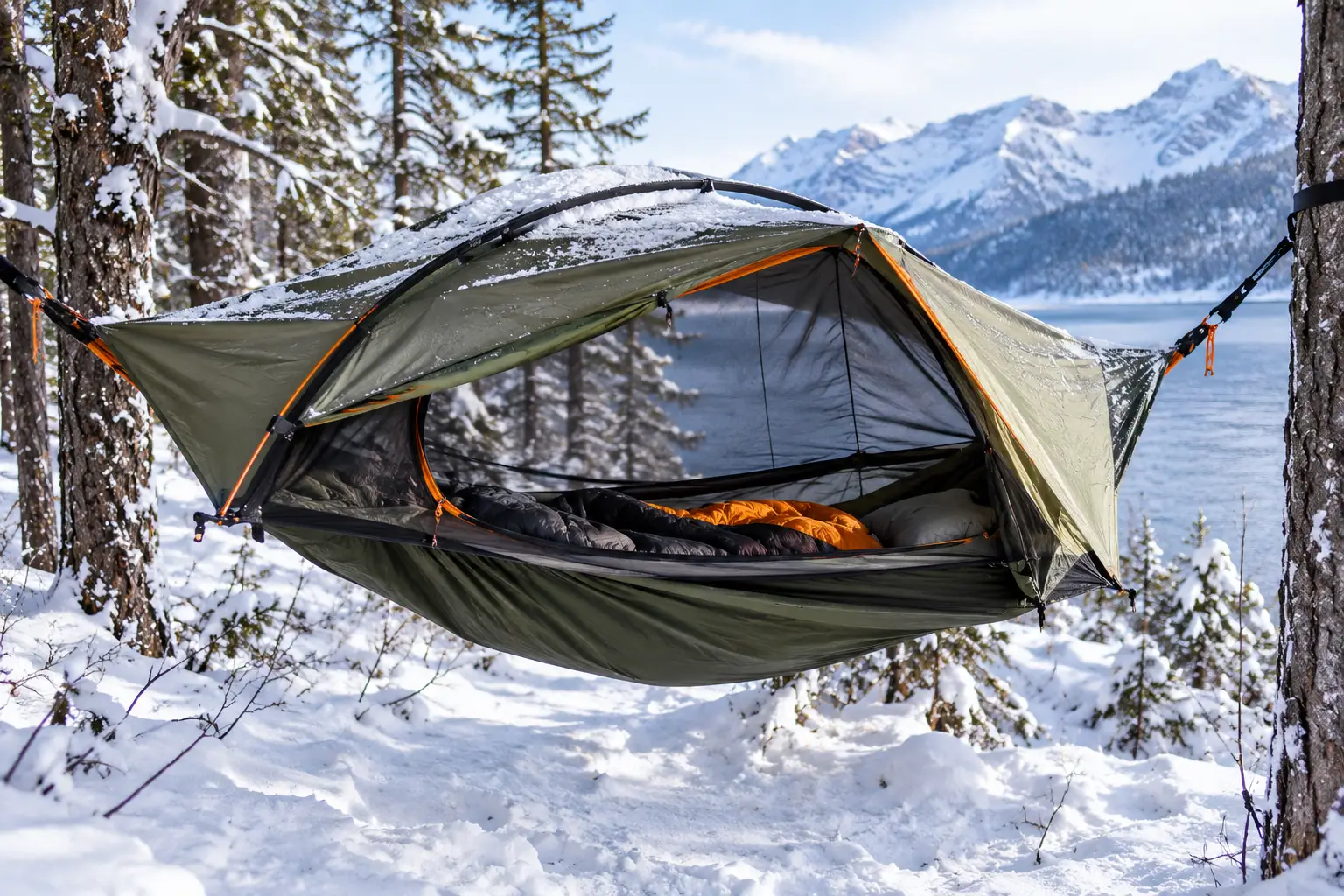
Here’s the catch most buyers learn the hard way: a hammock alone is one of the coldest ways to sleep outdoors. Air moves freely underneath you, and your sleeping bag insulation gets crushed flat under your body weight, so it stops doing its job. A proper winter hammock tent isn’t just a hammock with a bug net. It’s a system — hammock body, full-coverage tarp, bottom insulation (an underquilt or an insulated pad), and top insulation — tuned to work together.
That’s why this guide doesn’t just list products. We compared spec sheets, dug through aggregated owner feedback and independent reviews, and translated all of it into practical answers: which setups actually suit cold weather hammock tent use, what you’ll need to add, what it’ll really cost, and how to avoid the classic first-winter mistakes.
Whether you’re a deer hunter who needs a warm, quiet perch, a backpacker stretching your season into November, or a car camper who just hates sleeping on frozen dirt, you’ll find a match below — plus the setup know-how that turns a chilly night into a cozy one.
What Is a Winter Hammock Tent?
A winter hammock tent is an elevated, tree-suspended shelter configured for cold weather. It combines a hammock with an integrated or attached bug net/cover, a large tarp (ideally with closable “doors”), and dedicated insulation underneath and on top. The insulation, not the fabric, is what keeps you warm.
That last point matters more than anything else in this article. Wind is the hammock camper’s enemy, because it strips heat from the exposed underside of your hammock. The National Weather Service wind chill chart shows how quickly “feels like” temperatures fall when wind picks up — at 0°F with a 15 mph wind, the wind chill drops to about -19°F. A good tarp pitch and a well-sealed underquilt are your defense against exactly that effect.
In practice, there are three flavors of winter hammock tent:
- ⚡ Purpose-built 4 season hammock tent systems with double layers or insulation pockets built in.
- 🔋 Flat-lay “hammock tents” that use spreader bars to give you a bed-like surface, so a regular insulated sleeping pad works.
- 🌲 Modular all-in-one kits that are three-season out of the box but winterize well with an underquilt and a bigger tarp.
Quick Comparison: The 7 Best Winter Hammock Tent Picks at a Glance
| Product | Type | Approx. Weight | Winter Readiness Out of the Box | Approx. Price Range | Best for |
|---|---|---|---|---|---|
| Hennessy Hammock 4Season Expedition Zip | Asym, double-layer | ~5 lb 3 oz | High | ~$400–$500 | Hennessy Hammock 4Season Expedition Zip: year-round hangers |
| Haven Tents XL Lay Flat Hammock Tent | Flat-lay | ~7.2 lb | Medium (add pad) | ~$340–$400 | Haven Tents XL Lay Flat Hammock Tent: side sleepers, tall users |
| Onewind Airstream Camping Hammock | Gathered-end + windsock | ~2.8 lb | Medium (add underquilt) | ~$100–$150 | Onewind Airstream Camping Hammock: budget winter starters |
| Kammok Mantis UL | All-in-one kit | ~2 lb 3 oz | Low–Medium | ~$290–$330 | Kammok Mantis UL: weight-conscious backpackers |
| Hennessy Hammock Expedition Asym Zip | Asym, single layer | ~2.5 lb (hammock system) | Medium (add insulation) | ~$160–$180 | Hennessy Hammock Expedition Asym Zip: rugged, upgrade-friendly |
| Grand Trunk Air Bivy | All-in-one kit | ~3.3 lb | Low–Medium | ~$180–$200 | Grand Trunk Air Bivy: budget all-in-one buyers |
| Lawson Hammock Blue Ridge Camping Hammock | Hammock/ground hybrid | ~4.3 lb | Medium (add pad) | ~$200–$260 | Lawson Hammock Blue Ridge Camping Hammock: no-tree backup plan |
Prices are approximate at the time of writing; check the current price before you buy.
Reading the table, the pattern is clear: the more “winter-ready” a setup is out of the box, the heavier it tends to be. The Hennessy Hammock 4Season Expedition Zip buys convenience with weight, while the Kammok Mantis UL and Onewind Airstream Camping Hammock stay light but require you to budget for an underquilt. If you’re mostly car camping, weight barely matters and the Haven Tents XL Lay Flat Hammock Tent becomes very tempting.
💬 One click helps other shoppers make an informed choice too! 😊
Top 7 Winter Hammock Tent Options: Expert Analysis
Each pick below includes what the specs mean in the cold, who it suits, what owners and reviewers consistently report, and what you’ll realistically need to add for winter hammock camping.
1. Hennessy Hammock 4Season Expedition Zip — purpose-built four-season shell
If you want a cold weather hammock tent designed for winter from the start rather than retrofitted, this is the most deliberate option here. Per published specs, it’s about 5 lb 3 oz with straps, rated to 250 lb, roughly 10 ft long and 59 in wide, and uses a double bottom: one layer of 70-denier nylon plus one layer of 40-denier.
That double bottom is the clever bit. It creates a sleeve where insulation can sit without being compressed by your body — the core physics problem of hammock warmth. The asymmetric shape lets you lie diagonally and flatter, which also reduces shoulder squeeze and cold spots where your bag pulls tight.
Our honest read: this is for people who hang year-round and want one integrated system rather than a pile of accessories. It’s heavy for backpacking, but for hunters, base campers, and cold-climate car campers, the weight is a fair trade for fewer moving parts at 15°F with numb fingers.
Independent reviewers consistently praise its temperature adaptability and asym comfort, while noting it’s heavy and a bit fiddly to set up compared with simpler hammocks.
Pros:
- ✅ Double bottom protects insulation from compression
- ✅ Asymmetric lay improves comfort and flatness
- ✅ Integrated system means fewer parts to forget
Cons:
- ❌ Heavy for long backpacking trips
- ❌ Setup takes practice before your first cold night
💲 Typically in the $400–$500 range depending on configuration; strong value if you hang all year, overkill for two winter nights a season.
2. Haven Tents XL Lay Flat Hammock Tent — flattest sleep for side sleepers
The Haven Tents XL Lay Flat Hammock Tent solves the most common complaint about hammocks: you can’t sleep flat. Spreader-bar geometry creates a genuinely flat bed, and reviewers report it hangs firm enough that side and even stomach sleeping become realistic.
Spec-wise, third-party listings put it at about 7.2 lb with a 210T polyester floor and a 20D ripstop nylon rainfly. In winter terms, the flat floor is the big deal: it means a standard insulated sleeping pad works properly instead of sliding around or creating “taco” gaps. Haven also sells a dedicated XL Pad rated R5.3 (sold separately, roughly $160–$170), which is genuinely winter-grade insulation.
Who’s it for? Tall campers (the XL is the size reviewers recommend for anyone over 6 feet), side sleepers, and car or truck campers who don’t mind the weight. It’s less ideal for long-distance backpackers.
Aggregated reviews are enthusiastic about comfort — a common theme is people sleeping better than they do in tents. Note that some gear-rating sites list it as three-season, so winter performance depends on adding a high-R-value pad and blocking wind.
Pros:
- ✅ True flat lay for side and stomach sleepers
- ✅ Works with standard insulated pads
- ✅ Roomy enough for tall campers
Cons:
- ❌ Heavy at roughly 7 pounds
- ❌ Winter use requires a pricey high-R-value pad
💲 Around $340–$400 for the tent alone; excellent value if flat sleep is your top priority.
3. Onewind Airstream Camping Hammock — budget winter windsock included
The Onewind Airstream Camping Hammock is the rare budget hammock that ships with an actual winter accessory: a detachable “windsock” top cover alongside a no-see-um bug net. The listed weight is 2.8 lb including bug net, windsock, and suspension, packing to about 5 × 11 inches.
Why the windsock matters: a fabric top cover traps a pocket of warmer air around you and blocks drafts, which can add several degrees of comfort. The tradeoff is condensation — your breath has nowhere to go — so you’ll want to leave a small gap near your face.
This is the smart pick for someone testing winter hammock camping without committing $400+. Pair it with an affordable synthetic underquilt and a large tarp, and you have a legitimately capable cold-weather kit for well under the price of premium options.
Honest caveat: Airstream-specific review data is thinner than for Onewind’s flagship Tempest line, which independent testers have rated highly for value and comfort. Treat brand reputation as encouraging but not a guarantee for this exact model.
Pros:
- ✅ Winter windsock included at a budget price
- ✅ Light enough for backpacking
- ✅ Three-in-one versatility across seasons
Cons:
- ❌ Tarp and underquilt sold separately
- ❌ Fewer verified long-term reviews for this model
💲 Usually around $100–$150; outstanding value as the base of a budget winter build.
4. Kammok Mantis UL — lightest complete kit to winterize
The Kammok Mantis UL is a full shelter system — hammock, removable zippered bug net, structural ridgeline, catenary-cut tarp, suspension straps, and stakes — weighing about 2 lb 3 oz packed, with a 300 lb capacity per Kammok’s specs.
For winter, the selling point is modularity. The perimeter grosgrain loops let Kammok’s underquilts snap directly on, which keeps the quilt sealed against the hammock instead of drifting and leaving cold gaps. The catenary-cut tarp pitches tight, which matters when wind would otherwise flap it all night.
One important update: Kammok previously sold a “Winter Barrier” top cover for the Mantis line, but SectionHiker’s Winter Barrier review reports it has been discontinued, and noted condensation issues with its coated fabric. So plan on a top quilt and good tarp management rather than a cover.
Reviewers and testers widely praise its comfort and ease of use for an all-in-one kit; a recurring gripe is that the bug-net zipper stops partway along the body, and some owners have reported fabric failures that Kammok’s warranty handled.
Pros:
- ✅ Very light for a complete kit
- ✅ Underquilt attachment loops built in
- ✅ Tight, catenary-cut tarp sheds wind
Cons:
- ❌ Winter cover accessory no longer offered
- ❌ Zipper stops partway along the hammock
💲 Roughly $290–$330; great value for backpackers, though winter use adds underquilt cost.
5. Hennessy Hammock Expedition Asym Zip — rugged classic, built for upgrades
The Hennessy Hammock Expedition Asym Zip is the durable workhorse. Its hammock body uses 70D high-density nylon taffeta — noticeably tougher than the 20D–40D fabrics on lightweight kits — and a heavy #10 side zipper with double sliders.
That 70D fabric is a quiet winter advantage: ice-stiff straps, branches, and frozen gear clips are rougher on fabric than summer conditions. The integrated fly attaches to the suspension, so it essentially can’t be pitched crooked — handy when you’re setting up at dusk in a cold wind.
Hennessy itself says that for true four-season use, you should add its SuperShelter insulation system or step up to a 4Season model. So think of this as a solid foundation: buy it, then add an underquilt or the SuperShelter as your winter hammock tent plans grow.
Independent testing rates it very comfortable thanks to the asym design, but also one of the harder hammocks to pitch, and reviewers note the attached bug net can’t be tucked fully out of the way.
Pros:
- ✅ Tough 70D fabric resists winter abuse
- ✅ Fly integrates neatly with suspension
- ✅ Comfortable asymmetric diagonal lay
Cons:
- ❌ Stock fly is small for winter storms
- ❌ Steeper learning curve to pitch well
💲 Often around $160–$180; solid value as a durable base, especially for hard users.
6. Grand Trunk Air Bivy — best budget all-in-one tarp
The Grand Trunk Air Bivy stands out for one reason that matters a lot in cold weather: its tarp. CleverHiker named it their best budget all-in-one hammock kit and called its hex tarp the best they’d seen on an entry-level hammock.
Third-party listings put it around 3.3 lb. In winter, a generous hex tarp is more valuable than almost any hammock feature, because it blocks wind from scouring your underquilt. A cheap kit with a good tarp often outperforms an expensive hammock with a skimpy fly when temperatures drop.
This is the right pick for someone who wants to buy once, get everything in one box, and add a single underquilt later. It’s less suited to deep-winter trips where you’d want a tarp with full doors.
Reviews and testers describe classic, comfortable hammock lay and a well-designed ridgeline, while noting it’s not as light or refined as premium kits.
Pros:
- ✅ Excellent hex tarp for the price
- ✅ Complete kit in one box
- ✅ Ridgeline keeps the sag consistent
Cons:
- ❌ No integrated winter cover
- ❌ Heavier than premium ultralight kits
💲 Around $180–$200; one of the best value-to-weather-protection ratios here.
7. Lawson Hammock Blue Ridge Camping Hammock — hammock-to-ground-tent flexibility
The Lawson Hammock Blue Ridge Camping Hammock is a hybrid: hang it between trees, or set it up on the ground as a one-person tent when trees are scarce. It’s about 4.3 lb, 90 × 42 inches, rated to 275 lb, with spreader bars, arch poles, and a bathtub-style floor with taped seams.
The winter angle here is insurance. Above treeline, in open fields, or at campgrounds with thin trees, a pure hammock leaves you stranded. The ground-tent mode means you’re never without a shelter — though on frozen ground you’ll need a thick pad either way.
It’s ideal for car campers, beginners, and anyone who camps in mixed terrain. Its spreader bars create a flatter lay than a typical gathered-end hammock.
Owner feedback is mixed in an honest, useful way. Many love its comfort and versatility, but a recurring theme is that it gets cold fast without a pad, the arch poles add noticeable weight, and some users find it tippy with a very thick pad.
Pros:
- ✅ Works on the ground when trees fail
- ✅ Bathtub floor with taped seams
- ✅ Flatter lay than gathered-end hammocks
Cons:
- ❌ Needs a pad or underquilt in cold
- ❌ Can feel tippy with thick pads
💲 Usually around $200–$260; good value for versatility, less so for ultralight goals.
Side-by-Side: Winter Features of the Top 7
| Product | Bottom Insulation Strategy | Top Cover/Wind Block | Tarp Coverage | Capacity | Best for |
|---|---|---|---|---|---|
| Hennessy Hammock 4Season Expedition Zip | Double-bottom sleeve | Integrated design | Good | 250 lb | Hennessy Hammock 4Season Expedition Zip: deep cold |
| Haven Tents XL Lay Flat Hammock Tent | Insulated pad (R5+ ideal) | Fly + body | Good | Check listing | Haven Tents XL Lay Flat Hammock Tent: flat sleepers |
| Onewind Airstream Camping Hammock | Add underquilt | Windsock included | Add tarp | Check listing | Onewind Airstream Camping Hammock: budget builds |
| Kammok Mantis UL | Snap-on underquilt | Top quilt only | Catenary tarp | 300 lb | Kammok Mantis UL: light kits |
| Hennessy Hammock Expedition Asym Zip | Underquilt or SuperShelter | Add-on | Small stock fly | Check listing | Hennessy Hammock Expedition Asym Zip: durability |
| Grand Trunk Air Bivy | Add underquilt | None | Generous hex | Check listing | Grand Trunk Air Bivy: value kits |
| Lawson Hammock Blue Ridge Camping Hammock | Pad or underquilt | Rainfly | Moderate | 275 lb | Lawson Hammock Blue Ridge Camping Hammock: mixed terrain |
The takeaway: only the Hennessy Hammock 4Season Expedition Zip handles bottom insulation as part of its core design. Every other option needs either an underquilt or a high-R-value pad — so when comparing prices, add roughly $100–$300 for insulation to the cheaper options before declaring a winner. Notice also that tarp coverage varies widely; the Grand Trunk Air Bivy punches above its price here.
✨ Don’t miss these winter-ready picks!
🔍 Take your cold-weather camping to the next level with this carefully curated lineup. Click a highlighted product to check current pricing and availability — the right setup will keep you warm, dry, and sleeping soundly when the temperature drops! 🏕️
How to Set Up a Winter Hammock Tent: A Practical Guide
Most “my hammock was freezing” stories come from setup, not gear. Here’s how to get it right.
Step 1: Pick your trees and spot with wind in mind
Choose live, sturdy trees roughly 12–15 feet apart, and look up for dead branches (“widowmakers”), which snow loads make more dangerous. Hang so the narrow end of your tarp faces the prevailing wind. The Leave No Trace hammock camping guide recommends wide, tree-friendly straps, established campsites, and staying at least 200 feet from water — all good habits that also keep you out of cold, damp drainage areas.
Step 2: Hang low and use a 30° angle
Aim for about 18 inches of clearance and suspension lines at roughly 30 degrees. Lower hangs mean less wind exposure underneath and an easier, safer exit in the dark.
Step 3: Tarp first, in storm mode
Pitch the tarp before the hammock, then drop the edges close to the hammock (“porch” or “storm mode”). If your tarp has doors, close the windward one.
Step 4: Hang the underquilt so it touches — but isn’t compressed
The underquilt should gently kiss the bottom of the hammock with no gaps along the sides. Gaps are where heat escapes.
Step 5: Vent to beat condensation
Leave a gap near your face. Breathing into a sealed cover or quilt dampens insulation overnight.
Common first-30-day mistakes
- ❌ Pulling the hammock too tight (creates shoulder squeeze and cold spots)
- ❌ Relying on a sleeping bag underneath you (it compresses to almost zero warmth)
- ❌ Skipping a test night in the backyard before a real trip
Real-World Scenarios: Matching the Right Winter Hammock Tent to You
Scenario A: The November deer hunter
Budget: around $500 total. Use: multi-day stays in hardwood forests at 15–30°F. The Hennessy Hammock 4Season Expedition Zip fits best, because its built-in insulation sleeve means less to pack and fewer cold-fingered adjustments at 4 a.m. Weight barely matters when you’re hiking a short distance from the truck.
Scenario B: The shoulder-season backpacker
Budget: $350–$450 total. Use: weekend trips at 25–40°F with real mileage. The Kammok Mantis UL plus a 20–30°F underquilt gives you a light, complete system, and the snap-on loops keep the quilt from drifting. Expect to carry a top quilt instead of a heavy mummy bag.
Scenario C: The side-sleeping car camper
Budget: $500+. Use: state parks, frequent trips, comfort first. The Haven Tents XL Lay Flat Hammock Tent with an R5-class pad gives the closest thing to a bed in the woods. Since you’re parking nearby, the extra weight is irrelevant.
Scenario D: The curious beginner on a budget
Budget: under $300 total. The Onewind Airstream Camping Hammock plus a budget synthetic underquilt and a hex tarp lets you test winter hammock camping without a big commitment. If it clicks, you upgrade one part at a time.
The common thread? Each choice starts with temperature, distance, and sleep style — not brand names.
Problem → Solution: Fixing Common Winter Hammock Headaches
🥶 Problem 1: “My back is cold even though I’m in a 0°F sleeping bag.”
Solution: This is the classic “cold butt syndrome.” Your body crushes the bag’s insulation flat. Add an underquilt (or an insulated pad for flat-lay models like the Haven Tents XL Lay Flat Hammock Tent).
💧 Problem 2: “Everything’s damp by morning.”
Solution: Condensation from your breath. Vent the top cover near your face, avoid breathing inside your quilt, and keep the tarp slightly open on the leeward side. The Onewind Airstream Camping Hammock windsock works best partly unzipped.
🌬️ Problem 3: “Wind keeps waking me up.”
Solution: Lower the hang, drop the tarp into storm mode, and reorient so the narrow end faces the wind. A bigger tarp like the one on the Grand Trunk Air Bivy makes a measurable difference.
📏 Problem 4: “My underquilt keeps sliding off to one side.”
Solution: Tighten the side shock cords and use a hammock with dedicated attachment points, like the Kammok Mantis UL.
🌲 Problem 5: “There weren’t any good trees.”
Solution: Carry a backup plan. The Lawson Hammock Blue Ridge Camping Hammock sets up as a ground tent, so you’re never shelterless.
How to Choose a Winter Hammock Tent
- Start with your coldest expected temperature. Your underquilt rating should match it, ideally with a 10°F cushion. Insulation is the number-one warmth factor.
- Decide on underquilt vs. pad. Gathered-end hammocks work best with underquilts; flat-lay designs work with insulated pads (look for R4–R5+ for winter).
- Size the tarp for winter. Look for full coverage and ideally doors. Wind protection protects your insulation.
- Check fabric durability. Heavier fabrics (40D–70D) handle frozen gear and rough handling better than ultralight 20D.
- Confirm weight capacity with gear. Winter layers and a heavy pad add weight; leave margin under the rating.
- Match weight to your travel style. Car campers can carry 7 lb; backpackers usually want under 3 lb for the shelter.
- Plan your total system budget. Hammock + tarp + underquilt + top quilt is the real price, not the hammock sticker.
Common Mistakes to Avoid When Buying a Winter Hammock Tent
The biggest mistake is buying a “hammock tent” and assuming it’s winter-ready because it’s labeled all-weather. Most hammock tents are three-season shelters that can be winterized. Read the insulation plan, not the marketing headline.
The second is underbudgeting insulation. A $150 hammock paired with a $40 “underquilt” that’s really a thin blanket will leave you miserable at 25°F. A quality underquilt rated to 20°F commonly costs $150–$300, and that’s where your warmth comes from.
Third: ignoring tarp size. Stock flies on many hammocks — including the Hennessy Hammock Expedition Asym Zip — are sized for rain, not for winter wind. Budget for a larger winter tarp if you plan sub-freezing trips.
Fourth: buying ultralight for rough use. The Kammok Mantis UL is fantastic for backpacking, but hunters dragging gear through brush may be happier with the 70D toughness of a Hennessy.
Finally, skipping a practice run. Every product here has a learning curve, and the backyard is where you want to discover it — not 6 miles in at dusk.
Winter Hammock Tent vs. Traditional 4-Season Ground Tent
| Factor | Winter Hammock Tent | 4-Season Ground Tent | Best for |
|---|---|---|---|
| Uneven/frozen ground | Irrelevant — you’re suspended | Needs leveling, stakes struggle | Hammock: rocky, rooty forests |
| Insulation needs | Top + bottom (underquilt) | Top + insulated pad | Tent: treeless terrain |
| Wind exposure | Higher underneath | Lower, ground-level | Tent: exposed alpine sites |
| Campsite flexibility | Needs trees | Needs flat ground | Depends on terrain |
| Comfort for back pain | Often better (no pressure points) | Depends on pad | Hammock: back sleepers |
Hammocks win decisively in forested terrain with uneven or frozen ground, where tents struggle with stakes and lumpy floors. Tents win above treeline and in open, windy country, since a hammock’s exposed underside is a heat-loss liability there. The Lawson Hammock Blue Ridge Camping Hammock splits the difference for people who camp in both.
In short, a winter hammock tent isn’t “better” than a 4-season tent — it’s better in specific conditions. Know your terrain first.
What to Expect: Everyday Performance in the Cold
Translating specs into reality: with a properly rated underquilt and top quilt, most well-pitched setups can be comfortable into the 20s°F, and purpose-built or carefully layered systems go lower. Without bottom insulation, expect to feel cold even in the 40s°F.
Setup time stretches in winter. Gloves make buckles, zippers, and knots slower, so models with simple suspension (like the knotless straps on the Kammok Mantis UL) save real minutes. The Hennessy Hammock 4Season Expedition Zip rewards practice — once dialed, it’s consistent; before that, it’s fiddly.
Getting in and out is also different. Side zips (Hennessy) are easier with bulky layers than bottom entries. Flat-lay designs like the Haven Tents XL Lay Flat Hammock Tent feel more like crawling into a cot, which many beginners find reassuring.
Expect morning frost on the tarp’s inner surface and some moisture near your face. That’s normal; the goal is keeping it off your insulation.
Long-Term Cost and Maintenance
| Setup Path | Hammock/Kit | Underquilt/Pad | Winter Tarp | Approx. System Total | Best for |
|---|---|---|---|---|---|
| Budget build | Onewind Airstream Camping Hammock ~$100–$150 | Synthetic UQ ~$100–$150 | ~$60–$120 | ~$260–$420 | Testing the waters |
| Value all-in-one | Grand Trunk Air Bivy ~$180–$200 | UQ ~$150–$250 | Included | ~$330–$450 | One-box simplicity |
| Ultralight | Kammok Mantis UL ~$290–$330 | Down UQ ~$200–$300 | Included | ~$490–$630 | Backpackers |
| Flat-lay comfort | Haven Tents XL Lay Flat Hammock Tent ~$340–$400 | R5 pad ~$160–$170 | Included | ~$500–$570 | Side sleepers |
| Integrated winter | Hennessy Hammock 4Season Expedition Zip ~$400–$500 | Built-in sleeve design | Included | ~$400–$500+ | Year-round hangers |
The numbers reveal that the “cheapest” hammock is rarely the cheapest system. The Hennessy Hammock 4Season Expedition Zip looks expensive until you compare it with an ultralight kit plus a down underquilt. Over 5+ years, quality insulation is the part that pays off most, because you can move it to a new hammock later.
Maintenance tips: dry everything fully at home (hang it indoors), store down quilts loosely uncompressed, re-treat tarps with DWR spray as water stops beading, and inspect straps and carabiners each season for wear.
Features That Actually Matter (and Ones That Don’t)
Matter a lot:
- ✅ Underquilt compatibility or a flat floor for pads — your warmth lives here.
- ✅ Tarp size and doors — wind protection protects insulation.
- ✅ Structural ridgeline — consistent sag means consistent comfort and fewer gaps.
- ✅ Side zip vs. bottom entry — side zips are easier in bulky clothes.
Matter less than marketing suggests:
- ❌ Built-in pockets and organizers — nice, but no warmth benefit.
- ❌ “Waterproof hammock body” claims — the tarp handles rain; a coated body can actually trap condensation.
- ❌ Ultra-low denier for casual use — saving 3 oz isn’t worth losing durability if you’re car camping.
The theme: prioritize anything that controls heat loss — insulation fit, wind blocking, condensation management — over convenience extras.
Safety, Regulations, and Standards for Winter Hammock Camping
Cold-weather sleeping has real risks. The CDC’s winter weather prevention guidance explains how hypothermia develops when your body loses heat faster than it produces it — and warning signs like shivering, confusion, fumbling hands, and drowsiness. In a hammock, the risk rises if your insulation fails, gets wet, or you go to bed already chilled.
Practical safeguards:
- 🔥 Eat a snack before bed and go to sleep warm, not shivering.
- 🧤 Change into dry base layers; never sleep in sweaty clothes.
- 🚫 Never use fuel-burning heaters inside an enclosed hammock or covered tarp; carbon monoxide is a serious hazard in any enclosed shelter.
- 🌲 Check overhead for dead branches, especially under snow load.
- 📏 Respect weight ratings — winter gear adds pounds.
On the legal side, many U.S. parks and forests have their own rules about hammocks and tree attachment, so check local regulations before you go. Tree-friendly straps at least 1 inch wide are widely expected and often required.
FAQ: Winter Hammock Tent Questions Answered
❓ Is a winter hammock tent warmer than a regular tent?
❓ What temperature underquilt do I need for winter hammock camping?
❓ Can I use a sleeping pad instead of an underquilt in a hammock tent?
❓ Is an insulated hammock tent worth buying for beginners?
❓ How heavy is a complete cold weather hammock tent setup?
Conclusion: Find Your Warmest Hang This Winter
Choosing a winter hammock tent really comes down to one idea: warmth is a system. The hammock body gets you off the frozen ground, but your underquilt or pad, your tarp, and your setup skills decide whether you sleep soundly or shiver until sunrise.
If you want a purpose-built option, the Hennessy Hammock 4Season Expedition Zip is the most complete winter design here. Side sleepers and car campers will love the bed-like comfort of the Haven Tents XL Lay Flat Hammock Tent. Backpackers get the best weight-to-features balance from the Kammok Mantis UL, while the Grand Trunk Air Bivy and Onewind Airstream Camping Hammock make winter hammock camping affordable. Want rugged durability? The Hennessy Hammock Expedition Asym Zip is a proven foundation. And if trees are unpredictable where you camp, the Lawson Hammock Blue Ridge Camping Hammock keeps a ground-tent backup in your pack.
Whichever you choose, budget for insulation, practice in the backyard, and respect the cold. Do that, and you may never want to sleep on frozen ground again.
🏕️ Ready to hang warm this winter?
🔍 Click any highlighted pick above to check current pricing and availability — and start building the cozy, cold-proof sleep system you’ve been dreaming about! ❄️
Recommended for You
- Truck Hammock Mount: 7 Best Picks That Actually Hold Up (2026)
- Car Hammock Stand Guide 2026: 7 Best Picks That Won’t Wobble
- Bliss Hammocks Hammock in a Bag: 7 Best Picks Ranked for 2026
Disclaimer: This post contains affiliate links. As an Amazon Associate, I earn from qualifying purchases made through these links, at no additional cost to you.
✨ Found this article helpful? Share it with someone who needs it! 💬🤗