
In This Article
What Is a Car Hammock Stand?
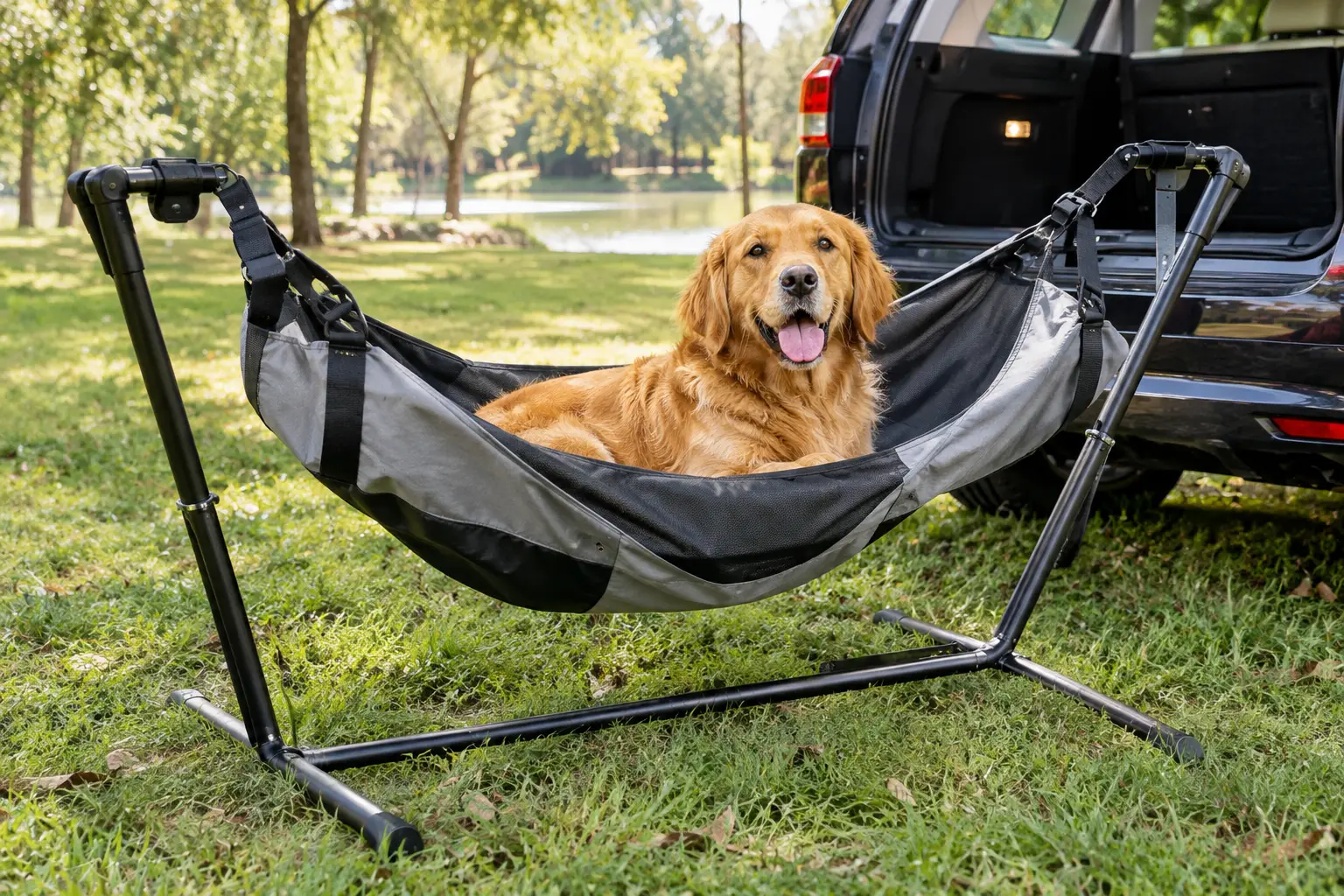
A car hammock stand is a steel or aluminum frame that mounts to your vehicle — usually a 2-inch trailer hitch receiver, a roof rack, or a wheel — and gives you two solid anchor points to hang a hammock wherever you park. Your car, truck, or SUV becomes one half of a portable campsite, no trees required.
If you’ve ever pulled into a campsite at dusk only to discover that the two trees you need are either 30 feet apart or suspiciously dead, you already understand the appeal. Hammock camping has exploded in popularity because it gets you off cold, wet, lumpy ground — but it has always depended on luck with tree spacing. A car hammock stand removes the luck. Beach parking lots, desert pull-offs, stadium tailgates, the gravel pad at a state park: if your vehicle can get there, so can your hammock.
That said, this category is full of look-alike frames with nearly identical product titles, and the differences that actually matter — span length, how much the frame flexes, whether it blocks your tailgate, whether it fits your specific hitch or rack — are rarely explained on the listing. ⚡ That’s what this guide is for.
Below, you’ll find seven real, currently listed options covering every mounting style: classic hitch frames, a tire-mount design for vehicles with no hitch, and a premium roof rack system for overlanders. Every pick is analyzed from its actual spec sheet and from the aggregated sentiment in real owner reviews, with honest notes wherever that review data is thin. You’ll also get a setup walkthrough, a problem-solving section for wobble and sag, and a clear decision framework, so you can buy once and hang happily for years. 🏕️
Quick Comparison: The Best Car Hammock Stand Options at a Glance
| Product | Mount Type | Rated Capacity | Hammock Fit | Best For |
|---|---|---|---|---|
| Hammaka 10314-KP | 2-inch hitch | 300 lbs | Uprights just over 10 ft apart | Families who want hammock + chair modes |
| Kammok Outpost | Roof rack (ball hitch mount) | 350 lbs | 141.5 in point-to-point | Overlanders and tall sleepers |
| CROSSHIP Hitch Mount | 2-inch hitch | 350 lbs | Adjustable, 98 in and up; hammock included | Budget-minded first-timers |
| CROSSHIP Tire Mount | Tire + 2-inch hitch | 350 lbs | 98 in extended | Cars with no hitch receiver |
| KUAFU Hitch Hammock Stand | 2-inch hitch | 300 lbs | Up to 114 in | Hammock-tent owners on a budget |
| Kojem Hitch Mount | 2-inch hitch | 300 lbs | Up to 114 in | Small cargo areas |
| AugFir Trailer Hammock Hitch Stand | 2-inch hitch | 350 lbs | Hanging chair included | Tailgate lounging |
Looking at the table above, the first decision isn’t really about brand — it’s about mounting style. If you have a 2-inch receiver, five of the seven options are open to you, and the real trade-off becomes span length versus price: the Hammaka 10314-KP and the budget KUAFU Hitch Hammock Stand and Kojem Hitch Mount handle longer camping hammocks, while the CROSSHIP Hitch Mount wins on out-of-the-box convenience. If your hitch is busy towing a trailer or carrying bikes, the Kammok Outpost is the only pick here that leaves it free, and if you have no hitch at all, the CROSSHIP Tire Mount is your realistic entry point.
💬 One click helps other shoppers make an informed choice too! 😊 Tap any highlighted product name to check current pricing and availability on Amazon.
Top 7 Car Hammock Stand Picks: Expert Analysis
1. Hammaka 10314-KP — the two-mode all-rounder for hitch owners
The Hammaka 10314-KP is the closest thing this category has to a benchmark, mostly because it does two jobs instead of one. In hammock mode, its uprights sit just over 10 feet apart and the frame is rated for 300 lbs; reconfigure it and it hangs two hammock chairs instead, each rated at 300 lbs.
The stand weighs around 50 lbs and breaks down into five pieces, the longest about 46 inches. In practice, that means it slides across the cargo floor of most SUVs and truck beds, but it’s a two-hand lift, not a grab-and-go accessory. One geometry detail deserves attention: installed, it extends a little over 6 inches past the hitch pin hole, so Jeep Wrangler owners with a rear-mounted spare commonly need a hitch extender.
Based on the spec sheet, this is the stand for families and tailgaters who want a sleeping hammock on Saturday night and two lounge chairs at Sunday’s game, from one frame. The 10-foot span suits most camping hammocks with a ridgeline shorter than 10 feet, including many with 11-foot bodies.
Reviews consistently praise the build and easy setup, with retail listings showing an average around 4.4 stars at the time of writing. A recurring tip from owners is to add a hitch shim or anti-rattle clamp to stop rocking, and at least one reviewer reported the receiver tube failing under load — a good reminder to inspect welds before every trip.
Pros:
- ✅ Switches between hammock mode and two-chair mode
- ✅ Heavy steel frame rated to 300 lbs
- ✅ Breaks down into five storable pieces
Cons:
- ❌ Around 50 lbs makes it a two-hand carry
- ❌ Rear spare tires may require a hitch extender
💲 Typically in the $250-$300 range at the time of writing — fair value if you’ll genuinely use both modes; check the current price before buying.
2. Kammok Outpost — the longest span with roof rack mounting
The Kammok Outpost takes a completely different approach: instead of your hitch, it anchors to your roof rack through a quick-release ball hitch, then stands on telescoping A-frame legs at the far end. That design frees your receiver for a bike rack or trailer, which is exactly why overlanders love it.
The spec sheet is impressive. The aluminum frame weighs 22 lbs, carries 350 lbs, and offers 141.5 inches point-to-point — long enough for taller campers to get a genuinely flat, diagonal lay. Packed, it measures about 52 x 6.5 x 6 inches, roughly the size of a collapsible camp chair. The horizontal crossbar doubles as a tarp ridgeline, though Kammok says not to hang more than 10 lbs from it. The roof rack you mount to should sit between 50 and 80 inches high, and the stock mount fits most crossbars, basket racks, and platform racks — but Kammok is upfront that it isn’t 100% universal.
Who is it for? Overlanders with a quality rack, campers over six feet tall, and anyone whose hitch is already spoken for. If you don’t have a rack, it’s the wrong tool.
Owner discussions on Jeep forums describe it as solid and appreciate getting the hitch back for towing, while skeptics point to the premium price and the rack requirement.
Pros:
- ✅ Longest hammock span in this lineup
- ✅ Leaves your hitch free for towing or bikes
- ✅ Crossbar doubles as a tarp ridgeline
Cons:
- ❌ Requires a compatible roof rack system
- ❌ Costs several times more than hitch frames
💲 Usually in the $500-$550 range at the time of writing — premium, but justified for frequent overland trips; hammock sold separately.
3. CROSSHIP Hitch Mount — the budget all-in-one kit
The CROSSHIP Hitch Mount is built for people who want to open one box and be hanging the same afternoon: it ships with the frame, a 210T parachute nylon hammock, and a storage bag.
The powder-coated alloy steel frame weighs about 16 lbs and is rated for 350 lbs, with a three-length bracket that accommodates hammocks longer than 98 inches. It fits standard 2-inch Class III and IV receivers. Compared with the Hammaka 10314-KP at roughly three times the weight, that 16-lb figure means you can carry it one-handed and store it behind a seat — but less mass also usually means more flex under load.
That trade-off shows up in independent coverage: one hands-on review noted the vertical arms flexing noticeably inward once weight was applied. On paper, that makes the CROSSHIP Hitch Mount a strong fit for lounging, tailgates, and lighter users, and a more cautious pick for heavier sleepers planning full overnights.
Aggregated sentiment highlights easy setup and the convenience of the bundled hammock, with structural flex as the most common reservation.
Pros:
- ✅ Hammock and storage bag included in the box
- ✅ Light 16-lb frame is easy to carry
- ✅ Adjustable length for different hammocks
Cons:
- ❌ Arms reportedly flex inward under heavier loads
- ❌ Bundled hammock is basic, not a sleep-system upgrade
💲 Generally around $80-$130 at the time of writing — excellent starter value; check the current price and bundle options.
4. CROSSHIP Tire Mount — a hammock without a hitch
The CROSSHIP Tire Mount solves the most common objection to this whole category: what if your car doesn’t have a trailer hitch? The current dual-mount version anchors to a vehicle tire or a 2-inch receiver, and a tire-only version is also listed.
The idea is clever physics. Instead of a receiver, your vehicle’s own weight pressing down on the wheel bracket becomes the anchor. Rated capacity is 350 lbs, and the stand reaches an extended length of 98 inches with a parachute nylon hammock included. Practically, that opens hammock lounging to sedans, hatchbacks, and crossovers that would otherwise need an aftermarket hitch installed.
The catch is span. At 98 inches, it’s shorter than the 114-inch frames, so expect a deeper curve in the hammock — fine for reading and napping, less ideal for a tall camper hoping to sleep flat all night.
Review data is still relatively thin, which is typical of a newer listing. Early reviewers consistently flag hammock length as the main limitation, which matches what the spec sheet predicts.
Pros:
- ✅ Works on vehicles without a hitch receiver
- ✅ Dual mounting adds flexibility for future vehicles
- ✅ Hammock included for immediate use
Cons:
- ❌ Shorter span limits long camping hammocks
- ❌ Limited long-term review history so far
💲 Roughly in the $90-$140 range at the time of writing — solid value if you have no hitch; check the current price.
5. KUAFU Hitch Hammock Stand — the longest span among budget frames
The KUAFU Hitch Hammock Stand stretches your dollar furthest in terms of usable length, supporting hammocks up to 114 inches at a 300-lb rating.
Its construction is a smart hybrid: the long silver upper tubes are aluminum, while the black base that slides into your 2-inch receiver is steel, all powder coated. What that means in practice is less weight hanging high and far from the hitch — where leverage magnifies every pound — and stronger material exactly where stress concentrates. It also disassembles for storage.
Based on the specs, this is a great match for budget-conscious campers using a full-size gathered-end hammock or a hammock tent. One verified US reviewer reported it working well with a Haven hammock tent and called it a better deal than premium mounts costing several times more, but also noted the hitch connection wasn’t fully solid and recommended adding shims.
That aligns with a pattern you’ll see across nearly every budget car hammock stand: the frame is fine, the receiver fit is loose. A hitch tightener is cheap insurance.
Pros:
- ✅ Supports hammocks up to 114 inches long
- ✅ Aluminum uppers keep weight off the leverage arm
- ✅ Steel base adds strength at the receiver
Cons:
- ❌ Receiver fit may need shims to stop wobble
- ❌ 300-lb rating trails some 350-lb rivals
💲 Typically around $100-$160 at the time of writing — strong value for long hammocks; check the current price.
6. Kojem Hitch Mount — a compact pack for small cargo areas
The Kojem Hitch Mount earns its spot by packing down small — its listed package dimensions are roughly 33 x 13 x 5 inches, which slips into a compact SUV’s cargo well without eating your cooler space.
The frame combines steel and aluminum with a powder-coated finish, is rated for 300 lbs, and is designed for hammocks 114 inches or shorter. It hangs a single hammock and breaks down into loose parts when not in use. The spec sheet looks remarkably similar to the KUAFU Hitch Hammock Stand — same capacity, same maximum hammock length, same two-tone material split — so if you’re choosing between the two, it’s reasonable to let current price and shipping speed decide.
Who should buy it? Solo campers and couples with smaller vehicles who want long-hammock compatibility without hauling a 50-lb steel frame.
Honest note on reviews: at the time of writing, there isn’t enough verifiable review volume to summarize a reliable durability trend for this specific listing. Treat the spec sheet as your main evidence, inspect the welds and pins on arrival, and test it with a slow, gradual load while you’re still inside the return window.
Pros:
- ✅ Small packed size suits compact vehicles
- ✅ Fits hammocks up to 114 inches
- ✅ Powder coat resists scratches and UV
Cons:
- ❌ Limited verifiable owner review history
- ❌ Single-hammock design with no chair mode
💲 Usually in the $100-$150 range at the time of writing — fair value for space-limited cars; check the current price.
7. AugFir Trailer Hammock Hitch Stand — a bundled hanging chair for lounging
The AugFir Trailer Hammock Hitch Stand leans into the tailgate crowd by bundling a nylon hanging chair, not a flat sleeping hammock, along with a storage bag.
It fits all standard 2-inch receivers, carries a 350-lb rating, and uses quick-install plugs, so assembly needs no tools and no screwing. A Large Size variant is also listed. The practical takeaway: a hanging chair keeps you upright, which is great for reading, watching a game, or chatting around a fire — but it isn’t something you’ll sleep in. If overnight hammock camping is your goal, budget for a separate hammock or choose a frame built around span length.
This pick suits game-day regulars, anglers waiting on a bite, and parents who want a comfy perch at the kids’ soccer tournament.
The listing is relatively new on Amazon, and there isn’t yet enough review history to verify a clear durability pattern. The safest approach is the same as with any newer listing: inspect it on arrival, load it gradually, and keep the packaging until you’re confident.
Pros:
- ✅ Tool-free quick-install plug assembly
- ✅ Hanging chair included for upright lounging
- ✅ 350-lb rated capacity
Cons:
- ❌ Included chair isn’t designed for sleeping
- ❌ Very limited review history so far
💲 Around $90-$120 at the time of writing — good value for tailgaters; check the current price and available sizes.
Detailed Comparison of All 7 Picks
| Product | Frame Weight | Material | What’s Included | Approx. Price Range | Best For |
|---|---|---|---|---|---|
| Hammaka 10314-KP | ~50 lbs | Steel | Stand + hardware | $250-$300 | Families, chair mode |
| Kammok Outpost | 22 lbs | Aluminum + steel mount | Stand, straps, mount kit | $500-$550 | Overlanding, tall sleepers |
| CROSSHIP Hitch Mount | ~16 lbs | Alloy steel | Stand, hammock, bag | $80-$130 | First-timers |
| CROSSHIP Tire Mount | Not clearly listed | Steel | Stand, hammock, bag | $90-$140 | No-hitch vehicles |
| KUAFU Hitch Hammock Stand | Not clearly listed | Aluminum + steel | Stand | $100-$160 | Hammock tents |
| Kojem Hitch Mount | Not clearly listed | Steel + aluminum | Stand | $100-$150 | Compact cars |
| AugFir Trailer Hammock Hitch Stand | Not clearly listed | Metal | Stand, hanging chair, bag | $90-$120 | Tailgates |
The weight column tells an important story: the Kammok Outpost delivers the longest span at less than half the weight of the Hammaka 10314-KP, which is what aluminum and a premium price buy you. Among budget frames, the deciding factors are what’s in the box and the span — the CROSSHIP Hitch Mount and AugFir Trailer Hammock Hitch Stand save you a separate purchase, while the KUAFU Hitch Hammock Stand and Kojem Hitch Mount reward buyers who already own a good hammock. Where weight isn’t clearly published, ask the seller before buying if storage space is tight.
✨ Your tree-free campsite is one click away!
🔍 Ready to hang anywhere you can park? Click any highlighted product name to check current pricing and availability — and pick the frame that matches your vehicle, your hammock, and the way you actually camp. 🏕️
How to Set Up a Car Hammock Stand the Right Way
A car hammock stand is only as safe as its installation. Here’s a practical first-use routine that listings rarely spell out.
Before your first trip
- Measure your hammock. Note its length and your preferred hang. A hammock longer than the frame’s span will sag onto the ground.
- Check your receiver. Confirm it’s a 2-inch receiver, then look up its class and tongue-weight rating in your owner’s manual.
- Dry-fit at home. Assemble everything in the driveway once, so you’re not reading instructions by headlamp.
At camp
- Park on level ground and set the parking brake. Leave an automatic in Park, a manual in gear.
- Insert the stand, then the hitch pin and clip. Add an anti-rattle clamp or shim if there’s any play.
- Extend arms to the same length and lock every pin fully — half-seated pins are the most common setup error.
- Hang the hammock with a slight sag, aiming for roughly a 30-degree angle on the suspension. A drum-tight hammock puts far more force on the uprights.
- Load it gradually. Sit in the middle first, then lie back.
Maintenance schedule
- 🔧 Every trip: inspect welds, pins, and the receiver tube for cracks or bending.
- 🧽 Every month of use: wipe off dust, salt, and sand, especially after beach trips.
- 🎨 Every season: touch up chipped powder coat with rust-inhibiting paint so steel parts don’t corrode from the inside out.
Follow this routine and you’ll sidestep most of the problems covered later in this guide.
Which Car Hammock Stand Fits Your Trip? Three Real-World Scenarios
Specs only matter when they meet a real situation. Here are three common buyer profiles, matched with reasoning.
🚙 Scenario 1: The weekend family tailgater
You drive a full-size SUV with a factory 2-inch receiver, you hit 6-8 football games a season, and you camp twice a summer. Your budget stretches to about $300. The Hammaka 10314-KP fits best: chair mode lets two adults lounge at the tailgate, and hammock mode handles the camping weekends. Its extra weight barely matters when the cargo area is huge.
🏔️ Scenario 2: The solo overlander with a full rack
You run a mid-size truck or 4×4 with a platform rack, tow a small trailer some weekends, and spend 20-30 nights a year outdoors. You’re 6’2″. A hitch frame forces you to choose between towing and hanging, and a 98-inch span won’t let you lie flat. The Kammok Outpost is the logical pick: it uses the rack, keeps the hitch free, and its 141.5-inch point-to-point span suits a tall frame.
🚗 Scenario 3: The commuter-car day-tripper
You own a compact crossover with no hitch, a budget under $150, and you mostly want a shady nap at the lake or a trailhead a few times a month. Installing a receiver could cost more than the stand itself. The CROSSHIP Tire Mount makes the most sense — it uses your wheel as the anchor, includes a hammock, and its shorter span is perfectly comfortable for lounging and daytime naps.
The pattern across all three: start from your vehicle and your nights per year, not from the product photos.
Problems and Fixes: Wobble, Sag, and Other Car Hammock Stand Headaches
Even a well-built stand can misbehave. These are the most common complaints in owner reviews across the category, with practical fixes.
❌ Problem 1: The whole stand rocks side to side
Cause: standard receivers leave a little clearance around the shank, and leverage from a long upright magnifies it. Fix: add an anti-rattle hitch clamp or receiver shim. This is the most repeated tip from owners of the Hammaka 10314-KP and KUAFU Hitch Hammock Stand, and it costs far less than the stand itself.
❌ Problem 2: Your hammock drags on the ground
Cause: the hammock is longer than the span allows, or the hang is too loose. Fix: shorten the suspension, raise the hang points if your frame allows, or choose more span — a 114-inch frame or the Kammok Outpost for long hammocks.
❌ Problem 3: The arms bow inward when you climb in
Cause: lighter frames flex under concentrated load, as independent coverage of the CROSSHIP Hitch Mount noted. Fix: lower your hang height, keep a moderate sag instead of a tight pitch, enter slowly from the center, and stay well under the rated capacity.
❌ Problem 4: You can’t open the tailgate or hatch
Cause: receiver-mounted frames sit directly behind the vehicle. Fix: grab everything you need before setup, or switch to a design that hangs alongside the vehicle, such as a roof-rack or tire-mount stand.
❌ Problem 5: Rust spots appear after a beach trip
Cause: salt air attacks chipped powder coat. Fix: rinse with fresh water, dry thoroughly, and touch up chips the same week.
Tire Mount Hammock Stand: The No-Hitch Workaround Explained
A tire mount hammock stand deserves its own discussion, because it opens this whole category to the millions of drivers whose cars never came with a receiver.
The principle is simple. A bracket sits around or under a tire, and the vehicle’s weight resting on that bracket becomes the anchor. Nothing bolts to the body, nothing drills into the frame, and nothing is installed permanently. When you leave, you lift the stand off and drive away.
That convenience comes with trade-offs worth weighing. First, span tends to be shorter — the CROSSHIP Tire Mount reaches 98 inches extended, versus 114 inches for frames like the KUAFU Hitch Hammock Stand. That puts a tire mount hammock stand firmly in the lounging-and-napping camp rather than full-length sleeping for taller users. Second, setup position is fixed relative to the wheel, so you’ll hang beside the vehicle rather than behind it, which actually keeps your hatch accessible.
There’s also a cost argument. Having a receiver professionally installed can easily rival or exceed the price of a tire-mount stand, so for occasional use, the tire mount hammock stand is often the more rational buy. Dual-mount designs that also accept a 2-inch hitch are smart future-proofing if a truck or SUV might be your next vehicle.
One safety note: set the parking brake firmly and never move the vehicle while the bracket is in place.
How to Choose a Car Hammock Stand
Use these seven steps to narrow the field quickly:
- Identify your anchor point. Hitch, roof rack, or tire — this eliminates half the options instantly.
- Confirm hitch size and class. Most frames require a 2-inch receiver; check your vehicle’s rating, and review how tow hitch classes differ if you’re unsure what you have.
- Match span to your hammock. Measure your hammock and compare it to the frame’s span — 98, 114, or roughly 140+ inches.
- Check rated capacity with margin. Stay well under the rating, especially with two people lounging.
- Weigh portability. A 16-lb frame and a 50-lb frame are very different to carry and store.
- Decide what’s in the box. Bundled hammocks and chairs save money for beginners; experienced hangers often prefer stand-only.
- Consider access and towing. If you need your tailgate or hitch while camped, a roof-rack design is worth the premium.
These steps mirror how the products in this guide genuinely differ, so working through them in order usually leaves you with one or two clear finalists.
Hitch Hammock Stand vs Roof Rack Hammock Stand vs Freestanding Frame
Every car hammock stand competes not just with other vehicle mounts but with two traditional alternatives: trees and a freestanding portable stand.
| Option | What You Need | Blocks Tailgate? | Typical Span | Best For |
|---|---|---|---|---|
| Hitch hammock stand | 2-inch receiver | Yes | ~98-120 in | Truck and SUV owners, tailgates |
| Roof rack hammock stand | Compatible roof rack | No | ~140+ in (e.g., Kammok Outpost) | Overlanders, tall sleepers |
| Tire mount hammock stand | Any vehicle tire | No | ~98 in (e.g., CROSSHIP Tire Mount) | Cars without a hitch |
| Freestanding portable stand | Flat, open ground | No | Varies | Walk-in sites, backyards |
| Trees | Two healthy, well-spaced trees | No | Varies | Forested backcountry |
The table makes the core trade-off visible: a hitch hammock stand is the most affordable vehicle option but occupies the back of your vehicle, while a roof rack hammock stand costs more yet preserves access and adds span. Freestanding stands win when you can’t drive to your site — a point several overlanding forum members raise — while vehicle mounts win whenever uneven ground and tree spacing are the problem.
When the hitch hammock stand wins
If you already have a receiver and you camp where you park, a hitch hammock stand delivers the best value per night. It also avoids one limitation of rack mounting: a roof rack channels the load through crossbars that carry their own weight limits.
When the roof rack hammock stand wins
Kammok notes that crossbars are commonly rated around 165 lbs, so check yours. If your rack is rated appropriately and you tow or carry bikes, the roof rack hammock stand is the only option that keeps everything in play.
Common Mistakes to Avoid When Buying a Vehicle Hammock Stand
Most disappointing purchases in this category come down to a handful of avoidable errors.
1. Ignoring the hammock-to-span match
Buyers often fall for a bundled kit, then discover their favorite 11-foot camping hammock won’t fit a 98-inch frame. Measure first, always.
2. Assuming every receiver is the same
A 1.25-inch receiver won’t accept a 2-inch shank, and step-up adapters add leverage and wobble. A vehicle hammock stand rated for Class III and IV receivers expects that class of hardware.
3. Forgetting the rear spare tire
Jeeps and some SUVs carry a spare on the tailgate. As noted with the Hammaka 10314-KP, a frame extending only about 6 inches past the pin hole may collide with it, so budget for an extender.
4. Treating rated capacity as a target
A 300-lb rating is a ceiling for static weight. Dropping into a hammock creates load spikes well above your body weight, so leave a meaningful margin.
5. Driving with the stand attached
Kammok explicitly advises against driving with the Outpost’s bars attached, and hitch-frame owners echo the same caution in reviews. A vehicle hammock stand is a parked-only accessory.
6. Skipping the anti-rattle clamp
That small play at the receiver is the root of most wobble complaints. A clamp is the cheapest upgrade you’ll make.
Features That Actually Matter (and Ones That Don’t)
Product titles in this space are crowded with buzzwords. Here’s how to separate what changes your experience from what doesn’t.
✅ Features that matter
- Span length. This single number decides whether you sleep flat or folded, and it matters most for overnight use.
- Material split. Aluminum high and steel low, as on the KUAFU Hitch Hammock Stand, puts strength where stress concentrates while keeping leverage weight down.
- Pin quality and fit. Positive-locking pins that seat fully prevent the most common setup failure.
- Packed dimensions. If it doesn’t fit your cargo area alongside your cooler, it’ll stay home.
- Mounting flexibility. A rotating ball mount like the one on the Kammok Outpost lets you aim your hammock at the view or away from the wind.
❌ Features that matter less
- Bundled accessories for experienced campers. If you already own a quality hammock, the included one is just extra bulk.
- Color options. Black versus silver doesn’t change performance, although an intact powder coat does matter for rust.
- Marketing labels. Words like “ultimate” and “premium” tell you nothing; capacity, span, and material do.
- Capacity claims without context. A 350-lb rating on a light frame doesn’t automatically mean less flex than a 300-lb steel frame.
Put your money into span, fit, and build, and you’ll get a car hammock stand that feels solid every time.
Car Hammock Stand Advice for Beginners, Families, and Solo Overlanders
Different campers need different things from the same category, so here’s tailored advice.
🙋 For beginners
Start with a bundled kit like the CROSSHIP Hitch Mount or, if you have no hitch, the CROSSHIP Tire Mount. You’ll learn what span and hang angle you prefer without spending premium money, and the included hammock means no second purchase. Practice in your driveway first.
👨👩👧 For families
Versatility beats specialization. Chair mode on the Hammaka 10314-KP lets two people lounge side by side, which is far more useful at a tailgate or kids’ sporting event than a single hammock. For upright lounging only, the AugFir Trailer Hammock Hitch Stand with its hanging chair is a lower-cost alternative. Supervise children closely — a cantilevered frame is not a swing set.
🧭 For solo overlanders
Your priorities are span, low weight, and keeping your hitch available. The Kammok Outpost checks all three if you run a compatible rack. If you don’t, the KUAFU Hitch Hammock Stand or Kojem Hitch Mount offers 114-inch compatibility for full-length camping hammocks at a fraction of the price.
🎉 For trailer hitch hammock tailgaters
A trailer hitch hammock setup is the fastest way to claim a comfortable spot in a crowded lot. Set it up first, before the canopy and grill, so you’re not wrestling it into a tight space later.
Long-Term Cost and Maintenance
The sticker price is only part of what a car hammock stand costs you. A realistic total cost of ownership includes a few extras.
Upfront add-ons
- Anti-rattle hitch clamp: a small, worthwhile expense for almost any hitch frame.
- Hitch extender: needed for many vehicles with tailgate-mounted spares.
- A quality hammock or tarp: stand-only frames like the Kojem Hitch Mount and KUAFU Hitch Hammock Stand assume you already own one.
- Hitch installation: if you need a receiver installed, that cost can exceed the stand itself — the strongest argument for the CROSSHIP Tire Mount.
Cost per night
Here’s a useful lens. A Kammok Outpost in the $500-$550 range, used 25 nights a year for four years, works out to roughly $5 per night. A $100-$150 budget frame used 5 nights a year for four years lands in a similar range. In other words, frequency of use matters more than sticker price — buy premium only if you’ll actually use it.
Longevity factors
Aluminum doesn’t rust the way steel does, so the Kammok Outpost and aluminum-upper designs tend to age more gracefully near salt water. Powder-coated steel frames last for years if you touch up chips promptly and store them dry. Lubricate locking pins with a light, dry lubricant each season so they don’t seize — a stuck pin at camp is a frustrating way to end a trip.
Resale value
Established names like Hammaka and Kammok tend to draw more interest on used-gear marketplaces than generic frames, which partly offsets their higher upfront cost.
Safety, Regulations, and Campsite Etiquette
A car hammock stand is low-risk when used sensibly, but a few rules make all the difference.
Vehicle safety
- Respect your hitch rating. Your receiver’s class and tongue-weight rating appear in your owner’s manual and on the hitch label. A stand rated to 300-350 lbs still applies leverage, so a Class III or IV receiver is the sensible baseline.
- Never drive with the stand attached unless the manufacturer explicitly allows it for a specific component.
- Set the parking brake and pocket the keys so no one moves the vehicle while someone is hanging.
- Check roof rack ratings before using any roof rack hammock stand; stock crossbars may be lighter-duty than aftermarket systems.
Hang height and weather
Keep your hang low — a fall from knee height is a non-event, while a fall from shoulder height is not. In high winds, take the hammock down or stake out the frame, as Kammok recommends for the Outpost. Skip hanging during thunderstorms; a metal frame attached to a vehicle is not shelter.
Campsite rules and etiquette
Public lands and campgrounds set their own rules about where you can park and camp, so check before you go. The Leave No Trace hammock camping guidelines recommend camping at least 200 feet from water, trails, and other campsites in the backcountry and taking your hammock down when it’s not in use. A vehicle-based setup actually makes Leave No Trace easier: no straps on living trees, no bark damage, and a footprint limited to where you parked.
Car Hammock Stand FAQs
❓ Can you sleep overnight on a car hammock stand?
❓ Will a hitch hammock stand damage my receiver?
❓ Can I leave a car hammock stand on while driving?
❓ Does a car hammock stand work with a 1.25-inch hitch?
❓ Can two people use a car hammock stand at once?
Conclusion: Pick the Car Hammock Stand That Matches Your Vehicle
The best car hammock stand isn’t the one with the flashiest listing — it’s the one that fits your anchor point, your hammock, and the number of nights you’ll actually spend hanging.
If you want one frame that does double duty, the Hammaka 10314-KP remains the versatile benchmark, with chair mode adding real value for families and tailgaters. If you’re a serious overlander, tall, or need your hitch for towing, the Kammok Outpost justifies its premium with the longest span and a rack mount that leaves the hitch free. Budget-minded beginners will find an easy start with the CROSSHIP Hitch Mount, while cars without a receiver finally get a real option in the CROSSHIP Tire Mount.
For experienced hangers who already own a quality hammock, the KUAFU Hitch Hammock Stand and Kojem Hitch Mount deliver 114-inch compatibility for a modest outlay. And if your idea of camping is a comfy seat at the tailgate, the AugFir Trailer Hammock Hitch Stand with its bundled hanging chair is built for exactly that.
Whichever you choose, the same habits will serve you well: shim the hitch, lock every pin, keep your hang low, and never drive with the frame attached. Do that, and every parking spot becomes a potential campsite. 🌄
✨ Don’t wait for the perfect trees!
🔍 Take your camping and tailgating to the next level with this carefully curated lineup. Click any highlighted product name to check current pricing and availability. These picks will help you turn any parking spot into a relaxing hangout the whole family will enjoy! 🏕️
Recommended for You
- Bliss hammock in a bag: 7 Best Models Worth Hanging in 2026
- Best Hammock for Sleeping: 7 Top Picks for Deep Sleep (2026)
- Beach Hammock Chair: 7 Best Picks That Truly Swing in 2026
Disclaimer: This post contains affiliate links. As an Amazon Associate, I earn from qualifying purchases made through these links, at no additional cost to you.
✨ Found this article helpful? Share it with someone who needs it! 💬🤗