
In This Article
How to Tie Hammock Straps Without Knots, Sag Fails, or Tree Damage
You found two perfect trees, unrolled your hammock, and then… stared at a tangle of webbing like it was a puzzle box. Sound familiar? Knowing how to tie hammock straps is the one skill that separates a saggy, butt-on-the-dirt disaster from a hang so comfortable you forget your phone exists. The good news is that modern hammock tree straps barely involve “tying” at all. Most use a sewn daisy chain of loops, a simple choke around the trunk, and a carabiner clip. No Scout merit badge required. 🌲
The details, however, matter more than most quick guides admit. Strap width decides whether you leave a scar on the bark. Mounting height decides whether you sleep flat or fold up like a taco. And the hang angle quietly decides how much force your trees, straps, and hardware absorb all night long.
What Does It Mean to Tie Hammock Straps?
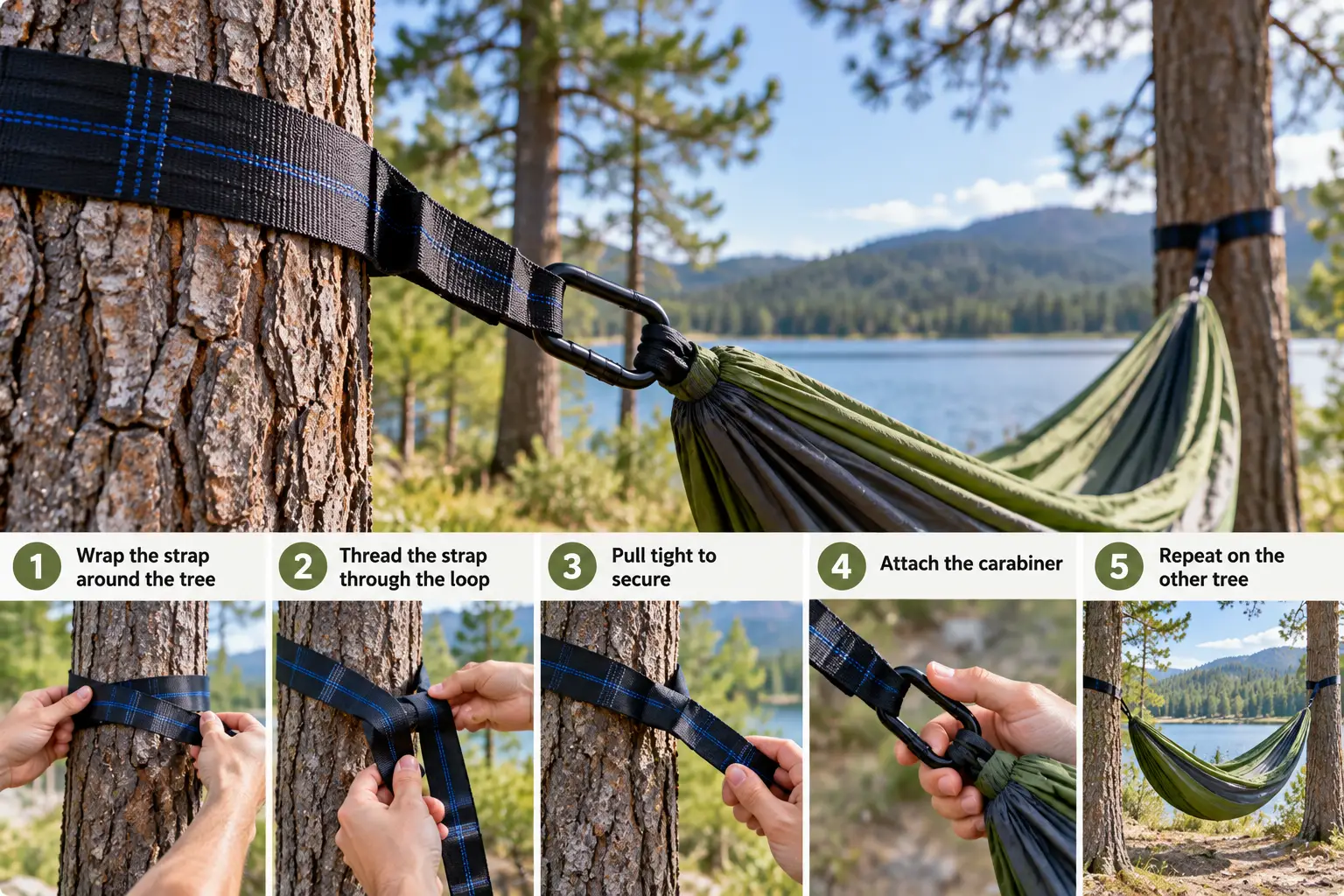
Tying hammock straps means anchoring a hammock to two trees or posts with wide webbing straps. You wrap each strap once around the trunk, pass one end through its own end loop to cinch it, then clip the hammock to a loop at the height that gives the suspension a roughly 30-degree angle.
This guide pairs a step-by-step method for how to tie hammock straps with an honest look at seven real strap systems you can find on Amazon, from budget daisy chains to ultralight whoopie-sling suspensions. Everything here is built on published outdoor-ethics guidance (the Leave No Trace Center’s hammock tips recommend webbing at least 1 inch wide), manufacturer spec sheets, and aggregated customer feedback. You won’t find invented test stories here — just the reasoning you need to make a smart call and hang well on your very first try.
Quick Comparison: The 7 Best Hammock Straps at a Glance
Before we dig into each pick, here’s the cheat sheet. Specs come from manufacturer listings at the time of writing; always double-check the current listing before you buy.
| Strap | Length per strap | Width at tree | Rated capacity | Adjustment | Best for |
|---|---|---|---|---|---|
| ENO Atlas Hammock Straps | 9 ft | 1.5″ (tapers to 0.75″) | 400 lbs combined | 30 sewn loops | ENO Atlas Hammock Straps: everyday campers |
| ENO Atlas XL Hammock Straps | 13 ft 6 in | 1.5″ (tapers to 0.75″) | 400 lbs combined | 40 sewn loops | ENO Atlas XL Hammock Straps: big trees, wide gaps |
| Kammok Python 10 | ~10 ft 2.5 in | 1.5″ (tapers to 0.75″) | 500 lbs | 40 loops (20 per strap) | Kammok Python 10: warranty-backed all-rounder |
| ENO Helios Ultralight Hammock Straps | 8 ft 1 in | 1″ | 300 lbs | Infinite (whoopie sling) | ENO Helios Ultralight Hammock Straps: ultralight backpackers |
| Wise Owl Outfitters Hammock Straps | 10 ft | 1″ | Listings cite 400–500 lbs | 38 loops | Wise Owl Outfitters Hammock Straps: first-timers on a budget |
| Grand Trunk Trunk Straps | 10 ft | 1″ | 400 lbs combined | 36 loops | Grand Trunk Trunk Straps: posts, racks, and festivals |
| Bear Butt Kodiak Hammock Straps | 10 ft | 1″ | Marketed up to 1,000 lbs | 40 loops | Bear Butt Kodiak Hammock Straps: doubles on a budget |
Reading across the table, the real dividing line isn’t capacity — it’s how you adjust and how much strap wraps the tree. The tapered designs from ENO Atlas Hammock Straps and Kammok Python 10 put the widest webbing on the bark and save weight at the hammock end, while the 1-inch budget straps meet the common 1-inch minimum but give the tree less cushion. Ultralight hikers should notice that the ENO Helios Ultralight Hammock Straps trade 100 lbs of rated capacity for being the lightest option here by a wide margin.
💬 One click helps other shoppers make an informed choice too! 😊
Top 7 Hammock Straps: Expert Analysis
Each pick below gets the same treatment: what the spec sheet says, what it means when you’re actually standing between two trees, and what customer reviews consistently report.
1. ENO Atlas Hammock Straps — the benchmark daisy-chain setup
There’s a reason almost every other strap gets compared to the ENO Atlas Hammock Straps: ENO pioneered the knotless daisy-chain suspension, and this redesign still sets the template.
Each strap runs 9 feet of 1000D polyfilament webbing that measures 1.5 inches where it hugs the tree and tapers to 0.75 inches at the hammock end. In practice, that means the bark gets the wide part while you skip carrying unnecessary bulk, and the pair weighs just 9 ounces. You get 30 combined loops (15 per strap), plus reflective stitching that keeps you from clotheslining yourself on a midnight bathroom run.
Here’s what to weigh: wrapping a trunk eats strap length equal to its circumference, roughly 3.14 × diameter. A 12-inch tree uses about 3 feet, leaving plenty of loops; a 30-inch giant uses nearly 8 feet, which leaves almost nothing. So the ENO Atlas Hammock Straps shine on typical campground trees but can come up short on old-growth trunks.
Customer reviews on REI consistently describe setup as fast and the multi-pass stitching as reassuring; the main recurring caveat is that very large trees call for an extension.
Pros:
- ✅ Tapered webbing protects bark without extra weight
- ✅ True loops make carabiner clipping quick and easy
- ✅ Reflective stitching improves nighttime visibility at camp
Cons:
- ❌ 9-foot length struggles on very wide trunks
- ❌ Rated capacity lower than some budget competitors
💲 Typically around $30–$35 at the time of writing (check the current price) — fair value for a proven, tree-friendly standard.
2. ENO Atlas XL Hammock Straps — extra reach for big trunks
The ENO Atlas XL Hammock Straps solve the one real weakness of the standard Atlas: running out of strap.
ENO adds 42 inches per strap, bringing each to 13 feet 6 inches, with 40 combined loops and the same tapered 1.5-to-0.75-inch webbing. The weight climbs to 13 ounces for the pair, and capacity stays at 400 lbs combined. What that extra length buys you is freedom: you can wrap a 30-inch Douglas fir and still have loops to spare, or bridge trees spaced a little farther apart than ideal.
Based on comparing the specs, this is the version to buy if you camp in the Pacific Northwest, the Sierra, or anywhere with fat conifers. If you mostly hang in a backyard or a Midwest state park, the standard length usually covers you and saves 4 ounces.
Reviews on REI frequently praise the added length and the ease of fine-tuning sag with the extra loops. At least one daily user reports retiring the straps after one to two years of nightly use — a useful reminder that webbing is a wear item for heavy users.
Pros:
- ✅ Handles giant trunks and wider tree spacing
- ✅ Forty loops allow fine height adjustments
- ✅ Same tree-friendly tapered webbing as the original
Cons:
- ❌ Extra 4 ounces matters to ultralight hikers
- ❌ Long tails of unused loops can dangle messily
💲 Usually around $40 at the time of writing — worth the small premium if big trees are your norm.
3. Kammok Python 10 — strongest rating plus a lifetime warranty
The Kammok Python 10 is the pick that quietly outspecs the market leader on paper.
Each strap is about 10 feet 2.5 inches long with 20 daisy-chain loops, built with Kammok’s patented Nanoweave construction, which weaves each loop into the webbing instead of using bulky bar-tack stitching. The result is a 500-lb rating, a variable width of 1.5 to 0.75 inches, and high-tenacity polyester that Kammok markets as low-stretch, so your 30-degree angle holds through the night. A Sil/PU-coated stuff sack and reflective tracers round it out.
Who is it for? Campers who want one set of straps for years, since a lifetime warranty backs it, and anyone hanging a carabiner-equipped hammock from any brand. If a park requires 2-inch straps, Kammok sells 2-inch-wide Python Extenders separately, which is a smart modular option.
REI reviewers often call the Kammok Python 10 longer and lighter than the ENO Atlas Hammock Straps. One couple totaling about 360 lbs reported noticeable stretch after a shared hang, which suggests doubles should leave a little extra adjustment room.
Pros:
- ✅ 500-lb rating leads the premium straps here
- ✅ Woven-in loops cut bulk and stitching wear
- ✅ Lifetime warranty adds long-term peace of mind
Cons:
- ❌ Some stretch reported under heavy two-person loads
- ❌ Extenders for 2-inch rules cost extra
💲 Generally in the $30–$40 range at the time of writing — excellent value given the warranty.
4. ENO Helios Ultralight Hammock Straps — lightest pack weight, infinite adjustment
The ENO Helios Ultralight Hammock Straps swap sewn loops for a whoopie sling, and that changes the whole experience.
The pair weighs just 4.3 ounces, with 8 feet 1 inch per strap made of 1-inch polyfilament webbing joined to Silverlite cord and ENO’s Microtune adjustment. Instead of picking a loop, you slide the sling to lengthen or shorten — meaning infinite fine-tuning instead of fixed steps. It’s toggle-ready for ENO’s Sub-series hammocks and compatible with all ENO hammocks, with a 300-lb capacity.
On paper, this is the thru-hiker’s tool: less than half the weight of the ENO Atlas Hammock Straps and endlessly adjustable. The trade-offs are length and learning curve. The webbing section is shorter than the total length suggests, so large trees are a real limitation; ENO’s XL version adds about 5 feet if you need it.
REI reviews split clearly. Fans love the weight savings and the precise adjustability; critical reviewers say the whoopie system feels less intuitive than sewn loops and worry about large-diameter trees.
Pros:
- ✅ Just 4.3 ounces for the complete pair
- ✅ Infinite adjustment dials in perfect sag
- ✅ Pairs seamlessly with toggle-style ultralight hammocks
Cons:
- ❌ Whoopie sling adjustment takes practice to master
- ❌ Short webbing limits use on big trees
💲 Around $35 at the time of writing — a strong value per ounce saved.
5. Wise Owl Outfitters Hammock Straps — budget kit with carabiners included
The Wise Owl Outfitters Hammock Straps are the “I just bought a hammock and it came with nothing” solution.
You get two 10-foot, 1-inch-wide polyester straps with 38 loops total, two D-shaped carabiners, and a carry bag. That carabiner bundle matters: with premium straps, you often supply your own hardware. Note that listings have cited both 400 and 500 lbs for capacity over time, so plan around the lower number and confirm the current listing.
In practice, 38 loops give you more adjustment points than the ENO Atlas Hammock Straps, which helps when kids want the hammock lower or you’re hanging between uneven trees. The 1-inch width meets the most common park minimum but offers less bark protection than tapered 1.5-inch designs.
Aggregated Amazon review sentiment is strongly positive on ease of setup and the number of loops. A recurring note is a small slip when you first sit down before the straps settle and grip, and ultralight users point out that the kit can weigh nearly as much as a featherweight hammock.
Pros:
- ✅ Carabiners and carry bag included in the box
- ✅ Thirty-eight loops offer flexible height choices
- ✅ Very approachable price for a first setup
Cons:
- ❌ Heavier than premium tapered straps
- ❌ Capacity listings have varied over time
💲 Typically under $25 at the time of writing — hard to beat as a complete starter kit.
6. Grand Trunk Trunk Straps — most versatile anchor options
The Grand Trunk Trunk Straps come from a brand with deep roots in festival and travel hammocks, and they’re designed to anchor to more than trees.
Each strap is 10 feet of 1-inch high-tenacity polyfilament webbing with 18 adjustment points (36 total), triple-stitched with heavy nylon thread. The pair weighs 12 ounces and carries a 400-lb combined rating (200 lbs per strap). Grand Trunk explicitly lists porch posts, vehicle roof racks, and boat masts as compatible anchors, and a lifetime warranty covers the straps.
Here’s what to weigh: the loop count sits between the ENO Atlas Hammock Straps and the budget kits, so you get decent micro-adjustment without endless dangling tails. The color options are a small but real perk if you like your strap to match your hammock or want high visibility in a crowded campground.
We couldn’t verify a large body of independent customer reviews for this specific model on major US retailer pages, so it’s fairest to judge it on its spec sheet and warranty — both of which are solid for the price tier.
Pros:
- ✅ Lifetime warranty at a mid-range price
- ✅ Rated for posts, racks, and non-tree anchors
- ✅ Multiple colors for visibility or matching
Cons:
- ❌ Carabiners not included with the straps
- ❌ Fewer verifiable reviews than leading competitors
💲 Usually in the $25–$30 range at the time of writing — sensible value for multi-use hangs.
7. Bear Butt Kodiak Hammock Straps — heavy-duty value for doubles
The Bear Butt Kodiak Hammock Straps lean hard into strength, and they’re a favorite among families running double hammocks.
You get 20 feet of polyester webbing in total (10 feet per strap), 40 combined loops, 1-inch width, and stainless steel carabiners in the box. Bear Butt markets a capacity of up to 1,000 lbs. Here’s the honest translation: your real limit is your hammock’s rating, not the strap’s. Bear Butt’s own double hammock, for example, is rated at 500 lbs, so a 1,000-lb strap claim is a safety margin, not permission to pile in.
This set is a great match for couples sharing a double, for car campers, and for anyone who wants a no-fuss kit with hardware included. As with any 1-inch strap, check local rules, as some parks require more padding.
Aggregated Amazon review sentiment highlights how easy the knot-free setup is for total beginners, with several reviewers reporting that two adults over 300 lbs combined hang without trouble. A few buyers noted receiving a different stitching color than ordered — cosmetic, but worth knowing.
Pros:
- ✅ Stainless carabiners included with the kit
- ✅ Forty loops cover a wide adjustment range
- ✅ Comfortably supports two-person double hammocks
Cons:
- ❌ 1,000-lb claim can mislead casual buyers
- ❌ Color variants sometimes differ from listing
💲 Typically in the $20–$30 range at the time of writing — strong value for doubles and families.
Head-to-Head: Which Strap Wins Where?
Specs on their own blur together, so this table focuses on the differences you’ll actually feel at camp.
| Strap | Pair weight | Hardware included | Attachment style | Warranty highlight | Best for |
|---|---|---|---|---|---|
| ENO Atlas Hammock Straps | 9 oz | No | Carabiner loops | ENO guarantee | ENO Atlas Hammock Straps: reliable all-round hangs |
| ENO Atlas XL Hammock Straps | 13 oz | No | Carabiner loops | ENO guarantee | ENO Atlas XL Hammock Straps: old-growth forests |
| Kammok Python 10 | Light (woven loops) | No | Carabiner loops | Lifetime | Kammok Python 10: buy-once campers |
| ENO Helios Ultralight Hammock Straps | 4.3 oz | Toggle-ready | Whoopie sling | ENO guarantee | ENO Helios Ultralight Hammock Straps: thru-hikers |
| Wise Owl Outfitters Hammock Straps | Heavier | Yes (2 carabiners) | Carabiner loops | Check listing | Wise Owl Outfitters Hammock Straps: starter kits |
| Grand Trunk Trunk Straps | 12 oz | No | Carabiner loops | Lifetime | Grand Trunk Trunk Straps: posts and roof racks |
| Bear Butt Kodiak Hammock Straps | Heavier | Yes (stainless) | Carabiner loops | Check listing | Bear Butt Kodiak Hammock Straps: double hammocks |
The pattern is clear: if you already own carabiners and care about bark protection, the tapered ENO Atlas Hammock Straps or Kammok Python 10 deliver the most refined experience. If you’re starting from zero, the bundled hardware in the Wise Owl Outfitters Hammock Straps and Bear Butt Kodiak Hammock Straps quietly saves you an extra purchase. Only weight-obsessed backpackers truly need the ENO Helios Ultralight Hammock Straps.
✨ Don’t miss these tree-friendly picks!
🔍 Take your hammock setup to the next level with this carefully curated lineup. Click a highlighted strap to check current pricing and availability — the right pair turns any two trees into the comfiest seat in the woods! 🌲
How to Tie Hammock Straps: A Step-by-Step Setup Guide
This is the part you’ll bookmark. Here’s how to use hammock straps with sewn loops, the style used by six of our seven picks.
Step 1: Pick the Right Trees 🌳
Look for two living, sturdy trees roughly 12 to 15 feet apart for a typical 9- to 11-foot hammock. Check overhead for dead branches, and skip any tree that bends, leans, or grows in soggy ground.
Step 2: Choose Your Mounting Height
For trees about 12–15 feet apart, a mounting height around 5 to 6 feet usually works. The farther apart the trees, the higher you mount; the closer, the lower.
Step 3: Wrap Once and Choke the Strap
This is how to attach hammock straps to a tree: wrap the strap once around the trunk, keep the webbing flat (no twists), then thread the looped end through the plain end loop and pull snug. That cinch, often called a girth hitch or choke, tightens under load instead of slipping.
Step 4: Clip at the 30-Degree Angle
Clip a carabiner through the loop that leaves the suspension at roughly 30 degrees from horizontal — about one-third of the way from flat to straight down. If you like numbers, an online hammock hang calculator will translate tree distance and hammock length into exact heights.
Step 5: Repeat and Sit-Test
Mirror the setup on the second tree at the same height. Then sit in the center first: the hammock should sit around 18 inches off the ground with you in it. Adjust a loop or two as needed.
Step 6: Lie Diagonally ⚡
Lie at a slight angle, head off-center one way and feet the other. With a proper sag, you’ll lie nearly flat — this is the secret behind every “I sleep better in a hammock” convert.
When You Actually Need a Knot
If your hammock ends in rope rather than a carabiner, tie it to a strap loop with a Becket hitch: it holds firmly under load and unties easily. Whoopie-sling systems like the ENO Helios Ultralight Hammock Straps use a toggle instead, so there’s still no real knot required.
Troubleshooting: 5 Common Hammock Strap Problems and Fixes
Even experienced hangers hit these. Here’s how to diagnose and fix each one fast.
1. Your butt touches the ground when you sit. ❌ Problem: straps mounted too low, or the hammock clipped too far from the tree. ✅ Fix: raise the strap 6–12 inches on the trunk or clip a loop closer to the tree. Hammocks stretch slightly as they settle, so build in a few extra inches of clearance.
2. The strap slides down the trunk. ❌ Problem: the choke wasn’t snugged, or the bark is smooth and slick (birch, beech). ✅ Fix: pull the cinch tight before loading and keep the webbing flat. A little initial slip is normal — reviews of the Wise Owl Outfitters Hammock Straps describe exactly that before the straps settle.
3. Shoulder squeeze and “banana” posture. ❌ Problem: the hammock is hung too tight and flat. ✅ Fix: lower the hang angle back toward 30 degrees and lie diagonally. Tight hangs feel worse and put much more force on your gear.
4. The trees are too far apart. ❌ Problem: your straps run out of loops before reaching the hammock. ✅ Fix: switch to longer straps like the ENO Atlas XL Hammock Straps, add an extension, or simply pick a closer pair of trees.
5. Carabiner twisting or gate loading. ❌ Problem: the webbing twisted, and the carabiner is loading sideways against its gate. ✅ Fix: untwist the strap and make sure the carabiner sits spine-loaded. Use only load-rated carabiners, never keychain clips.
Real-World Scenarios: Matching Straps to Your Hang
Specs make more sense when you picture who’s actually hanging. Here are three common profiles and the reasoning behind each match.
🏕️ The Weekend Car Camper with Kids
Budget: under $30. Use: state park campgrounds, maybe 8–10 weekends a year, plus backyard lounging. Priorities: easy setup, included hardware, and loops for kid-friendly low hangs.
Best match: the Wise Owl Outfitters Hammock Straps or the Bear Butt Kodiak Hammock Straps. Both include carabiners, both offer 38–40 loops for setting a low, safe height, and reviews consistently describe setup as beginner-proof. If the family shares a double hammock, the Bear Butt Kodiak Hammock Straps edge ahead.
🎒 The Ultralight Backpacker
Budget: around $35. Use: multi-day trips where every ounce counts, often 20+ nights a year. Priorities: weight, packed size, and precise adjustment on unpredictable tree spacing.
Best match: the ENO Helios Ultralight Hammock Straps. At 4.3 ounces, they save almost 5 ounces over the ENO Atlas Hammock Straps. Just practice the whoopie adjustment at home before relying on it after dark, and consider the XL version if you hike through big-tree country.
🌲 The Pacific Northwest Hammock Camper
Budget: $40–$50. Use: frequent trips among huge conifers, sometimes as a couple. Priorities: length, bark protection, durability.
Best match: the ENO Atlas XL Hammock Straps for maximum reach, or the Kammok Python 10 with the optional 2-inch extenders for parks with stricter width rules. Both put wide webbing against the bark, and the lifetime warranty on the Kammok Python 10 makes it the long-haul favorite.
How to Choose Hammock Straps (7 Key Criteria)
Choosing well comes down to matching the strap to your trees, your hammock, and your trips. Use these seven criteria in order:
- Width at the tree. Choose at least 1 inch, and wider is kinder to bark; some parks require more, so check before you go.
- Length versus trunk size. Wrapping uses about 3.14 × the trunk’s diameter; a 24-inch tree eats roughly 6 feet of strap.
- Capacity versus your hammock. The lower of the strap or hammock rating is your real limit, regardless of bold marketing claims.
- Attachment style. Carabiner hammocks pair with daisy chains; toggle hammocks pair best with whoopie-sling systems.
- Adjustment system. Sewn loops are faster for beginners; whoopie slings give infinite fine-tuning once you learn them.
- Weight and packed size. Car campers can ignore ounces, but backpackers will feel every extra ounce on a long climb.
- Warranty and build. Lifetime warranties and woven or multi-pass stitching signal a strap built to last for years.
If you’re new to hammocks and want a single rule of thumb: buy a tapered 1.5-inch daisy-chain strap in a length that fits the biggest trees you expect to hang from.
Daisy-Chain Straps vs. Whoopie Slings vs. Rope
Rope is the “traditional” way people hung hammocks, and it’s still what many cheap hammocks ship with. Here’s how it stacks up against modern strap systems.
| Factor | Rope | Daisy-chain straps | Whoopie-sling straps |
|---|---|---|---|
| Tree impact | High — thin cord can cut into bark | Low — wide webbing spreads load | Low — webbing at the tree |
| Setup speed | Slow; knots required | Fast; clip a loop | Fast once learned |
| Adjustability | Re-tie every time | Fixed loop steps | Infinite |
| Weight | Varies | Moderate | Lightest |
| Learning curve | High (knots) | Very low | Moderate |
| Best for | Not recommended on trees | Kammok Python 10, ENO Atlas Hammock Straps | ENO Helios Ultralight Hammock Straps |
The table makes the verdict obvious: rope is the worst choice for trees, since a thin line concentrates the load on a narrow band of bark, and it forces you to re-tie knots every time. Daisy-chain straps are the sweet spot for most people because they’re fast, foolproof, and tree-friendly. Whoopie slings only beat them when weight and micro-adjustment matter more than simplicity.
That said, rope still has one niche: as a ridgeline or as the suspension between a strap loop and your hammock, where it never touches bark. If your hammock came with rope, keep the rope on the hammock side and let wide straps handle the tree.
Common Mistakes to Avoid When Tying Hammock Straps
Most bad hangs trace back to a handful of avoidable errors.
❌ Hanging too tight and flat. This is the biggest one, and the physics is brutal. With a 200-lb person at a 30-degree hang angle, each strap carries about 200 lbs of tension. Drop to 15 degrees and that jumps to roughly 386 lbs per side; at 10 degrees, it’s around 576 lbs. A flat hang multiplies the load on your trees, straps, and carabiners while also being less comfortable.
❌ Wrapping the trunk multiple times. Leave No Trace guidance calls for one wrap and a loose, natural hang. Multiple tight wraps on a narrow tree can squeeze and damage bark.
❌ Hanging too high. Outdoor-ethics guidance suggests keeping the hammock under about 5 feet off the ground. Higher hangs turn a minor tumble into a real injury.
❌ Choosing dead or small trees. Dead trees and dead branches overhead are genuine hazards. A thin sapling can also bend or break.
❌ Twisted webbing. A twist concentrates pressure on the bark and can roll the carabiner into a side load. Keep everything flat.
❌ Leaving your setup up for days. Prolonged pressure stresses bark and can entangle wildlife. Take your hammock down whenever you leave camp, even if you leave the straps for a short break.
Safety, Regulations, and Tree-Protection Rules
Hammocking rules in the US vary widely, and that variation catches many campers off guard.
Some state agencies spell out precise requirements. Minnesota’s state park hammocking rules, for example, require trees at least 12 inches in diameter at the attachment point and straps at least 1 inch wide. They also limit you to one hammock per tree, ban stacked or “wheel spoke” setups, and may require extra padding if bark shows damage. That’s a useful benchmark even where no rule is posted.
Other places restrict hammocks on trees entirely. Some National Park Service units, especially busy urban parks, prohibit attaching hammocks to trees at all and encourage freestanding stands instead. National forests, state forests, and private campgrounds each set their own policies, so check the official website or ask a ranger before you go.
Beyond regulations, a few safety habits matter:
- ⚡ Use load-rated hardware. Carabiners should carry a rated strength; decorative “accessory” clips aren’t designed for body weight.
- 🔋 Respect the lowest rating. If your straps say 500 lbs and your hammock says 400 lbs, 400 lbs is your limit.
- ✅ Inspect before each trip. Look for fraying, sun-faded webbing, and pulled stitching, especially near the end loops.
- ✅ Supervise kids. Keep hammocks low, and take them down when unattended so children and animals don’t get tangled.
None of this is complicated, and following it keeps hammocks welcome in the parks where many of us love to hang.
Long-Term Cost and Maintenance
Hammock straps are cheap compared with tents, but their true cost depends on how long they last and what you have to buy alongside them.
| Strap | Typical price range* | Hardware needed? | Warranty | Value verdict |
|---|---|---|---|---|
| Wise Owl Outfitters Hammock Straps | Under $25 | No | Check listing | Wise Owl Outfitters Hammock Straps: best starter value |
| Bear Butt Kodiak Hammock Straps | $20–$30 | No | Check listing | Bear Butt Kodiak Hammock Straps: best for doubles |
| Grand Trunk Trunk Straps | $25–$30 | Yes | Lifetime | Grand Trunk Trunk Straps: best multi-use value |
| ENO Atlas Hammock Straps | $30–$35 | Yes | ENO guarantee | ENO Atlas Hammock Straps: best proven standard |
| Kammok Python 10 | $30–$40 | Yes | Lifetime | Kammok Python 10: best long-term value |
| ENO Helios Ultralight Hammock Straps | Around $35 | Toggle or carabiner | ENO guarantee | ENO Helios Ultralight Hammock Straps: best per ounce |
| ENO Atlas XL Hammock Straps | Around $40 | Yes | ENO guarantee | ENO Atlas XL Hammock Straps: best for big trees |
*Prices may vary; check the current price.
The cheapest sticker price isn’t always the cheapest setup: premium straps without carabiners add the cost of two rated carabiners, which can close much of the gap with all-in-one kits. Over several years, though, a lifetime warranty on the Kammok Python 10 or Grand Trunk Trunk Straps can make them the lowest cost of ownership for frequent campers.
Maintenance is simple but often ignored:
- Dry before storing. Damp webbing packed away can mildew and smell.
- Limit sun exposure. UV gradually weakens synthetic webbing, so don’t leave straps up all summer.
- Rinse off grit. Sand and dirt act like sandpaper on fibers; a gentle rinse in cool water helps.
- Retire worn straps. Fraying, stiffness, or faded color near the loops means it’s time for a new pair.
Features That Actually Matter (and Ones That Don’t)
Marketing for hammock straps loves big numbers. Here’s how to cut through it.
✅ Features That Matter
- Width where the strap meets bark. This affects both tree health and park compliance more than any other spec.
- Length matched to your trees. A strap that’s too short is useless, no matter how strong it is.
- Low-stretch webbing. Polyester and polyfilament hold your 30-degree angle; stretchy material slowly lowers you toward the ground overnight.
- Loop spacing and count. More loops mean finer adjustment, which matters most on uneven or awkwardly spaced trees.
- Reflective details. A small touch that prevents real tripping hazards in a dark campsite.
❌ Features That Matter Less Than You’d Think
- Capacity claims far beyond your hammock. A 1,000- or 2,000-lb strap rating adds margin, but your hammock rating is still your real limit.
- Fancy stuff sacks. Nice to have, but they don’t change how well you hang.
- Color. Fun for matching, irrelevant for performance — except visibility in crowded campgrounds.
The takeaway: spend your money on width, length, and low-stretch materials, and don’t pay extra for oversized capacity numbers you’ll never use.
FAQ: Hammock Straps Questions Shoppers Ask Most
❓ What are the best hammock straps for beginners?
❓ Can I hang a hammock with straps from a car or porch post?
❓ Do I need to buy carabiners separately?
❓ How long should hammock straps be for large trees?
❓ Can two people use one set of hammock straps?
Conclusion: Hang It Right, Hang It Kind
Mastering how to tie hammock straps comes down to a few simple habits: wrap the trunk once, choke the strap snug, clip in at roughly 30 degrees, and sit-test before you settle in. Do that, and you’ll get a deep, comfortable sag that lets you lie almost flat while keeping the forces on your gear and trees reasonable.
Picking the right strap makes those habits effortless. The ENO Atlas Hammock Straps remain the proven all-rounder, while the ENO Atlas XL Hammock Straps handle the giants. The Kammok Python 10 offers the best long-term value thanks to its lifetime warranty. Ultralight hikers will love the ENO Helios Ultralight Hammock Straps, and budget-minded families can’t go wrong with the Wise Owl Outfitters Hammock Straps, Grand Trunk Trunk Straps, or Bear Butt Kodiak Hammock Straps.
Finally, remember that tree-friendly hammocking keeps hammocks welcome in our parks. Some managers have already restricted hanging from trees — the National Park Service explains in its guidance on protecting trees from hammocks and ropes how thin lines can harm bark and tree health. Wide straps, short stays, and a light touch help keep those spots open for everyone.
🌲 Ready for your perfect hang?
🔍 Pick the strap that matches your trees, your hammock, and your adventures. Click a highlighted product to check current pricing and availability — your next lazy afternoon between two trees is just a few loops away! ✨
Recommended for You
- Stand Alone Hammock with Stand: 7 Proven Picks for 2026 (Ranked)
- Hammock Tent Setup 2026: 7 Best Kits + Foolproof Step-by-Step Guide
- ENO Parkway Hammock Stand: 7 Best Picks Reviewed (2026)
Disclaimer: This post contains affiliate links. As an Amazon Associate, I earn from qualifying purchases made through these links, at no additional cost to you.
✨ Found this article helpful? Share it with someone who needs it! 💬🤗