
In This Article
Why a Zip Up Hammock Changes Bug-Season Camping
Picture this: it’s 2 a.m. somewhere in the Smokies, the air is thick and humid, and a single mosquito has found the one gap between your face and a loosely draped bug net. You slap, you swear, you lie awake. A zip up hammock exists to end that exact scene. 🦟
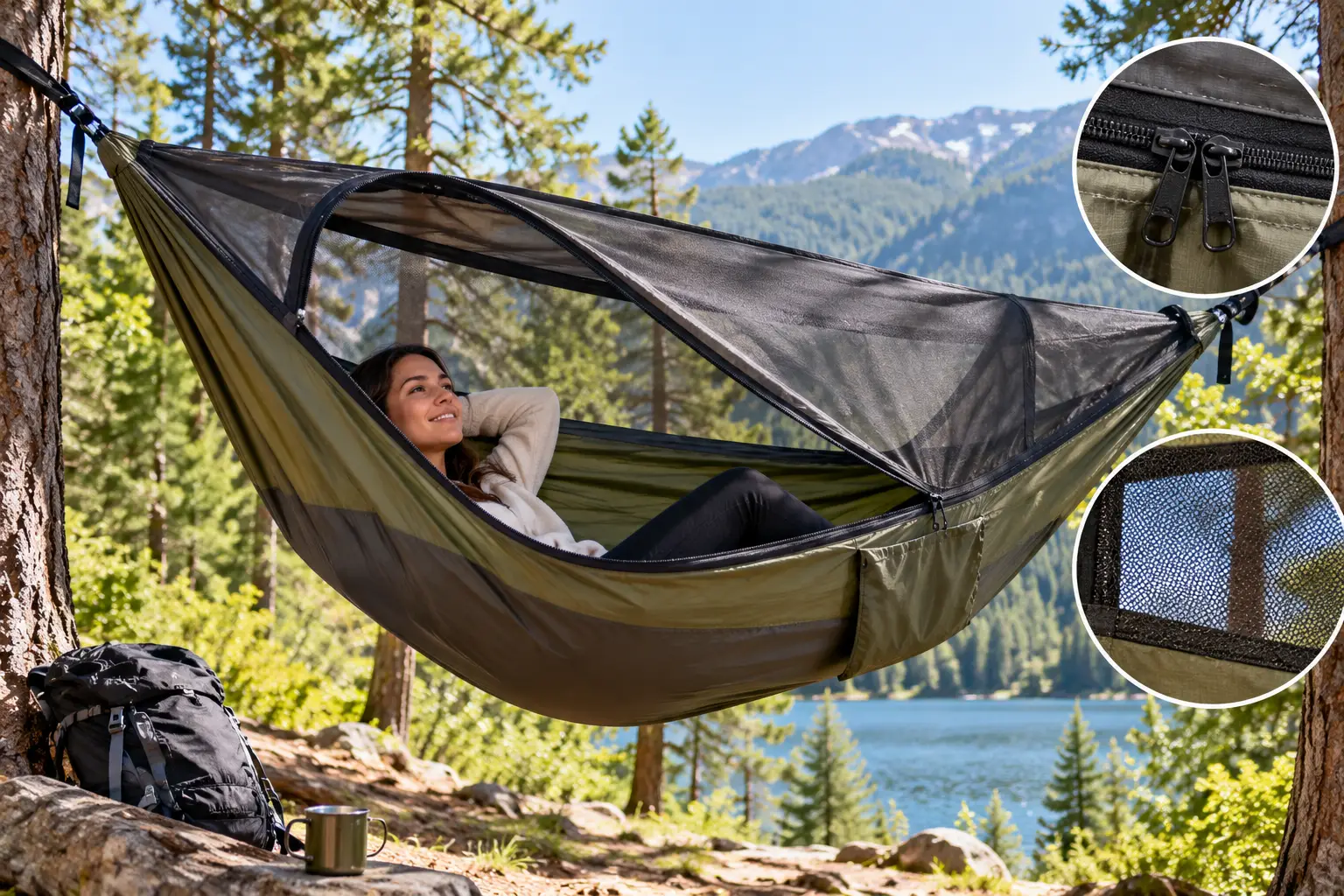
Instead of a separate net you drape, tie, and pray over, the mesh is sewn or zipped directly to the hammock body, so the whole sleep space seals like a tent door. That one design choice changes everything — setup gets faster, gaps disappear, and your hang becomes a genuine shelter rather than a lounge chair with a veil.
What Is a Zip Up Hammock?
A zip up hammock is a camping hammock with an integrated, zippered bug net — usually fine no-see-um mesh — that closes completely around the sleeper. Unlike sock-style or drape-over nets, the zipper creates a sealed, tent-like enclosure that keeps mosquitoes, gnats, and spiders out while still letting air flow freely.
The broader practice of hammock camping has long relied on mosquito netting in buggy climates, but the zippered, all-in-one format is what pushed hammocks from backyard toy to legitimate backpacking shelter. Today you can find a hammock with zippered bug net for the price of a pizza night or for the price of a premium ultralight tent — and the gap between those two extremes is exactly what this guide unpacks.
Below, you’ll find seven real models available to US buyers, compared on the things that actually decide whether you sleep well: mesh quality, zipper layout, weight capacity, length, suspension, and what’s included in the box. Every verdict is grounded in published specs and aggregated owner feedback — no fluff, no fake test stories. ✅
Quick Comparison: Zip Up Hammock Picks at a Glance
| Model | Capacity | Weight (approx.) | What’s Included | Price Range | Best for |
|---|---|---|---|---|---|
| Sunyear Camping Hammock with Net | 500 lb | ~2.4 lb | Hammock, net, straps, carabiners | Under $50 | Sunyear Camping Hammock with Net: first-timers on a budget |
| Covacure Camping Hammock | 772 lb (stated) | ~1.9 lb | Hammock, net, straps, stakes | Under $35 | Covacure Camping Hammock: backyard and car camping |
| Onewind 11ft Camping Hammock with Mosquito Net | 500 lb | ~2–2.6 lb | Hammock, zip net, ridgeline, straps | $60–$100 | Onewind 11ft: tall sleepers and diagonal lay |
| ENO JungleNest | 300 lb | ~1.25 lb | Hammock, net, ridgeline (straps extra) | $100–$130 | ENO JungleNest: brand-backed mid-range buyers |
| Hennessy Hammock Expedition Asym Zip | 250 lb | ~2.8 lb | Hammock, net, rainfly, straps | $150–$180 | Hennessy Expedition Asym Zip: flat sleepers under 6 ft |
| Sea to Summit Jungle Hammock Set | ~300 lb | ~1.7 lb | Hammock, net, straps (tarp extra) | $150–$200 | Sea to Summit Jungle: humid, rugged trips |
| Kammok Mantis UL | 300 lb | ~2.4 lb full kit | Hammock, net, tarp, straps, stakes | $250–$320 | Kammok Mantis UL: ultralight backpackers |
Reading across the rows, the big split isn’t price — it’s what you get in the bag. The Sunyear Camping Hammock with Net, Covacure Camping Hammock, and Onewind 11ft Camping Hammock with Mosquito Net cover the sleep space and suspension but leave rain protection to you, while the Hennessy Hammock Expedition Asym Zip and Kammok Mantis UL arrive as complete shelters. Notice, too, that weight capacity runs backward to price: the cheapest models advertise the highest limits, while premium brands rate conservatively around 250–300 lb.
💬 One click helps other shoppers make an informed choice too! Tap a highlighted model to check current pricing and availability. 😊
Top 7 Zip Up Hammocks: Expert Analysis
Each pick below was chosen to cover a different budget, body type, and trip style. The analysis leans on manufacturer specs, independent outdoor reviews, and the recurring themes in customer feedback — not on invented hands-on stories.
1. Sunyear Camping Hammock with Net — best budget all-rounder
The Sunyear Camping Hammock with Net proves a sealed bug shelter doesn’t have to cost much. Its standout trick is a reversible, permanently sewn net: zip it closed on bug nights, or flip it underneath and use the hammock open when the air is clear.
The body is 210T ripstop nylon rated to 500 lb, and the kit includes two 10-ft tree straps with multiple adjustment loops plus carabiners. In practice, those loops mean no knots — you clip into whichever loop gives the right sag, which matters enormously for beginners who haven’t learned a structural ridgeline yet. The single size runs about 106 × 55 inches, with a longer double version around 118 × 78 inches.
Based on comparing the specs, this is the model to buy if you’re curious about hammock camping but not ready to commit triple digits. It suits car campers, festival-goers, and scouts more than thru-hikers, since at roughly 2.4 lb it’s no featherweight.
Aggregated customer reviews are broadly positive, with thousands of ratings averaging in the mid-4-star range at the time of writing; common praise centers on easy setup, while recurring complaints mention mosquitoes biting through the single-layer floor.
Pros:
- ✅ Reversible net works open or fully zipped
- ✅ Knot-free loop straps simplify first setups
- ✅ Generous 500 lb rated capacity
Cons:
- ❌ Single-layer floor lets determined mosquitoes bite through
- ❌ No rainfly included in the base kit
💲 Typically under $50 — hard to beat for value-per-feature, so check the current price.
2. Covacure Camping Hammock — lightest wallet-friendly double
The Covacure Camping Hammock squeezes a full bug enclosure into a package under 2 lb, making it the lightest budget pick here.
It uses 210T parachute nylon with a stated 772 lb capacity, and the listed 1.93 lb weight already includes two aluminum stakes, carabiners, and nylon straps. The mesh is stitched to one side and closed on the other with double-sided zippers, so you can roll the net away when bugs aren’t an issue. An elastic support cord lifts the mesh off your face — a small detail that decides whether you sleep or wrestle netting all night.
That 772 lb figure is best read as a static marketing number; treat it as “comfortably holds one adult plus a kid lounging,” not as permission to pile in three people. For backyard hangs and drive-up campsites, though, it’s a smart buy.
Reviews consistently praise the weight-to-price ratio and the convenience of the attached net. The most common criticisms: the support cord only does a so-so job keeping mesh off your head, the straps offer limited adjustability for closely spaced trees, and — like most single-layer hammocks — mosquitoes can still bite from underneath.
Pros:
- ✅ Under 2 lb including stakes and straps
- ✅ Net rolls away when you don’t need it
- ✅ Very low entry price
Cons:
- ❌ Mesh support cord sags against the face
- ❌ Limited strap adjustment for tight tree spacing
💲 Usually in the $20–$35 range — an excellent starter or spare hammock at the time of writing.
3. Onewind 11ft Camping Hammock with Mosquito Net — roomiest for tall sleepers
The Onewind 11ft Camping Hammock with Mosquito Net is built around one idea: length equals comfort. At 11 ft long and roughly 64 inches wide, it gives you room to lie diagonally and nearly flat.
The zippered version pairs a 40D ripstop nylon body with an adjustable UHMWPE structural ridgeline and an integrated net that opens via a full two-way zipper. A ridgeline matters more than most shoppers realize: it locks in the same sag every time, so your hang is consistent whether the trees are 12 or 18 feet apart. Onewind also sells an earlier bottom-entry version with a removable net, so double-check which model you’re ordering.
This is the value pick for anyone over 6 ft, side sleepers, and campers who plan to add an underquilt later — the brand sells a whole ecosystem of matching insulation and tarps.
Aggregated reviews frequently highlight the spaciousness, with taller owners (one noted being 6’2″ and 250 lb) calling it their most comfortable hammock; a recurring note is that the zippered net can’t be fully detached.
Pros:
- ✅ 11-ft length enables a genuinely flat diagonal lay
- ✅ Adjustable structural ridgeline for repeatable setups
- ✅ Two-way zipper makes entry easy from either end
Cons:
- ❌ Zippered net isn’t fully removable
- ❌ Heavier and bulkier than ultralight options
💲 Roughly $60–$100 depending on version — strong value against brand-name rivals.
4. ENO JungleNest — best brand-name mid-range
The ENO JungleNest brings Eagles Nest Outfitters’ polish to the integrated-net category at a mid-range price.
Its 10-ft body measures about 10 ft × 4’10” and is cut from 40D NewWave ripstop nylon, rated to 300 lb, at roughly 20 oz. The SkyWeave Lite mesh is no-see-um grade — tight enough to stop midges, not just mosquitoes — and dual zippers with ENO’s signature pulls let you open from either side. A DAC Featherlite spreader bar holds the canopy up like a mini tent, and the net stows into a sack at the foot end.
What most buyers overlook: straps are sold separately, and the aluminum toggles are designed for ENO’s Helios suspension. Budget that in, and the ENO JungleNest becomes a refined, lightweight choice for weekend backpackers who already trust the brand.
On REI, the ENO JungleNest holds roughly a 4.3-out-of-5 average from a modest number of reviews; owners praise build quality and bug protection, while some taller users find the dimensions snug. Independent testers similarly flag small dimensions and no side pull-outs.
Pros:
- ✅ No-see-um mesh blocks even tiny midges
- ✅ Spreader bar keeps netting off your face
- ✅ Light at about 20 oz for the hammock
Cons:
- ❌ Straps cost extra on top of the hammock
- ❌ Snug fit for taller or broader sleepers
💲 Generally $100–$130 before straps — fair for the quality, but factor in suspension.
5. Hennessy Hammock Expedition Asym Zip — flattest lay for average heights
The Hennessy Hammock Expedition Asym Zip is the design that helped launch modern hammock camping, and its asymmetric cut still delivers one of the flattest lies you can buy.
Hennessy’s patented asymmetrical shape and structural ridgeline let you lie level on the diagonal with support under the lower back and knees. The “Zip” in the name is a side-entry, heavy-duty #10 zipper with two double sliders, and the body is durable 70D Oxford nylon with no-see-um polyester mesh. Crucially, a fitted rainfly and webbing straps come in the box, so it’s a complete shelter at around 2 lb 13 oz packaged.
The catch is sizing: Hennessy rates it for sleepers up to 6 ft and 250 lb. Within those limits, it’s arguably the best-value complete system here; outside them, look at the Onewind 11ft Camping Hammock with Mosquito Net instead.
Independent reviewers echo this. OutdoorGearLab’s review praises the comfort and integrated design but rates it among the trickier models to pitch, and other testers note the diamond-shaped tarp covers the hammock but little else.
Pros:
- ✅ Asymmetric cut gives a remarkably flat lay
- ✅ Rainfly and straps included in the box
- ✅ Tough 70D Oxford nylon body
Cons:
- ❌ Capped at 6 ft and 250 lb
- ❌ Steeper setup learning curve than rivals
💲 Usually $150–$180 — a fair price for a full shelter if you fit the size limits.
6. Sea to Summit Jungle Hammock Set — toughest for humid climates
The Sea to Summit Jungle Hammock Set is built for the places where bugs and moisture never let up — think Gulf Coast swamps or tropical travel.
It’s cut from 70D ripstop nylon, measures about 260 × 145 cm (roughly 8.5 × 4.75 ft), weighs around 775 g (about 1.7 lb), and carries a roughly 300 lb (135 kg) rating. The integrated mesh zips open for entry, a drip guard stops rain from wicking down the suspension into the bed, and attached “snakeskin” sleeves let you sheath the hammock in seconds. Straps and a compression sack are included; the matching Jungle Hammock Tarp is sold separately.
Based on comparing the specs, the 70D fabric is the story here: it’s noticeably thicker than the 20D–40D fabrics on ultralight rivals, which should help against both abrasion and probing mosquito mouthparts. The trade-off is a shorter body than the Onewind 11ft Camping Hammock with Mosquito Net.
Verifiable US customer reviews are thin for this model, and stock has been spotty across retailers; international reviews generally praise its compact pack size and build quality while noting it works only with Sea to Summit’s own suspension connectors.
Pros:
- ✅ Thick 70D fabric resists wear and bites
- ✅ Drip guard and snakeskins add real convenience
- ✅ Packs small at around 1.7 lb
Cons:
- ❌ Tarp sold separately, raising total cost
- ❌ Availability on amazon.com can be inconsistent
💲 Typically $150–$200 when in stock — premium, but justified for wet, buggy trips.
7. Kammok Mantis UL — lightest complete shelter system
The Kammok Mantis UL is the pick when every ounce counts but you still want a full shelter — hammock, bug net, tarp, suspension, and stakes in a single sack.
The body uses Kammok’s Levitas 20D nylon ripstop with a full-length zippered bug net that can be removed entirely, plus an integrated ridgeline and built-in pockets. CleverHiker measured the hammock alone at about 1 lb 2.5 oz and the full kit at roughly 2 lb 7 oz, with a 300 lb limit. Grosgrain loops around the perimeter let you snap on a Kammok underquilt, and an optional Winter Barrier extends the season.
This is the system for thru-hikers and weekend backpackers who want an “open the bag, hang, sleep” experience without piecing gear together. Independent reviewers point out that its tarp is generously sized compared with the skimpy flies on budget all-in-ones.
Aggregated feedback is strongly positive on comfort and ease of use; the recurring concerns are long-term durability of the ultralight fabric and fit for sleepers around 6’3″ and taller, though owners report Kammok’s lifetime warranty has been honored.
Pros:
- ✅ Complete shelter in roughly 2.5 lb
- ✅ Fully removable zippered bug net
- ✅ Generous full-coverage tarp included
Cons:
- ❌ Highest price in this roundup
- ❌ Thin 20D fabric demands careful handling
💲 Usually $250–$320 — expensive, but cheaper than assembling equivalent premium pieces separately.
Detailed Comparison of the Top 7
| Model | Body Fabric | Net Entry | Length | Rainfly Included | Best for |
|---|---|---|---|---|---|
| Sunyear Camping Hammock with Net | 210T ripstop | Reversible zip | ~8.8 ft | No | Sunyear: budget car campers |
| Covacure Camping Hammock | 210T parachute | Side zip | ~9.5 ft | No | Covacure: backyard lounging |
| Onewind 11ft Camping Hammock with Mosquito Net | 40D ripstop | Two-way zip | 11 ft | No | Onewind 11ft: tall sleepers |
| ENO JungleNest | 40D NewWave | Dual zip | 10 ft | No | ENO JungleNest: weekend backpackers |
| Hennessy Hammock Expedition Asym Zip | 70D Oxford | Side #10 zip | ~10 ft | Yes | Hennessy: flat sleepers ≤ 6 ft |
| Sea to Summit Jungle Hammock Set | 70D ripstop | Zip | ~8.5 ft | No | Sea to Summit Jungle: humid trips |
| Kammok Mantis UL | 20D Levitas | Full-length zip | ~9 ft | Yes | Kammok Mantis UL: thru-hikers |
The fabric column is where the real trade-offs hide. Lower denier — like the 20D on the Kammok Mantis UL — saves weight but asks for gentler handling, while the 70D bodies on the Hennessy Hammock Expedition Asym Zip and Sea to Summit Jungle Hammock Set trade ounces for toughness. Only two models ship with a rainfly, so if you compare total cost honestly, the gap between the ENO JungleNest and the Hennessy Hammock Expedition Asym Zip shrinks considerably once you add straps and a tarp to the ENO.
✨ Your bug-free night starts here!
🔍 Ready to trade swatting for snoozing? Click any highlighted model to check current pricing and availability — one of these seven is a perfect match for your next trip! 🏕️
How to Set Up a Zip Up Hammock in Under 10 Minutes
A zip up hammock is only as good as its hang. Most “this hammock is uncomfortable” complaints trace back to setup, not the product. Here’s a routine that works with any of the seven models above.
- Pick two healthy trees 12–18 feet apart. Look for live trunks at least 6 inches thick, and avoid dead limbs overhead (“widowmakers”).
- Wrap tree-friendly straps around the trunk at about head height. Wide webbing protects bark; never use bare rope or hammer anything into a tree, as the Leave No Trace hammock camping guidelines emphasize.
- Aim for a 30-degree hang angle. If the straps point down at roughly the angle of a clock’s hands at 1 and 11, you’ve nailed it. Too tight a pitch causes “shoulder squeeze” and dramatically raises the load on your anchors.
- Set the ridgeline, then the net. On models like the Onewind 11ft Camping Hammock with Mosquito Net and ENO JungleNest, the ridgeline defines the sag; on the Sunyear Camping Hammock with Net and Covacure Camping Hammock, tension the net’s support cord so mesh sits well above your face.
- Sit first, then lie diagonally. Center your seat, swing your legs in, and angle your body 15–30 degrees off the centerline for a flatter lay.
- Zip fully closed before dusk. Mosquitoes are most active at twilight; close the zipper before you start reading by headlamp.
⚡ First-30-days tip: Practice a full pitch in your backyard twice before your first overnight. You’ll learn your preferred strap loop, and you won’t be fumbling with zipper sliders in the dark.
Which Zip Up Hammock Fits You? Real-World Scenarios
Specs only matter in context, so here are three common buyer profiles matched to the right pick.
🚗 The Weekend Car Camper (budget under $50, 4–6 trips a year)
You drive to established campgrounds, hang near the car, and mostly want bug-free naps and a comfortable night. Weight doesn’t matter; price and simplicity do. The Sunyear Camping Hammock with Net is the call: its knot-free loop straps eliminate the biggest beginner frustration, and the reversible net doubles as an open lounger for daytime. Pair it with a closed-cell foam pad to block bites from below.
🎒 The Section Hiker (budget around $150–$200, 10–15 nights a year)
You’re on the Appalachian Trail for long weekends, carrying everything on your back. You need a complete, reliable shelter without spending top dollar. If you’re under 6 ft, the Hennessy Hammock Expedition Asym Zip includes its rainfly and straps, so there’s no à la carte shopping. Over 6 ft? Choose the Onewind 11ft Camping Hammock with Mosquito Net and budget for a separate tarp.
🏔️ The Ultralight Thru-Hiker (budget $250+, 60+ nights a year)
You’re counting grams across months of continuous use. The Kammok Mantis UL delivers a full shelter in roughly 2.5 lb, and its removable net lets you shave weight further once bug season ends. The heavy annual use also justifies the price: spread over 60 nights, the cost per night drops quickly.
Fixing Common Hammock with Zippered Bug Net Problems
Even the best camping hammock with mosquito net has quirks. Here are the five issues owners mention most, with practical fixes.
Problem 1: Mosquitoes bite through the bottom. Single-layer fabric is thin enough for a mosquito’s proboscis. ✅ Solution: add a sleeping pad or underquilt — the gap stops them cold. Thicker 70D bodies, like the Sea to Summit Jungle Hammock Set, also help.
Problem 2: The net sags onto your face. ✅ Solution: tension the ridgeline or support cord more tightly, and use any side pull-outs. The spreader bar on the ENO JungleNest solves this by design.
Problem 3: The zipper snags or gaps. ✅ Solution: open zippers with two hands, keep the track free of fabric, and periodically clean grit with a soft brush and water. Never force a stuck slider.
Problem 4: You feel cold even on warm nights. Called “cold butt syndrome,” it happens because compressed insulation beneath you doesn’t trap heat. ✅ Solution: an underquilt or pad, even in summer below about 70°F.
Problem 5: Shoulder squeeze. ✅ Solution: lie more diagonally, or choose a wider or asymmetric model such as the Hennessy Hammock Expedition Asym Zip.
How to Choose a Zip Up Hammock
Use these seven criteria, in this order, to narrow the field fast.
- Match capacity and length to your body. Add 50 lb of headroom above your weight plus gear, and look for at least 10 ft of length if you’re over 5’10”; longer bodies allow a flatter diagonal lay.
- Check the mesh grade. No-see-um mesh stops midges and sand flies; standard mosquito mesh may not. In the Southeast or near coastlines, this distinction matters.
- Study the zipper layout. Two-way and dual zippers let you exit from either side, while a single side zipper is simpler but less flexible.
- Decide whether the net must come off. Fully removable (like the Kammok Mantis UL) or reversible (like the Sunyear Camping Hammock with Net) nets make the hammock useful in cool months.
- Count what’s in the box. Straps, rainfly, and stakes can add $50–$150 if bought separately.
- Weigh fabric denier against your trip style. 20D–40D for backpacking, 70D or 210T for car camping and rough use.
- Look for a structural ridgeline. It keeps sag consistent and gives the net something to hang from.
Common Mistakes to Avoid When Buying a Camping Hammock with Mosquito Net
The most common pitfall is trusting the weight-capacity number as a comfort rating. A 772 lb rating tells you the fabric won’t fail under load; it says nothing about whether two adults will be comfortable sharing it (they usually won’t be).
Second, many shoppers forget the bottom. A camping hammock with mosquito net protects you from above and the sides, but a single-layer floor leaves your back exposed. Budget for a pad or underquilt from day one.
Third, buyers underestimate the rainfly. Only the Hennessy Hammock Expedition Asym Zip and Kammok Mantis UL in this roundup include one. A surprise thunderstorm with no tarp turns a hammock into a soaked sling.
Fourth, people buy too short. Ignoring length is the fastest way to end up with shoulder squeeze and a banana-shaped back. If you’re tall, the Onewind 11ft Camping Hammock with Mosquito Net costs less than a night’s discomfort is worth.
Finally, avoid ignoring suspension compatibility. The ENO JungleNest uses toggles meant for ENO straps, and the Sea to Summit Jungle Hammock Set uses proprietary connectors — mixing brands can mean extra purchases.
Zippered Hammock Tent vs Traditional Tent
A zippered hammock tent and a ground tent solve the same problem — a bug-proof, weatherproof sleep space — in opposite ways. A tent needs flat, clear, durable ground; a hammock needs two trees and is indifferent to roots, rocks, and slopes. That makes hammocks brilliant in the forested East and frustrating in the treeless desert Southwest or above timberline.
Comfort is the second divide. Many side and back sleepers find a well-hung hammock kinder to hips and shoulders than a pad on hard ground, while dedicated stomach sleepers usually prefer a tent. Hammocks also keep you out of runoff during downpours, provided you’ve rigged a tarp.
Weight is closer than people expect: the Kammok Mantis UL full kit sits right alongside many one-person backpacking tents.
| Factor | Zip Up Hammock | Ground Tent | Best for |
|---|---|---|---|
| Campsite needs | Two trees 12–18 ft apart | Flat, clear ground | Hammock: forests; Tent: deserts, alpine |
| Ground hazards | Floats above rocks, roots, runoff | Exposed to all three | Hammock: wet, uneven terrain |
| Insulation | Needs underquilt or pad | Needs pad | Tie |
| Group sleeping | One per hammock | 2–4 per tent | Tent: families |
| Impact on site | Minimal with wide straps | Compacts soil and plants | Hammock: low-impact camping |
The table shows that neither shelter wins outright — terrain decides. If most of your trips are in wooded areas east of the Rockies, a zip up hammock earns its place; if you camp with kids or above treeline, keep a tent in the mix and treat the hammock as your solo or warm-weather option.
Features That Actually Matter (and Ones That Don’t)
Matter a lot: mesh grade, zipper quality, length, a structural ridgeline, and tree-friendly suspension. These determine whether you sleep through the night or wake up itchy and sore.
Matter somewhat: interior pockets and gear lofts (handy for a phone and headlamp), a spreader bar like the one on the ENO JungleNest, and color — earth tones blend into campsites, bright colors help in search-and-rescue scenarios.
Matter less than marketing suggests: huge capacity figures beyond 500 lb, “2-person” claims, and tiny weight differences of an ounce or two between otherwise similar budget models. Two adults rarely share a gathered-end hammock comfortably, whatever the label says.
What to Expect: Everyday Performance
On a typical summer night, a properly hung zip up hammock feels like a gentle cocoon: the net forms a canopy, airflow is excellent, and you’ll hear far fewer insects than in an open hang. Setup becomes a five-minute routine after a few pitches.
Expect a learning curve, though. The first night often involves fiddling with sag and position. By the third trip, most owners report finding their preferred diagonal angle and strap loop, and that’s when hammock sleep tends to click.
In cool, breezy conditions, you’ll notice air moving beneath you more than you would in a tent. That’s when an underquilt shifts from “nice to have” to essential.
Long-Term Cost and Maintenance
The sticker price is only part of the story. To compare fairly, add the pieces each model lacks.
| Model | Base Price Range | Likely Add-Ons | Approx. Total Setup | Best for |
|---|---|---|---|---|
| Covacure Camping Hammock | $20–$35 | Tarp, pad | $70–$120 | Covacure: lowest total cost |
| Onewind 11ft Camping Hammock with Mosquito Net | $60–$100 | Tarp, underquilt | $150–$250 | Onewind 11ft: value comfort |
| ENO JungleNest | $100–$130 | Straps, tarp | $200–$280 | ENO JungleNest: brand ecosystem |
| Kammok Mantis UL | $250–$320 | Underquilt (cool weather) | $250–$450 | Kammok Mantis UL: no-shopping shelter |
Once add-ons are counted, the gap between budget and premium narrows sharply. The Kammok Mantis UL looks pricey alone but needs nothing else for summer trips, while the ENO JungleNest climbs into similar territory once straps and a tarp are added. For occasional campers, the Covacure Camping Hammock still delivers the lowest total cost by a wide margin.
🔧 Maintenance routine: air-dry the hammock fully before storage to prevent mildew; hand-wash in cold water with mild soap a few times a season; check strap stitching and carabiners before each trip; and store loosely in a cool, dry place rather than compressed in a stuff sack.
Safety, Regulations, and Standards
No federal certification governs camping hammocks the way UL or ENERGY STAR covers appliances, so safety comes down to smart use. Treat manufacturer weight ratings as limits, not targets, and inspect fabric, stitching, and hardware before every trip.
Hang no higher than you’d be comfortable falling — around 18 inches above the ground to the bottom of the hammock is a common recommendation. Climbing-rated carabiners are a worthwhile upgrade over the basic hardware in budget kits.
Rules vary by location. Some national, state, and city parks restrict or ban hammocks on certain trees, monuments, or historic structures, so check posted regulations or call the ranger station before you hang. Wide, tree-friendly straps are increasingly required, not just recommended.
Finally, remember that a bug net is one layer of protection. Health agencies such as the CDC recommend combining nets with EPA-registered repellents and long clothing in areas where mosquito-borne illness is a concern.
Zip Up Hammock FAQs
❓ Is a zip up hammock worth it for backyard use?
❓ Can you buy a zip up hammock that fits two people?
❓ What's the best zip up hammock for someone over 6 feet tall?
❓ Do I need a separate tarp with a camping hammock with mosquito net?
❓ Can I use a hammock with zippered bug net in winter?
Conclusion: Pick Your Zip Up Hammock and Sleep Bug-Free
The right zip up hammock comes down to three honest questions: how tall you are, how far you’ll carry it, and how much you want in the box. Answer those, and the choice gets simple.
For first-timers and backyard loungers, the Sunyear Camping Hammock with Net and Covacure Camping Hammock deliver sealed bug protection at bargain prices. Taller campers should go straight to the Onewind 11ft Camping Hammock with Mosquito Net, while brand loyalists who want refinement will appreciate the ENO JungleNest — just budget for straps.
If you want a complete shelter, the Hennessy Hammock Expedition Asym Zip is the value play for sleepers under 6 ft, the Sea to Summit Jungle Hammock Set shines in humid, rugged conditions, and the Kammok Mantis UL is the ultralight system that lets you stop shopping and start hiking.
Whichever you choose, remember the fundamentals: a 30-degree hang, a diagonal lay, insulation underneath, and tree-friendly straps. Get those right, and your next buggy night in the woods could be the best sleep you’ve had outdoors. 🌲
✨ Don’t miss these top picks!
🔍 Take your hammock camping to the next level with this carefully curated lineup. Click a highlighted model to check current pricing and availability — these picks will help you enjoy bug-free nights the whole family will love!
Recommended for You
- Vivere Hammock and Stand: 7 Best Combos Worth Buying in 2026
- Turtlebug Hammock Stand Review 2026: 7 Best Tree-Free Picks
- Triangle Camping Hammock: 7 Best Picks That Won’t Sag (2026)
Disclaimer: This post contains affiliate links. As an Amazon Associate, I earn from qualifying purchases made through these links, at no additional cost to you.
✨ Found this article helpful? Share it with someone who needs it! 💬🤗