
In This Article
Introduction: Why the Turtlebug Hammock Stand Has Hammock Campers Talking
Every hammock camper knows the feeling. You roll into a campsite after five hours on the road, and the “perfect” trees are either 30 feet apart, protected by a no-attachment rule, or simply don’t exist. That’s exactly the problem the turtlebug hammock stand was built to solve — and it’s why the name keeps popping up in hammock forums, motorcycle camping groups, and scout leader chats.
The Turtlebug comes from YOBOgear, a small Wyoming company run by Cal and Kristen Fenton. Cal designed it after years of ranch work, fence building, and bull riding left his back unhappy about sleeping on hard ground. The result is a shock-corded aluminum frame that unfolds almost like a slinky and holds a full-size camping hammock — no trees, posts, or drills required.
But here’s the honest question: is a turtlebug hammock stand worth roughly $300 to $400 when steel stands sell for under $100? The answer depends on how you camp, what hammock you own, and how far you carry your gear.
In this guide, you’ll get a clear breakdown of the Turtlebug Camper and Lounger, plus five real alternatives from Kammok, ENO, Grand Trunk, and Vivere. Every product section translates specs into real-world meaning, summarizes genuine owner feedback (not invented testimonials), and tells you exactly who should — and shouldn’t — buy it. You’ll also find setup tips, problem-solving fixes, a decision framework, and a look at the park rules that make tree-free hanging more useful every year.
One quick note on availability: YOBOgear sells the Turtlebug primarily through its own website and specialty retailers like Hammock Gear and Dutchware, so Amazon listings may come and go. Always check the current price and seller before you buy. Prices may vary.
What Is a Turtlebug Hammock Stand?
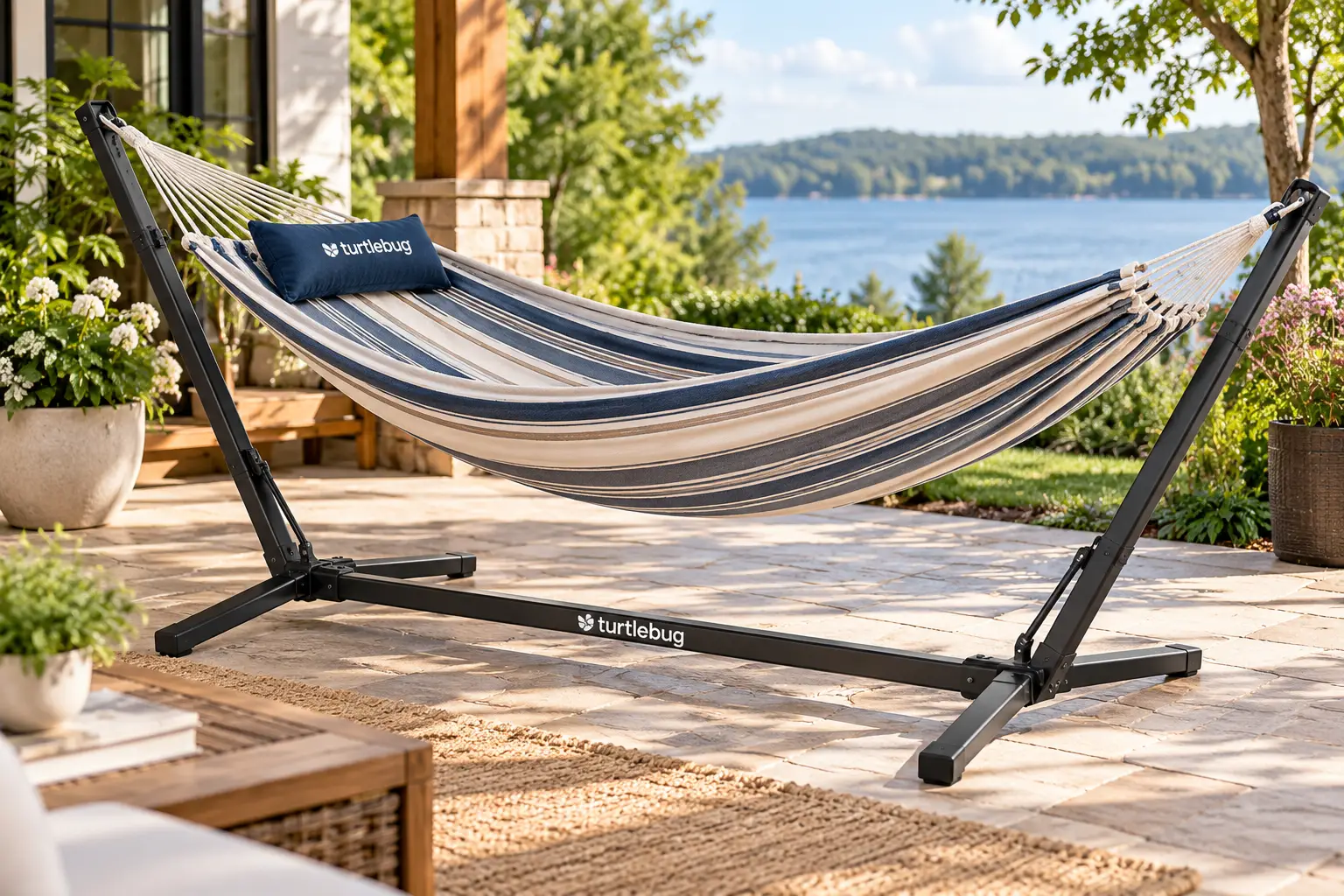
A turtlebug hammock stand is a portable, freestanding hammock frame made by YOBOgear. It uses two shock-corded aluminum tripods joined by a horizontal pole, sets up in about 60 seconds with practice, and lets you hang a hammock anywhere — beaches, deserts, campgrounds, or your living room — without trees.
That definition hides some clever engineering. According to coverage of the original launch, the frame uses 6000-series aluminum alloy tubes with shock cord running through them, joined by glass-reinforced nylon hubs that carry the hammock hooks. Because the cords stay threaded even when folded, the whole stand collapses into a bundle roughly 20 inches long.
The smarter detail is load distribution. Only the two inner legs of each tripod carry your weight and the hammock’s pull; the third outer leg acts as a stabilizing strut. In practice, that means you can shift around without the frame walking or tipping — the same principle that keeps a camera tripod steady on uneven ground.
If you’re new to the gear itself, the history and design of the hammock is worth a quick read: camping hammocks today are longer and more technical than the backyard rope versions most people picture, and that length difference is exactly why stand compatibility matters so much.
YOBOgear originally announced four Turtlebug sizes — Camper, Lounger, Chair, and Mini. The Camper (for overnight camping hammocks) and Lounger (for 9-10 ft recreational hammocks) are the two most relevant for most buyers, so they anchor this guide.
Quick Comparison: Turtlebug Hammock Stand vs. the Competition
| Stand | Weight | Capacity | Hammock Fit | Price Range | Best For |
|---|---|---|---|---|---|
| Turtlebug Camper | ~17.1-17.5 lb | 300 lb | 11-12 ft camping hammocks | Around $400 | Turtlebug Camper: overnight camping without trees |
| Turtlebug Lounger | ~16 lb | 350 lb | 9-10 ft lounging hammocks | $300-$320 | Turtlebug Lounger: beach, patio, RV lounging |
| Kammok Swiftlet | 12.6-15.25 lb (frame) | 300 lb | Lounging hammocks; camping with extension bar | $300-$350 | Kammok Swiftlet: chair-mode versatility |
| Grand Trunk Hangout | 32 lb | 400 lb | Hammocks under 11 ft | Around $250 | Grand Trunk Hangout: car camping on a budget |
| ENO SoloPod | 58-63 lb | 400 lb | Most ENO hammocks | $250-$300 | ENO SoloPod: semi-permanent backyard setup |
| ENO SoloPod XL | 89 lb | 400 lb | Hammocks up to 14’6″ | Around $350 | ENO SoloPod XL: long hammocks, big yards |
| Vivere 9′ Universal Stand | ~30 lb | 450 lb | 9 ft hammocks | Under $100 | Vivere 9′ Universal Stand: lowest-cost entry |
Looking at the table, the split is obvious: the Turtlebug Camper and Turtlebug Lounger win on packability, while the ENO SoloPod and Vivere 9′ Universal Stand win on raw capacity per dollar. If you’ll ever carry your stand more than a few hundred feet, that 40-pound weight gap matters far more than the extra 100 pounds of rated capacity. The Kammok Swiftlet sits in between, trading full overnight capability for a lighter frame and a chair mode.
💬 One click helps other shoppers make an informed choice too! Tap a highlighted stand to check current pricing and availability. 😊
Top 7 Portable Hammock Stands: Expert Analysis
1. Turtlebug Camper Hammock Stand — the tree-free camping benchmark
The Turtlebug Camper Hammock Stand is the flagship of the line and the model most people mean when they search for a turtlebug hammock stand. It’s built specifically for full-length camping hammocks.
Its hammock attachment points sit 129 inches apart and 62 inches off the ground, which is what lets an 11- or 12-foot gathered-end hammock achieve a proper diagonal lay instead of a banana-shaped sag. The footprint is 160 x 44 inches, so plan on a space roughly the size of a one-person tent pad. It also ships with tarp extension poles that accept 11-13 ft rainflies — a genuine differentiator, since most stands leave you improvising rain protection.
On paper, this is the stand for motorcycle, kayak, and bike campers, plus anyone who travels with a hammock and wants to sleep in it in a hotel room. At about 17 pounds, it’s car-camping light, not backpacking light.
On YOBOgear’s own site, the Camper holds a 4.9-out-of-5 average across roughly 190 reviews (store-hosted reviews tend to skew positive, so weigh them accordingly). Reviews consistently praise sub-two-minute setup after a few practice runs; recurring caveats involve staking in wind and fine-tuning the hang for shorter users.
Pros:
- ✅ Sets up in about a minute once practiced
- ✅ Tarp extension poles included for rainfly coverage
- ✅ Fits full 11-12 ft camping hammocks properly
Cons:
- ❌ Must be staked down in gusty conditions
- ❌ Too heavy for most backpacking trips
Priced around $400, it’s the best value if overnight tree-free camping is your main goal.
2. Turtlebug Lounger Hammock Stand — compact lounging for beach and patio
The Turtlebug Lounger Hammock Stand brings the same shake-and-snap design to shorter recreational hammocks, aimed at relaxing rather than sleeping.
It’s rated for 350 pounds — 50 more than the Camper — and weighs about 16 pounds. It packs into a 20 x 10 x 8-inch bag, which is small enough for a car trunk or even a large duffel. YOBOgear lists it as compatible with 9-10 ft lounging hammocks like the Grand Trunk Double, ENO SingleNest and DoubleNest, and Kammok Roo models. An optional UPF 20 sunshade turns it into a shaded beach lounger.
Choose the Turtlebug Lounger if your hammock is a classic parachute-nylon model and your plans involve pools, lake days, picnics, or the backyard. If you ever want to sleep overnight in an 11-footer, skip ahead to the Camper instead.
The Lounger averages 4.7 out of 5 across a smaller pool of 14 reviews on YOBOgear’s site. Owners highlight how much smaller it packs than steel stands, and one reported it held steady in 30+ mph winds. The single negative review described parts coming apart during assembly; the company’s reply attributed it to skipping a cord-stopper step in the setup video.
Pros:
- ✅ Higher 350 lb capacity than the Camper
- ✅ Packs into a small 20-inch bag
- ✅ Works with most mainstream nylon hammocks
Cons:
- ❌ Too short for 11 ft camping hammocks
- ❌ Assembly order matters; watch the video first
At $300-$320, it’s pricey for a lounger, but justified if portability is your priority.
3. Kammok Swiftlet — the versatile chair-and-lounge hybrid
The Kammok Swiftlet is the Turtlebug’s most direct rival, an aluminum stand that doubles as a hammock chair frame.
The frame weighs 12.6-12.9 pounds in short-bar mode and around 15 pounds in long-bar mode, with a total packed weight near 17.5 pounds including the bag. Each arm offers 11 adjustment points, and the patent-pending design switches between chair mode and lounge mode. It folds to roughly 50 x 8.5 x 8.5 inches — longer than the Turtlebug’s 20-inch bundle, which matters if you pack in a motorcycle or small trunk. For camping hammocks of at least 124 inches, Kammok sells a separate extension bar.
Based on comparing the specs, the Kammok Swiftlet is the better pick for people who mostly sit and lounge and only occasionally sleep. The Turtlebug Camper is stronger if overnight lay is the priority. Note that Kammok’s current listings rate it at 300 pounds, while some older reviews cite 400 — trust the current manufacturer figure.
Reviews consistently describe it as intuitive to assemble, with a padded, well-made travel bag. One Turtlebug owner noted the Swiftlet was slightly lighter but required more ridgeline adjustment when switching between trees and stand.
Pros:
- ✅ Chair mode adds real everyday versatility
- ✅ Lightest frame weight in this lineup
- ✅ Eleven adjustment points per arm
Cons:
- ❌ Overnight camping requires a separately sold extension bar
- ❌ 50-inch packed length is awkward for motorcycles
At roughly $300-$350, it offers strong value for lounge-first users.
4. Grand Trunk Hangout Hammock Stand — budget car-camping workhorse
The Grand Trunk Hangout Hammock Stand is the affordable middle ground: portable enough for car camping, cheaper than any aluminum option.
It weighs 32 pounds, holds 400 pounds, and measures 11’6″ long by 4’4″ wide when assembled. Eight steel pieces lock together with push-button pins, so there are no tools, and SectionHiker reported setup in about five minutes. Two 18-inch webbing straps are included, but carabiners are not — budget a few dollars for those.
Honest analysis: the Grand Trunk Hangout officially supports hammocks under 11 feet, but SectionHiker’s hands-on review found that hammocks with whoopie-sling suspensions hang low enough to make an underquilt awkward. That makes it best for simple gathered-end hammocks with continuous loops, not for technical camping setups.
Owner sentiment centers on easy, tool-free assembly and a comfortable shoulder-strap carry bag. The common caveat is ground clearance with longer or stretchier hammocks.
Pros:
- ✅ Tool-free push-pin assembly in minutes
- ✅ Generous 400 lb capacity
- ✅ Carry bag with padded shoulder strap
Cons:
- ❌ Nearly twice the Turtlebug’s weight
- ❌ Hangs low with long camping suspensions
Around $250, it’s the smart pick if you drive to camp and use a basic hammock.
5. ENO SoloPod Hammock Stand — the backyard staple
The ENO SoloPod Hammock Stand is the sculptural steel arc many people picture when they think “hammock stand,” designed more for the yard than the trail.
It’s rated at 400 pounds and measures 10’6″ x 3’1″ x 4’4″. At 58-63 pounds depending on the listing, it’s stable as a rock, and non-slip feet protect decks and patios. It breaks down into eight pieces with quick-release, tool-free construction, and includes stainless steel carabiners. ENO says it can stay outside for extended periods.
The ENO SoloPod suits anyone who wants a semi-permanent backyard or poolside hammock spot. It’s not a travel stand — and it isn’t built for 11-foot camping hammocks, since ENO lists compatibility with its standard nest hammocks rather than its SuperNest or Sky-series models.
At REI, the SoloPod averages 4.6 out of 5 across 84 reviews. Reviewers praise its stability for heavier users and easy entry and exit. The repeated complaint: at about 60 pounds and with no included travel case, moving it is a chore.
Pros:
- ✅ Extremely stable for heavier users
- ✅ Non-slip feet protect patios and decks
- ✅ Stainless carabiners included
Cons:
- ❌ Roughly 60 lb makes transport a chore
- ❌ No carry case included
At $250-$300, it’s a fair price for a long-lasting backyard fixture.
6. ENO SoloPod XL Hammock Stand — maximum hammock compatibility
The ENO SoloPod XL Hammock Stand stretches the SoloPod concept to fit almost any hammock length.
It accepts hammocks up to 14’6″ and includes adjustable chain links, shackles, and stainless steel carabiners for fine-tuning the hang. It’s rated at 400 pounds, measures roughly 15’8″ x 3’8″ x 4’4″, and weighs a hefty 89 pounds. ENO calls it its most universally compatible stand, pairing well with the extra-wide SuperNest.
The ENO SoloPod XL is for people with large yards and long or premium hammocks who never plan to move the stand far. Measure carefully first — this is a long footprint.
REI shows a 4.5-out-of-5 average across 11 reviews. Owners love its comfort and sturdy feel, but one reviewer measured the assembled stand at about 186 inches tip to tip, longer than they expected — a reminder to plan space with margin.
Pros:
- ✅ Fits hammocks up to 14’6″
- ✅ Chain links allow precise hang adjustment
- ✅ Very sturdy with stainless hardware
Cons:
- ❌ 89 lb weight; effectively stationary
- ❌ Huge footprint needs careful measuring
Around $350, it’s justified only if you own a long hammock and a big yard.
7. Vivere 9′ Universal Hammock Stand — the lowest-cost entry point
The Vivere 9′ Universal Hammock Stand is the budget benchmark, widely sold on its own and in hammock combos.
It’s made of powder-coated steel, rated at 450 pounds, and assembles without tools. Combo versions list a footprint of roughly 110 x 47 x 43 inches and weigh around 27-30 pounds. The “space-saving” 9-foot design is specifically sized for 9-foot hammocks — the classic cotton or Brazilian-style double hammock.
Here’s what to weigh: the Vivere 9′ Universal Stand delivers excellent capacity for the money, but its 9-foot frame won’t accommodate 11-foot camping hammocks at all. It’s a patio-relaxation tool, not a camping tool.
Retail reviews for Vivere’s stand-and-hammock combos are generally positive, with owners citing easy assembly and solid two-person stability. Common notes include cotton hammocks stretching over time and the steel frame being heavier than folding portable models.
Pros:
- ✅ Highest weight capacity in this list
- ✅ Tool-free assembly in minutes
- ✅ Lowest price by a wide margin
Cons:
- ❌ Incompatible with long camping hammocks
- ❌ Bulky to transport compared with aluminum stands
Under $100, it’s the best value for casual backyard use.
✨ Don’t miss these tree-free hanging picks!
🔍 Take your hammock time to the next level with this carefully curated lineup. Click a highlighted stand to check current pricing and availability. These picks will help you get relaxing, back-friendly naps the whole family will enjoy!
Turtlebug Camper Hammock Stand vs. Turtlebug Lounger: Which One Fits You?
This is the most common question new buyers face, and it comes down to one measurement: your hammock’s length.
The Turtlebug Camper is designed around 11-12 ft camping hammocks — the kind with structural ridgelines, bug nets, and underquilt compatibility. Its 129-inch hang-point spacing gives those hammocks enough room to sag at roughly the right angle for a flat diagonal lay. It also includes the tarp extension poles, so you get weather protection out of the box.
The Turtlebug Lounger is shorter and sized for 9-10 ft lounging hammocks, the kind most people buy at REI or Walmart for day use. It actually carries more weight (350 lb vs. 300 lb), weighs a bit less, and costs about $90 less.
A simple rule: if you plan to sleep overnight, buy the Turtlebug Camper. If you plan to nap, read, and lounge, buy the Turtlebug Lounger. Buying the Lounger to “save money” and then hanging a camping hammock in it is a recipe for a hammock that bottoms out or can’t tension properly.
One more consideration: YOBOgear sells a Turtlebug Bridge Kit that adapts the Turtlebug Camper for bridge hammocks. Owners report it works, though it takes some creativity with strap configuration. If you own a bridge hammock, the Camper is your only Turtlebug option.
Full Spec Comparison of the Top 7 Stands
| Stand | Frame Material | Packed Size | Setup Time | Hang Style | Best For |
|---|---|---|---|---|---|
| Turtlebug Camper | 6000-series aluminum | ~20″ long bag | ~60 sec (practiced) | Overnight camping | Turtlebug Camper: moto, kayak, desert camping |
| Turtlebug Lounger | Aluminum | 20″ x 10″ x 8″ | ~60 sec (practiced) | Lounging | Turtlebug Lounger: travel lounging |
| Kammok Swiftlet | Aluminum + UV-treated nylon | ~50″ x 8.5″ x 8.5″ | A few minutes | Chair + lounge | Kammok Swiftlet: sitting and lounging |
| Grand Trunk Hangout | Steel | Duffel-style bag | ~5 min | Lounging, light camping | Grand Trunk Hangout: drive-up camps |
| ENO SoloPod | Powder-coated steel | 8 pieces, no case | Several minutes | Backyard lounging | ENO SoloPod: permanent patio spot |
| ENO SoloPod XL | Powder-coated steel | 72″ x 13″ x 8.5″ | Several minutes | Long hammocks | ENO SoloPod XL: SuperNest owners |
| Vivere 9′ Universal Stand | Powder-coated steel | Carry case | Minutes, tool-free | Backyard lounging | Vivere 9′ Universal Stand: budget patios |
The pattern is clear: aluminum and shock cord buy you speed and packability, while steel buys you capacity and permanence. The Turtlebug Camper is the only stand here that combines true camping-hammock length with a 20-inch packed size. If your stand will live in one spot, the ENO SoloPod or Vivere 9′ Universal Stand gives you more stability for less money.
How to Set Up Your Turtlebug Hammock Stand (and Avoid First-Month Mistakes)
The Turtlebug’s 60-second claim is real, but only after practice. Here’s a practical routine that owners and YOBOgear’s own guidance point toward.
🏠 Step 1: Practice at home first
Do your first two or three setups in the yard or living room. Owners repeatedly say setup time drops dramatically after a few tries, and packing it back into the bag is the trickier half at first.
🎥 Step 2: Watch the official video before touching it
The Lounger’s lone one-star review came from assembly done out of order. Follow the sequence, including removing the cord stoppers when instructed.
⚓ Step 3: Stake the frame before adding fabric
This is the single biggest tip. YOBOgear advises staking the stand down before attaching the hammock or tarp. A tarp turns the frame into a sail; one owner described his unstaked stand acting like “a giant sail” in an ocean breeze.
🔩 Step 4: Bring real stakes, not ultralight pegs
One owner found backpacking-size stakes useless in hard soil and switched to spikes and a hammer.
🧭 Step 5: Point into the wind
A freestanding frame lets you orient your hammock and tarp to the weather instead of to the trees — a real advantage on open ground.
🧼 Step 6: Maintain it simply
Wipe sand and grit off the poles and hubs after beach or desert trips, dry it before storing, and inspect the shock cord tension each season. YOBOgear sells spare parts, so worn components are replaceable rather than fatal.
Wherever you set up, follow Leave No Trace’s hammock camping guidelines — a stand removes the tree-damage concern, but campsite selection and durable surfaces still matter.
Real-World Scenarios: Matching the Right Stand to the Right Camper
Specs only matter in context. Here are four realistic buyer profiles and the stand that fits each best.
🏍️ The motorcycle camper
You ride 300 miles a day and camp wherever the road ends. Space on the bike is precious, and trees are never guaranteed. Best fit: Turtlebug Camper. Its 20-inch bundle straps to a rack, it handles your 11-foot hammock, and the tarp poles mean you can leave the “just in case” tent at home — something several owners say they’ve done.
🏖️ The beach-and-pool family
You want a lounge spot for weekends at the lake, and the kids will pile in. Budget is flexible, but trunk space isn’t. Best fit: Turtlebug Lounger. The 350-pound rating and optional sunshade fit family use, and it packs small enough to share the trunk with coolers.
🏡 The backyard relaxer
You have a patio, no suitable trees, and no plans to move the stand. Best fit: ENO SoloPod if you want a premium, stable fixture, or the Vivere 9′ Universal Stand if you’d rather spend under $100.
🏕️ The weekend car camper on a budget
You drive straight to the site and use a basic gathered-end hammock. Best fit: Grand Trunk Hangout. It costs far less than aluminum options and the extra weight doesn’t matter when the car is 20 feet away.
The common thread: how far you carry the stand determines how much you should pay for lightness. If the answer is “never more than the driveway,” steel wins on value.
Problem → Solution: Fixing the Most Common Hammock Stand Headaches
❗ Problem: The stand tips or walks in the wind
Solution: Stake every foot before attaching fabric, and add guylines in exposed spots. With the Turtlebug Camper, owners report it holds up well in 25-30 mph gusts once anchored.
❗ Problem: The ridgeline feels slack
Solution: One owner noted that the ridgeline isn’t as taut on the stand as between trees. YOBOgear recommends adjusting suspension and offers model-specific advice; a whoopie sling ridgeline makes tensioning easier than fiddling with carabiners.
❗ Problem: You’re hanging too high to get out
Solution: Shorter users sometimes find a good lay puts them too high. One 5’1″ owner solved this by switching to cinch-buckle suspension and lowering the head end, achieving one of the best diagonal lays she’d experienced.
❗ Problem: Webbing straps slip on the hooks
Solution: Wide straps can feel insecure on hub hooks. Thinner dyneema daisy chains or continuous loops grip better.
❗ Problem: Hammock hangs too low on a steel stand
Solution: On stands like the Grand Trunk Hangout, extra suspension length eats ground clearance. Clip continuous loops directly to the stand with carabiners instead of adding whoopie slings.
❗ Problem: Tarp attachment feels fiddly
Solution: One owner added stainless split rings to the Turtlebug tarp pole tips so micro-carabiners clip on securely. Small mods like this are common and reversible.
How to Choose a Turtlebug Hammock Stand (or Any Portable Stand)
- Measure your hammock first. An 11-12 ft camping hammock needs the Turtlebug Camper or an extended frame; 9-10 ft lounging hammocks fit the Turtlebug Lounger and most steel stands.
- Decide how far you’ll carry it. Under 20 pounds matters for motorcycles, kayaks, and walk-in sites; it barely matters for a backyard.
- Check weight capacity against real use. Include gear, kids climbing in, and the dynamic load of flopping into the hammock — not just your body weight.
- Consider packed length, not just weight. A 20-inch bundle and a 50-inch bag weigh about the same but fit very differently in a car or on a bike.
- Factor in weather protection. If you’ll camp overnight, included tarp poles (like the Camper’s) save you from improvising rain cover.
- Plan your footprint. Measure the space, then add margin; long stands like the ENO SoloPod XL surprise people.
- Check where you’ll use it. Many parks restrict tree attachment, and some, like the National Park Service’s Rock Creek Park, encourage free-standing hammock frames in open grassy areas instead of trees. That’s a strong argument for a stand if you visit managed parks often.
Portable Aluminum Stands vs. Traditional Steel Hammock Stands
| Factor | Portable Aluminum (Turtlebug, Swiftlet) | Traditional Steel (ENO, Vivere, Grand Trunk) | Best For |
|---|---|---|---|
| Weight | ~13-18 lb | ~27-89 lb | Aluminum: anyone who carries gear |
| Packed size | 20-50″ bundles | Long tubes, often no case | Aluminum: small vehicles |
| Capacity | 300-350 lb | 400-450 lb | Steel: heavier users, two adults |
| Setup | ~1-3 minutes | ~5+ minutes | Aluminum: frequent movers |
| Price | ~$300-$400 | Under $100-$350 | Steel: tight budgets |
The tradeoff is consistent across every product here. Aluminum stands like the Turtlebug Camper and Kammok Swiftlet cost more because they solve a portability problem steel can’t. Steel stands like the ENO SoloPod and Vivere 9′ Universal Stand cost less and hold more, but they assume you’re staying put.
In written terms, think of steel stands as patio furniture and aluminum stands as camping gear. A steel stand left outdoors can last years with powder coating, but you’ll rarely move it. An aluminum stand earns its price every time you load it into a car, strap it to a motorcycle, or carry it from the parking lot to a beach. If you’re torn, ask yourself honestly how many times a year the stand will leave your yard. If it’s fewer than three, steel is likely the better value.
Long-Term Cost and Value of a Turtlebug Hammock Stand
| Stand | Upfront Range | Likely Add-Ons | Durability Notes | Best For |
|---|---|---|---|---|
| Turtlebug Camper | Around $400 | Stakes, thinner straps | Spare parts sold individually | Turtlebug Camper: frequent travelers |
| Turtlebug Lounger | $300-$320 | Sunshade, stakes | Spare parts sold individually | Turtlebug Lounger: lounge-first users |
| Kammok Swiftlet | $300-$350 | Extension bar for camping | Backed by Kammok lifetime guarantee | Kammok Swiftlet: long-term chair use |
| Vivere 9′ Universal Stand | Under $100 | Carabiners, hammock | 1-year limited warranty | Vivere 9′ Universal Stand: occasional use |
The real cost of a turtlebug hammock stand isn’t just the sticker price. Budget for sturdy stakes and possibly thinner suspension straps. The good news is that YOBOgear sells individual spare parts — hubs, cables, tarp kits — so a broken component doesn’t mean replacing the whole stand. Kammok backs the Kammok Swiftlet with a lifetime guarantee, which is a strong long-term argument in its favor.
Consider the cost-per-use math. A stand used 30 nights a year for five years works out to under $3 per night for the Turtlebug Camper — less than most campground firewood bundles. A Vivere 9′ Universal Stand used only a few summer weekends may cost more per use than you’d expect once you factor in replacing a weathered cotton hammock.
Features That Actually Matter (and Ones That Don’t)
✅ Features that matter
- Hang-point spacing and height. This determines whether your hammock lays flat or folds you like a taco. The Turtlebug Camper‘s 129-inch spacing exists for a reason.
- Packed dimensions. A short bundle beats a light-but-long bag in most vehicles.
- Included weather protection. Tarp poles are a big deal for overnight use.
- Spare-parts availability. Shock-corded designs have wear points; replaceable parts extend lifespan.
❌ Features that matter less than marketing suggests
- Maximum capacity beyond your needs. A 450 lb rating doesn’t make a stand “better” for a 170 lb solo user.
- Exact setup seconds. Whether it’s 37 or 90 seconds hardly matters; what matters is that it’s simple and repeatable.
- Steel vs. aluminum strength debates. Both are safe within their rated limits. The real difference is weight and portability.
The smartest buyers focus on fit and transport first, then capacity — not the other way around.
Common Mistakes to Avoid When Buying a Portable Hammock Stand
Mistake 1: Ignoring hammock length. The most common error by far. Buying a 9-foot steel stand for an 11-foot camping hammock simply won’t work.
Mistake 2: Skipping the stakes. Freestanding doesn’t mean wind-proof. Every lightweight stand needs anchoring when a tarp is involved.
Mistake 3: Buying for capacity instead of carry. A 60-pound stand you never take anywhere is worth less than a 17-pound one you use every trip.
Mistake 4: Forgetting carabiners and suspension. Several stands don’t include carabiners; the Grand Trunk Hangout is one of them.
Mistake 5: Not measuring the space. Long stands need more room than spec sheets suggest — measure tip to tip with margin.
Mistake 6: Expecting perfect lay on day one. Owners consistently say getting the hang dialed in takes a few adjustments. Treat the first week as tuning time.
Mistake 7: Assuming every Amazon listing is authentic. For niche brands like YOBOgear, confirm the seller and listing details, or compare against the manufacturer’s site before purchasing.
Safety, Regulations, and Where You Can Use a Hammock Stand
Hammock rules on public land vary widely, and that’s a major reason freestanding stands are growing in popularity. Some national parks don’t allow attaching hammocks to trees or vegetation at all, while others allow hammocks only within designated campsites. Many state parks set their own requirements — for example, Wisconsin DNR’s hammock rules limit overnight hammock use to designated campsites and dispersed camping areas. Always check the specific park’s rules before you go.
A stand doesn’t automatically exempt you from rules, but it does remove the tree-damage concern that drives most restrictions. Several Turtlebug owners specifically mention using their stands where tree attachment isn’t allowed.
🛡️ Practical safety checklist
- Respect the rated capacity. 300 lb for the Turtlebug Camper, 350 lb for the Turtlebug Lounger, 400 lb for the ENO SoloPod — and remember that dropping into a hammock creates momentary loads above body weight.
- Inspect before each use. Check hubs, shock cords, cables, and carabiners for wear or cracks.
- Use rated carabiners. Climbing-rated or manufacturer-supplied hardware only — never hardware-store keychain clips.
- Supervise kids. Children swinging aggressively stress frames more than adults lying still.
- Watch for heat. Dark aluminum and steel can get very hot in direct summer sun.
Treat your stand like any load-bearing gear: follow the instructions, stay within its rating, and replace worn parts promptly.
FAQ: Turtlebug Hammock Stand Questions Answered
❓ Where can I buy a turtlebug hammock stand?
❓ Is the turtlebug hammock stand worth the price?
❓ Can two people use a Turtlebug hammock stand?
❓ Does the turtlebug hammock stand work with a bridge hammock?
❓ Can I use a turtlebug hammock stand indoors?
Conclusion: Is the Turtlebug Hammock Stand Right for You?
The turtlebug hammock stand earns its reputation honestly. It solves a real problem — hammocking where trees don’t cooperate — with a clever shock-corded aluminum design, a genuinely compact packed size, and strong owner satisfaction. The Turtlebug Camper is the standout choice for motorcycle, kayak, bike, and desert campers who want to sleep in a full-length hammock anywhere. The Turtlebug Lounger brings that portability to beach days and patios at a lower price.
It isn’t for everyone, though. If you want chair-mode flexibility, the Kammok Swiftlet deserves a close look. If you drive to camp and use a simple hammock, the Grand Trunk Hangout saves money. And if your hammock will live permanently in the backyard, the ENO SoloPod, ENO SoloPod XL, or budget-friendly Vivere 9′ Universal Stand deliver more capacity per dollar.
The decision really comes down to three questions: How long is your hammock? How far will you carry the stand? And how often will it leave home? Answer those honestly, and the right pick becomes obvious. Whichever you choose, practice setup at home, bring real stakes, and check park rules before you go — then enjoy the freedom of hanging wherever the view is best.
🌟 Ready to hang anywhere, no trees required?
🛒 Click any highlighted stand above to check current pricing and availability, and pick the one that matches your hammock and your adventures. Your back — and your next campsite — will thank you!
Recommended for You
- Triangle Camping Hammock: 7 Best Picks That Won’t Sag (2026)
- Tarp with Doors: 7 Best Storm-Proof Picks Worth Buying in 2026
- Rain Fly Camping: 7 Best Tarps That Keep You Dry in 2026
Disclaimer: This post contains affiliate links. As an Amazon Associate, I earn from qualifying purchases made through these links, at no additional cost to you.
✨ Found this article helpful? Share it with someone who needs it! 💬🤗