
In This Article
Why a Tarp with Doors Is the Upgrade Your Hammock Has Been Waiting For
It’s 3 a.m., the wind swings around, and suddenly rain is blowing sideways under your shelter. That’s the exact moment a tarp with doors earns its keep. A standard rain fly protects you from what falls straight down; a tarp with doors also blocks what blows in from the ends: the spray, the gusts, and the cold drafts that sneak across your quilt and steal heat all night long.
Here’s the good news for 2026: you don’t need a months-long custom order from a cottage brand to get that protection. Several door-equipped tarps are sold on amazon.com, from featherweight silnylon shelters in the $80 to $100 range, to budget polyester flies, all the way up to a fully zippered tarp tent. The catch? Nearly every listing promises “4-season” or “storm-proof” performance, and the spec sheets rarely explain what those numbers mean once you’re actually hanging between two trees.
That’s what this guide is for. We compared real spec sheets, read through aggregated customer feedback, and translated fabric weights, waterproof ratings, and door designs into plain-English advice. You won’t find invented test reports here, just honest analysis of what each design is likely to do for you, who it suits, and where it falls short.
What Is a Tarp with Doors?
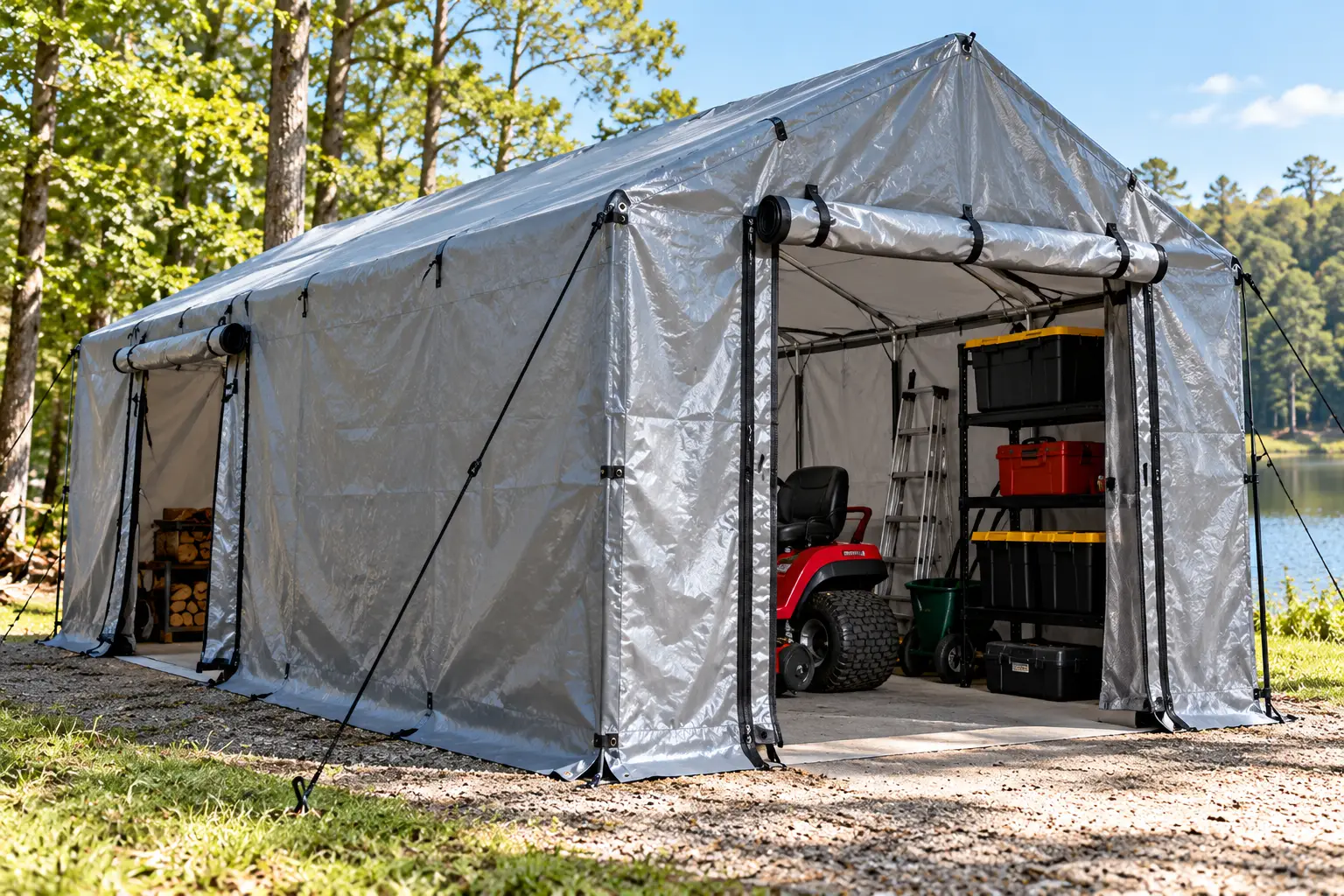
A tarp with doors is a hammock or camping tarp with extra fabric panels at each end that fold inward to close off the open sides. Stowed, the panels leave a breezy, open “porch”; closed, they block wind and driving rain, turning a simple tarpaulin shelter into something close to a lightweight tent.
Quick Comparison: 7 Tarp with Doors Picks at a Glance
| Product | Fabric & Waterproof Rating | Approx. Weight | Price Range | Best For |
|---|---|---|---|---|
| Onewind 12×10 ft Silnylon Hammock Tarp | 20D silnylon, 4000mm | ~1.8 lb (tarp only) | ~$80–$100 | Onewind 12×10 ft Silnylon Hammock Tarp: best all-around value |
| ENO HouseFly Rain Tarp | 30D silnylon, 1000mm PU | 29 oz | ~$130–$170 | ENO HouseFly Rain Tarp: brand-name full coverage |
| Onewind Blackthorn Zippered Tarp | 1.1 oz silnylon, 3000mm | Check listing | ~$150–$190 | Onewind Blackthorn Zippered Tarp: tent-like enclosure |
| Onewind 12ft Camo Camping Tarp | 20D silnylon | ~1.96 lb | ~$80–$110 | Onewind 12ft Camo Camping Tarp: stealth and hunting camps |
| Sunyear Small Door Hammock Rain Fly | 210D Oxford, PU3000 | Check listing | ~$35–$60 | Sunyear Small Door Hammock Rain Fly: first-time hammockers |
| Travel Bird 14ft Rain Fly | 210T polyester, PU2000 | Check listing | ~$50–$90 | Travel Bird 14ft Rain Fly: groups and camp kitchens |
| Travel Bird Hammock Rain Fly with Doors | 210T polyester, PU2000 | ~1.4 lb | Under ~$50 | Travel Bird Hammock Rain Fly with Doors: tight budgets, mild weather |
Prices are approximate ranges at the time of writing and change often. Check the current price on Amazon.
Looking at the table above, the Onewind 12×10 ft Silnylon Hammock Tarp hits the sweet spot: silnylon fabric, a high 4000mm rating, and full doors for less than many brand-name tarps without doors. If you already own an ENO hammock and want plug-and-play compatibility with excellent coverage, the ENO HouseFly Rain Tarp justifies its higher price through build details like taped seams and a 10-point anchor system.
On the budget end, the Sunyear Small Door Hammock Rain Fly and the Travel Bird Hammock Rain Fly with Doors trade weight and fabric refinement for a much lower entry price, which makes them reasonable for backyard naps, festivals, and fair-weather weekends. Meanwhile, the Onewind Blackthorn Zippered Tarp is a different animal altogether: zippered doors give it a near-tent seal, but you pay for that in price and complexity.
One quick reality check before you scroll: waterproof ratings aren’t directly comparable across coating types. A 1000mm silnylon with taped seams can outperform a 3000mm polyester with leaky stitching, so read the product notes below rather than shopping by the biggest number.
💬 One click helps other shoppers make an informed choice too! 😊
Top 7 Tarps with Doors: Expert Analysis
Each pick below is a real product available (or orderable) on amazon.com. We looked at manufacturer specs, retailer listings, and aggregated review sentiment. Where reliable review data was thin, we say so plainly instead of filling the gap with guesses.
1. Onewind 12×10 ft Silnylon Hammock Tarp — best all-around value with doors
This is the tarp that made door-equipped shelters affordable without pushing you into heavy polyester.
The fabric is 1.1 oz 20D ripstop silnylon with a silicone/PU coating rated at 4000mm, which in practice means it’s built to shed a long, soaking downpour rather than just a passing shower. At roughly 1.8 lb for the tarp alone (the full kit with stakes and lines is listed around 2.2 lb), it’s light enough for backpacking. The overlapping door system, 11 tie-outs, and 4 panel pull-outs give you real pitching flexibility: storm mode, porch mode, or a half-open A-frame.
Who’s it for? Based on comparing the specs, this is the natural first “serious” tarp for hammock campers moving up from a kit fly. You get winter-tarp coverage at a three-season weight. What most buyers overlook: silnylon stretches slightly when wet, so plan to re-tension your guylines about an hour into steady rain.
Reviews consistently report that closing the doors keeps campers dry during heavy, wind-driven rain, and repeat buyers frequently praise the build quality for the money. A recurring caution is that the thin fabric demands care around stakes and sharp branches.
Pros:
- ✅ Silnylon with doors at a mid-range price
- ✅ Generous tie-outs for flexible storm pitches
- ✅ Complete kit with reflective guylines and stakes
Cons:
- ❌ Thin fabric punctures if staked carelessly
- ❌ Sags slightly when wet and needs re-tensioning
At around $80 to $100 at the time of writing, it’s exceptional value for a silnylon tarp with full doors.
2. ENO HouseFly Rain Tarp — the most coverage in ENO’s lineup
The ENO HouseFly Rain Tarp turns ENO’s familiar hammock ecosystem into a near-enclosed shelter.
It measures 10’8″ × 8’10” and weighs 29 oz, using 30D silicone-impregnated nylon with a 1000mm PU coating, double-stitched and taped seams, and a 10-point anchor system with knotless tensioners. The 1000mm figure looks modest next to budget polyester claims, but taped seams matter more than headline numbers, since stitching is where most tarps actually leak. The overlapping doors clip back with small buckles, so they don’t flap around in porch mode.
The ENO HouseFly Rain Tarp makes the most sense for ENO hammock owners, car campers, and backpackers who value brand support over grams. One practical bonus a reviewer highlighted: you can change clothes standing up with real privacy. Heads up on stakes: ENO’s own page lists 8 aluminum stakes included, while some retailers say stakes are sold separately, so confirm on your listing.
REI reviewers report staying dry through multiple days of steady rain and appreciate the reflective cords at night. Common critiques: one buyer wished it were a foot longer for gear, another wanted hook-and-loop door closures, and several call it overkill for summer weight-wise.
Pros:
- ✅ Taped seams and a 10-point anchor system
- ✅ Doors stow neatly with built-in buckles
- ✅ Huge coverage that fits most ENO setups
Cons:
- ❌ Heavier than ENO’s own ProFly for summer
- ❌ Doors lack a quick hook-and-loop closure
Typically between $130 and $170 (prices may vary), it’s a fair price for a polished, brand-backed shelter.
3. Onewind Blackthorn Zippered Tarp — zippered doors for a tent-like seal
If overlapping flaps feel too drafty, the Onewind Blackthorn Zippered Tarp replaces them with real zippers.
It’s made from 1.1 oz silnylon ripstop with a 3000mm waterproof rating, covers about 102″ × 94″ on the ground, and packs down to roughly 17.7″ × 4.7″. The listing also notes fire-retardant fabric and compatibility with bridge hammocks as well as ground setups. In practice, zippers seal the ends more completely than overlapping panels, and you can get in and out faster on a cold night.
On paper, this suits campers who want tent-like privacy without carrying a tent: bridge hammock users, bivy sleepers, and anyone camping where wind funnels through the trees. Here’s what to weigh, though. A zipper is a failure point that a flap simply doesn’t have, and a sealed shelter traps more moisture, so condensation management becomes your job. Crack a door or pitch one end higher on still, humid nights.
Honestly, we couldn’t verify a substantial body of US customer reviews for this specific model at the time of writing. The brand’s other tarps draw consistently positive feedback, but treat the Onewind Blackthorn Zippered Tarp as the less proven design on this list.
Pros:
- ✅ Zippered doors seal tighter than overlapping flaps
- ✅ Works over bridge hammocks or ground beds
- ✅ Silnylon keeps it packable for its size
Cons:
- ❌ Zippers add a potential failure point
- ❌ Limited verifiable review history so far
Expect roughly $150 to $190; worth it only if you specifically want zippered closure.
4. Onewind 12ft Camo Camping Tarp — stealth pattern for hunters and bushcrafters
The Onewind 12ft Camo Camping Tarp takes the same proven 12-foot silnylon platform and wraps it in a low-visibility pattern.
It uses 1.1 oz 20D ripstop silnylon, measures 144″ × 116.4″, and is listed at about 1.96 lb. The kit includes 4 aluminum stakes, six 10-foot reflective guylines, adjusters, carabiners with door cordage already attached, and a double-ended stuff sack. That pre-rigged door cordage is a small detail that saves real fumbling when you’re closing up in the dark.
Who should pick camo over solid colors? Hunters on late-season sits, bushcrafters, and dispersed campers who want to blend into the tree line instead of advertising their site. One trade-off worth noting: the reflective guylines partly defeat the stealth purpose, so swap them for non-reflective cord if visibility truly matters, and accept a higher trip-hazard risk at night.
Reviewers describe closing the side doors to create a cozy, almost tent-like space, and they frequently praise the included hardware and ease of pitching. The review pool is smaller than the flagship model’s, but the sentiment we could find was consistently positive.
Pros:
- ✅ Camo pattern blends into wooded campsites
- ✅ Door cordage arrives pre-attached and ready
- ✅ Same proven silnylon platform as the flagship
Cons:
- ❌ Reflective guylines undercut the stealth look
- ❌ Slightly heavier than the solid-color version
Around $80 to $110 at the time of writing, it’s a smart buy if camouflage genuinely matters to you.
5. Sunyear Small Door Hammock Rain Fly — beginner-friendly kit with a long ridgeline
The Sunyear Small Door Hammock Rain Fly is built for people who want everything in one bag and a short learning curve.
It’s made from 210D Oxford polyester with a PU3000 coating and measures roughly 9.8 × 9.5 ft (some listings say 10 × 9.6 ft). The kit includes a 32-foot ridgeline, six reflective guylines, 4 aluminum stakes, and two stuff sacks. 210D Oxford resists abrasion far better than 20D silnylon, so it shrugs off bark and rocky ground, but it’s noticeably bulkier in a pack. The “small doors” are partial end panels: think wind deflectors rather than a full storm seal.
Based on the specs, this is the right call for first-time hammock campers, scouts, and car campers who’d rather spend money on a good underquilt than on ultralight fabric. What the spec sheet doesn’t say: PU coatings slowly break down with UV exposure and heat, so store it dry and out of the sun between trips.
Aggregated reviews include buyers who stayed dry through severe storms, and several recommend it specifically for anyone trying hammock camping for the first time.
Pros:
- ✅ Tough 210D Oxford resists everyday abrasion
- ✅ Long ridgeline and full hardware included
- ✅ Low entry price for a door-equipped fly
Cons:
- ❌ Small doors give only partial end coverage
- ❌ Bulkier and heavier than silnylon options
At roughly $35 to $60, it’s strong value for beginners and car-camping trips.
6. Travel Bird 14ft Rain Fly — biggest coverage for groups and camp kitchens
The Travel Bird 14ft Rain Fly is less about a solo hammock and more about covering a whole campsite.
It uses 210T polyester with a PU2000 coating, delivers roughly 14 × 12 ft of coverage, and, per its listings, comes with dual support poles. Those poles are the real story: they let you pitch a porch over a picnic table or a ground shelter where there are no trees. A PU2000 rating is adequate for moderate rain, though sustained storms will test the seams more than the fabric itself.
Here’s what to weigh if you’re thinking of using it solo. A very long ridgeline sits high above a single hammock, which reduces side protection in blowing rain, a point experienced hangers often raise about oversized tarps. So we’d frame the Travel Bird 14ft Rain Fly as a family and group shelter, a camp-kitchen roof, or a canopy for two hammocks side by side.
We couldn’t verify a meaningful volume of US reviews for this exact listing at the time of writing, so long-term durability remains an open question. Seam-sealing it before your first trip is cheap insurance.
Pros:
- ✅ Huge footprint covers tables or two hammocks
- ✅ Included poles enable treeless pitches
- ✅ Doors help block wind at group sites
Cons:
- ❌ Too large for a tight solo storm pitch
- ❌ Limited verifiable review data so far
In the $50 to $90 range, it’s a solid value as a group canopy rather than a solo shelter.
7. Travel Bird Hammock Rain Fly with Doors — lightest budget pick with door panels
The Travel Bird Hammock Rain Fly with Doors is the cheapest way on this list to find out whether you actually like hammock doors.
It’s made from 210T polyester with a PU2000 coating plus a silver UV-reflective layer, and it’s listed at about 1.4 lb. That silver coating isn’t just marketing: it reflects sunlight, which keeps the space underneath noticeably cooler during summer afternoon naps. At 1.4 lb, it’s also surprisingly light for polyester at this price.
This fly makes sense for summer hammockers, festival-goers, and backyard loungers who want shade and light-rain protection with the option to close an end against a breeze. However, budget tarps have a known weak point. In one Reddit hammock-camping thread, a first-timer described a cheap Amazon tarp tearing at its grommets in strong winds. Adding shock-cord tensioners to your guylines and pitching low in gusts are your best defenses.
We couldn’t verify a substantial body of US reviews for this specific model, so we’d treat it as a fair-weather tool, not a storm shelter.
Pros:
- ✅ Lowest price of any pick with doors
- ✅ Silver coating keeps summer shade cooler
- ✅ Light enough for casual backpacking trips
Cons:
- ❌ PU2000 polyester struggles in sustained storms
- ❌ Tie-out durability is unproven in high winds
Usually under $50, it’s a sensible low-risk entry point, as long as you keep expectations modest.
Side-by-Side Spec Comparison
| Product | Door Style | Coverage | Fabric Type | Review Sentiment | Best For |
|---|---|---|---|---|---|
| Onewind 12×10 ft Silnylon Hammock Tarp | Overlapping flaps | 12 × 10 ft | Silnylon | Strongly positive | Onewind 12×10 ft Silnylon Hammock Tarp: three-season backpacking |
| ENO HouseFly Rain Tarp | Overlapping, buckle-stowed | 10’8″ × 8’10” | Silnylon + PU | Strongly positive | ENO HouseFly Rain Tarp: ENO owners |
| Onewind Blackthorn Zippered Tarp | Zippered | ~102″ × 94″ footprint | Silnylon | Limited data | Onewind Blackthorn Zippered Tarp: tent-like privacy |
| Onewind 12ft Camo Camping Tarp | Overlapping flaps | 144″ × 116.4″ | Silnylon | Positive, smaller pool | Onewind 12ft Camo Camping Tarp: hunting camps |
| Sunyear Small Door Hammock Rain Fly | Partial end panels | ~9.8 × 9.5 ft | 210D Oxford | Positive | Sunyear Small Door Hammock Rain Fly: beginners |
| Travel Bird 14ft Rain Fly | End panels + poles | ~14 × 12 ft | 210T polyester | Limited data | Travel Bird 14ft Rain Fly: group sites |
| Travel Bird Hammock Rain Fly with Doors | End panels | Check listing | 210T polyester | Limited data | Travel Bird Hammock Rain Fly with Doors: summer shade |
The pattern here is clear: silnylon models with full overlapping doors (the Onewind 12×10 ft Silnylon Hammock Tarp and ENO HouseFly Rain Tarp) have the deepest, most consistent review support. Polyester models cost less and handle abrasion well, but their review histories are thinner, so you’re accepting more uncertainty. If you camp in genuinely bad weather, that uncertainty is the hidden cost of the lower price.
✨ Don’t miss these storm-ready picks!
🔍 Take your hammock camping to the next level with this carefully curated lineup. Click a highlighted item to check current pricing and availability. These picks will help you stay dry, warm, and comfortable on every trip, whatever the forecast says!
How to Pitch a Hammock Tarp with Doors: Your First 30 Days
A hammock tarp with doors has more moving parts than a simple rain fly, so a little practice before your first stormy night pays off. Here’s a realistic first-month plan.
Week 1: Backyard rehearsal. Pitch the tarp at least three times at home, in daylight, with no time pressure. Learn which tie-outs belong to the doors and which belong to the side panels; on the Onewind 12×10 ft Silnylon Hammock Tarp, the pre-attached door cordage makes this easier.
Week 2: Get the order right. Hang the ridgeline first, then the tarp, then the hammock. Pitching the tarp first means you can set up your bed in the dry if the sky opens mid-setup.
Week 3: Practice storm mode. Lower the ridgeline until the side panels sit close to the ground, then fold each door inward so the two halves overlap. Crisscross the door lines to your corner stakes, as owners of the ENO HouseFly Rain Tarp often describe, so gusts can’t peel them apart.
Week 4: First overnight. Choose a forecast with light rain, not a storm. Check tension before bed and again around midnight, since nylon fabrics relax as they get wet.
Common first-month mistakes to avoid:
- ✅ Forgetting drip lines on your hammock suspension, which wick water inside
- ✅ Over-tightening the doors so the seams strain
- ✅ Packing the tarp wet and leaving it in the trunk for a week
Real-World Scenarios: Which Rain Fly with Doors Fits Your Trip?
Specs only tell half the story. Matching a rain fly with doors to how you actually camp tells the rest.
Profile 1: The weekend section hiker
You hike 8 to 12 miles a day on Appalachian Trail sections, mostly spring through fall, with a total shelter budget near $100. Choose the Onewind 12×10 ft Silnylon Hammock Tarp. The weight keeps your pack reasonable, and the full doors cover you when a ridge-top storm rolls in at night. Pair it with a lightweight snakeskin sleeve for faster pack-up.
Profile 2: The family car camper
You camp at state parks six or seven weekends a year with two kids, a picnic table, and a pile of gear. Choose the Travel Bird 14ft Rain Fly as a camp-kitchen roof, plus the Sunyear Small Door Hammock Rain Fly for a kid’s hammock. Weight doesn’t matter when the trunk is five steps away, but coverage and toughness do.
Profile 3: The late-season hunter
You spend cold November mornings in the woods and want a warm, hidden base. Choose the Onewind 12ft Camo Camping Tarp for stealth, or the Onewind Blackthorn Zippered Tarp if you want zippered doors to lock out wind. Either way, pitch low and close both ends.
Profile 4: The ENO loyalist
You already own an ENO hammock, bug net, and straps. The ENO HouseFly Rain Tarp slots right into that system, and brand support makes warranty questions simpler.
Problem → Solution: Fixing the 5 Most Common Tarp Headaches
Even the best tarp with doors misbehaves sometimes. Here’s how to fix the problems campers report most often.
- The tarp sags overnight. Silnylon stretches when wet. Add small shock-cord loops to your tie-outs, or simply re-tension before bed. This matters most on the Onewind 12×10 ft Silnylon Hammock Tarp and ENO HouseFly Rain Tarp.
- Water runs down the straps into the hammock. Tie a short drip line (a scrap of cord or a twist of bandana) on each suspension strap just inside the tarp’s edge. The water drips off before it reaches your bed.
- Doors flap or blow open. Crisscross the door guylines to opposite stakes, or add a small clip or clothespin where the panels overlap. A reviewer of the ENO HouseFly Rain Tarp wished for hook-and-loop tabs, and adding your own is a common owner fix.
- Condensation drips on you. Closed doors trap moist air. Leave one door slightly open, pitch the downwind end higher, and avoid camping in the lowest, dampest spot of a valley.
- Grommets or tie-outs tear in wind. This is the classic budget-tarp failure. On the Travel Bird Hammock Rain Fly with Doors or Sunyear Small Door Hammock Rain Fly, add shock cord to absorb gust loads, pitch lower in exposed sites, and never use the tarp as a windbreak in open fields.
How to Choose a Tarp with Doors
The right tarp with doors depends on where you camp, how you carry it, and how bad the weather gets. Work through these seven steps in order.
- Match the ridgeline to your hammock. Most gathered-end hammocks need an 11- to 12-foot ridgeline. Shorter leaves your ends exposed; much longer sits high and loses side protection.
- Decide between silnylon and polyester. Silnylon is lighter and packs smaller but stretches when wet. Polyester stretches less and costs less, but it’s heavier at the same coverage.
- Read waterproof ratings in context. A 1000mm rating with taped seams can beat a 3000mm rating with untaped stitching. Seams, not fabric, are where most leaks start.
- Choose your door style. Overlapping flaps are simple and nearly failure-proof. Zippers seal tighter but add weight and a part that can break.
- Count the tie-outs. More tie-outs and panel pull-outs mean more ways to pitch, plus better stability in wind.
- Check what’s in the box. Stakes, guylines, tensioners, and a stuff sack can add $20 to $40 of value, or cost if you must buy them separately.
- Be honest about weight. If you carry everything on your back, every extra half-pound matters across a weekend. If you car camp, it barely matters at all.
Hammock Tarp with Doors vs. Standard Hex Tarp
Should you even bother with doors? It’s a fair question, because a classic hex tarp is lighter, cheaper, and simpler. The answer depends almost entirely on wind.
A hex or catenary tarp covers your hammock from above and partly from the sides, but its ends stay open. In calm rain, that’s fine. In blowing rain, or on a cold night when air flows over and under your hammock, open ends cost you warmth and dryness. Doors close that gap.
The trade-off is weight. As SectionHiker’s review of a hammock tarp with doors explains, door-equipped hammock tarps are generally heavier than open-ended designs, which is why ultralight hikers often pay premium prices for lighter fabrics.
| Factor | Tarp with Doors | Standard Hex Tarp | Best For |
|---|---|---|---|
| Wind protection | High: ends close fully | Moderate: ends stay open | Doors: exposed or cold sites |
| Weight | Heavier at the same fabric | Lighter | Hex: summer ultralight trips |
| Privacy | High, can change clothes inside | Low | Doors: shared or busy campgrounds |
| Ventilation | Adjustable, needs managing | Excellent by default | Hex: hot, humid nights |
| Price | Usually higher | Usually lower | Hex: tight budgets |
Looking at the table, doors win clearly on wind protection and privacy, while hex tarps win on weight and ventilation. If most of your trips are humid summer weekends, a hex tarp is honestly enough. But if you camp in spring, fall, or anywhere wind funnels through the trees, a tarp with doors like the Onewind 12×10 ft Silnylon Hammock Tarp gives you a margin of safety that’s hard to replicate any other way.
Winter Hammock Tarp Tips: Getting the Most from Your Doors in the Cold
Any good winter hammock tarp has one job above all others: stop convective heat loss. Moving air steals warmth far faster than still air, so blocking wind is often worth more than adding insulation.
Start by pitching low. Bring the side panels close to the ground and close both doors fully, so the hammock sits inside a pocket of still air. Next, think about snow load. Silnylon tarps like the Onewind 12×10 ft Silnylon Hammock Tarp shed snow best with a steep pitch, so raise the ridgeline slightly and knock snow off before it piles up overnight.
Condensation becomes more noticeable in cold weather because warm, moist breath hits cold fabric. Leave a small vent at one door, and consider a polyester or zippered option such as the Onewind Blackthorn Zippered Tarp only if you’re prepared to manage that moisture actively.
Finally, remember that a tarp blocks wind, not cold. You’ll still need an underquilt and a top quilt rated for the temperatures you expect. A winter hammock tarp simply makes that insulation work as efficiently as it was designed to.
Camping Tarp with Doors for Ground Campers and Families
A camping tarp with doors isn’t only for hammocks. Pitched lower, many of these shelters work over a ground bed, a bivy, or a whole group site.
For solo ground sleepers, the Onewind Blackthorn Zippered Tarp is the most tent-like option, with a footprint designed for ground use. You’ll want a groundsheet and, in buggy months, a mesh inner or bivy underneath.
Families and groups get the most mileage from the Travel Bird 14ft Rain Fly. Its included poles let you pitch over a picnic table at a campground with no trees in the right place, and closing a door against the prevailing wind turns a breezy kitchen into a comfortable one.
For kids, simplicity wins. The Sunyear Small Door Hammock Rain Fly uses tough 210D Oxford fabric that tolerates being dragged, stepped on, and stuffed into a bag by small hands. That durability matters more for family use than shaving a few ounces.
Features That Actually Matter (and Ones That Don’t)
Shopping for a tarp with doors means wading through a lot of marketing language. Here’s how to separate useful features from noise.
Features that matter
- ✅ Taped or sealed seams. Stitch holes are where water gets in first.
- ✅ Reinforced tie-outs. Corners take the most stress in wind.
- ✅ Panel pull-outs. They add interior room and reduce flapping.
- ✅ Stowable doors. Clips or buckles keep doors tidy in porch mode.
- ✅ Reflective guylines. They prevent nighttime trips and falls.
Features that matter less than you’d think
- ❌ “4-season” labels. No industry standard defines this term for tarps.
- ❌ Huge waterproof numbers alone. Seam quality matters more.
- ❌ Bonus extras. Spare carabiners rarely beat proper tensioners.
The takeaway: judge a tarp by its seams, tie-outs, and door design first. A modest rating on a well-built tarp, like the ENO HouseFly Rain Tarp, usually beats a big number on a poorly finished one.
Long-Term Cost and Maintenance
The sticker price is only part of what a tarp with doors costs you. Lifespan, maintenance, and replacement hardware change the real value over several years.
| Product | Price Range | Typical Upkeep | Long-Term Value | Best For |
|---|---|---|---|---|
| Onewind 12×10 ft Silnylon Hammock Tarp | ~$80–$100 | Seam check, careful staking | High | Onewind 12×10 ft Silnylon Hammock Tarp: frequent backpackers |
| ENO HouseFly Rain Tarp | ~$130–$170 | Minimal, seams taped | High | ENO HouseFly Rain Tarp: long-term ENO users |
| Sunyear Small Door Hammock Rain Fly | ~$35–$60 | UV and storage care for PU | Moderate | Sunyear Small Door Hammock Rain Fly: occasional trips |
| Travel Bird Hammock Rain Fly with Doors | Under ~$50 | Tie-out reinforcement | Moderate | Travel Bird Hammock Rain Fly with Doors: trying doors cheaply |
Here’s a simple way to read this table. If you spend roughly 10 nights a year out for five years, a $90 tarp works out to under $2 per night, while a $45 tarp that needs replacing after two seasons may end up costing more per night. The ENO HouseFly Rain Tarp costs the most upfront, but taped seams mean less maintenance over time.
Maintenance is simple but non-negotiable. Always dry your tarp fully before storage, since packing it wet invites mildew and, on PU-coated fabrics, speeds up coating breakdown. Store it loosely in a cool, dark place. Inspect tie-outs and seams at the start of each season, and seal any suspicious stitching with a silicone seam sealer suited to your fabric type.
Safety, Weather, and Campsite Rules
A tarp with doors makes bad weather more comfortable, but it can’t make dangerous weather safe. A few rules apply no matter which model you buy.
First, lightning. A tarp offers no protection from strikes, and the National Weather Service’s lightning safety guidance is clear that no outdoor location is safe during a thunderstorm. Avoid ridgelines, isolated tall trees, and open summits when storms are forecast.
Second, check above you before you hang. Dead branches, often called “widowmakers,” can fall in wind, and a closed tarp makes it harder to notice a swaying limb overhead.
Third, never run a stove, heater, or lantern that burns fuel inside a closed tarp. Enclosed spaces let carbon monoxide build up, and most budget polyester fabrics aren’t flame-resistant. Even where a listing mentions fire retardancy, as with the Onewind Blackthorn Zippered Tarp, keep open flames well away.
Finally, camp responsibly. Use established sites, protect trees with wide straps, and pack out everything you bring, following the Leave No Trace Seven Principles. Some state parks and national forests also restrict hammocks or limit where you can attach to trees, so check local rules before your trip.
FAQ: Tarp with Doors Buying Questions
❓ Is a tarp with doors worth buying for summer camping?
❓ Can I use a hammock tarp with doors as a ground shelter?
❓ Which is better to buy, a silnylon or polyester tarp with doors?
❓ Do tarps with doors come with stakes and guylines?
❓ How much should I spend on a good rain fly with doors?
Conclusion: Choosing the Right Tarp with Doors for Your Next Trip
A tarp with doors solves the one problem a basic rain fly can’t: weather that comes in sideways. Close the doors and you block wind, spray, and cold drafts. Open them and you’re back to a breezy porch with a view. That flexibility is why so many hammock campers upgrade once and never look back.
For most people, the Onewind 12×10 ft Silnylon Hammock Tarp is the smartest starting point, pairing silnylon fabric and full doors with a mid-range price and strong review support. If you live in the ENO ecosystem, the ENO HouseFly Rain Tarp delivers polished construction and generous coverage. Want zippered, tent-like privacy? The Onewind Blackthorn Zippered Tarp is the bold choice, while the Onewind 12ft Camo Camping Tarp serves hunters and stealth campers well.
On a budget, the Sunyear Small Door Hammock Rain Fly is a friendly first step, the Travel Bird 14ft Rain Fly covers the whole family’s campsite, and the Travel Bird Hammock Rain Fly with Doors lets you test the idea for very little money.
Whichever you choose, practice your pitch at home, manage condensation, respect lightning, and leave your campsite better than you found it. Do that, and your next stormy night might just become your favorite one.
🌲 Ready to stay dry when the weather turns?
🛒 Click any highlighted tarp above to check current pricing and availability, and pick the shelter that fits your trips. Your future self, warm and dry at 3 a.m., will thank you!
Recommended for You
- Swing Chair Outside: 7 Best Picks for 2026 (Avoid These Mistakes)
- Sleeping in a Hammock Camping: 7 Proven Picks for Better Sleep (2026)
- Ridgerunner Hammock 2026: 7 Best Flat-Lay Picks (Honest Guide)
Disclaimer: This post contains affiliate links. As an Amazon Associate, I earn from qualifying purchases made through these links, at no additional cost to you.
✨ Found this article helpful? Share it with someone who needs it! 💬🤗