
In This Article
Why Sleeping in a Hammock Camping Can Beat the Ground
Ask anyone who has spent a night on a rocky tent pad, and they’ll tell you the ground is a terrible mattress. Roots find your hips, slopes slide you into the tent wall, and a surprise rainstorm turns your campsite into a shallow pond. Sleeping in a hammock camping style sidesteps most of that. You hang between two trees, float above mud and roots, and skip the nightly hunt for a flat spot.
But here’s the catch: hammocks don’t automatically deliver great sleep. Hang one too tight and you’re folded like a taco. Forget insulation underneath and you’ll shiver at 55°F. Pick a model that’s too short and your calves will ache by midnight. Sleeping in a hammock camping overnight is a skill, and the gear you choose decides how fast you learn it.
This guide does the heavy lifting. We compared spec sheets, manufacturer data, and published reviews from respected outdoor testers to shortlist seven real hammocks you can find on amazon.com, from a budget parachute-nylon double to a true lay-flat hammock tent. Then we go further than any product listing: you’ll get a step-by-step hammock camping setup, fixes for the most common sleep problems, a hammock underquilt vs. sleeping pad breakdown, and a reality check on park rules. Responsible hanging matters too, which is why the Leave No Trace hammock camping guidelines are worth reading before your first trip.
What Is Sleeping in a Hammock Camping?
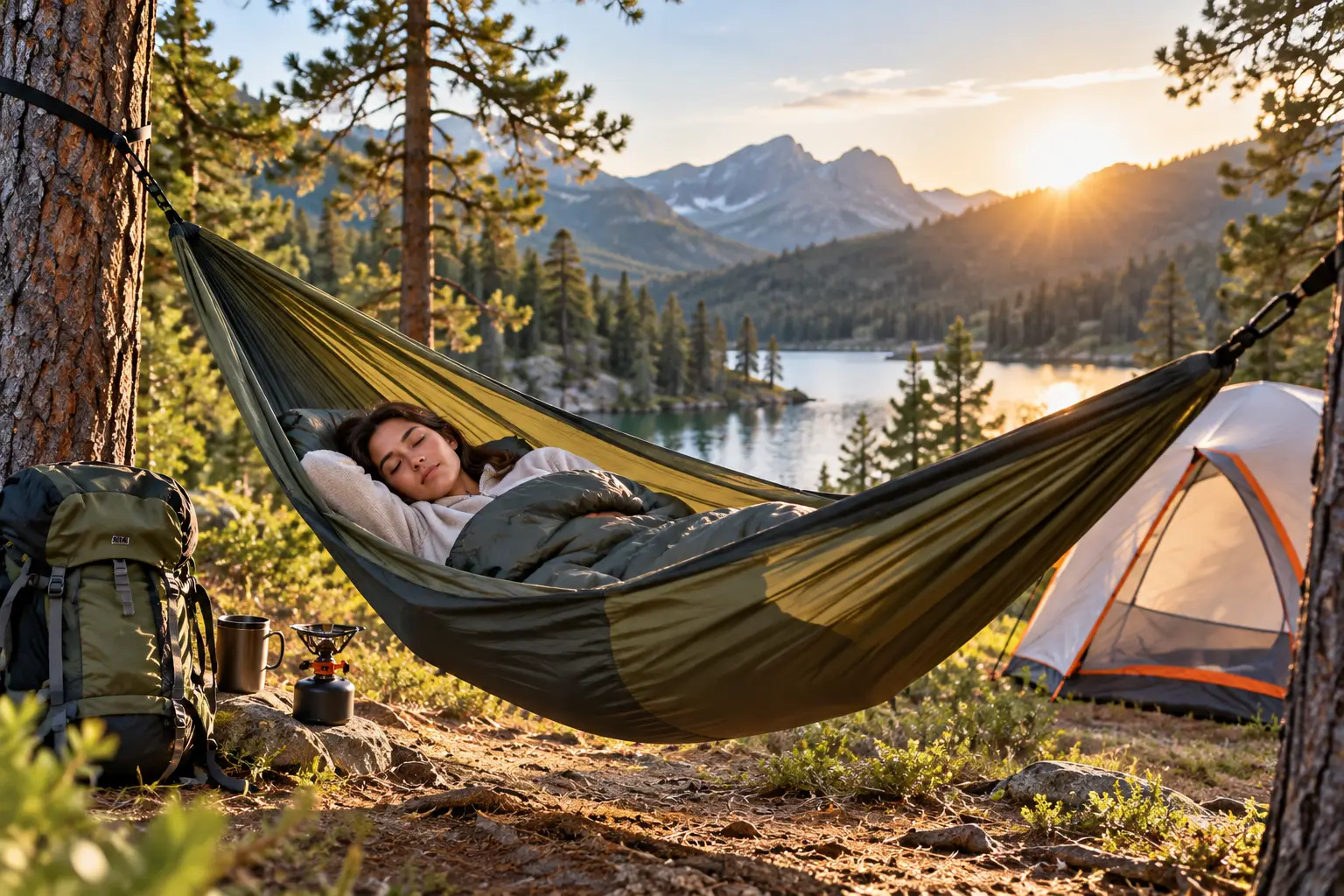
Sleeping in a hammock camping means using a suspended fabric bed, hung between two trees with tree-friendly straps, as your overnight shelter instead of a tent. A complete setup usually adds a bug net, a rain tarp, and insulation underneath, so you sleep dry, bug-free, and warm off the ground.
Think of it as a modular bedroom: the hammock is the mattress frame, the tarp is the roof, the bug net is the screen door, and the underquilt is the insulation. Skip any one piece in the wrong conditions, and the whole system underperforms. Get all four right, and many campers say they sleep better outdoors than at home. ✅
Quick Comparison: The 7 Best Camping Hammocks at a Glance ⚡
Short on time? This table gives you the essentials — type, approximate price range, and who each hammock suits best. Prices are approximate at the time of writing and change often, so always check the current price on Amazon.
| Hammock | Type | Approx. Price | Max Capacity | Best for |
|---|---|---|---|---|
| Wise Owl Outfitters DoubleOwl | Open double hammock + straps | Under $50 | 500 lb (double) | Wise Owl Outfitters DoubleOwl: first-timers on a budget |
| ENO DoubleNest | Open double hammock | $70–$90 | 400 lb | ENO DoubleNest: all-around reliability |
| Kammok Roo Double | Open double hammock | $80–$100 | 500 lb | Kammok Roo Double: soft fabric, light pack |
| ENO JungleNest | Hammock with integrated bug net | $100–$125 | 300 lb | ENO JungleNest: buggy summer trips |
| Hennessy Hammock Expedition Asym Zip | All-in-one kit (net, tarp, straps) | $150–$180 | 250 lb | Hennessy Hammock Expedition Asym Zip: one-box simplicity |
| Kammok Mantis UL | Ultralight all-in-one kit | $225–$320 | 300 lb | Kammok Mantis UL: backpackers counting ounces |
| Haven Tent Lay Flat Hammock Tent | Lay-flat hammock tent | $330–$370 | Check listing | Haven Tent Lay Flat Hammock Tent: side sleepers |
Looking at the table, the split is clear: the first three are “bare” hammocks, so you’ll still need straps (except the Wise Owl Outfitters DoubleOwl), a tarp, and a bug net to build a full system. The Hennessy Hammock Expedition Asym Zip and Kammok Mantis UL arrive as complete shelters, which explains the price jump. Meanwhile, the Haven Tent Lay Flat Hammock Tent solves a different problem entirely — it’s the only pick here designed for genuinely flat side sleeping, and you pay for that in both dollars and pounds.
One more pattern worth noticing: capacity ratings drop as kits get lighter. The 500 lb doubles use thicker or wider fabric, while ultralight kits trade some of that margin for a smaller pack. If you’re a heavier or taller camper, read the capacity and height limits before anything else.
💬 One click helps other shoppers make an informed choice too! 😊
Top 7 Hammocks for Sleeping in a Hammock Camping: Expert Analysis 🏕️
Each pick below is a real, widely sold model. We translate the spec sheet into what it means at 2 a.m. in the woods, summarize what published testers and owners report, and flag who should skip it.
1. Wise Owl Outfitters DoubleOwl — cheapest complete starter hang
The Wise Owl Outfitters DoubleOwl is the lowest-risk way to find out whether hammock sleep works for you. It measures about 10 ft by 6.5 ft, weighs roughly 26 oz, and is sewn from 210T parachute nylon with triple-stitched seams. That generous width matters more than it sounds: wide fabric is what lets you lie diagonally and flatten out, which is the core trick of comfortable hammock sleep.
It also ships with two 9-ft tree straps and carabiners, so you can hang it the day it arrives. Based on comparing the specs, that bundled suspension is the real value story — many premium hammocks make you buy straps separately. The trade-off is fabric feel and longevity; parachute nylon at this price is serviceable rather than refined. It’s best for car campers, scout troops, and curious beginners testing the waters before investing.
Reviews consistently praise the value and easy setup, and OutdoorGearLab’s review of the Wise Owl kit notes the included straps are rated to hold two adults. Owners treat it as a starter rather than a forever hammock.
Pros:
- ✅ Straps and carabiners included in the box
- ✅ Wide 6.5-ft body allows a proper diagonal lay
- ✅ Machine washable and quick to dry
Cons:
- ❌ No bug net or tarp for overnight protection
- ❌ Fabric feels thinner than premium nylon competitors
💲 Usually under $50 — outstanding value as a first hammock or a spare for friends.
2. ENO DoubleNest — the dependable all-rounder
The ENO DoubleNest is the hammock most people picture when they hear “camping hammock,” and it has earned that spot through consistency. It spans roughly 9.5 ft by 6.3 ft, holds up to 400 lb, and weighs about 19 oz. In practice, that means a roomy, breathable bed that packs to the size of a grapefruit and clips onto almost any accessory ecosystem.
That ecosystem is the hidden strength. ENO sells matching bug nets, rainflies, and underquilts, so the ENO DoubleNest can grow from a lounging hammock into a full overnight shelter piece by piece. On paper, it’s slightly shorter than 10-ft models, so campers over about 6’2″ may find the diagonal lay a bit tighter. For most people under that height, it’s a reliable, no-drama choice.
Outdoor Life named it its best overall camping hammock, and owner reviews repeatedly highlight durability and quick setup. The most common gripe is that straps are sold separately, which raises the real starting cost.
Pros:
- ✅ Huge accessory lineup lets you build a full system
- ✅ Packs small and weighs around 19 oz
- ✅ Proven track record and strong brand support
Cons:
- ❌ Straps not included, adding to the total cost
- ❌ Slightly short for very tall sleepers
💲 Typically in the $70–$90 range — fair value given its versatility and longevity.
3. Kammok Roo Double — softest fabric in its class
The Kammok Roo Double stands out the moment you touch it: its GravitasX 40D diamond ripstop nylon is made from 100% recycled, bluesign-approved fabric and feels noticeably softer than typical parachute nylon. It measures 10 ft long, carries a 500 lb rating, and packs into its own stuff sack at about 17 oz.
Why does softness matter for sleep? Because you’re lying on bare fabric all night, and a smoother, less crinkly surface means less noise and less sweaty stickiness on warm evenings. The 10-ft length also gives tall campers better diagonal room than 9.5-ft models. Kammok includes its Dyneema slings and carabiners, but tree straps are sold separately, so budget for Python straps or a compatible set.
Published testers single out the fabric’s comfort, and owners frequently mention the eight gear loops for hanging headlamps and bottles. Common critiques focus on the missing straps and the need to add a bug net for overnight use.
Pros:
- ✅ Exceptionally soft, quiet recycled ripstop fabric
- ✅ 500 lb capacity in a 17 oz package
- ✅ Lifetime warranty backs long-term ownership
Cons:
- ❌ Tree straps must be bought separately
- ❌ Needs add-on net and tarp for overnights
💲 Usually $80–$100 — strong value for campers who prioritize comfort and durability.
4. ENO JungleNest — built-in bug defense
The ENO JungleNest answers the number-one summer complaint: mosquitoes. Its integrated SkyWeave Lite mesh bug net zips fully closed against no-see-ums, then stows into the end sack when you want an open view. The 10-ft body, structural ridgeline, and lightweight spreader bar give it a tent-like canopy without much bulk — about 20 oz total.
The structural ridgeline is the quiet star here. It fixes the hammock’s sag at the same curve every night, so you get a consistent lay without fiddling with strap angles. The spreader bar lifts the mesh off your face, which matters more than you’d think at 3 a.m. Based on the specs, the main compromise is width — at about 4 ft 10 in, it’s narrower than double hammocks, which makes the diagonal lay tighter.
CleverHiker’s testers liked its materials and pockets but flagged the smaller dimensions and lack of side pull-outs. Owner reviews at major retailers frequently praise the attached net and easy entry.
Pros:
- ✅ Integrated no-see-um bug net with dual zippers
- ✅ Structural ridgeline delivers a repeatable hang
- ✅ Interior gear loft and side pocket
Cons:
- ❌ Narrower body limits the diagonal lay
- ❌ Straps and rainfly are sold separately
💲 Typically $100–$125 — good value if bugs are your biggest overnight concern.
5. Hennessy Hammock Expedition Asym Zip — everything in one box
The Hennessy Hammock Expedition Asym Zip is the design that helped launch modern hammock camping, and it still makes the jump from “hammock” to “shelter” painless. You get the hammock, an integrated no-see-um net, a structural ridgeline, an asymmetric rainfly, and webbing straps — no shopping list required.
Its patented asymmetrical cut is the headline feature. The hammock body is offset so you naturally lie on a diagonal, which flattens your back and shoulders without you having to hunt for the sweet spot. It’s rated for sleepers up to 6 ft and 250 lb, and the body uses durable 70-denier Oxford nylon with double-stitched seams — tougher than many lighter kits. The side zipper entry is easier for beginners than Hennessy’s older bottom-entry design.
What the spec sheet doesn’t emphasize, but reviews reveal, is the tarp. CleverHiker’s testers found the diamond-shaped fly covers the hammock but not much else, and they felt longer straps should be standard. They still rated the full kit a strong value for newcomers, measuring it at about 46.5 oz.
Pros:
- ✅ Complete shelter kit ready for the first night
- ✅ Asymmetric cut makes the flat lay effortless
- ✅ Tough 70D fabric with double-stitched seams
Cons:
- ❌ Small diamond tarp leaves gear exposed in storms
- ❌ Height and weight limits exclude bigger campers
💲 Typically $150–$180 — excellent value compared to buying a hammock, net, and tarp separately.
6. Kammok Mantis UL — lightest full system here
The Kammok Mantis UL packs a hammock, zip-off bug net, structural ridgeline, catenary-cut rainfly, ultralight straps, and stakes into a single compact sack. CleverHiker measured the complete kit at about 2 lb 7 oz, and the hammock alone at roughly 1 lb 2.5 oz, with a 300 lb rating.
Those numbers translate directly into trail miles. Swap a typical 3–4 lb backpacking tent for this kit and you save meaningful weight while gaining a bed that doesn’t care about rocks or slopes. The 20D Levitas nylon is light, and the catenary-cut tarp pitches tight with less flapping in wind. The modular design is smart, too: the bug net zips off for cool fall nights, and grosgrain loops let compatible underquilts snap on.
CleverHiker’s team chose it as their favorite all-in-one kit and the one they reached for most during testing. One user on a gear-review site at 6’3″ said it fit but was near the limit, so very tall campers should check sizing. The main complaint is the price.
Pros:
- ✅ Full shelter kit under 2.5 pounds
- ✅ Generous, tight-pitching tarp for real weather
- ✅ Modular net and quilt-ready loops
Cons:
- ❌ Premium price compared to DIY setups
- ❌ Light 20D fabric demands careful handling
💲 Generally $225–$320 depending on sales — worth it for backpackers who hike often and value pack weight.
7. Haven Tent Lay Flat Hammock Tent — truly flat for side sleepers
The Haven Tent Lay Flat Hammock Tent exists for one reason: people who can’t sleep in a curve. Instead of relying on a diagonal lay, it uses a structured system with an inflatable pad and side tensioning to create a genuinely flat sleeping surface, complete with a bug net and rainfly.
For side and stomach sleepers, this is the difference between giving up on hammocks and loving them. The shelter also pitches on the ground with trekking poles when there are no trees, which adds real flexibility for mixed terrain. The trade-off is weight — published specs put it around 7 lb — so it suits car camping, canoe trips, and short hikes far better than long backpacking routes. Setup takes practice the first few times.
Owner feedback aggregated by review sites is strongly positive, with the true flat lay repeatedly called the standout feature. Critics point to the weight, the lack of a vestibule for gear, and a finicky first setup.
Pros:
- ✅ Genuinely flat for side and stomach sleepers
- ✅ Can pitch on the ground without trees
- ✅ Integrated net and fly for full protection
Cons:
- ❌ Heavy for backpacking at around 7 pounds
- ❌ No vestibule, so wet gear needs planning
💲 Usually $330–$370 — pricey, but cheaper than a sleepless trip if curved hammocks don’t work for you.
Detailed Spec Comparison of the Top 7
| Hammock | Length × Width | Weight (approx.) | Bug Net | Rainfly | Best for |
|---|---|---|---|---|---|
| Wise Owl Outfitters DoubleOwl | 10 ft × 6.5 ft | 26 oz (hammock) | No | No | Wise Owl Outfitters DoubleOwl: budget starters |
| ENO DoubleNest | ~9.5 ft × 6.3 ft | ~19 oz | Add-on | Add-on | ENO DoubleNest: modular builders |
| Kammok Roo Double | 10 ft × ~5.7 ft | ~17 oz | Add-on | Add-on | Kammok Roo Double: comfort seekers |
| ENO JungleNest | 10 ft × 4 ft 10 in | ~20 oz | Integrated | Add-on | ENO JungleNest: bug-heavy regions |
| Hennessy Hammock Expedition Asym Zip | Asymmetric, up to 6 ft sleeper | ~46.5 oz (kit) | Integrated | Included | Hennessy Hammock Expedition Asym Zip: one-box beginners |
| Kammok Mantis UL | Full-size, 300 lb rating | ~2 lb 7 oz (kit) | Zip-off | Included | Kammok Mantis UL: backpackers |
| Haven Tent Lay Flat Hammock Tent | Lay-flat platform | ~7 lb (kit) | Integrated | Included | Haven Tent Lay Flat Hammock Tent: side sleepers |
The table reveals the real decision: you’re choosing between building a system and buying one. The ENO DoubleNest or Kammok Roo Double plus add-ons can match a kit’s features, but you’ll spend time and often similar money assembling it. If you just want to sleep on night one, the Kammok Mantis UL offers the best weight-to-features balance, while the Hennessy Hammock Expedition Asym Zip wins on price.
✨ Don’t miss these smart picks for your next night under the trees!
🔍 Take your hammock camping to the next level with this carefully curated lineup. Click a highlighted hammock to check current pricing and availability — these picks will help you get deeper, warmer, bug-free sleep on every trip! 🌙
How to Sleep in a Hammock: Step-by-Step Hammock Camping Setup 🛠️
Most “hammocks are uncomfortable” stories trace back to a bad hang, not a bad hammock. Learning how to sleep in a hammock comes down to five habits you can practice in your backyard before your first overnight.
- Pick healthy trees about 12–15 ft apart. Look for live, sturdy trunks at least 12 inches in diameter at the strap point — roughly the width of a dinner plate. Avoid dead limbs overhead (campers call them “widowmakers”).
- Wrap wide straps around the trunk. Tree-friendly webbing at least an inch wide spreads the load and protects bark. Wrap once and let the strap sit loosely until you climb in.
- Aim for a 30-degree strap angle. This is the classic sweet spot. A tighter hang folds you into a banana; a looser one sags without tension. Attach straps around head height to get there.
- Keep the seat low. When you sit in it, the hammock should be about chair height — roughly 18 inches off the ground. ENO’s own warning label caps the JungleNest at that height for safety.
- Lie diagonally. Put your head left of center and your feet right of center (or vice versa), roughly 15–30 degrees off the hammock’s centerline. The fabric flattens beneath you, your knees bend slightly, and shoulder squeeze disappears.
A few first-30-day tips: hang the tarp before the hammock so you’re never setting up in rain; tie a small “drip line” (a short cord) on each strap so rain doesn’t wick down into your bed; and keep a knee pillow or rolled jacket under your knees if you feel hyperextension. After every trip, air-dry everything fully before packing — nylon stored damp mildews fast.
Real-World Scenarios: Matching the Right Hammock to Your Trip 🎒
Specs only matter in context, so here are three common camper profiles and the reasoning behind each match.
Scenario 1: The weekend car camper (budget ~$100, 4–6 nights a year). You camp at state parks, drive to your site, and care more about comfort than ounces. The Wise Owl Outfitters DoubleOwl gets you hanging cheaply, but for overnight comfort, the Kammok Roo Double with an add-on bug net is the smarter long-term buy. Its soft fabric and 10-ft length make lounging and sleeping equally pleasant, and weight barely matters when your car is 30 feet away.
Scenario 2: The Appalachian backpacker (budget ~$300, 15+ nights a year). You’re covering 12–15 miles a day through humid, buggy forest. The Kammok Mantis UL fits best: under 2.5 lb for a full shelter, a tarp that actually handles summer thunderstorms, and a net that keeps out no-see-ums. Pair it with a three-season underquilt and you’ve replaced your tent with a lighter, more comfortable bed.
Scenario 3: The side sleeper who “can’t do hammocks” (budget ~$350, car-camping and canoe trips). You’ve tried a regular hammock and woke up sore. Diagonal-lay tricks help many people, but not everyone. The Haven Tent Lay Flat Hammock Tent is built for exactly this case; the weight penalty matters little when a canoe or car carries the load.
Problem → Solution: Fixing the Most Common Hammock Sleep Problems ❄️
Even a great hammock throws curveballs. Here are the five issues new hangers report most, with precise fixes.
- Problem: Cold back at 55°F. Your sleeping bag’s insulation gets crushed under your body weight, and wind strips away heat — hammockers call it “cold butt syndrome.” Solution: add a hammock underquilt that hangs outside the hammock, or a closed-cell foam pad inside. Cold, damp nights deserve respect: the CDC’s winter weather prevention guidance explains how body heat loss leads to hypothermia, and rain plus wind can make that risk real even in shoulder season.
- Problem: Calf ridge or knee hyperextension. Solution: shift your diagonal angle, loosen the hang slightly, or place a small pillow under your knees. Asymmetric designs like the Hennessy Hammock Expedition Asym Zip reduce this by design.
- Problem: Bug net sagging onto your face. Solution: use a structural ridgeline or spreader bar — the ENO JungleNest includes both — and tension side pull-outs where available.
- Problem: Sliding toward the middle all night. Solution: your hang is too tight. Lower the attachment points or lengthen the straps to get closer to that 30-degree angle.
- Problem: Waking up wet after rain. Solution: pitch the tarp lower and longer than the hammock, add drip lines, and choose a generous fly like the one on the Kammok Mantis UL if storms are common where you camp.
How to Choose the Best Camping Hammock for Sleeping in a Hammock Camping 🧭
The best camping hammock is the one that matches your body, your climate, and your trip style. Work through these seven steps in order:
- Check your height against the length. A 10-ft hammock comfortably fits most adults; if you’re over about 6’2″, treat 10 ft as a minimum, because extra length is what makes the diagonal lay flat.
- Respect weight capacity and height limits. Ultralight kits often top out at 250–300 lb, while doubles reach 400–500 lb. Leave a comfortable margin rather than living at the limit.
- Decide: system or build-your-own. Kits like the Kammok Mantis UL save research time; open hammocks like the ENO DoubleNest let you upgrade piece by piece.
- Match bug protection to your region. Humid Southeast summers practically require an integrated net; dry Western shoulder seasons often don’t.
- Size the tarp for real weather. A bigger fly with catenary cuts sheds wind-driven rain better than a minimal diamond.
- Budget for insulation. Underneath warmth matters more than the hammock itself once nights drop below the mid-60s.
- Weigh pack size honestly. Backpackers should count every ounce; car campers can prioritize comfort and price.
Hammock Underquilt vs. Sleeping Pad: Which Keeps You Warmer? 🔥
This is the single most important gear choice for sleeping in a hammock camping beyond summer. A hammock underquilt hangs outside and beneath the fabric, so your body never compresses its loft. That’s why underquilts deliver more warmth per ounce and feel like lying on a cloud — but they typically cost more than the hammock itself.
A sleeping pad sits inside the hammock. Closed-cell foam is cheap and bombproof, while inflatable pads add comfort. The downside is behavior: pads slide around in a curved hammock, and narrow ones leave your shoulders exposed to cold air. Wider pads, or double-layer hammocks with a pad sleeve, help a lot.
Here’s what to weigh: if you camp mostly in summer, a foam pad is the smart, low-cost answer. If you camp spring through fall — or plan any trip where temps dip toward 40°F — a hammock underquilt is the upgrade that pays for itself in sleep quality. Many experienced hangers use both on cold nights: the quilt for warmth, a thin pad as a backup layer. Pair either one with a top quilt or an unzipped sleeping bag, since full mummy bags are awkward to get into while hanging.
Hammock vs. Tent: Is Sleeping in a Hammock Camping Better?
Neither shelter wins everywhere, but each has clear strengths. This table summarizes the trade-offs.
| Factor | Hammock System | Backpacking Tent | Best for |
|---|---|---|---|
| Sleep surface | Suspended, no rocks or roots | Depends on ground | Hammock: uneven, rooty forests |
| Site flexibility | Needs two trees (or a stand) | Needs flat clear ground | Tent: deserts and alpine zones |
| Weather in cold | Needs underquilt | Pad + bag is enough | Tent: winter beginners |
| Pack weight | 2–3 lb for full kits | 2–4 lb for 1-person models | Hammock: wooded thru-hikes |
| Partner sleeping | One per hammock | Shared shelter possible | Tent: couples |
The pattern is simple: hammocks shine in forests with plenty of trees and lousy ground, while tents rule open terrain and cold-weather beginner trips. For a solo hiker on the Appalachian Trail, a kit like the Kammok Mantis UL is often the more comfortable and equally light choice. For a couple camping above treeline, a tent remains the practical answer.
Common Mistakes to Avoid When Buying a Camping Hammock ⚠️
- Buying for lounging, not sleeping. A short, narrow backyard hammock won’t allow a flat diagonal lay. For overnights, choose about 10 ft long and at least 5 ft wide.
- Forgetting the straps. The ENO DoubleNest, Kammok Roo Double, and ENO JungleNest all ship without tree straps. Factor them into your budget.
- Ignoring insulation. New hangers spend everything on the hammock and freeze on night one. Budget for a pad or underquilt from the start.
- Choosing rope suspension. Thin rope bites into bark and often violates park rules. Use wide webbing.
- Assuming two people can sleep in a “double.” Brands like Kammok themselves recommend one sleeper for overnight use, even when a hammock lounges two.
- Skipping a practice hang. Set up in your backyard first, so you learn your ideal angle in daylight, not at dusk in the rain.
Long-Term Cost and Total System Price 💰
The sticker price of a hammock rarely tells the full story. A comfortable overnight setup has four parts — hammock, suspension, bug net, and rain tarp — plus insulation for cooler nights. Here’s how real totals compare.
| Path | What You Buy | Approx. Total | Best for |
|---|---|---|---|
| Budget build | Wise Owl Outfitters DoubleOwl + budget net + budget tarp | $90–$140 | Summer car campers |
| Modular mid-range | ENO DoubleNest + straps + net + rainfly | $200–$280 | Upgraders who like choice |
| Value kit | Hennessy Hammock Expedition Asym Zip | $150–$180 | Beginners who want one box |
| Premium ultralight | Kammok Mantis UL + underquilt | $400–$550+ | Frequent backpackers |
The takeaway: the Hennessy Hammock Expedition Asym Zip is the cheapest route to a complete, bug-proof, rain-proof shelter. Modular builds cost more but let you replace one worn part instead of a whole kit. Over five years, durability matters too — lifetime warranties like Kammok’s lower the long-term cost of ownership.
Maintenance is cheap but essential. Wash nylon hammocks on a gentle cold cycle (many are machine washable), air-dry them fully, inspect straps for fraying before each trip, and store gear loosely in a dry closet rather than compressed in a stuff sack.
Safety, Regulations, and Leave No Trace Rules 🛡️
Hammock rules vary widely across US public lands, so check before you go. Some parks ban hanging from trees altogether; others allow it with conditions. Minnesota state parks, for example, require trees at least 12 inches in diameter at the attachment point. At Glacier National Park, the National Park Service explains that backcountry campers must sleep on designated tent pads and suggests a hammock stand instead of relying on trees.
For your own safety, never exceed the rated capacity, keep the hang low (around 18 inches when seated), inspect carabiners and straps for wear, and look up for dead branches before committing to a site. Avoid hanging over water, steep drop-offs, or rocks. Kids should always be supervised.
For the trees, use straps at least an inch wide, avoid wrapping the trunk multiple times, and skip small, dead, or soft-barked trees. These simple habits keep hammocks one of the lowest-impact shelters you can carry.
Features That Actually Matter (and Ones That Don’t) 🎯
Matter a lot: length (10 ft or more for most adults), a structural ridgeline for a repeatable sag, an integrated or well-fitted bug net, a properly sized tarp, and an insulation plan. These directly affect whether you sleep.
Matter some: fabric denier and feel, gear pockets, and suspension style. Lighter fabric saves weight but asks for gentler handling; softer fabric improves comfort on warm nights.
Matter less than marketing suggests: color options, “two-person sleeping” claims, spreader bars on open hammocks (they make lounging tippy), and extreme capacity numbers you’ll never approach. A hammock rated for 500 lb isn’t more comfortable than one rated for 300 lb — it’s just built for a different load.
FAQ: Sleeping in a Hammock Camping ❓
❓ Is sleeping in a hammock camping bad for your back?
❓ How much does a complete camping hammock setup cost?
❓ Can two people sleep in one camping hammock overnight?
❓ Do I need an underquilt for summer hammock camping?
❓ Are budget Amazon hammocks safe for overnight camping?
Conclusion: Your Best Night Outdoors Starts Off the Ground 🌙
Sleeping in a hammock camping isn’t magic — it’s a system. Get the hang angle near 30 degrees, lie on the diagonal, protect yourself from bugs and rain, and plan for warmth underneath, and you’ll understand why so many campers never go back to the ground.
As for gear, the right choice depends on how you camp. The Wise Owl Outfitters DoubleOwl is the low-risk experiment. The ENO DoubleNest and Kammok Roo Double are excellent foundations for a modular setup, with the Kammok Roo Double winning on fabric comfort. The ENO JungleNest is the easy answer for buggy summers. If you want one box and a fair price, the Hennessy Hammock Expedition Asym Zip delivers. Serious backpackers will appreciate the weight savings of the Kammok Mantis UL, and side sleepers finally have a real option in the Haven Tent Lay Flat Hammock Tent.
Whichever you pick, practice in the backyard first, check the hammock rules wherever you’re headed, and treat the trees gently. Do that, and your next trip could deliver the best outdoor sleep you’ve ever had.
✨ Ready to trade rocky tent pads for a floating bed?
🛒 Click any highlighted hammock above to check current pricing and availability on Amazon — and get one step closer to deep, comfortable sleep under the stars your whole crew will envy! 🌲
Recommended for You
- Hammock 2 People: 7 Best Double Hammocks Worth Sharing in 2026
- Loft Hammock 2026: 7 Best Picks to Turn Dead Space Into Bliss
- Nags Head Hammock Chair: 7 Best Handcrafted Picks for 2026
Disclaimer: This post contains affiliate links. As an Amazon Associate, I earn from qualifying purchases made through these links, at no additional cost to you.
✨ Found this article helpful? Share it with someone who needs it! 💬🤗