
In This Article
The Best Hammock for Sleeping: Why Your Next Camp Night Could Be Your Best Night
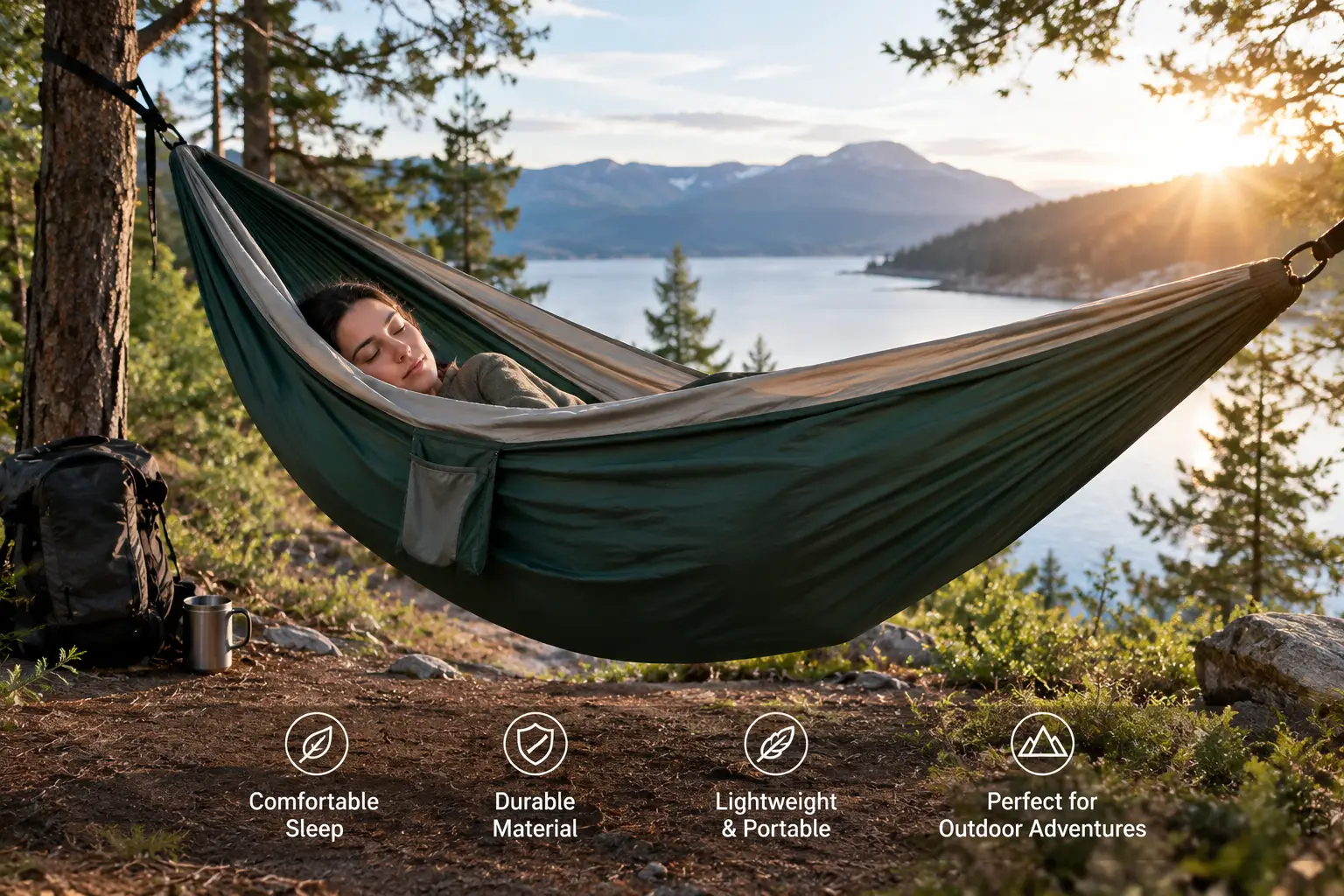
Picture this: it’s 2 a.m., a root is drilling into your hip, your sleeping pad has slid off to one side, and the tent floor is quietly collecting rainwater. Now picture the alternative — floating 18 inches off the ground, gently swaying, with nothing pressing into your shoulder but air. That second scene is why so many campers go shopping for the best hammock for sleeping, and why so many of them never go back to the ground.
But here’s the catch nobody mentions in the glossy photos: the hammock you nap in at the beach is not the hammock you want for eight hours in the backcountry. Choosing the best hammock for sleeping means thinking about lay (how flat you can get), bug protection, insulation underneath you, and how much weight you’ll carry to reach those trees.
What Is a Sleeping Hammock?
A sleeping hammock is a suspended bed designed for full overnight rest, not just lounging. Compared with a casual backyard hammock, it typically adds a fixed ridgeline for a repeatable sag, an integrated bug net, an asymmetric or spreader-bar design for a flatter lay, and compatibility with a tarp, underquilt, or sleeping pad for weather and warmth.
Hanging your bed between trees isn’t a new idea — the history of hammock camping on Wikipedia traces it back centuries, to people who slept off the ground to stay clear of snakes, insects, and runoff. What is new is the engineering. Today you can choose between classic gathered-end hammocks, asymmetric jungle-style hammocks, bridge hammocks with spreader bars, and true lay-flat “hammock tents.”
In this guide, we compare seven real models available to US shoppers, translate spec sheets into what they mean at 2 a.m., summarize what aggregated owner reviews actually say, and walk you through setup, troubleshooting, and long-term cost. No invented tests, no fake testimonials — just honest analysis so you can buy once and sleep well.
Quick Comparison: Best Hammock for Sleeping at a Glance
| Hammock | Style | Bug Net | Rated Capacity | Approx. Price Range | Best For |
|---|---|---|---|---|---|
| Haven Tent XL | Lay-flat hammock tent | Yes | See listing | $350–$500 | Haven Tent XL: side and stomach sleepers |
| Kammok Mantis UL | All-in-one gathered-end | Yes (removable) | 300 lb | $300–$330 | Kammok Mantis UL: backpackers wanting a complete kit |
| Hennessy Hammock Expedition Asym Zip | Asymmetric jungle hammock | Yes | 250 lb | $150–$180 | Hennessy Hammock Expedition Asym Zip: value all-in-one shelter |
| ENO SkyLite | Bridge (spreader bars) | Yes | 250 lb | $180–$220 | ENO SkyLite: cot-like flat lay |
| Hammock Bliss Sky Bed Bug Free | Engineered asymmetric | Yes | ~385 lb (175 kg) | Low-to-mid $100s | Hammock Bliss Sky Bed Bug Free: using your existing sleeping pad |
| ENO DoubleNest | Classic gathered-end | No | 400 lb | $65–$85 | ENO DoubleNest: roomy diagonal lay on a budget |
| Wise Owl Outfitters DoubleOwl | Classic gathered-end | No | 500 lb | $25–$45 | Wise Owl Outfitters DoubleOwl: first-timers testing the waters |
Looking at this table, the dividing line isn’t really price — it’s lay geometry. The Haven Tent XL, ENO SkyLite, and Hammock Bliss Sky Bed Bug Free each use a different trick (structure, spreader bars, or engineered panels with a pad) to flatten you out, which matters most if you hate sleeping on your back. Meanwhile, the ENO DoubleNest and Wise Owl Outfitters DoubleOwl are cheap and comfortable but need add-ons — a bug net, a tarp, insulation — before they become true overnight shelters.
💬 One click helps other shoppers make an informed choice too! 😊
Top 7 Hammocks for Sleeping: Expert Analysis
Every pick below is a real product sold to US buyers. Specs come from manufacturer listings and retailer spec sheets; review sentiment is aggregated from public owner reviews and professional reviews, and it’s labeled as such.
1. Haven Tent XL — the flattest sleep you can hang
If you’ve ever woken up folded like a taco, the Haven Tent XL is built for you. Rather than relying on fabric sag, it uses two spacer bars and a fitted, rectangular insulated pad to create a structured floor — reviewers at GearJunkie liken the build to an upside-down suspension bridge.
In practice, that structure means you can sleep on your side or stomach, which almost no traditional hammock allows. The fitted pad also doubles as bottom insulation, so you skip buying an underquilt for three-season trips. The trade-off is weight: depending on configuration, owners and reviewers report roughly 7 to 8+ pounds for the system — fine for car camping, hunting, or motorcycle touring, but heavy for big backpacking miles.
Based on the specs, this is the pick for back-pain sufferers and committed side sleepers who prioritize sleep over pack weight. Aggregated owner feedback is strongly positive about the flat lay, with many saying it’s the first hammock that let them sleep on their side; the most consistent complaints are weight and a snug interior width.
Pros:
- ✅ Genuinely flat lay for side and stomach sleepers
- ✅ Fitted insulated pad handles bottom warmth
- ✅ Can pitch in the trees or on the ground
Cons:
- ❌ Heavy for long-distance backpacking
- ❌ Interior feels narrow compared to a tent
Expect to pay in the $350–$500 range depending on color and bundle (check the current price); for side sleepers, the Haven Tent XL delivers value no curved hammock can match.
2. Kammok Mantis UL — lightest complete kit with a knotless setup
The Kammok Mantis UL answers a simple question: what if you could buy one box and be ready to sleep in the woods tonight? According to Kammok, it bundles the hammock, removable no-see-um canopy, structural ridgeline, rainfly with guy-outs, Python 10 UL tree straps, and stakes into one roll-top sack.
Its body uses 20-denier Levitas nylon ripstop with a 300-pound capacity, and the whole kit weighs in around 2 pounds 3 ounces. What that means in practice: you’re carrying roughly the weight of a lightweight one-person tent while getting a full bug-proof, rain-ready shelter. The structural ridgeline sets the same sag every time, so the comfortable diagonal lay is repeatable night after night, and the knotless suspension means no fiddly hitches in the dark.
Here’s what to weigh: thinner 20D fabric is lighter and more breathable but less forgiving than burlier hammocks, so it’s best for careful users under the weight limit. Reviews consistently praise the easy, all-in-one setup and the generous 11-by-4-foot asymmetric hex tarp, though some owner reviews on REI report fabric stretch and durability concerns over time.
Pros:
- ✅ Truly complete kit, straps and stakes included
- ✅ Light enough for serious backpacking trips
- ✅ Ridgeline makes the comfortable sag repeatable
Cons:
- ❌ Thin 20D fabric demands careful handling
- ❌ Still needs an underquilt or pad below 60°F
Typically around $300–$330 at the time of writing; the Kammok Mantis UL is pricey upfront but cheaper than piecing together equivalent parts.
3. Hennessy Hammock Expedition Asym Zip — the budget all-in-one veteran
The Hennessy Hammock Expedition Asym Zip has been around for years, and that track record is its strongest selling point. It’s an asymmetrically cut, single-person jungle hammock with a side-entry zipper, integrated mesh, and an included rainfly.
Hennessy’s patented asymmetric cut nudges your body into a diagonal position, which flattens your lay without any spreader bars. The double-slider zipper lets you open the mesh partway for airflow. Sturdier fabric (versus ultralight competitors) means it tolerates rough handling — it’s widely used by hunters and canoe trippers. The flip side: the included tarp is small, and because it attaches to the hammock’s suspension lines, you can’t pitch it independently without extra cord.
Based on comparing the specs, this is a smart first “real” hammock for buyers under 6 feet and 250 pounds who want everything in one package. Review sentiment is mixed-to-positive: it averages in the mid-4s out of 5 among REI reviewers, with praise for bug protection and durability, while professional reviewers like Clever Hiker flag the cramped feel for taller users and the undersized tarp.
Pros:
- ✅ Proven, durable design for rugged use
- ✅ Bug net, fly, and suspension included
- ✅ Asymmetric cut helps you lie flatter
Cons:
- ❌ Small tarp leaves ends exposed in storms
- ❌ Tight for sleepers over six feet
Usually around $150–$180; the Hennessy Hammock Expedition Asym Zip is one of the most affordable complete shelters from an established brand.
4. ENO SkyLite — cot-like comfort from spreader bars
The ENO SkyLite is ENO’s answer to people who simply can’t get flat in a regular hammock. It’s a bridge-style design: removable DAC aluminum spreader bars hold the head and foot ends open, and a proprietary cut drops your feet slightly so your knees don’t hyperextend.
Per ENO, the body is 7 by 3 feet, made from 40D NewWave ripstop nylon, with an integrated zippered bug net and a 250-pound capacity at about 2 pounds. In everyday terms, that feels more like a camp cot with a sway than a sling — side sleeping becomes realistic, which is rare at this weight. Note that ENO Helios straps are sold separately, and the short 7-foot body suits average heights better than very tall sleepers.
On paper, this is the sweet spot for side sleepers who backpack moderate distances and don’t want the Haven Tent XL‘s weight. Professional reviewers at OutdoorGearLab praised its flat lay, but aggregated REI owner reviews are mixed (mid-3s out of 5), citing a zipper that snags and a tippier feel than gathered-end hammocks.
Pros:
- ✅ Flat, cot-like lay for side sleepers
- ✅ Integrated bug net with zippered door
- ✅ Spreader bars remove for easier packing
Cons:
- ❌ Straps sold separately, adding cost
- ❌ Bridge design can feel tippy at first
Roughly $180–$220 at the time of writing; the ENO SkyLite is fair value if lay comfort matters more than ultralight weight.
5. Hammock Bliss Sky Bed Bug Free — flat lay using the pad you already own
The Hammock Bliss Sky Bed Bug Free takes a clever shortcut to a flatter night: instead of bars or a rigid floor, it’s sewn from shaped panels that are wider in the middle and narrower at the ends, creating a built-in asymmetric lay.
The real trick is the integrated pad sleeve, which accepts common backpacking pads up to 20 by 72 inches. Slide in an inflated pad and two things happen at once: the pad stiffens the hammock into a flatter surface, and it insulates your back so you may skip an underquilt in mild weather. The no-see-um mesh canopy keeps bugs out, and interior pockets hold your headlamp and phone. The lay is fixed in one direction, and rope suspension means you’ll want to buy tree straps separately.
This is the pick if you already own a quality sleeping pad and want to convert to hammock sleeping without buying a $200+ underquilt. Long-running reviews from The Ultimate Hang and Backpacker report an impressively flat lay with an inflated pad, but note that without a pad it feels much like a standard gathered-end hammock; users also mention needing a large tarp due to its length.
Pros:
- ✅ Pad sleeve flattens and insulates simultaneously
- ✅ Reuses gear you probably already own
- ✅ Fitted bug net with useful interior pockets
Cons:
- ❌ Tree straps are not included
- ❌ Lay direction is fixed, not reversible
Generally in the low-to-mid $100s (prices may vary); the Hammock Bliss Sky Bed Bug Free is excellent value for pad owners.
6. ENO DoubleNest — the roomy classic for diagonal sleepers
The ENO DoubleNest is the hammock most Americans picture when they hear “ENO,” and its generous dimensions are exactly why it works for overnights. It’s a simple gathered-end design, but a wide one.
The body measures 9 feet 6 inches by 6 feet 4 inches, uses 70D FreeWave nylon with triple-stitched seams, holds up to 400 pounds, and weighs about 19 ounces. Width is the hidden comfort spec: the more fabric you have, the further diagonally you can lie, and the flatter your body sits. That’s why a “double” hammock often sleeps better solo than a single. What it doesn’t include — straps, bug net, or tarp — you’ll need to add for real camping.
Based on the specs, this is ideal for warm-weather campers, festival-goers, and anyone who wants one hammock for both lounging and occasional overnights. According to Treeline Review, Amazon reviewers widely agree the DoubleNest is roomy enough for taller and broader users and more comfortable for overnight sleep than its smaller SingleNest sibling.
Pros:
- ✅ Extra width enables a flatter diagonal lay
- ✅ Durable, triple-stitched 70D nylon body
- ✅ Packs down to grapefruit size
Cons:
- ❌ No bug net or rainfly included
- ❌ Straps must be purchased separately
Typically around $65–$85; the ENO DoubleNest is strong value, as long as you budget for straps and bug protection.
7. Wise Owl Outfitters DoubleOwl — the cheapest way to test hammock sleep
The Wise Owl Outfitters DoubleOwl is the “try before you commit” option. It costs a fraction of premium models yet includes the straps most brands charge extra for.
It’s made of 210T parachute nylon with triple-interlocking stitching, measures about 10 by 6.5 feet, and is rated to 500 pounds, according to the brand’s listings. The included 9-foot tree straps each have five loops, which means you can adjust hang height and tension in seconds without learning knots — a genuine plus for beginners. That generous width, like the ENO DoubleNest, lets you find a comfortable diagonal lay.
Here’s what to weigh: this is a lounging-first hammock, so for overnight use in buggy or cold places you’ll need a bug net, tarp, and insulation. Aggregated owner feedback on retail and review sites is broadly positive about value and strength, with several buyers noting the fabric looks thinner than it performs; quality-control comments are less common but present.
Pros:
- ✅ Straps and carabiners included in the box
- ✅ Very high 500-pound capacity rating
- ✅ Wide body supports a comfortable diagonal lay
Cons:
- ❌ Lounging-first design needs overnight add-ons
- ❌ Less refined fabric feel than premium brands
Usually in the $25–$45 range; the Wise Owl Outfitters DoubleOwl is the lowest-risk entry point into hammock sleeping.
✨ Don’t miss these sleep-ready picks!
🔍 Take your camping sleep to the next level with this carefully curated lineup. Click a highlighted hammock to check current pricing and availability. These picks will help you wake up rested, dry, and bite-free — trip after trip!
How to Sleep in a Hammock: Your First-Night Setup Guide
Most “hammocks are uncomfortable” stories come from setup mistakes, not bad hammocks. Here’s how to dial it in before your first real night.
1. Find the right trees. Look for live, healthy trunks roughly 12–15 feet apart, at least 6 inches in diameter. Look up for dead branches before you commit.
2. Aim for a 30-degree hang angle. With gathered-end hammocks like the ENO DoubleNest, your straps should sit at about 30 degrees from horizontal. Too tight and the fabric squeezes your shoulders; too loose and you sag into a deep banana. A structural ridgeline, as on the Kammok Mantis UL and Hennessy Hammock Expedition Asym Zip, sets this sag for you.
3. Hang the foot end slightly higher. Raising the foot end 6–10 inches keeps you from sliding toward the middle overnight.
4. Lie diagonally. Angle your body 15–30 degrees off the centerline. This is the single biggest comfort fix in gathered-end hammocks — it flattens your back and stops the fabric from cupping your shoulders.
5. Solve warmth below you first. Your sleeping bag’s insulation compresses under your body, so cold air underneath steals heat fast. Use an underquilt or a pad (the Hammock Bliss Sky Bed Bug Free and Haven Tent XL are designed around pads).
6. Do a backyard trial. Spend one full night at home before your trip. You’ll discover pressure points, gear placement, and how to get in and out in the dark.
⚡ Common first-30-day mistakes: hanging too high (keep the seat about 18 inches off the ground), forgetting a pillow, and skipping a knee pillow — a small rolled jacket under your knees removes the hyperextension that many new hangers feel.
Real-World Scenarios: Matching the Right Hammock to the Right Sleeper
Specs only matter once they meet a real life. Here are three common buyer profiles and the reasoning behind each match.
🏕️ The Side-Sleeping Car Camper
Budget: flexible · Use: 10–15 nights a year at drive-in sites · Priority: sleep quality
If you sleep on your side at home and plan to drive to camp, weight barely matters, so the Haven Tent XL makes the most sense. Its structured floor and fitted pad let you sleep the way you already do. If the budget won’t stretch that far, the ENO SkyLite gets you a cot-like lay for considerably less, though it feels tippier.
🎒 The Weekend Backpacker
Budget: $150–$350 · Use: 2–3 night trips, 8–12 miles a day · Priority: weight and simplicity
Here, every ounce counts and so does setup speed after a long day. The Kammok Mantis UL wins on its complete kit and low weight. If $300+ is too much, the Hennessy Hammock Expedition Asym Zip delivers a similar all-in-one approach for roughly half — just plan to upgrade its small tarp if you camp where storms roll in.
🌄 The Curious First-Timer
Budget: under $100 · Use: backyard nights, summer car camping · Priority: low risk
You don’t yet know whether you’ll love hammock sleep, so don’t spend like you do. The Wise Owl Outfitters DoubleOwl comes with straps and costs less than a dinner out. Spend the savings on a bug net and a basic pad. If you discover you love it, step up to the ENO DoubleNest for a softer fabric feel or the Hammock Bliss Sky Bed Bug Free for a flatter lay.
The pattern across all three? Match the hammock to how you already sleep and how far you’ll carry it — not to the most popular brand.
Problem → Solution: Fixing the 5 Most Common Hammock Sleep Complaints
❌ Problem 1: “My back hurts in the morning.” ✅ Solution: You’re likely lying straight down the middle. Shift diagonally and loosen the hang toward 30 degrees. If pain persists, a flatter design — the ENO SkyLite or Haven Tent XL — removes the curve entirely.
❌ Problem 2: “My shoulders feel squeezed.” ✅ Solution: This “shoulder squeeze” comes from a hammock hung too tight or too narrow. A wider body like the ENO DoubleNest or Wise Owl Outfitters DoubleOwl gives the fabric room to relax around you.
❌ Problem 3: “I’m freezing even though it’s 55°F.” ✅ Solution: Cold Butt Syndrome is real — the air under you pulls heat away. Add an underquilt, or use a hammock built around a pad such as the Hammock Bliss Sky Bed Bug Free.
❌ Problem 4: “Mosquitoes ate me alive.” ✅ Solution: Choose a model with integrated mesh (the Kammok Mantis UL, Hennessy Hammock Expedition Asym Zip, or ENO SkyLite) or add a separate bug net to an open hammock.
❌ Problem 5: “My feet keep sliding to the middle.” ✅ Solution: Raise the foot end 6–10 inches higher than the head end. It sounds backward, but your heavier torso then settles into the lowest point and stays put.
How to Choose the Best Hammock for Sleeping
Picking the best hammock for sleeping comes down to seven decisions, roughly in order of importance:
- Your sleep position. Back sleepers do fine in gathered-end hammocks; side and stomach sleepers should look at bridge or lay-flat designs, because only those remove the curve.
- Lay geometry. Asymmetric cuts, spreader bars, or engineered panels each flatten the lay differently — choose based on how much weight and complexity you’ll accept.
- Bug protection. If you camp east of the Rockies in summer, integrated mesh is close to mandatory; adding a net later costs more and weighs more.
- Insulation plan. Decide upfront between an underquilt or a pad. Pad-compatible designs save money if you already own a good pad.
- Weight capacity and length. Choose a rating at least 50 pounds above your body weight plus gear, and a body at least 2–3 feet longer than your height.
- Total carry weight. Compare complete systems — hammock, straps, net, and tarp — not just the bare hammock.
- What’s included. Straps, tarps, and stakes add up quickly; an all-in-one kit can be cheaper than a “budget” hammock plus parts.
Get these right and the brand name becomes secondary.
Lay-Flat Hammock vs. Tent: Which Sleeps Better?
For a lot of shoppers, the real question isn’t “which hammock?” but “should I swap my tent at all?” Here’s how the three main sleep systems stack up.
| Factor | Lay-Flat Hammock | Gathered-End Hammock | Backpacking Tent |
|---|---|---|---|
| Sleep positions | Back, side, stomach | Mostly back, diagonal | All positions |
| Uneven/rocky ground | Unaffected | Unaffected | Major problem |
| Needs trees | Usually (some pitch on ground) | Yes | No |
| Bottom insulation | Pad usually included | Underquilt or pad needed | Pad needed |
| Best for | Haven Tent XL, ENO SkyLite | ENO DoubleNest, Kammok Mantis UL | Treeless terrain |
The table shows why hammocks dominate in forested terrain like the Appalachians and Ozarks: lumpy, sloped, or rooty ground stops mattering the moment you’re off it. Tents still win above treeline and in deserts, but if your trips are wooded, a lay-flat hammock gives you tent-like positional freedom without the hunt for flat dirt.
There’s also an intriguing comfort angle. A small 2011 study published in Current Biology found that gentle rocking during a nap sped up sleep onset and boosted markers of deeper sleep in healthy adult men. That was a rocking bed in a lab, not a hammock in the woods, so treat it as an encouraging hint rather than proof — but it helps explain why so many people report dozing off faster when gently swaying.
Most Comfortable Hammock for Sleeping if You’re a Side Sleeper
Side sleepers have the hardest time in hammocks, and they deserve their own section. In a curved hammock, lying on your side twists your spine: your hips sink while your shoulders ride the fabric wall. So which is the most comfortable hammock for sleeping on your side?
Option 1: True Lay-Flat Structure
The Haven Tent XL is the most complete solution, since its rigid floor behaves like a narrow bed. Expect a heavier pack, but expect real side sleeping.
Option 2: Bridge Hammocks
Spreader bars on the ENO SkyLite keep the fabric open and shallow, creating a cot-like surface. Many side sleepers adapt within a night or two; a few never get used to the slight tippiness.
Option 3: Wide Diagonal + Pad
With a wide hammock like the ENO DoubleNest, a deep diagonal lay plus a pad can support a “three-quarter” side position. The Hammock Bliss Sky Bed Bug Free formalizes this with its pad sleeve.
🔋 Pro tip: Side sleepers benefit most from a slightly looser hang than back sleepers, because the deeper sag gives your hips room to rotate.
According to Healthline’s overview of hammock sleeping, research on full-time hammock sleep is limited, so if you have chronic back issues, it’s sensible to test for a few nights at home before committing.
Common Mistakes to Avoid When Buying a Hammock for Sleeping
Buying a lounging hammock for overnight use. Rope or spreader-bar backyard hammocks look inviting, but they’re tippy and unprotected. For sleeping, choose camping-oriented designs.
Ignoring hidden add-on costs. The ENO DoubleNest looks inexpensive until you add straps, a bug net, a tarp, and insulation. Compare complete-system prices.
Choosing too small a hammock. A narrow, short hammock forces a straighter lay and a deeper curve. When in doubt, size up — width directly translates to flatness.
Skipping insulation planning. Many buyers assume their sleeping bag is enough. Compressed insulation underneath you loses most of its warmth, which is why cold nights catch so many beginners off guard.
Overweighting ultralight specs. Shaving ounces is satisfying, but if you’re camping near your car, the heavier Haven Tent XL may give you dramatically better sleep for zero real penalty.
Assuming every model fits tall sleepers. The Hennessy Hammock Expedition Asym Zip is rated for sleepers up to about 6 feet, and the ENO SkyLite body is 7 feet long. Taller users should check length carefully.
Long-Term Cost and Maintenance of a Sleeping Hammock
Sticker price tells only half the story. Here’s an honest look at the approximate total cost to reach a three-season-ready sleep system.
| Hammock | Hammock Price Range | Likely Add-Ons | Approx. System Total | Best Value For |
|---|---|---|---|---|
| Wise Owl Outfitters DoubleOwl | $25–$45 | Bug net, tarp, pad/underquilt | $120–$300 | Wise Owl Outfitters DoubleOwl: testing hammock life |
| ENO DoubleNest | $65–$85 | Straps, bug net, tarp, insulation | $200–$400 | ENO DoubleNest: modular upgraders |
| Hennessy Hammock Expedition Asym Zip | $150–$180 | Larger tarp (optional), insulation | $200–$400 | Hennessy Hammock Expedition Asym Zip: budget complete kits |
| Kammok Mantis UL | $300–$330 | Insulation | $350–$550 | Kammok Mantis UL: lightweight simplicity |
The cheapest hammock rarely produces the cheapest system. The Wise Owl Outfitters DoubleOwl stays the lowest-cost entry, but by the time you add quality protection to an ENO DoubleNest, an all-in-one like the Hennessy Hammock Expedition Asym Zip often costs about the same with less guesswork.
Maintenance That Extends Lifespan
- ✅ Dry your hammock fully before storing it to prevent mildew.
- ✅ Hand-wash or gentle-cycle nylon bodies per manufacturer instructions; many, like Wise Owl’s, are machine-washable on gentle.
- ✅ Inspect straps, stitching, and carabiners every few trips.
- ✅ Store away from UV light — sunlight degrades nylon faster than use does.
A well-maintained nylon hammock can last many seasons, which makes even premium models reasonable on a cost-per-night basis.
Safety, Regulations, and Standards for Hammock Sleeping
Hammocks don’t have a single US safety certification the way cribs or helmets do, so your own setup choices are the main safety system. That makes the following habits non-negotiable.
Respect Weight Ratings
Manufacturer capacity ratings (250 pounds for the ENO SkyLite, 300 for the Kammok Mantis UL, 400 for the ENO DoubleNest) refer to static load. Dropping into a hammock creates higher momentary forces, so leave margin and sit down gently.
Hang Low and Choose Healthy Trees
The Leave No Trace guidance on hammock camping recommends using straps at least an inch wide to protect bark, hanging on live, sturdy trees at the thickest part of the trunk, and keeping your setup at least 200 feet from water, trails, and other campsites. Hanging low — about 18 inches — also limits fall injuries.
Check Local Rules
Some state and national parks restrict hanging from trees or require specific strap widths; check regulations before you go.
Never Use a Hammock for Infants
Adult hammocks are not safe sleep spaces for babies — the CPSC and pediatric experts advise placing infants on a firm, flat surface. Keep children supervised around any hanging hammock.
⚡ Weather awareness: Avoid hanging during lightning storms or high winds, and scan above for “widowmakers” — dead limbs that can fall without warning.
FAQ: Best Hammock for Sleeping
❓ Is it bad to sleep in a hammock every night?
❓ Which hammock is best for side sleepers who camp?
❓ Do I need an underquilt for hammock camping in summer?
❓ Can two people sleep in a double hammock overnight?
❓ What should I buy with my first camping hammock?
Conclusion: Finding the Best Hammock for Sleeping for Your Style
The best hammock for sleeping is the one that matches your sleeping position and your trip style — not the one with the loudest marketing. Side and stomach sleepers who drive to camp will find the Haven Tent XL in a league of its own. Backpackers who want a ready-to-go, lightweight shelter should start with the Kammok Mantis UL, while the Hennessy Hammock Expedition Asym Zip delivers a similar all-in-one approach for less.
If a cot-like lay is the priority without the full weight of a lay-flat tent, the ENO SkyLite fills that gap. Already own a good sleeping pad? The Hammock Bliss Sky Bed Bug Free turns it into a flatter, warmer bed. And if you’re just curious, the ENO DoubleNest and Wise Owl Outfitters DoubleOwl let you discover diagonal-lay comfort for very little money.
Whichever you choose, remember the fundamentals: hang at about 30 degrees, lie diagonally, plan your insulation, and practice at home before your first trip. Get those right and you may never miss the ground again. 🌲
🌙 Ready to sleep better under the stars?
🛒 Pick the hammock that fits how you sleep, click a highlighted name to check current pricing and availability, and get ready for your most restful camping nights yet — no roots, no rocks, just gentle sway!
Recommended for You
- Multi Person Hammock Guide: 7 Best Picks for Epic Hangs (2026)
- Three Point Hammock: 7 Best Picks for Flat, Comfy Sleep (2026)
- 12 ft Hammock Stand: 7 Best Picks That Won’t Wobble (2026)
Disclaimer: This post contains affiliate links. As an Amazon Associate, I earn from qualifying purchases made through these links, at no additional cost to you.
✨ Found this article helpful? Share it with someone who needs it! 💬🤗