
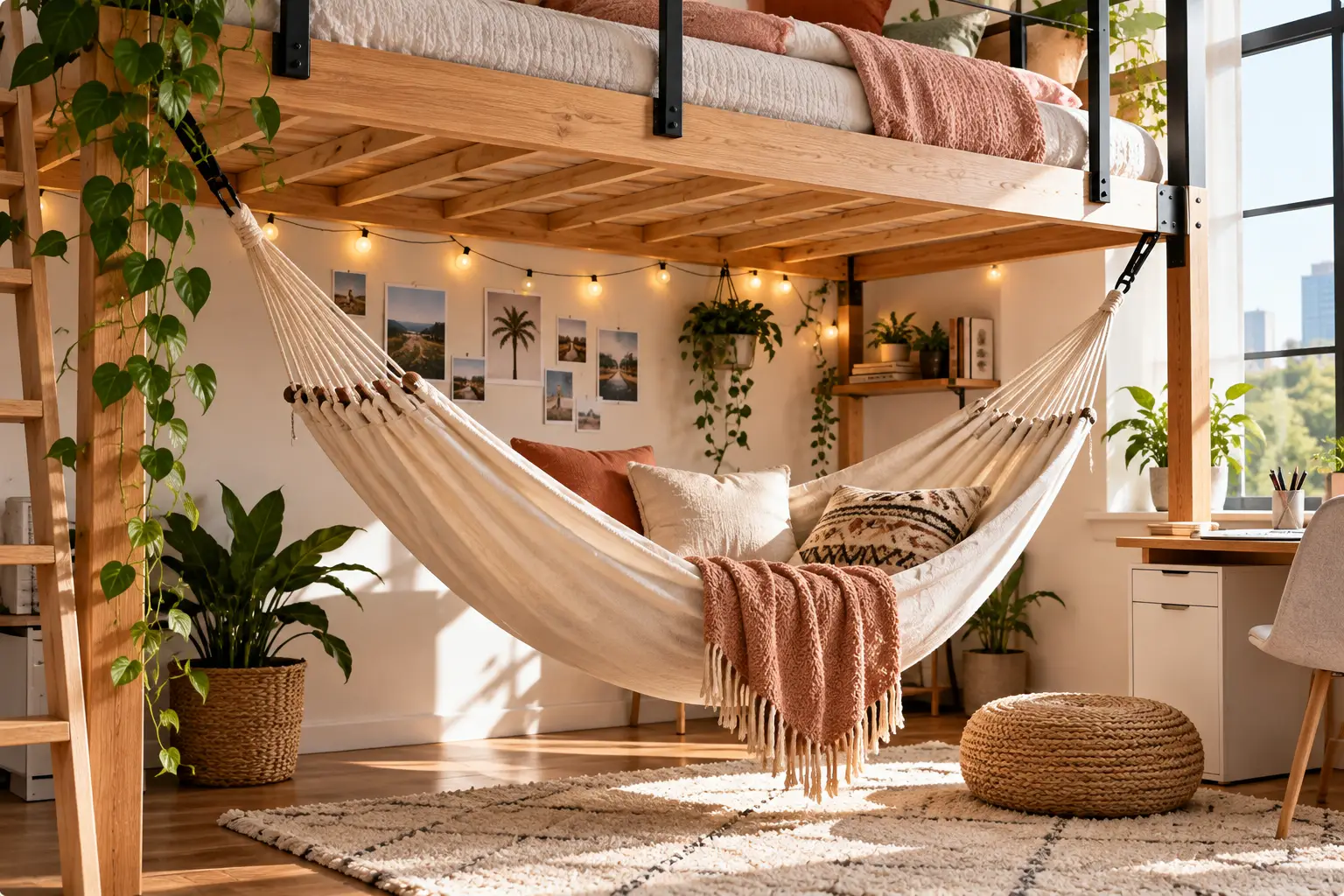
In This Article
Why a Loft Hammock Is the Smartest Upgrade Your Upstairs Hasn’t Had Yet
Every home with a loft has the same problem: a strange, half-used space that collects laundry baskets, forgotten exercise bikes, and boxes labeled “misc.” A loft hammock fixes that in one move. Instead of another piece of furniture eating floor space, you get a place to read, nap, or let the kids burn off energy, all suspended in the air where nothing else was happening anyway.
Here’s the catch, though. The phrase loft hammock covers two very different things. Some people mean a tensioned net stretched across an open loft or mezzanine, like a trampoline you lounge on. Others mean a regular fabric hammock that fits a loft’s footprint, usually on a freestanding steel stand because the ceiling isn’t built for anchors. Mix those up, and you’ll end up with the wrong product, the wrong hardware, or worse, an unsafe install.
This guide sorts it out. Below, you’ll find seven real products available on amazon.com, split between loft net hammock options and stand-mounted fabric hammocks, with honest analysis built on published spec sheets, manufacturer guidance, and aggregated customer feedback. You won’t find invented test results here. You will find the stuff product listings skip: how rope thickness changes comfort, why mesh size matters for little feet, what “600 lb capacity” really means once the net is installed, and which installs need a contractor rather than a cordless drill.
By the end, you’ll know which type fits your ceiling, your budget, and your household, and you’ll have a clear plan to set it up safely. Grab a coffee. Let’s turn that dead zone into the best seat in the house.
What Is a Loft Hammock?
A loft hammock is a suspended lounging surface designed for an elevated or open interior space. It’s either a tensioned rope or knotless net anchored across a loft opening or framed void, or a fabric hammock sized for a loft and hung from structural members or a freestanding stand. Both turn unused vertical space into seating.
The word “hammock” itself goes back centuries; the history of the hammock traces it to Indigenous peoples of Central and South America, who wove sleeping nets long before Europeans adopted them aboard ships. The modern loft version borrows from both traditions.
The Two Main Families
Net-style (loft net hammock). A double-layer net is tensioned between beams, joists, or a purpose-built wood frame. You walk on it, sprawl on it, or let kids roll around like it’s a giant indoor trampoline. Some homeowners even install a hammock net for loft openings that would otherwise need a full floor, keeping light flowing to the room below.
Fabric-style (indoor hammock for loft). A Brazilian- or Colombian-style cotton or acrylic hammock on a steel stand, or hung from wall studs and ceiling joists. It’s a classic swing-and-sway experience, just indoors.
Who Each Type Suits
Net-style fits families, open-plan homes, cabins, and Airbnb rentals that want a “wow” feature. Fabric-style suits renters, apartment lofts, and anyone who can’t, or shouldn’t, drill into structure. Keep that split in mind; it shapes every recommendation that follows.
Loft Hammock Quick Comparison: All 7 Picks at a Glance
| Product | Type | Size | Rated capacity | Approx. price range | Best for |
|---|---|---|---|---|---|
| Tongmo Climbing Cargo Net | Double-layer net | 6.5′ × 9.8′ | 600 lb (listed) | Around $40–$70 | Small loft openings, kids |
| LPIW Climbing Net 9.9′ × 9.9′ | Double-layer net | 9.9′ × 9.9′ | 600 lb (per listings/roundups) | Around $50–$90 | Square lofts, family lounging |
| LPIW Climbing Net 14.8′ × 9.9′ | Double-layer net | 14.8′ × 9.9′ | 600 lb (per listings/roundups) | Around $80–$130 | Wide mezzanines |
| SCITOY Loft Net (Single Layer) | Single-layer knotless net | 7′ × 10′ | Not clearly specified | Around $30–$60 | Railing guards, light decor |
| Vivere Double Cotton Hammock with Stand | Fabric + steel stand | 9′ stand | 450 lb | Around $100–$140 | Renters, no-drill lofts |
| Vivere Sunbrella Double Hammock with Stand | Fabric + steel stand | 9′ stand | 450 lb | Around $200–$300 | Sunny lofts, skylights |
| Amazon Basics Double Hammock with 9-Foot Stand | Fabric + steel stand | 9′ stand | 450 lb | Around $80–$120 | Budget fabric setups |
Looking at this table, the dividing line is obvious: nets give you more lounging area per dollar, while stand hammocks give you zero-drill flexibility. The LPIW Climbing Net 9.9′ × 9.9′ hits the sweet spot for most square lofts, whereas the Vivere Double Cotton Hammock with Stand is the safer bet if your lease or ceiling rules out anchors. The SCITOY Loft Net sits apart because, as you’ll see, single-layer netting isn’t the right tool for full-body lounging.
💬 One click helps other shoppers make an informed choice too! 😊
Top 7 Loft Hammock Picks: Expert Analysis
Each pick below includes what the specs mean in practice, who should buy it, what aggregated reviews and roundups report, and an honest pros/cons breakdown. Prices are ranges at the time of writing; check the current price on Amazon before you buy.
1. Tongmo Climbing Cargo Net — best compact net for small loft gaps
The Tongmo Climbing Cargo Net is the easiest way to test the loft net hammock idea without committing to a huge span. Its 6.5′ × 9.8′ footprint fits narrow openings above stairwells, closet tops, or a kid’s bunk-style loft.
The listing shows a double-layer polyester build with 2-inch square mesh, a listed 600 lb load capacity, and a weight of about 6.9 lb. In practice, 2-inch mesh is small enough that toddler-sized feet won’t punch through, and well below the 3.5-inch threshold where head-entrapment concerns begin. The listing also notes the net stretches to distribute load, which feels comfy but means you’ll need to re-tension it after the first few weeks.
Based on comparing the specs, this is a kids’-zone net first and an adult lounger second. Two adults will sag it noticeably at this size, so it shines as a reading nook for children or as a cozy “catwalk” across a short gap. The bundled six carabiners, eight bells, and short fix rope are fine for testing placement, but plan to upgrade to rated quick links for permanent installs.
Detailed customer review text wasn’t independently verifiable at the time of writing; what is consistent across third-party roundups is the 600 lb listing and the included accessory kit, and the manufacturer itself pitches it for 4–5 kids playing at once.
Pros:
- ✅ Compact size fits narrow loft openings and stairwell gaps
- ✅ Tight 2-inch mesh feels secure for small children
- ✅ Storage bag makes seasonal removal painless
Cons:
- ❌ Too small for comfortable two-adult lounging
- ❌ Included carabiners aren’t ideal for permanent overhead loads
In the $40–$70 range, the Tongmo Climbing Cargo Net is strong value for a kid-focused starter install.
2. LPIW Climbing Net 9.9′ × 9.9′ — best all-around square loft net
If your loft opening is roughly square, the LPIW Climbing Net 9.9′ × 9.9′ is the pick most buyers should start with. Nearly 100 square feet of double-layer net is enough for two adults to stretch out without bumping elbows.
Third-party roundups describe it as knotless polyester with roughly 1.5-inch mesh and a 600 lb bearing capacity. Knotless matters more than it sounds: there are no hard knots digging into your back when you lie down, and fewer snag points for socks and toes. The smaller mesh also catches phones, pencils, and toy cars before they rain down on the room below.
On paper, this is the most balanced indoor hammock for loft spaces in the lineup. It’s big enough for adults, fine-meshed enough for kids, and still light enough to fold into its included storage bag. What the spec sheet doesn’t say is that a 600 lb rating is only meaningful if your anchors and framing can carry the same load, plus the extra tension forces a taut net creates.
Roundups that feature this net consistently highlight the wide coverage and the included kit (carabiners, bells, fix rope, storage bag). Detailed, verifiable review complaints were limited, so treat color-fastness and long-term stretch as unknowns you’ll monitor yourself.
Pros:
- ✅ Large square footprint suits two adults comfortably
- ✅ Knotless weave feels smooth against bare skin
- ✅ Small mesh catches dropped items before they fall
Cons:
- ❌ Needs a properly framed opening to install safely
- ❌ Long-term stretch behavior is not well documented
Around $50–$90, the LPIW Climbing Net 9.9′ × 9.9′ delivers the best area-per-dollar of any net here.
3. LPIW Climbing Net 14.8′ × 9.9′ — widest span for mezzanines
The LPIW Climbing Net 14.8′ × 9.9′ is the stretched-out sibling of pick #2, built for long rectangular lofts, open mezzanines, and cabin catwalks where one net needs to cover the whole void.
It shares the same double-layer polyester construction, roughly 1.5-inch mesh, and 600 lb rating listed in roundups, but spreads that capacity over nearly 147 square feet. In plain terms, you get more room without more strength per square foot. That’s fine for lounging, but it means a long, unsupported span will sag more at the center, so a mid-span support beam or extra tension points become important.
This net is for homeowners willing to plan the install properly, ideally with a contractor sizing the frame. It’s overkill for small spaces and a poor match for renters. For a vacation rental or a family room with a dramatic open loft, though, it creates exactly the “floating floor” look people photograph.
Aggregated listing information emphasizes the large coverage and the same accessory kit as the smaller LPIW net. I couldn’t verify a large body of detailed written reviews specific to this size, so I won’t claim more than the specs support.
Pros:
- ✅ Covers long mezzanines with a single net
- ✅ Same comfortable knotless double-layer build
- ✅ Dramatic visual centerpiece for open-plan homes
Cons:
- ❌ Center sag increases without mid-span support
- ❌ Capacity doesn’t scale up with the bigger area
At roughly $80–$130, the LPIW Climbing Net 14.8′ × 9.9′ is fair value if your space truly needs the length.
4. SCITOY Loft Net (Single Layer) — best budget edge guard, not a lounger
The SCITOY Loft Net (Single Layer) shows up when you search for loft netting on Amazon, and it’s worth explaining why it’s a different tool. It’s a black single-layer knotless woven mesh, roughly 7′ × 10′, marketed for climbing, stair guarding, and balcony anti-fall use.
Single-layer construction is lighter and more see-through, which looks sleek. But Treehouse Supplies, a US netting specialist, says it no longer recommends single-layer netting for hammock use and points buyers toward double-layer nets for anything supporting body weight. That’s a meaningful signal from a company that builds these installs for a living.
So here’s the honest positioning: use the SCITOY Loft Net to guard a loft railing, close off a staircase gap, or add a decorative barrier, not as your primary loft hammock. If you already own a properly installed double-layer net, this works well as an edge barrier around it.
Detailed, verifiable review themes weren’t available to me for this specific listing, and the listing doesn’t clearly state a lounging weight capacity, which is itself a reason to keep it in a guard role.
Pros:
- ✅ Lowest-cost way to guard railings and gaps
- ✅ Sleek black mesh suits modern interiors
- ✅ Lightweight and easy to cut-to-fit planning
Cons:
- ❌ Single layer isn’t recommended for lounging loads
- ❌ No clearly stated weight rating for hammock use
In the $30–$60 range, the SCITOY Loft Net (Single Layer) is worth it only as a barrier or accent piece.
5. Vivere Double Cotton Hammock with Stand — best no-drill loft hammock
The Vivere Double Cotton Hammock with Stand is the answer for renters and anyone with a ceiling that can’t take anchors. It’s a fabric hammock paired with a 9-foot space-saving steel stand that assembles without tools.
Listings describe a USA-grown cotton bed of about 63″ × 94″, polyester end strings, a total hammock length around 130″, and a 450 lb capacity. Polyester end strings matter because cotton strings are usually the first thing to fray; swapping them out extends service life. The 9-foot stand footprint fits most lofts with at least 10 feet of clear floor along one wall.
Based on the specs, this is the best indoor hammock for loft spaces where structure is a question mark. You trade the sprawling “floating floor” feel for a cocooning sway, and you can move it to the porch in summer. Keep in mind that a stand concentrates weight on four small feet, so check your loft floor’s rating if it’s an older or lightly framed mezzanine.
Reviews consistently describe the cotton bed as soft and cocoon-like, and praise the stand’s sturdiness. A recurring note from heavier users is that the lowest hook setting can let the hammock sit too close to the stand bar, so expect to adjust hook height.
Pros:
- ✅ Zero drilling, ideal for renters and apartments
- ✅ Soft cotton bed with a cocoon-style feel
- ✅ Polyester end strings resist fraying better
Cons:
- ❌ Lowest hook setting can sit too low
- ❌ Cotton absorbs humidity in damp lofts
Around $100–$140, the Vivere Double Cotton Hammock with Stand is excellent value for a full hammock-plus-stand combo.
6. Vivere Sunbrella Double Hammock with Stand — most fade-resistant pick
The Vivere Sunbrella Double Hammock with Stand solves a problem most loft owners don’t think about until it’s too late: skylights. Lofts tend to sit right under them, and constant UV slowly bleaches ordinary fabric.
This version uses Sunbrella, a solution-dyed acrylic where the color runs through the fiber rather than sitting on the surface. Listings put the bed around 58″ × 95″ with a 144″ total length and the same 450 lb, 9-foot stand system. Solution-dyed acrylic also resists mildew, which matters in uninsulated attic lofts that get muggy in summer.
On paper, this is the premium fabric pick. It’s for homeowners with sun-soaked lofts, people who want to move the hammock outdoors seasonally, and anyone who hates watching a pricey purchase fade. If your loft is dim and climate-controlled, the cotton version gives you nearly the same experience for less.
Aggregated reviews describe a cocoon-like feel and note that it works well indoors despite being marketed for outdoor use; reviewers also mention it’s easy to move between rooms.
Pros:
- ✅ Solution-dyed fabric resists fading under skylights
- ✅ Mildew resistance suits humid attic lofts
- ✅ Moves easily between indoor and outdoor spots
Cons:
- ❌ Noticeably pricier than cotton equivalents
- ❌ Acrylic feels less soft than brushed cotton
In the $200–$300 range, the Vivere Sunbrella Double Hammock with Stand earns its price only if sun exposure is real.
7. Amazon Basics Double Hammock with 9-Foot Stand — best budget fabric option
The Amazon Basics Double Hammock with 9-Foot Stand is the value play for buyers who want a fabric loft hammock without paying for brand-name cotton. It includes a 9-foot space-saving steel stand, a carrying case, and a two-person hammock rated at 450 lb.
The stand dimensions mirror the Vivere system, so the floor-space planning is identical. What you’re giving up is mostly fabric quality and finish; the stand concept is the same steel-tube, four-foot design. For a loft where the hammock is a weekend-nap accessory rather than daily seating, that trade-off is reasonable.
Here’s what to weigh: if you’ll use it every evening, the extra money for the Vivere Double Cotton Hammock with Stand probably pays off in comfort and durability. If it’s an occasional guest-loft feature, this one keeps the budget for a good rug and reading lamp.
One third-party freestanding hammock roundup reports this model handled combined loads around 380 lb without concerning creaks or flex in its testing. Broader verified review themes weren’t available to me beyond the shared 450 lb rating.
Pros:
- ✅ Lowest-cost complete hammock and stand bundle
- ✅ Same 9-foot footprint as pricier stands
- ✅ Carrying case simplifies moving and storage
Cons:
- ❌ Fabric finish is less premium than Vivere’s
- ❌ Fewer verified long-term durability reports available
Around $80–$120, the Amazon Basics Double Hammock with 9-Foot Stand is the smart pick for occasional use.
Head-to-Head: Comparing the Top 7
| Product | Layers / fabric | Mesh or bed size | Install method | Kid-friendly? | Best for |
|---|---|---|---|---|---|
| Tongmo Climbing Cargo Net | Double polyester | 2″ mesh | Anchors + frame | Yes | Small gaps, kids’ nooks |
| LPIW Climbing Net 9.9′ × 9.9′ | Double polyester | ~1.5″ mesh | Anchors + frame | Yes | Most square lofts |
| LPIW Climbing Net 14.8′ × 9.9′ | Double polyester | ~1.5″ mesh | Anchors + frame + mid support | Yes | Long mezzanines |
| SCITOY Loft Net (Single Layer) | Single knotless | Fine mesh | Railing/edge ties | As a guard only | Edge barriers |
| Vivere Double Cotton Hammock with Stand | Cotton | ~63″ × 94″ bed | Freestanding | Supervised | Renters, no-drill |
| Vivere Sunbrella Double Hammock with Stand | Solution-dyed acrylic | ~58″ × 95″ bed | Freestanding | Supervised | Skylit lofts |
| Amazon Basics Double Hammock with 9-Foot Stand | Fabric | Double bed | Freestanding | Supervised | Tight budgets |
Reading across the rows, install method is the real decision-maker, not price. If you can build or verify a framed opening, the LPIW Climbing Net 9.9′ × 9.9′ gives the most lounging per dollar; if you can’t, the Vivere Double Cotton Hammock with Stand is the safest route. Kid-heavy households should lean net-side, since a fabric hammock flips far more easily during rough play.
How to Install a Loft Net Hammock the Right Way
This is the section product listings skip, and it’s the one that decides whether your loft hammock is a joy or a liability. When in doubt, hire a licensed contractor or structural engineer.
Step 1: Confirm the Structure
Nets don’t just carry weight downward; a tensioned net pulls sideways on its anchors. You need solid framing, typically joists, beams, or a dedicated perimeter frame. Treehouse Supplies’ own guidance calls for a wood frame at least 3 inches thick for its hammock nets, and the company deliberately avoids publishing weight capacities because every installation differs. Take that seriously: the net’s rating is meaningless if a screw pulls out of drywall.
Step 2: Choose Rated Hardware
Use forged or stainless eye bolts or screw eyes rated well above your expected load, set into solid wood, never drywall alone. Connect the net with quick links or rated shackles rather than the decorative carabiners included in many kits. Indoors, zinc-plated quick links are generally adequate; stainless is better near bathrooms or in humid attic spaces.
Step 3: Space Anchors Evenly
Place anchor points every 12–18 inches around the perimeter so load spreads across many points instead of four corners. Tension gradually, working opposite sides like tightening lug nuts on a tire.
Step 4: Close the Gaps
Check the space between the net edge and the frame. If that gap lands between 3.5 and 9 inches, it’s in the entrapment danger zone; tighten it below 3.5 inches.
Step 5: Test, Then Re-Tension
Load-test with heavy bags before anyone climbs on. Expect new polyester to stretch over the first two to four weeks, so re-tension then, and inspect hardware monthly after that.
🛠️ Ready to build your floating hideaway?
🔍 Take your loft makeover to the next level with this carefully curated lineup. Click a highlighted pick to check current pricing and availability. These choices will help you create a cozy upstairs retreat the whole family will enjoy!
Which Loft Hammock Fits Your Home? Three Real-World Scenarios
Specs only go so far. Here’s how the picks map onto real situations, including budget, use context, and frequency.
Scenario 1: The Family With an Open Loft Over the Living Room
Picture a suburban two-story with a 10′ × 10′ open loft and two kids under ten. Budget is around $300 including hardware, and the space will get daily use after school. The LPIW Climbing Net 9.9′ × 9.9′ is the natural fit: its fine mesh catches toys, its double layer handles roughhousing, and the knotless weave is comfortable for parents who’ll inevitably join movie night. Put money saved on the net toward stainless eye bolts and a contractor’s hour to verify the joists. Add the SCITOY Loft Net (Single Layer) along any open railing edge as a guard.
Scenario 2: The Renter With a Studio Loft
Now imagine a renter with a lofted sleeping area in a converted warehouse apartment. Drilling into the concrete ceiling is a lease violation, and the budget is about $150. The Vivere Double Cotton Hammock with Stand wins here. It needs no anchors, packs into a bag when moving out, and the 9-foot stand fits along one wall. If the loft gets afternoon sun through big industrial windows, stretching to the Vivere Sunbrella Double Hammock with Stand prevents fading.
Scenario 3: The Cabin Owner Building a Rental Showpiece
Finally, consider a mountain cabin listed on short-term rental sites, with a 15′ × 10′ mezzanine. The goal is a photogenic feature that drives bookings, with a $600-plus project budget. The LPIW Climbing Net 14.8′ × 9.9′ covers the span, but plan a mid-span support and professional install. Rental guests are unpredictable, so overbuild the anchors and post clear capacity rules.
Loft Hammock Problems and Fixes
Even a well-chosen loft hammock develops quirks. Here are the most common issues and what to do about them.
Problem 1: The Net Sags After a Few Weeks
Fix: That’s normal polyester creep. Re-tension evenly around the perimeter at two to four weeks, then quarterly. If sag persists on a big net like the LPIW Climbing Net 14.8′ × 9.9′, add a center support beam or extra anchor points.
Problem 2: Things Keep Falling Through
Fix: Choose a smaller mesh. The roughly 1.5-inch mesh on the LPIW nets catches more than the 2-inch Tongmo Climbing Cargo Net. For coarse-mesh nets, specialists add a fine “backer” layer underneath.
Problem 3: The Fabric Hammock Sits Too Low
Fix: Move the hooks up a notch on the stand. Reviews of the Vivere Double Cotton Hammock with Stand mention that the lowest setting can let heavier riders sink toward the bar; raising one or both hooks fixes it.
Problem 4: The Stand Scratches the Floor
Fix: Place furniture pads or a low-pile rug under each foot. Check that end caps are seated; listings for Vivere stands note plastic caps on the tube ends.
Problem 5: The Hammock Smells Musty
Fix: Cotton absorbs humidity in warm attic lofts. Improve airflow with a fan, spot-clean promptly, and consider the mildew-resistant Vivere Sunbrella Double Hammock with Stand for humid spaces.
How to Choose a Loft Hammock: 7 Steps
- Measure the space precisely. Record the opening or floor area in feet, plus clear headroom; a stand needs roughly 10 feet of wall length.
- Decide net or fabric. Nets need structure; fabric-on-stand needs only floor space.
- Verify the structure. For nets, confirm joists or a frame can take sideways tension, ideally with a pro’s sign-off.
- Match capacity to real users. Add up the heaviest realistic load, then leave a generous margin; ratings assume perfect installs.
- Pick the right mesh. Smaller mesh (1.5–2 inches) protects kids and catches dropped items.
- Choose double layer for lounging. As Treehouse Supplies explains in its netting guide, double-layer netting offers better durability and less sagging for long-term body weight.
- Budget for hardware. Rated eye bolts, quick links, and possibly labor often cost as much as the net itself.
Follow those steps in order, and you’ll eliminate about 90% of the wrong purchases people make with this category.
Loft Net Hammock vs. Hammock With Stand: Which Wins?
This is the core decision, so it deserves more than a table, though there’s one of those too.
A loft net hammock wins on space efficiency and wow factor. It uses the void itself, leaving the floor completely free. Multiple people can lounge at once, kids can play on it, and light still filters to the room below. The downside is commitment: you’re drilling into structure, often hiring help, and once it’s up, it stays up.
A hammock with a stand wins on flexibility. There’s no drilling, it moves with you, and it’s renter-friendly. But it eats floor space, fits two people at most, and the sway that makes it relaxing also makes it tippier for kids.
| Factor | Net hammock | Hammock with stand | Best for |
|---|---|---|---|
| Floor space used | None | ~9–10 ft footprint | Net: small floor plans |
| Installation | Structural anchors | Tool-free assembly | Stand: renters |
| People at once | Several | Up to 2 | Net: families |
| Portability | Low | High | Stand: frequent movers |
| Kid suitability | High (tight mesh) | Moderate | Net: young kids |
The table confirms the trade-off: nets are the better product, stands are the easier one. If you own your home and can verify the structure, a net like the LPIW Climbing Net 9.9′ × 9.9′ delivers more value; if you rent, the Vivere Double Cotton Hammock with Stand is the honest recommendation.
Features That Actually Matter (and Ones That Don’t)
Product listings for loft hammock gear love to shout about features. Some deserve attention; others are marketing glitter.
Features That Actually Matter
Double-layer construction. For any net that will hold body weight for long stretches, two layers mean better stability and less sagging. This isn’t optional for lounging.
Knotless weave. Knots create pressure points under your shoulder blades and catch toes. Knotless nets feel noticeably smoother.
Mesh size. Smaller openings keep small feet, phones, and toys where they belong. For homes with young kids, aim for 2 inches or less.
Fabric fiber. Solution-dyed acrylic resists fading and mildew; cotton is softer but more vulnerable to moisture.
End strings and stand adjustability. Polyester end strings outlast cotton ones, and multiple hook heights let you fine-tune ride height.
Features That Don’t Matter Much
Decorative bells. Fun for toddlers, irrelevant to safety or comfort.
Included carabiners. Many are convenience clips, not rated overhead hardware. Treat them as temporary.
Color names. “Rainbow” versus “black” changes the look, not the performance, though darker nets can hide dirt better.
Huge capacity numbers in isolation. A 600 lb net on weak anchors is a weak system. Capacity only matters alongside a verified install.
Safety, Codes, and Standards for an Indoor Hammock for Loft Spaces
No federal standard covers residential loft nets specifically, which is exactly why you should borrow guidance from adjacent rules.
Entrapment Spacing
The CPSC Public Playground Safety Handbook treats openings between 3.5 and 9 inches as head-entrapment hazards. It’s written for public playgrounds, not homes, but the physics of a child’s head don’t change. Keep net mesh and edge gaps below 3.5 inches.
Guards and Railings
The International Residential Code, which most US jurisdictions adopt in some form, generally requires guards on walking surfaces more than 30 inches above the floor below, typically at least 36 inches tall with openings that won’t pass a 4-inch sphere. A loft net doesn’t remove the need for a proper guard along open edges; check your local building department before altering railings.
Permits and Inspections
Adding a structural net or modifying framing may require a permit in some cities. Rental properties may also face insurance questions, so tell your insurer before guests use it.
Hardware Quality
Use load-rated hardware from reputable suppliers, avoid open S-hooks that can snag clothing, and inspect everything monthly.
Supervision
Even the best net isn’t a babysitter. Set capacity rules, keep younger children supervised, and never allow jumping from the loft edge onto the net.
Long-Term Cost and Maintenance
The sticker price is only part of the story. Here’s what owning a loft hammock really costs over a few years.
| Product | Upfront (approx.) | Typical extra costs | Long-term value | Best for |
|---|---|---|---|---|
| Tongmo Climbing Cargo Net | $40–$70 | Rated hardware, possible frame | Good for kids’ phase | Short-term family use |
| LPIW Climbing Net 9.9′ × 9.9′ | $50–$90 | Hardware, optional install labor | Excellent | Long-term family lounging |
| Vivere Double Cotton Hammock with Stand | $100–$140 | Replacement hammock bed eventually | Very good | Renters |
| Vivere Sunbrella Double Hammock with Stand | $200–$300 | Minimal | Strong in sunny lofts | Skylit lofts |
The pattern is clear: nets look cheapest but carry hidden hardware and labor costs, while stand hammocks bundle almost everything upfront. Over five years, the LPIW Climbing Net 9.9′ × 9.9′ still tends to win on cost per hour of use for families, while the Vivere Sunbrella Double Hammock with Stand justifies its premium only where sun would destroy a cotton bed.
A Simple Maintenance Schedule
- Monthly: inspect eye bolts, quick links, and stand joints for looseness or corrosion.
- Quarterly: re-tension nets; vacuum or brush off dust.
- Twice a year: spot-wash fabric hammocks following the maker’s care tag; air-dry fully.
- Yearly: check for UV brittleness or fraying, and replace any compromised rope or end strings.
Common Mistakes to Avoid When Buying a Loft Hammock
Buying a single-layer net for lounging. It’s the most common mistake in this category. Single-layer nets suit guards and accents, not full-body weight over time.
Trusting drywall anchors. Toggle bolts in drywall are made for shelves, not people. Every overhead anchor must hit solid wood or engineered framing.
Ignoring sideways forces. A taut net pulls inward on its anchors. Builders who only think about downward weight under-build the frame.
Forgetting floor load for stands. A stand plus two adults concentrates hundreds of pounds on four small feet. Older or lightly framed mezzanines may not love that.
Skipping the edge gap check. A perfect net with a 6-inch gap at the frame creates the very entrapment risk you were trying to avoid.
Measuring the opening but not the clearance. You need headroom above a net and clearance below a fabric hammock. Measure both.
Using decorative carabiners as permanent hardware. Upgrade to rated quick links before regular use.
FAQ: Loft Hammock Questions Shoppers Ask Most
❓ Can I put a loft hammock in a rental apartment?
❓ How much weight can a loft net hammock hold?
❓ Is a loft hammock safe for toddlers?
❓ How much does a loft net installation cost?
❓ Which is better for a small loft: hammock chair or full hammock?
Conclusion: Turn That Empty Loft Into Your Favorite Room
A loft hammock is one of those rare upgrades that adds real living space without adding square footage. The trick is choosing the right type for your structure, and then installing it like you mean it.
If you own your home and have a framed opening, the LPIW Climbing Net 9.9′ × 9.9′ is the best all-around pick, with the LPIW Climbing Net 14.8′ × 9.9′ for long mezzanines and the Tongmo Climbing Cargo Net for compact kid zones. Pair any of them with the SCITOY Loft Net (Single Layer) as an edge guard rather than a lounger.
If you rent, or your ceiling is a mystery, go freestanding. The Vivere Double Cotton Hammock with Stand is the best balance of comfort and price, the Vivere Sunbrella Double Hammock with Stand is worth it under skylights, and the Amazon Basics Double Hammock with 9-Foot Stand keeps costs low for occasional use.
Whichever you choose, remember the three non-negotiables: double layers for lounging nets, rated hardware into solid framing, and gaps under 3.5 inches. Do that, and your loft stops being a storage closet and starts being the room everyone fights over.
✨ Don’t miss these top loft hammock picks!
🔍 Take your loft to the next level with this carefully curated lineup. Click a highlighted product to check current pricing and availability. These picks will help you build a relaxing upstairs hideaway the whole family will enjoy!
Recommended for You
- Lounger Hammock: 7 Best Picks for Effortless Relaxation (2026)
- How to Tie Hammock Straps: 7 Foolproof Steps + Best Straps 2026
- Haven Tent Review 2026: 7 Best Lay-Flat Hammock Tents Ranked
Disclaimer: This post contains affiliate links. As an Amazon Associate, I earn from qualifying purchases made through these links, at no additional cost to you.
✨ Found this article helpful? Share it with someone who needs it! 💬🤗