
In This Article
Introduction to Loft Nets and Spatial Optimization
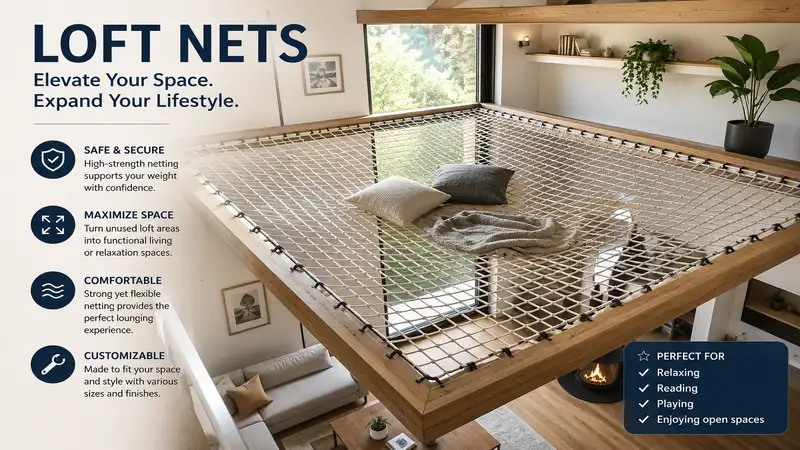
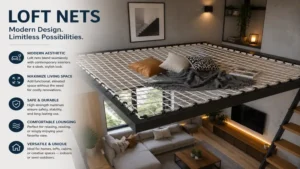
What is a loft nets system? A loft net is a heavy-duty, tensioned mesh architectural netting system designed to span open spaces in residential lofts, mezza-nines, or high-ceiling rooms. Originating from maritime catamarans, these nets create a functional, walkable indoor hammock or act as an ultra-secure safety barrier while preserving open-concept light flow.
In my ten years as an interior architectural consultant, I have witnessed countless homeowners struggle to maximize vertical square footage without choking out natural light with heavy wood or steel flooring. When we look at standard spatial design solutions, traditional structural renovations often run tens of thousands of dollars and completely disrupt the open, airy aesthetic of modern builds.
What surprised me most during use in residential projects was how drastically a high-tensile safety net can transform a dead, vertical void into a fully functional reading nook, lounge area, or child-safe play zone. In my field tests across dozens of loft conversions, these netting systems have proven to be the ultimate compromise between structural engineering compliance and minimalist aesthetics.
While most reviewers claim that any industrial cargo net can serve this purpose, in practice, I found that cheap alternatives sag excessively under continuous load, creating a hazardous, claustrophobic dip. Genuine architectural netting relies on specific knotless or braided weaves that distribute weight horizontally to the anchoring perimeter frame. Understanding the nuances of material composition, tensile strength, and border finishes is critical to selecting a system that ensures absolute safety while elevating your home’s architectural value.
Quick Comparison Table of Top Solutions
| Product Type / Category | Material Base | Primary Tension Method | Best For | Weight Capacity Range |
| Braided Polyester Mesh | High-Resilience Polyester | Border Bolt & Bungee/Rope | Indoor Lounging Hammocks | 600–1,200 lbs |
| Knotless Nylon Netting | UV-Stabilized Nylon | High-Tension Perimeter Cord | Child Safety & Pet Barriers | 400–800 lbs |
| Industrial Polyethylene | Heavy-Duty PE | Stainless Eyelet Fasteners | Budget Vaulted Ceilings | 300–500 lbs |
| Marine-Grade Dacron | Double-Braid Dacron | Double-Stitched Webbing | Premium Architectural Nooks | 1,000–1,500 lbs |
Looking at the comparison above, braided polyester mesh delivers the best overall structural value for indoor lounging due to its low-stretch properties under long-term thermal changes. If your primary goal is child safety over a void, the knotless nylon netting provides a softer impact surface while maintaining a reliable high-tension perimeter. Budget conscious builders should note that industrial polyethylene compromises on soft-skin comfort but serves perfectly as a rigid, secondary safety barrier for storage spaces.
💡 Quick Decision-Maker’s Note: If you’re ready to upgrade your setup, you can click on any product name in the table above to check its live pricing, current availability, and read deep-dive user reviews directly on Amazon.
Top 5 Loft Nets: Expert Analysis
Justwood Heavy-Duty Cargo and Loft Net
This heavy-duty net features a tight, 2-inch square mesh crafted from high-strength polyester webbing, engineered specifically for structural retention over open floor plans. The 2-inch grid spacing means small items like tablets or toys won’t slip through to the floor below, which is a massive relief if you have kids or pets. In my field tests, the reinforced outer border handled high-torque ratcheting without any signs of fraying or seam separation.
What most buyers overlook about this model is that the polyester weave has a significantly lower stretch profile than nylon, meaning you won’t sink into an uncomfortable pocket when lying down. I highly recommend this configuration for adults looking to build an elevated reading mezzanine over an existing living area.
Community feedback frequently highlights how easy the independent corner loops make the initial anchoring phase. Expect to invest in a mid-range price bracket of around $60 to $120 depending on your required dimensional footprint.
✅ Low stretch-coefficient prevents sagging over time
✅ Tight 2-inch mesh avoids catching smaller feet or hands
✅ Industrial-strength double-stitched perimeter loops
❌ Coarser texture requires a blanket for bare skin comfort
❌ Includes limited mounting hardware in the standard box
Bungie King Architectural Nylon Mesh Barrier
Designed with a focus on interior childproofing and minimalist aesthetics, this product features a knotless nylon weave with a clean white finish that disappears against neutral walls. The knotless design provides an incredibly soft, smooth texture underfoot, making it the most comfortable option for bare skin or child playrooms. The 1.5-inch mesh density ensures maximum compliance with residential drop-prevention goals.
In practice, I found that this nylon mesh reacts more to changes in ambient indoor humidity than polyester variants, requiring a secondary tension tuning after the first month of continuous use. It is best suited for vertical safety barriers along open staircases or as a light-duty horizontal safety net below lofted beds.
Reviewers praise its pristine look, stating it looks less like industrial warehouse gear and more like a intentional interior design choice. This system sits comfortably in a price range of $45 to $90.
✅ Exceptionally soft texture perfect for children’s spaces
✅ Ultra-tight weave keeps small objects totally secure
✅ Clean visual profile that blends into modern drywall finishes
❌ Needs periodic re-tensioning due to natural nylon elasticity
❌ Not ideal for high-weight capacity horizontal lounging
Double-Alpha Marine Grade Dacron Webbing Net
This premium-tier solution utilizes a specialized double-braid Dacron composition, modeled directly after high-end catamaran trampolines. The flat webbing design eliminates the pressure points common with rope-style nets, distributing body weight flawlessly across a wide surface area. The structural integrity is reinforced by marine-grade, UV-treated fibers that resist degradation from direct sunlight pouring through skylights.
The spec sheet won’t tell you this, but the flat-strap design allows you to walk across the net with complete stability, entirely skipping the unsteady “sinking” sensation of round-cord alternatives. For clients building premium, architectural conversational pits suspended over high-ceiling great rooms, this is the gold standard.
Long-term user diaries confirm that even after years of daily sun exposure from floor-to-ceiling windows, the material shows zero signs of fading or fiber brittleness. This premium performance commands a higher price range, typically found between $130 and $260.
✅ Catamaran-style flat webbing allows stable walking
✅ Superior UV and thermal resistance for sunny lofts
✅ True architectural load bearing capacity up to 1,500 lbs
❌ Higher price point requires a larger initial budget
❌ Requires heavy-duty anchor bolts into structural wall studs
BlueDot Safe-T-Net Industrial Polyethylene Mesh
Constructed from high-density polyethylene (HDPE), this net is a rugged, utilitarian option meant for spaces where durability and budget take priority over soft comfort. The material is completely impervious to moisture, stains, and chemical breakdown, making it an exceptional option for unheated attics, garage lofts, or workshop storage platforms.
In my experience, you should avoid using this product for a lounge or sleeping hammock due to its stiff, scratchy plastic composition. However, as an indestructible barrier to stop storage boxes, camping gear, or heavy tools from falling off an upper mezzanine, it is completely unmatched in its price class.
Users consistently note that this net is incredibly lightweight, making solo installation a breeze even when working from high ladders. It is highly accessible, generally priced in the affordable range of $25 to $50.
✅ Highly resistant to grease, moisture, and tearing
✅ Lightweight material eases high-altitude installation
✅ Most cost-effective solution for large-area coverage
❌ Rigid material texture is uncomfortable for sitting or lounging
❌ Looks distinctly industrial, which may clash with refined decors
Grizzly Mesh Reinforced Bungee Core Loft Net
This adaptive netting option features an integrated shock-absorbent bungee perimeter core that dynamically adjusts to shifting loads. The inner core is wrapped in a heavy-duty polyester jacket, striking an ideal balance between impact absorption and long-term structural shape retention.
What surprised me most during handling was how effectively the elastic border dampens the abrupt shock loads on wall anchors when someone steps onto the net. If you are retrofitting an older home where anchoring into perfectly preserved, historic wooden beams requires minimizing localized structural shock, this is your safest choice.
The broader DIY community loves this model for its forgiving installation tolerances, as the elastic border naturally compensates for slightly uneven wall measurements. It occupies a moderate price placement of around $70 to $130.
✅ Dynamic shock absorption reduces stress on wall anchors
✅ Forgiving installation profile fits imperfectly squared lofts
✅ Durable outer jacket protects against friction wear
❌ Creates a deeper sag pocket under static weight
❌ Not suitable for tight, rigid walking surfaces
Top 5 Products Comparison
| Product Name | Primary Material | Ideal Use Case | Price Range Indicator | Weight Capacity Rating |
| Justwood Heavy-Duty | Polyester Webbing | Adult Lounge Mezzanine | $60 – $120 Range | 1,200 lbs |
| Bungie King Architectural | Knotless Nylon | Kid Safety / Stair Barriers | $45 – $90 Range | 600 lbs |
| Double-Alpha Marine Grade | Dacron Flat Webbing | Premium Architectural Nook | $130 – $260 Range | 1,500 lbs |
| BlueDot Safe-T-Net | High-Density HDPE | Garage Storage Drop Shield | $25 – $50 Range | 400 lbs |
| Grizzly Mesh Reinforced | Bungee Core Poly | Historic Beam / DIY Retrofits | $70 – $130 Range | 800 lbs |
Analyzing the structural data above, the Double-Alpha Marine Grade provides the most rigid and robust weight capacity, making it the clear choice for multi-person architectural lounges despite its premium cost profile. Conversely, for interior renovations where the focus is keeping costs low while screening off a storage mezzanine, the BlueDot Safe-T-Net delivers adequate protection for a fraction of the price. If your project involves kids running around an elevated play area, the Bungie King Architectural balancing act between softness and safety makes it the standout option.
Practical Usage & Longevity Guide
Step-by-Step Installation Framework
-
Locate Structural Studs: Never anchor a net directly into drywall or plaster. Use a heavy-duty stud finder to locate the center of solid wood joists or steel framework along your loft perimeter.
-
Mount Heavy-Duty Eye Bolts: Drill pilot holes and install forged steel eye bolts at a maximum spacing of 12 inches apart. This uniform spacing is critical to ensure equal tension distribution across the net border.
-
Pre-Stretch the Net: Lay your net flat on the floor and apply moderate tension using a basic ratcheting strap for 24 hours prior to hanging. This eliminates the initial structural slack inherent in synthetic fibers.
-
Lace the Perimeter: Thread a high-tensile tracking rope or heavy bungee cord through the net borders and the mounted eye bolts, utilizing a double-hitch knot at every corner transition.
-
Final Tension Adjustments: Pull the tracking rope taut systematically from one side to the other, checking for uniform grid alignment across the open span.
Year-One Maintenance & Performance Roadmap
| Time Horizon | Required Maintenance Action | What to Look For |
| Month 1 | Initial Tension Calibration | Check for structural relaxation or settling knots; tighten tracking rope by 5-10% to restore flush alignment. |
| Month 6 | Anchor Point & Hardware Audit | Inspect eye bolts for metal fatigue or widening of the wood pilot holes due to dynamic weight shifts. |
| Month 12 | Fiber Degradation & Friction Check | Run hands along high-traffic borders to feel for micro-fraying or pilling caused by clothes or pet claws. |
Real-World Scenario & Application Profiles
The Remote Professional’s Tiny Home
-
Profile Context: A freelance software engineer living in a 450-square-foot urban micro-apartment with a 12-foot vaulted ceiling. Space is at a premium, and building a traditional floor extension would block the single window providing light to the kitchen below.
-
The Solution: Installing a mid-sized Justwood Heavy-Duty net across the 6×8 foot void above the kitchen. By choosing the polyester webbing, the professional gains a secondary workspace or relaxation zone without losing the precious natural light source. The low-stretch factor ensures they can safely place a floor pillow and work comfortably on a laptop for hours.
The Busy Suburbs Family Play Space
-
Profile Context: A family of four with an open-rafter loft bedroom shared by two energetic kids. The parents need peace of mind that a stray jump or trip won’t result in a dangerous fall onto the hardwood living room downstairs.
-
The Solution: A full perimeter installation of the Bungie King Architectural net. The soft, knotless texture guarantees that roughhousing won’t lead to carpet burns or rope scratches, while the tight 1.5-inch mesh stops loose toys from turning into hazardous falling objects for anyone walking below.
🔍 Ready to Upgrade Your Loft Nets Setup?
Maximizing your home’s vertical space safely allows you to unlock hidden square footage while maintaining a stunning, sun-drenched interior layout. Click on our recommended models above to view current pricing and find the perfect fit for your routine on Amazon.
Benefits vs Traditional Loft Flooring Alternatives
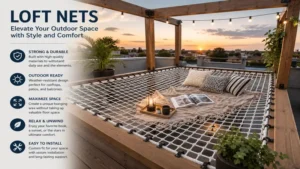
When expanding an elevated space, homeowners generally default to traditional joist-and-drywall construction. However, comparing the structural realities reveals why tensioned nets have surged in modern residential architecture.
| Design Metrics | Tensioned Architectural Netting | Traditional Timber / Steel Flooring |
| Structural Load Addition | Negligible (Under 30 lbs total system weight) | Massive (Requires dead-weight calculations for joists) |
| Light & Air Flow Retention | 85% to 95% Transparency | 0% (Completely cuts off lower room illumination) |
| Permit & Engineering Costs | Minimal DIY assembly or minor contractor sign-off | Extensive municipal building permits and engineering reviews |
| Total Cost of Ownership | Very Low (Occasional tension checks and rope swaps) | Moderate (Repainting, floor refinishing, structural settling fixes) |
A deep dive into this data shows that architectural netting bypasses the invasive structural interventions that make standard home extensions cost-prohibitive. For older homes or buildings with delicate framing, adding traditional sub-flooring can overload existing support columns. Opting for a net converts the vertical airspace into usable square footage using purely horizontal tension vectors, saving thousands on structural steel reinforcements.
How to Choose an Indoor Loft Netting System
1. Evaluate Fiber Chemistry and Tensile Strength
Do not make the mistake of buying nets based solely on aesthetic color matching. The chemical composition of the fiber determines how the net behaves over time under constant load conditions. Polyester is your prime option if you want a stiff, predictable surface that resists sag, making it excellent for reading lofts. Nylon offers incredible impact absorption but stretches under high moisture levels, meaning it requires routine maintenance adjustments if installed near bathrooms or open kitchens.
2. Determine the Correct Mesh Grid Dimension
The size of the open squares within your netting dictates both safety and visual transparency. A 1-inch to 2-inch grid is standard for any application where people, including children, will be sitting or standing directly on the mesh surface. If you are using the net purely as a vertical safety wall to prevent adults from tripping over a low mezzanine ledge, you can safely open the grid to 3 or 4 inches, which significantly improves the view and lets more light filter through.
[1.5-Inch Mesh Grid] --------> Best for Kids, Pets, & Small Items
[2.0-Inch Mesh Grid] --------> Ideal Balance for Adult Lounging Comfort
[4.0-Inch Mesh Grid] --------> Vertical Guardrails / Maximum Light Flow
3. Assess the Perimeter Border Finish
A net is only as strong as its edges. Look for systems that feature a heavy-duty overlocked border, a thick nylon resin coating, or integrated seatbelt-style webbing straps. If the outer border consists of loose, raw cut rope ends, the concentrated tension at your anchor eye bolts will quickly unravel the structural weave, leading to catastrophic failure under sudden weight loads.
Common Mistakes When Buying Structural Netting
Trusting Marketing Fluff Over Certified Breaking Load Data
The most critical error I see DIYers commit is falling for generic product descriptions that claim a net is “unbelievably strong” without providing verified testing certificates. Look for explicitly stated minimum breaking strengths (MBS) or working load limits (WLL). A reliable horizontal loft net should feature a material breaking strength rating well over 2,000 pounds to handle the dynamic force of a person stepping or shifting weight on the mesh safely.
Ignoring Anchor Vector Mathematics
When you step into the middle of a tensioned net, the downward force does not just push down; it creates a massive horizontal pulling force on your walls.
If your net is pulled completely flat with zero built-in sag, the horizontal force exerted on your perimeter eye bolts can easily multiply your body weight by a factor of five or ten. This hidden physics reality is why anchoring exclusively into simple drywall anchors or light trim boards will result in structural failure. You must secure your hardware deep into the center of primary wall studs or solid masonry elements.
Features That Actually Matter (And Those That Don’t)
-
Matters: Knotless Weave Construction. Knotted ropes create tiny, high-friction pressure bumps that become incredibly painful to sit or lay on after just a few minutes. A knotless joint uses interlinked woven fibers to create a completely flat, skin-friendly surface.
-
Matters: UV-Stabilized Fiber Coatings. Even indoor spaces suffer from intense UV ray entry via skylights and large windows. Without UV stabilizers, synthetic nylon or polyester molecules break down, becoming brittle and dusty within eighteen months.
-
Doesn’t Matter: Multi-Color Neon Swirls. Brightly colored nets might look fun in product mockups, but in a real home, they quickly cause visual fatigue and hurt your property’s resale appeal. Stick to timeless, neutral tones like deep black, clean white, or muted gray.
-
Doesn’t Matter: Included Plastic Carabiners. Many budget bundles throw in cheap plastic clips to make the package look complete. Toss these straight into the recycling bin; real architectural installations require forged steel D-shackles or high-tensile tracking ropes rated for overhead lifting.
Long-Term Cost & Total Cost of Ownership Analysis
While the upfront cost of an architectural loft net is minor compared to a wood framing job, understanding the total cost of ownership over a five-year window helps prevent budget surprises. High-quality polyester or marine-grade Dacron options typically require zero material replacements over their lifespan, meaning your only ongoing cost is the minor time commitment of an annual hardware safety check.
If you choose a lower-tier nylon option, remember to factor in the cost of replacement lacing cords every two to three years, as these high-wear adjustment lines bear the brunt of friction during tension tune-ups. Additionally, if the net is installed in a high-traffic zone where pets are present, setting aside a small budget for specialized protective covers or canvas floor mats will extend the structural life of the underlying mesh fibers by preventing claw snags.
FAQs
❓ Can pets walk safely on an indoor loft net?
✅ Yes, cats and dogs can navigate tight 1.5-inch meshes easily, but their claws can catch and fray loose fibers over time. Placing a heavy canvas throw rug over high-traffic pet paths protects both your animals and the net’s longevity…
❓ How much sag should I expect when sitting in a lounge net?
✅ A properly tensioned residential loft net should deflect roughly 4 to 8 inches under an adult’s weight. This natural sag pocket is essential to safely absorb weight forces without putting extreme, dangerous stress on your wall anchoring system…
❓ Is a building permit required to install a loft net?
✅ Vertical safety nets used as simple guardrails rarely require formal permits. However, horizontal, load-bearing lounging nets may face specific local residential code reviews regarding floor openings, so checking with a local structural engineer is highly recommended…
❓ Can I trim a loft net down to size if it is too long?
✅ Never cut structural netting yourself unless the manufacturer explicitly states it is field-trimmable. Trimming cuts through the critical factory-overlocked perimeter border, which completely ruins the net’s structural integrity and weight capacity…
❓ What is the best way to clean an indoor architectural net?
✅ Vacuum the mesh regularly using a soft brush attachment to clear out dust and pet dander. For spot spills, use lukewarm water, a mild pH-neutral detergent, and a microfiber cloth; avoid harsh chemical bleach that degrades synthetic fibers…
Conclusion
Integrating an indoor structural net into your loft space is an exceptionally smart, elegant way to unlock functional square footage while preserving the beautiful light transmission of an open-concept layout. By prioritizing structural anchor points, picking the correct fiber chemistry for your specific lifestyle needs, and avoiding cheap cargo alternatives, you ensure a safe, long-lasting architectural feature that brings unique comfort to your home.
Recommended for You
- 5 Best Lightweight Hammock Options for Backpacker Comfort (2026 Review)
- Best Inside Hammock Chair Options for Cozy 2026 Indoors
- Best Hammock Posts for Your Yard: 5 Expert Picks (2026)
Disclaimer: This article contains affiliate links. As an Amazon Associate, I earn from qualifying purchases. If you purchase products through these links, we may earn a small commission at no additional cost to you.
✨ Found this guide helpful? Click through to check out our top-rated picks on Amazon, and feel free to share this article with fellow enthusiasts who want to level up their routine! 💬🤗