
In This Article
Why a Winter Camping Hammock Tent Lives or Dies by Its Insulation
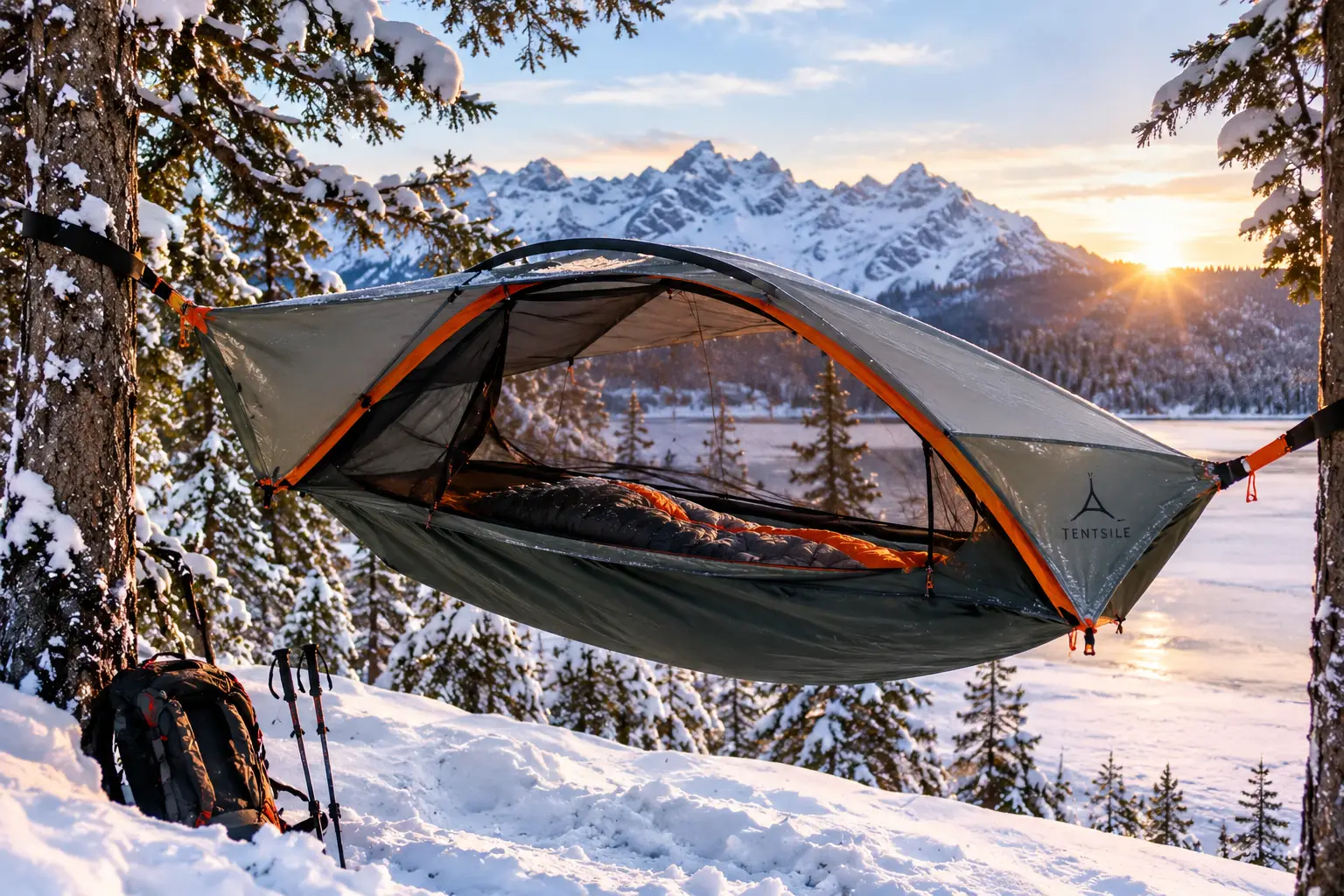
Picture this: it’s 22°F, the stars are absurdly bright, and you’re floating between two hemlocks instead of lying on frozen, lumpy ground. Sounds dreamy, right? It is, until a breeze slides under your hammock and steals every bit of warmth from your back in about ten minutes flat. That’s the paradox of a winter camping hammock tent. The same airflow that makes hammocks blissful in July can make them brutal in January.
What Is a Winter Camping Hammock Tent?
A winter camping hammock tent is a suspended, enclosed shelter (hammock body, bug net or weather cover, and a rain tarp) paired with cold-rated insulation, usually an underquilt beneath you and a top quilt above, so you can sleep off the frozen ground without losing body heat to moving air below.
Here’s the part most product listings skip: almost no hammock is warm on its own. As the hammock camping overview on Wikipedia explains, a regular sleeping bag gets crushed flat under your body weight, so its bottom insulation stops trapping air. That’s why serious hangers talk about a hammock system, not a hammock.
In this guide, we compare seven real hammock tents you can find on Amazon, from a purpose-built cold weather hammock tent with a double-layer bottom to budget kits that need a few add-ons to survive a hard freeze. For each one, you’ll get honest analysis based on spec sheets and published review sentiment, plus the exact upgrades it needs for winter. Then we cover setup, insulation, safety, and total cost, so you can build a winter hammock camping setup that actually keeps you warm.
Quick Comparison: 7 Winter Camping Hammock Tent Picks at a Glance
Before we dig into each model, here’s the 30-second version. Weights are the manufacturer or reviewer figures cited later in this guide, and prices are approximate ranges at the time of writing, so check the current price before you buy.
| Hammock Tent | Listed Weight | Standout Cold-Weather Feature | Approx. Price | Best For |
|---|---|---|---|---|
| Hennessy Hammock 4Season Expedition Zip | ~5 lb 3 oz (with straps) | Double-layer bottom holding a foam pad + space blanket | Upper tier, roughly $300–$450 | Hennessy Hammock 4Season Expedition Zip: one-box winter readiness |
| Kammok Mantis UL | 2 lb 3 oz (full kit) | Optional Winter Barrier + underquilt snap loops | Around $260–$330 | Kammok Mantis UL: weight-conscious backpackers |
| Haven Lay Flat Hammock Tent | ~7.2 lb | Truly flat lay that works with an insulated pad | Around $340–$370 | Haven Lay Flat Hammock Tent: side sleepers |
| Lawson Blue Ridge Camping Hammock | 4.25 lb | Spreader-bar bed + ground-tent mode | Around $170–$230 | Lawson Blue Ridge Camping Hammock: treeline-edge trips |
| Grand Trunk Air Bivy | 3 lb 5 oz (hammock + tarp) | Generous hex silnylon tarp | Around $180–$200 | Grand Trunk Air Bivy: budget all-in-one buyers |
| ENO JungleNest | 20 oz (hammock only) | Bug net fully stows for winter add-ons | Around $100–$120 (straps extra) | ENO JungleNest: modular builders |
| Onewind Airstream Hammock | 2.8 lb (with net, windsock, suspension) | Detachable winter windsock cover | Budget tier, typically under $150 | Onewind Airstream Hammock: first winter trips on a budget |
Reading the table, the clearest split is integrated insulation versus integrated weather protection. Only the Hennessy Hammock 4Season Expedition Zip ships with built-in bottom insulation; the Kammok Mantis UL and Onewind Airstream Hammock give you a wind barrier, but you still supply the underquilt. Meanwhile, the Haven Lay Flat Hammock Tent and Lawson Blue Ridge Camping Hammock win on comfort and flexibility, yet their weight makes them better suited to short hikes and car camping than long winter treks.
💬 One click helps other shoppers make an informed choice too! 😊
Top 7 Winter Camping Hammock Tent Picks: Expert Analysis
Every pick below is a real, currently listed product. We haven’t slept in all seven, so instead of invented test stories you get spec-sheet analysis, published editorial findings, and aggregated owner sentiment, with clear notes on what each model needs before it’s ready for freezing nights.
1. Hennessy Hammock 4Season Expedition Zip — built-in insulation out of the box
This is the rare hammock that arrives with a cold-weather plan already sewn in. The Hennessy Hammock 4Season Expedition Zip uses a two-layer bottom (one layer of 70D nylon, one of 40D) that holds an oversized 30-inch open-cell foam pad and a reflective space blanket. In practice, the pocket keeps the pad on the correct diagonal, so it won’t slide out from under your hips at 2 a.m. Hennessy states that most people are comfortable to about 39°F (4°C) with the pad alone, and that adding the space blanket takes you below freezing.
Based on comparing the specs, this is the best fit for campers who want one box and zero DIY. The patented asymmetrical shape and structural ridgeline give a flatter diagonal lay, and the 10-foot by 59-inch body supports up to 250 lb. The trade-off is bulk: GearJunkie lists it at roughly 5 lb 3 oz with straps.
Editorial reviewers consistently praise its temperature range and comfort while flagging the weight and a fiddly setup. We could not verify a large pool of Amazon reviews for this exact variant, so lean on those published findings.
Pros:
- ✅ Insulation system included, no underquilt purchase needed
- ✅ Asymmetrical lay is noticeably flatter than gathered-end hammocks
- ✅ Pad pocket stops insulation from shifting overnight
Cons:
- ❌ Heaviest hang-only option on this list
- ❌ Setup has a real learning curve
Premium-priced (roughly $300–$450, check current price), but it replaces a separate underquilt, which makes the value stronger than the sticker suggests.
2. Kammok Mantis UL — lightest complete kit with a winter upgrade path
The Kammok Mantis UL packs a hammock, removable bug net, structural ridgeline, catenary-cut tarp, Python 10 UL straps, and six stakes into a 2 lb 3 oz bundle. That’s a whole shelter for less than many solo tents weigh.
The hammock body is 20D diamond ripstop rated to 300 lb. In winter terms, two details matter more than the weight. First, the bug net zips off completely, and Kammok sells a Winter Barrier that swaps in to block wind and add a few degrees of warmth. Second, grosgrain loops around the perimeter let a Kammok underquilt snap on cleanly, which reduces drafty gaps.
Here’s what to weigh: this is a modular kit, so the winter version means buying the barrier and an underquilt. CleverHiker named it their best all-in-one kit after testing in Minnesota, though testers of different heights disagreed on comfort and found the bug-net zipper stopping mid-body annoying. A few owners in hammock-forum comment threads report fabric failures that Kammok replaced under warranty.
Pros:
- ✅ Full shelter under 2.5 pounds
- ✅ Clean underquilt attachment points reduce drafts
- ✅ Knotless suspension sets up in about a minute
Cons:
- ❌ Winter Barrier and underquilt cost extra
- ❌ Light 20D fabric demands careful handling
Around $260–$330 at the time of writing; strong value if you’ll use it all four seasons.
3. Haven Lay Flat Hammock Tent — true flat lay for side sleepers
If banana-shaped sleep is your dealbreaker, the Haven Lay Flat Hammock Tent is the answer. Its frame and tension system create a genuinely flat bed instead of a curve.
The body uses 210T polyester with a 20D ripstop nylon fly, and a standard and XL size are available. A flat bed changes winter math: because you lie on a pad like you would in a tent, a high R-value insulated pad becomes your bottom insulation. That’s simpler for beginners than tuning an underquilt, but the pad still needs to be cold-rated.
On paper, this suits side and stomach sleepers who have given up on traditional hammocks. The catch is weight, about 7.2 lb, which pushes it toward car camping and short hike-ins.
At the time of writing, a price-tracking aggregator showed about 123 Amazon reviews averaging 4.0 stars. Reviewers praise sleeping comfort and setup, while common complaints include a narrow feel, weight, a finicky setup, and air pads that lost pressure.
Pros:
- ✅ Flattest sleeping surface in this roundup
- ✅ Works with insulated pads you may already own
- ✅ Enclosed body cuts drafts around your sides
Cons:
- ❌ Too heavy for long backpacking trips
- ❌ Some owners report air-pad leaks
Around $340–$370; worth it if flat sleep matters more to you than ounces.
4. Lawson Blue Ridge Camping Hammock — goes to ground when trees run out
The Lawson Blue Ridge Camping Hammock is a hybrid: hang it between trees, or stake it out as a one-person ground tent when the forest thins near treeline.
An arch pole and spreader bars keep the nylon pack-cloth bed taut, which eliminates the cocoon squeeze. That flat-ish bed holds a sleeping pad well, so you can insulate it with a pad instead of an underquilt. The no-see-um netting is attached, and the rip-stop fly clips directly to the hammock, so you don’t need extra trees for a tarp. It weighs 4.25 lb and carries up to 275 lb.
Be honest with yourself about conditions, though. Lawson positions it as a three-season shelter, and its fly is compact, so it shines in late fall and mild winter rather than snowstorms. In GearJunkie’s head-to-head camping hammock test, it won on ease of use, comfort, and price, while other reviewers note it’s far from ultralight.
Pros:
- ✅ Doubles as a ground tent above treeline
- ✅ Spreader bars create a flatter, roomier bed
- ✅ Fly attaches directly, no separate tarp rigging
Cons:
- ❌ Small fly offers limited storm coverage
- ❌ Straps are sold separately
Around $170–$230; excellent value for shoulder-season and mild-winter versatility.
5. Grand Trunk Air Bivy — best-value hex tarp coverage
Most budget hammock kits cut corners on the tarp. The Grand Trunk Air Bivy does the opposite, and in winter, the tarp is your windbreak, snow shed, and heat trap all at once.
Grand Trunk chose a hex-shaped tarp in 20-denier silnylon, a smart balance between weight and durability. In practice, the hex shape covers the hammock ends better than a cheap square tarp, so wind-driven snow has fewer ways in. The hammock includes a bug net with a spreader bar and supports up to 400 lb. CleverHiker measured the hammock and tarp at 3 lb 5 oz and named it their best budget all-in-one kit, calling its tarp the best they’d seen on an entry-level hammock.
Who’s it for? Campers stepping into hammocks who want reliable weather protection without paying premium prices. For winter, you’ll still need an underquilt and top quilt, so think of this as a solid shell rather than a complete cold-weather system. Reviewers also note that the overhead gear loft sags into the sleeping area once you load it.
Pros:
- ✅ Hex silnylon tarp beats most budget kits
- ✅ High 400 lb weight capacity
- ✅ Spreader bar keeps netting off your face
Cons:
- ❌ No included insulation for cold nights
- ❌ Gear loft droops when loaded
Around $180–$200 at the time of writing; strong value for the tarp quality alone.
6. ENO JungleNest — big-brand build with a stowable net
The ENO JungleNest is the hammock body for people who like to assemble their own winter rig piece by piece.
Its 10-foot body (about 4 ft 10 in wide) is cut from 40D NewWave ripstop nylon and weighs just 20 oz, with a 300 lb capacity. A structural ridgeline sets the same sag every time, which matters in winter because consistent sag keeps an underquilt snug against you instead of gaping. The integrated net uses a DAC spreader bar for headroom, and it unzips completely and stows in an end pocket, freeing the body for a winter cover or extra layers. Straps are sold separately; ENO’s JungleLink system bundles the hammock with a DryFly tarp and Helios straps.
Based on comparing the specs, this is ideal for modular builders who already own, or plan to buy, a dedicated underquilt and winter tarp. The Ultimate Hang’s reviewer credited its dimensions and fixed hang angle for an unusually good night’s sleep, though they noted typical zipper frustrations. One REI reviewer wished it carried more weight.
Pros:
- ✅ Lightest hammock body on this list
- ✅ Structural ridgeline makes underquilt fit repeatable
- ✅ Net stows completely for winter use
Cons:
- ❌ Tarp, straps, and insulation not included
- ❌ 300 lb limit trails some rivals
Around $100–$120 for the hammock; the most affordable foundation for a custom winter build.
7. Onewind Airstream Hammock — built-in winter windsock on a budget
The Onewind Airstream Hammock is a 3-in-1 design: open hammock, bug-proof enclosure, or wind-blocking winter shelter thanks to a detachable windsock that covers the top.
Why does a windsock matter? Wind chill steals heat from your face and quilt surface even when your underquilt is perfect. A fabric top cover creates a pocket of calmer, slightly warmer air, the same idea as Kammok’s Winter Barrier but included in the box. Onewind lists the whole package, including bug net, windsock, and suspension, at 2.8 lb, packing down to about 5 by 11 inches.
This suits budget-minded campers trying their first freezing-night hangs. Pair it with a separate tarp and an underquilt. We couldn’t verify a substantial pool of Amazon reviews specific to the Airstream, so we can’t summarize owner sentiment honestly. For context, Onewind’s sibling Tempest hammock earned CleverHiker’s best budget backpacking hammock nod, which speaks to the brand’s build quality.
Pros:
- ✅ Winter top cover included, not an upsell
- ✅ Packs small at about 5 by 11 inches
- ✅ Converts between three modes in minutes
Cons:
- ❌ Limited verified review data for this model
- ❌ Tarp and underquilt sold separately
Typically under $150, check current price; a low-risk way to test winter hanging.
Winter Readiness Scorecard
| Hammock Tent | Bottom Insulation Included? | Wind Protection Included | Setup Effort | Best For |
|---|---|---|---|---|
| Hennessy Hammock 4Season Expedition Zip | Yes (foam pad + space blanket) | Asym tarp | High | Hennessy Hammock 4Season Expedition Zip: plug-and-play warmth |
| Kammok Mantis UL | No (snap-on underquilt ready) | Tarp; Winter Barrier optional | Low | Kammok Mantis UL: light winter backpacking |
| Haven Lay Flat Hammock Tent | Pad-based | Enclosed body + fly | Moderate | Haven Lay Flat Hammock Tent: comfort-first car camping |
| Lawson Blue Ridge Camping Hammock | Pad-based | Compact fly | Low | Lawson Blue Ridge Camping Hammock: mixed tree/ground sites |
| Grand Trunk Air Bivy | No | Hex silnylon tarp | Moderate | Grand Trunk Air Bivy: budget storm coverage |
| ENO JungleNest | No | None (tarp sold separately) | Low | ENO JungleNest: custom builds |
| Onewind Airstream Hammock | No | Windsock top cover | Moderate | Onewind Airstream Hammock: budget first winter trips |
The scorecard shows why the cheapest box isn’t always the cheapest system. The ENO JungleNest and Grand Trunk Air Bivy look affordable, but each still needs an underquilt, which often costs as much as the hammock. By contrast, the Hennessy Hammock 4Season Expedition Zip front-loads that cost, and the pad-based Haven Lay Flat Hammock Tent and Lawson Blue Ridge Camping Hammock let you reuse insulated pads you may already own.
✨ Don’t let a cold night cut your trip short!
🔍 Take your winter hangs to the next level with this carefully curated lineup. Click a highlighted hammock to check current pricing and availability. These picks will help you sleep warm, wake up rested, and actually enjoy those frosty sunrises!
Your First Night: A Winter Hammock Camping Setup, Step by Step
Great gear still fails with a sloppy pitch. Here’s the order that keeps heat in and snow out on your first freezing night.
- Check the real forecast, not just the low. Wind matters as much as temperature. The National Weather Service’s wind chill guidance shows that 0°F air with a 15 mph wind feels like -19°F on exposed skin. If gusts are forecast, plan a sheltered site and bring tarp doors or a windsock.
- Pick healthy trees 12–15 feet apart. Look up first. Snow-loaded dead branches (“widowmakers”) are the biggest site hazard in winter.
- Hang the tarp before the hammock. Pitch it low and tight, with one edge facing the wind. This gives you a dry work zone while you rig everything else.
- Set a 30-degree suspension angle. A deeper sag gives a flatter diagonal lay and lets an underquilt hug your body evenly.
- Attach and adjust the underquilt while you’re in the hammock. It should touch your back and hips without being compressed. A gap of even an inch lets cold air circulate.
- Pre-warm the system. Do 20 jumping jacks, eat a fatty snack, then get in. Your body is the only furnace in a hammock.
- Vent a little. Crack the windsock or net zipper near your face so your breath doesn’t soak the top quilt.
In your first 30 days, avoid the two classic rookie moves: skipping a backyard test night and packing a mummy bag instead of quilts. Test at home, where bailing to the couch is a ten-second walk.
Real-World Scenarios: Matching Campers to the Right Hammock Tent
Specs only mean something once you attach them to a real trip. Here are three common profiles and the picks that make the most sense for each.
Scenario 1: The weekend car camper in Michigan
You drive to a state-forest site, hike under half a mile, and camp three or four times each winter. Budget is flexible, but you hate fiddling. The Haven Lay Flat Hammock Tent fits best here. Its 7.2 lb weight barely matters on a short walk, and its flat bed means your existing insulated pad does the heavy lifting. Add a warm sleeping bag and you’re done.
Scenario 2: The Appalachian section hiker
You carry everything for three nights in late fall or early winter and count every ounce. The Kammok Mantis UL is the stronger match. At 2 lb 3 oz for the full kit, you can afford a 20°F underquilt and still beat many tent setups on weight. Add the Winter Barrier if your route crosses windy ridgelines.
Scenario 3: The budget-conscious first-timer
You want to try winter hanging once or twice before committing $500 or more. Start with the Onewind Airstream Hammock for its included windsock, or the Grand Trunk Air Bivy if you need a quality tarp in the box. Either way, put your remaining budget into the underquilt, since insulation determines your comfort far more than the hammock body does.
Cold-Night Problems and How to Fix Them
Every winter hanger hits these issues eventually. The good news: each one has a cheap, reliable fix.
Problem: Cold butt syndrome (CBS). Your back is warm, but a cold spot forms under your hips. ✅ Solution: Your underquilt is sagging away at the heaviest point. Tighten its end cords, or slide a foam sit pad between the hammock and underquilt. The Hennessy Hammock 4Season Expedition Zip largely avoids this because its pad sits inside a dedicated pocket.
Problem: A damp top quilt by morning. ✅ Solution: That’s condensation from your breath. Vent the top cover near your face and avoid breathing inside the quilt. Fully closed windsocks trap moisture fast.
Problem: Wind cutting through the side. ✅ Solution: Drop the tarp lower, angle a corner into the wind, and close tarp doors if you have them. A hex tarp like the one on the Grand Trunk Air Bivy helps here.
Problem: Shoulder squeeze and calf ridge. ✅ Solution: Lie more diagonally and add sag. If the curve still bothers you, a spreader-bar or lay-flat design like the Lawson Blue Ridge Camping Hammock may suit you better.
Problem: A frozen zipper at sunrise. ✅ Solution: Keep zippers dry, work them gently, and warm stiff sliders in your hand before forcing them.
How to Choose a Winter Camping Hammock Tent
Choosing well comes down to seven questions, asked in this order.
- What’s your realistic low temperature? Above 35°F, a pad may be enough. Below freezing, plan on a dedicated underquilt or built-in insulation like the Hennessy Hammock 4Season Expedition Zip.
- How will you insulate underneath? Decide between an underquilt (lighter, warmer) and a pad (cheaper, simpler). Pad users should favor flat beds such as the Haven Lay Flat Hammock Tent.
- How much tarp coverage do you get? A small diamond or asymmetric fly is fine in fall. For snow and wind, you want a hex or rectangular tarp with doors.
- Can the bug net come off? Bugs vanish in winter. A fully removable net, like the one on the ENO JungleNest, saves weight and frees room for covers.
- What’s the total weight of the system? Add hammock, tarp, underquilt, top quilt, and straps. A light hammock means little if insulation doubles the load.
- Does it fit your body? Taller campers need 10–11 foot bodies and higher weight ratings to lie diagonally.
- How much setup complexity will you tolerate with cold fingers? Knotless, clip-on systems beat knots when your hands are numb.
Answer these honestly, and the right pick usually becomes obvious.
Choosing a Hammock Underquilt for Winter (and Why Your Sleeping Bag Isn’t Enough)
If you remember one thing from this guide, make it this: your sleeping bag’s bottom half does almost nothing in a hammock. Your body weight crushes the insulation flat, and crushed insulation can’t trap warm air. That’s the whole reason a hammock underquilt for winter exists. It hangs outside and beneath the hammock, so nothing compresses its loft.
How to read underquilt ratings
A common rule of thumb among experienced hangers is to choose an underquilt rated about 10°F below the coldest night you expect. Ratings aren’t standardized across brands the way some sleeping-bag ratings are, so a buffer protects you from optimistic labels and from cold sleepers’ bad luck.
Down vs. synthetic
- Down is lighter and packs smaller, which matters for backpackers. However, it loses loft when wet, so condensation management becomes important.
- Synthetic is bulkier but keeps insulating when damp. It also tends to cost less, which suits car campers and budget builds.
Don’t forget the top
A top quilt replaces the upper half of your sleeping bag. Because it has no zipper or crushed back panel, it saves weight. Pair it with your underquilt and a warm hat, and the hammock becomes a genuinely cozy cocoon. If you choose a pad-based system instead, look for an insulated pad with a high R-value and consider a wider pad so your shoulders stay off the cold fabric.
Cold Weather Hammock Tent vs. Ground Tent: Which Wins in Winter?
A cold weather hammock tent and a four-season ground tent solve the same problem in opposite ways. One removes the ground; the other armors you against it.
| Factor | Winter Hammock Tent | 4-Season Ground Tent | Best For |
|---|---|---|---|
| Heat loss | Convection from air below; needs an underquilt | Conduction into snow; needs a high R-value pad | Hammock if you insulate well |
| Site options | Slopes, rocks, roots; requires trees | Flat ground or stamped snow | Hammock in forests |
| Above treeline | Not possible (except hybrids like the Lawson Blue Ridge Camping Hammock) | Fully capable | Ground tent |
| Wind and snow load | Depends on tarp pitch | Built for heavy snow and gusts | Ground tent |
| Sleep comfort | No hard ground; diagonal or flat lay | Pad-dependent | Hammock for back pain |
The table shows the trade-off clearly: hammocks win in wooded terrain and for sleepers who wake up sore on the ground, while ground tents dominate exposed, treeless, high-wind sites. If your winter trips stay below treeline, a well-insulated hammock is a serious contender. If you head into alpine terrain, a ground tent, or a hybrid like the Lawson Blue Ridge Camping Hammock, remains the safer call.
Is There Really Such a Thing as a 4 Season Hammock Tent?
Short answer: sort of. The phrase 4 season hammock tent gets used loosely in product titles, so treat it with healthy skepticism.
In ground tents, “four-season” means a structure built to shed heavy snow and withstand strong winds. Hammocks don’t have poles or a full floor, so the rating means something different. In practice, a hammock becomes four-season when three things come together: insulation underneath, a top cover or windsock, and a tarp large enough to close off the ends.
The Hennessy Hammock 4Season Expedition Zip comes closest to a true out-of-the-box version because its insulation lives inside the hammock. The Kammok Mantis UL and Onewind Airstream Hammock cover the wind side with a barrier or windsock, but they still need an underquilt. Everything else on this list is a three-season hammock that becomes winter-capable through add-ons.
That isn’t a weakness; it’s flexibility. A modular system lets you strip down to the bare hammock in July and build up to full winter armor in January. Just don’t assume a “4 season” label alone will keep you warm at 15°F.
Long-Term Cost and Maintenance: What a Warm Hang Really Costs
The sticker on the hammock is only the down payment. A complete winter camping hammock tent system usually includes the hammock, tarp, suspension, underquilt, and top quilt. As a rough guide, cold-rated underquilts commonly run from about $150 for synthetic models to $350 or more for premium down, and top quilts land in a similar range.
| Hammock Tent | Approx. Kit Price | What You Still Need for Freezing Nights | Relative System Cost | Best For |
|---|---|---|---|---|
| Hennessy Hammock 4Season Expedition Zip | $300–$450 | Top quilt or bag | Medium | Hennessy Hammock 4Season Expedition Zip: fewest extra purchases |
| Kammok Mantis UL | $260–$330 | Winter Barrier, underquilt, top quilt | High | Kammok Mantis UL: lightest finished system |
| Haven Lay Flat Hammock Tent | $340–$370 | Cold-rated insulated pad (if you lack one) | Medium–High | Haven Lay Flat Hammock Tent: pad owners |
| ENO JungleNest | $100–$120 | Straps, tarp, underquilt, top quilt | Medium | ENO JungleNest: building gradually |
| Onewind Airstream Hammock | Under ~$150 | Tarp, underquilt, top quilt | Low–Medium | Onewind Airstream Hammock: lowest entry price |
The takeaway: the Hennessy Hammock 4Season Expedition Zip often ends up cheaper than lighter kits once you add insulation, while the Kammok Mantis UL costs the most but rewards you with the lightest pack. Buyers with a good insulated pad already in the closet get the best deal from the Haven Lay Flat Hammock Tent.
Maintenance that protects your investment
- Dry everything at home. Hang the hammock, tarp, and quilts loosely within 24 hours to prevent mildew.
- Store quilts uncompressed. Keep down and synthetic insulation in a large cotton or mesh bag, never the stuff sack.
- Inspect suspension each season. Look for fraying webbing, worn whoopie slings, and bent toggles before your first trip.
- Re-treat tarps when water stops beading. A refreshed DWR finish helps snow slide off instead of soaking in.
Care for a quality system this way, and it can last many winters, which spreads its cost across dozens of nights.
Safety, Weather, and Regulations for Winter Hammock Camping
Winter adds risks that summer campers never think about. Most of them are preventable with a few firm rules.
Know the signs of cold injury
Hypothermia creeps in quietly: shivering, fumbling hands, confusion, and slurred speech are warning signs. The CDC’s winter weather safety guidance covers how to prevent and recognize hypothermia and frostbite. Camp with a partner when possible, and bail early if anyone can’t stop shivering.
Never run fuel-burning heaters under your tarp
A closed tarp and windsock create a small, poorly ventilated space. Running a stove or propane heater inside it risks carbon monoxide buildup and fire. Cook in the open, well away from your hang, and rely on insulation for warmth.
Respect tree, site, and land rules
- Use wide tree straps rather than thin rope to protect bark, and avoid dead or damaged trees.
- Check local rules before you go. Some parks, campgrounds, and public lands restrict hanging from trees or limit where hammocks can go, and policies vary by site.
- Stay within your hammock’s listed weight capacity, and include the weight of winter gear and clothing.
Plan a bail-out
Always carry a backup layer, a charged headlamp, and a route to the car. Gear can fail in ways you didn’t expect.
Common Mistakes to Avoid When Buying a Winter Camping Hammock Tent
Most bad winter nights trace back to buying decisions, not bad luck. Watch for these:
- ❌ Trusting a “4 season” label without checking insulation. Wind protection is not warmth underneath.
- ❌ Buying a hammock but skipping the underquilt budget. The underquilt often costs as much as the hammock, and it matters more.
- ❌ Choosing a short hammock. Bodies under about 10 feet make a comfortable diagonal lay harder, especially for taller campers.
- ❌ Ignoring tarp size. A small summer fly lets wind and snow into the ends of the hammock.
- ❌ Picking a pad-based system with a summer pad. A low R-value pad turns a flat-lay hammock into a refrigerator.
- ❌ Overlooking straps. Hammocks like the ENO JungleNest and Lawson Blue Ridge Camping Hammock ship without them, so add them to your cart.
Avoid these six, and you’ll sidestep most first-winter regrets.
FAQ: Winter Camping Hammock Tent Questions Shoppers Ask
❓ Is a winter camping hammock tent warmer than a regular tent?
❓ What's the best budget winter camping hammock tent?
❓ Can I use a sleeping pad instead of an underquilt?
❓ How cold is too cold for hammock camping?
❓ Do winter hammock tents work for tall or heavy campers?
Conclusion: Build a System, Not Just a Hammock
The best winter camping hammock tent isn’t the one with the boldest marketing. It’s the one that fits your temperatures, your terrain, and the insulation you’re willing to carry. If you want built-in warmth with the fewest extra purchases, the Hennessy Hammock 4Season Expedition Zip is the most complete package. Backpackers who count ounces will appreciate the Kammok Mantis UL, especially with its Winter Barrier and a snap-on underquilt.
Side sleepers and car campers should look hard at the Haven Lay Flat Hammock Tent, while anyone heading to the edge of treeline gains real flexibility from the Lawson Blue Ridge Camping Hammock. On a tighter budget, the Grand Trunk Air Bivy, ENO JungleNest, and Onewind Airstream Hammock are smart foundations, as long as you remember the underquilt is not optional below freezing.
Whatever you choose, test it in your backyard first, watch the wind forecast, and hang responsibly. The Leave No Trace Seven Principles are worth a quick review before every winter trip, especially around protecting trees and choosing durable campsites. Get the system right, and you’ll trade frozen, lumpy ground for some of the quietest, most beautiful nights of the year.
✨ Ready for your warmest winter hang yet?
🔍 Take your cold-weather camping to the next level with this carefully curated lineup. Click any highlighted hammock above to check current pricing and availability. These picks will help you sleep warm and wake up to frosty sunrises you’ll never forget!
Recommended for You
- Winter Hammock Tent Guide 2026: 7 Best Picks to Stay Warm
- Indoor Hammock Holder: 7 Best Stands & Mounts That Won’t Fail (2026)
- Truck Hammock Mount: 7 Best Picks That Actually Hold Up (2026)
Disclaimer: This post contains affiliate links. As an Amazon Associate, I earn from qualifying purchases made through these links, at no additional cost to you.
✨ Found this article helpful? Share it with someone who needs it! 💬🤗