
In This Article
Rain Fly Camping: Why a Good Tarp Changes Everything
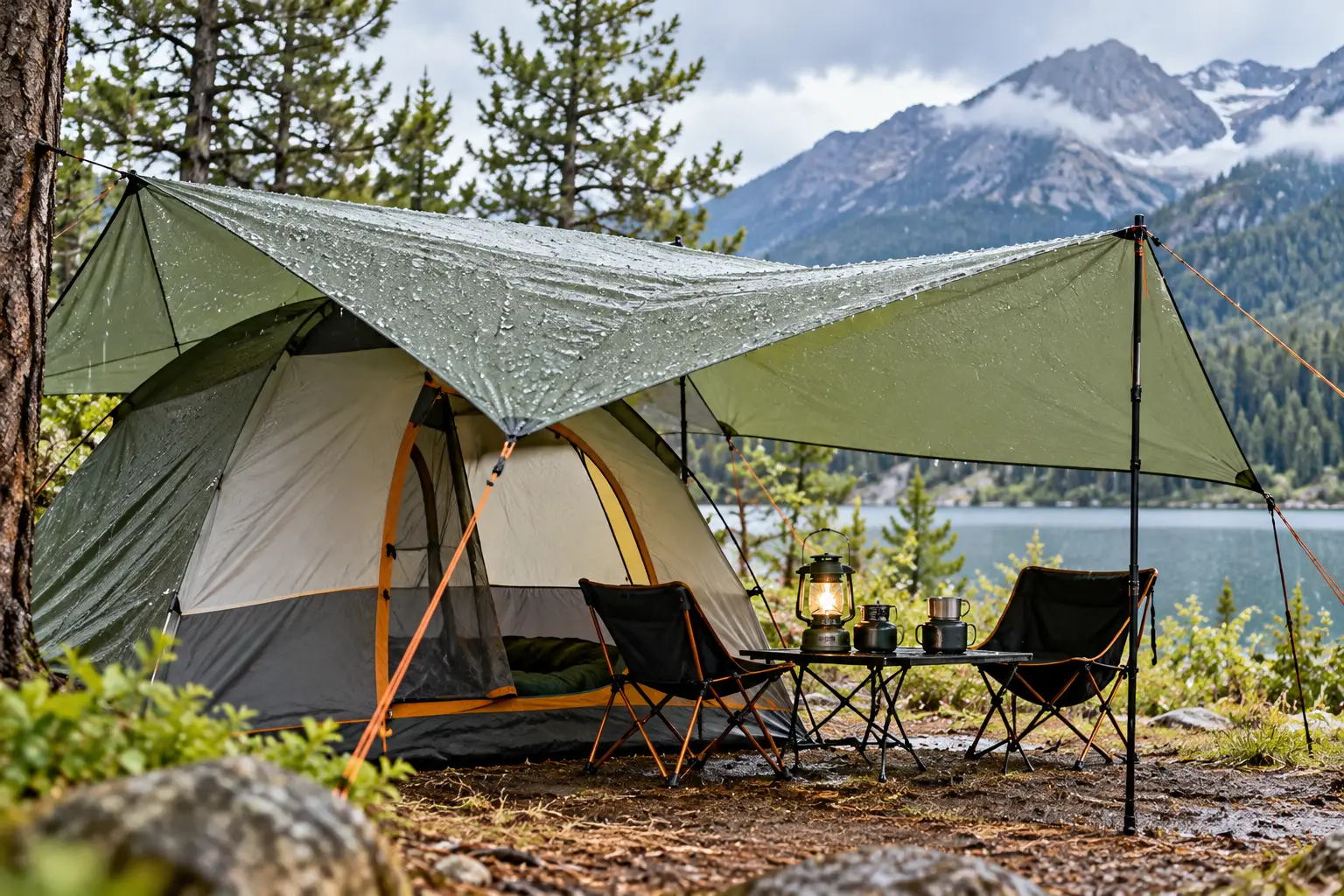
Rain fly camping is what separates a soggy, miserable night from a cozy one listening to rain drum overhead. Whether you sleep in a hammock, a tent, or just want a dry kitchen at the campsite, a well-chosen rain fly is the cheapest weather insurance you can pack. And yet most campers pick one by color or price alone. 🌧️
What Is Rain Fly Camping?
Rain fly camping means pitching a waterproof tarp, or “fly,” above your sleeping spot or camp area to block rain, wind, and sun. The fly is usually strung on a ridgeline between trees or poles and staked out with guy lines, creating a roof without the bulk of a full tent.
Most modern flies use ripstop fabric, a weave with reinforcing threads in a crosshatch pattern that stops small tears from spreading. That detail matters more than it sounds: a snag from a branch at 2 a.m. should stay a tiny hole, not become a split down the middle of your roof.
Here’s the catch, though. A camping rain fly lives or dies on a handful of specs that listings rarely explain: the waterproof rating in millimeters, the fabric weight, the number of tie-out points, and whether the seams are taped. A tarp that’s perfect for a backyard hammock can be a liability on a windy ridge.
In this guide, we compare seven real rain flies available on amazon.com, from a budget polyethylene sheet to a premium hex-cut shelter. You’ll find honest analysis grounded in manufacturer specs and aggregated customer reviews, plus setup tips, problem fixes, and a buyer framework. No invented test stories, just clear reasoning so you can choose with confidence. ⛺
Quick Comparison: The Best Camping Rain Fly Picks at a Glance
If you only have two minutes, this table gives you the short version. Prices are approximate ranges at the time of writing; check the current price on Amazon before you buy.
| Rain fly | Size | Waterproof rating | Weight | Price range | Best for |
|---|---|---|---|---|---|
| Amazon Basics Waterproof Camping Tarp | 9.5 x 11.3 ft | Polyethylene (no mm rating published) | ~2.2 lb | Under $25 | Amazon Basics fits car campers on a tight budget |
| Unigear Hammock Rain Fly | 9.8 x 9.8 ft | 3,000 mm PU | ~2.2 lb | $20–$35 | Unigear suits first-time hammock campers |
| Wise Owl Outfitters WiseFly | 11 x 9 ft | 3,000 mm PU | 26 oz | $30–$45 | Wise Owl wins for value-minded hammockers |
| ENO ProFly Rain Tarp | 10’6″ x 6’4″ | 1,000 mm PU | 22 oz | $70–$90 | ENO ProFly is best for fast, fair-weather setups |
| Kelty Noah’s Tarp 12 | 12 x 12 ft | 1,800 mm | ~2 lb 1 oz (min.) | $75–$105 | Kelty Noah’s Tarp 12 covers group kitchens |
| AquaQuest Guide Tarp (10×10) | ~9’7″ x 9’7″ | 5,000 mm+ | 1.3 lb | $70–$100 | AquaQuest Guide handles serious, sustained rain |
| Kammok Kuhli | 12 x 9 ft | Sil/PU + DWR | 20.5 oz | $150–$180 | Kammok Kuhli suits gear-savvy backpackers |
Reading the table, the biggest gap isn’t price, it’s waterproof rating. The AquaQuest Guide Tarp posts five times the hydrostatic head of the ENO ProFly Rain Tarp while weighing less, which tells you brand popularity and storm performance aren’t the same thing. Meanwhile, the Wise Owl Outfitters WiseFly and Unigear Hammock Rain Fly deliver a solid 3,000 mm rating for a fraction of premium prices, making them the logical starting point for most new campers.
💬 One click helps other shoppers make an informed choice too! 😊
Top 7 Rain Flies for Camping: Expert Analysis
Each pick below covers what the specs actually mean in the field, who it suits, what reviewers consistently report, and where it falls short. They run roughly from budget to premium.
1. Amazon Basics Waterproof Camping Tarp — cheapest dry roof you can buy
If all you need is a roof over the picnic table, the Amazon Basics Waterproof Camping Tarp is the lowest-cost way to get one. It’s a 9.5 x 11.3 ft polyethylene sheet with reinforced corners and edges, weighing about 2.2 pounds.
Polyethylene is inherently waterproof, so you don’t have to worry about coatings wearing off. The trade-off is stiffness and noise: PE crinkles in the wind and packs bulky compared to nylon. It also lacks a published hydrostatic head rating, so you’re trusting the material rather than a tested number.
Based on the specs, this is a car-camping tool, not a backpacking one. It shines as a ground sheet, a gear cover, or a quick shelter over a camp kitchen. Pitch it taut and it will shed rain fine, but don’t expect it to flex gracefully in gusts the way a ripstop fly does.
Aggregated reviews, which number in the thousands, consistently praise the price and the reinforced edges, while common complaints focus on bulk and the crinkly feel.
Pros:
- ✅ Lowest price in this roundup by a wide margin
- ✅ Polyethylene stays waterproof without any coating
- ✅ Doubles as a ground sheet or gear cover
Cons:
- ❌ Bulky and noisy compared with nylon flies
- ❌ No published waterproof rating or guy-line kit
Usually under $25, it’s unbeatable value for car camping and a poor fit for the trail.
2. Unigear Hammock Rain Fly — best starter kit for hammock beginners
The Unigear Hammock Rain Fly is the tarp many hammock newcomers start with, because it arrives as a complete kit. You get the 9.8 x 9.8 ft fly, six aluminum stakes, six guy lines with adjusters, and a carry bag.
The fabric is 210D rip-stop Oxford with a 3,000 mm PU coating. In practice, 3,000 mm is comfortably above what most rain throws at a taut tarp, so a properly pitched Unigear will keep a steady overnight shower off you. The interior is silver-coated for UV reflection, which helps on hot, exposed sites where shade matters as much as rain.
Here’s what to weigh: 210D Oxford is tough but heavy, so the fly lands around 2.2 pounds. That’s fine for car camping or short hikes, less ideal for long miles. Unigear also sells a hex-cut version in 12 x 10 ft and 15 x 14 ft for hammockers who want better end coverage.
Reviews, numbering in the thousands, frequently mention easy setup and that the included aluminum stakes beat the bent steel pins bundled with many budget tents.
Pros:
- ✅ Complete kit with stakes, lines, and bag
- ✅ 3,000 mm rating handles real overnight rain
- ✅ Silver interior adds useful sun protection
Cons:
- ❌ Heavy fabric adds noticeable pack weight
- ❌ Square cut leaves hammock ends a bit exposed
Typically $20 to $35, it’s one of the best price-to-protection ratios on Amazon.
3. Wise Owl Outfitters WiseFly — roomiest budget fly for hammocks
The Wise Owl Outfitters WiseFly gives you generous 11 x 9 ft coverage for a budget price. That extra length over a 10-foot fly matters, because it’s what keeps rain from blowing onto the ends of a standard hammock.
It’s made of 210T ripstop nylon with a 3,000 mm PU coating and taped seams. Taped seams are the quiet hero here: stitching creates thousands of tiny needle holes, and tape is what stops them from wicking water onto your face. It weighs 26 ounces and packs to roughly 9 x 5 inches, with six 10-foot guy lines and aluminum stakes included.
On paper, this is the best all-rounder for weekend backpackers and hammock campers who don’t count every ounce. Gear analysts note it’s a value workhorse rather than an ultralight tarp, and the rectangular cut has no doors, so in wind-driven rain you’ll need to pitch it low.
Reviews consistently report that it holds up well over several trips; a recurring theme is that the few leaks people describe trace back to pitching mistakes, not fabric failure.
Pros:
- ✅ Generous 11-foot length covers hammock ends
- ✅ Taped seams and 3,000 mm coating
- ✅ Packs small with a full accessory kit
Cons:
- ❌ 26 ounces is heavy by ultralight standards
- ❌ No doors for sideways, wind-driven rain
Usually $30 to $45, it’s arguably the smartest value pick in this roundup.
4. ENO ProFly Rain Tarp — fastest knot-free setup in the group
The ENO ProFly Rain Tarp is built for people who want to be dry in minutes, not fiddle with knots. Integrated LineLoc tensioners let you tighten guy lines by pulling, and a six-point guy system keeps the fly shaped.
The fabric is 70D ripstop nylon with a 1,000 mm PU coating and double-stitched seams, measuring 10’6″ x 6’4″ and weighing 22 ounces. Here’s what most buyers overlook: 1,000 mm is the lowest rating in this roundup. It’s fine for showers and short storms on a taut pitch, but it’s not a fly to bet on during a multi-day soaker.
It’s ideal for ENO hammock owners, day hikers, and festival campers who value quick setup. If you sleep in a wider double hammock, ENO itself recommends the ProFly XL (13′ x 9’2″) for better coverage. A sil-nylon version trims weight to about 18 ounces.
On REI, the ProFly averages 4.6 out of 5 across more than 80 reviews. Owners praise how fast it goes up, while a few note the tensioners can slip and that the fabric feels damp underneath in heavy rain.
Pros:
- ✅ LineLoc tensioners make setup quick and knot-free
- ✅ Light and compact at 22 ounces
- ✅ Four aluminum stakes included
Cons:
- ❌ 1,000 mm rating is modest for long storms
- ❌ Narrow 6’4″ width limits side coverage
Generally $70 to $90, you’re paying for convenience and brand fit more than raw waterproofing.
5. Kelty Noah’s Tarp 12 — most versatile shelter for group camps
The Kelty Noah’s Tarp 12 is the classic group tarp: a 12 x 12 ft square that can cover a whole camp kitchen. It comes in 9, 12, 16, and 20-foot versions, so you can size it to your crowd.
It uses 68D polyester rated at 1,800 mm with fully taped seams, attached corner guylines with storage pockets, and multiple reinforced guy-out points. Polyester sags less than nylon when wet, which helps a big flat tarp keep its shape overnight. Minimum weight is about 2 pounds 1 ounce, and poles are sold separately.
Analysis-wise, the size scaling is interesting: moving from the 9 to the 12 adds roughly a quarter more weight but nearly doubles the covered area. That makes the 12 the sweet spot for couples and small families. For backpacking solo, it’s more tarp than you need.
Customer feedback is broadly positive about durability and easy setup, with several owners describing it as a trip-saver during heavy rain. A recurring note is that a flat square tarp is happiest in calm conditions.
Pros:
- ✅ Huge 144 sq ft coverage for groups
- ✅ Fully taped seams and reinforced guy-outs
- ✅ Available in four sizes to match your crew
Cons:
- ❌ Poles sold separately, adding cost
- ❌ Large flat panel catches wind easily
Typically $75 to $105, it’s strong value per square foot for families and groups.
6. AquaQuest Guide Tarp — best waterproofing for its weight
The AquaQuest Guide Tarp is the one to pack when rain is guaranteed. Its dual silicone and PU coatings push the waterproof rating past 5,000 mm, far above the 1,000 to 3,000 mm typical of budget tarps.
The 10 x 10 kit version uses 40D ripstop nylon, finishes at about 9’7″ x 9’7″, weighs roughly 1.3 pounds, and offers 17 tie-outs. In practice, that many tie-outs means you can pitch an A-frame, a lean-to, a diamond, or a low storm configuration, then tune it as weather shifts. Heat-taped seams and a lifetime warranty round out the package.
Based on comparing specs, this is the best balance of weight and storm protection here. It suits thru-hikers, Pacific Northwest campers, and anyone who’s been burned by a leaking budget fly. AquaQuest also offers sizes from 10 x 7 up to 20 x 13 ft.
Reviews and gear roundups consistently praise its waterproofing; the most common caveat is that finished dimensions run slightly smaller than the nominal size, so plan your pitch accordingly.
Pros:
- ✅ 5,000 mm+ rating with heat-taped seams
- ✅ 17 tie-outs for nearly any pitch
- ✅ Lifetime warranty from an established brand
Cons:
- ❌ Finished size runs smaller than labeled
- ❌ Pricier than budget flies with similar dimensions
Often $70 to $100, it’s the best performance-per-dollar for serious rain.
7. Kammok Kuhli — premium knotless design built to last
The Kammok Kuhli is a premium hammock and ground shelter for campers who want refined details. It measures 144 x 108 inches and weighs 20.5 ounces, packing to about 4.5 x 8 inches.
The fabric is Kammok’s Diamond Shell 40D diamond ripstop nylon with Sil/PU coating plus DWR. Hypalon rubber reinforces all 10 guyout points, including the ridgeline, and each has an integrated cord pocket to stash lines. In practice, Hypalon reinforcement means your anchor points are the least likely part to fail in a storm, which is exactly where cheap tarps tear first.
Who’s it for? Backpackers who camp often enough that durability and packability justify the cost. Trekking-pole compatible reinforcements let you pitch it above treeline. Kammok also makes a Kuhli UL (around 14 ounces) and a Kuhli Pro for harsher weather. Check the listing to confirm which accessories ship with your version.
REI reviewers report that it has held in wind and thunderstorms, and they frequently highlight the knotless setup.
Pros:
- ✅ Hypalon-reinforced guyouts resist tearing
- ✅ Knotless setup with built-in cord pockets
- ✅ Packs small for a 12 x 9 ft fly
Cons:
- ❌ Highest price in this roundup
- ❌ Overkill for occasional car campers
Usually $150 to $180, it’s a buy-once investment for frequent backpackers.
Full Comparison: Specs, Materials, and Review Sentiment
| Rain fly | Fabric | Tie-outs / guy points | Seams | Review sentiment | Best for |
|---|---|---|---|---|---|
| Amazon Basics Waterproof Camping Tarp | Polyethylene | Grommeted edges | One-piece PE sheet | Praised for price, criticized for bulk | Amazon Basics for picnic-table cover |
| Unigear Hammock Rain Fly | 210D Oxford, 3,000 mm PU | 8 tie-down points | Not specified | Easy setup, good stakes | Unigear for beginners |
| Wise Owl Outfitters WiseFly | 210T ripstop nylon, 3,000 mm | 6 guy lines included | Taped | Durable over many trips | Wise Owl for weekend hammockers |
| ENO ProFly Rain Tarp | 70D ripstop nylon, 1,000 mm | 6-point guy system | Double-stitched | Fast setup, modest in long storms | ENO ProFly for ENO owners |
| Kelty Noah’s Tarp 12 | 68D polyester, 1,800 mm | Multiple reinforced guy-outs | Fully taped | Trip-saver for groups | Kelty Noah’s Tarp 12 for families |
| AquaQuest Guide Tarp | 40D ripstop silnylon, 5,000 mm+ | 17 tie-outs | Heat-taped | Excellent waterproofing | AquaQuest Guide for wet climates |
| Kammok Kuhli | 40D diamond ripstop, Sil/PU + DWR | 10 Hypalon guyouts | Check listing | Holds in wind and storms | Kammok Kuhli for frequent backpackers |
This table shows why tie-out count deserves as much attention as fabric. The AquaQuest Guide Tarp and Kammok Kuhli give you the most pitching options, which is what lets you drop a fly low against sideways rain. By contrast, the ENO ProFly Rain Tarp trades versatility for speed, a sensible choice for fair-weather hammockers but a limitation once storms roll in.
🎯 Ready to stay dry on your next trip?
🔍 Pick the rain fly that matches your camping style and click a highlighted name to check current pricing and availability on Amazon. The right tarp turns rainy weekends into the cozy kind you’ll actually remember! ⛺
How to Set Up a Rain Fly for Camping: A Step-by-Step Guide
Knowing how to set up a rain fly properly matters more than which fly you buy. Most “leaky tarp” complaints in reviews trace back to a slack pitch or a bad angle, not bad fabric. Here’s a reliable A-frame method that works for hammocks and ground sleepers alike. 🛠️
- Scout the site first. Look up for dead branches (“widowmakers”), then down for low spots where water pools. Note which way the wind is blowing.
- Run a ridgeline. Tie a taut line between two trees about 6 to 7 feet high for a hammock, lower for a ground bed. The ridgeline carries the load so your fly’s fabric doesn’t have to.
- Drape and center the fly. Clip or hang the tarp over the ridgeline so it overhangs your hammock or sleeping pad by at least 6 to 12 inches on each end.
- Stake the windward side first. Pull the side facing the weather low and tight. A lower edge blocks sideways rain far better than a high, airy pitch.
- Tension everything evenly. Tighten guy lines until the fabric is drum-taut with no wrinkles. Wrinkles collect water, and pooled water finds its way through.
- Add drip lines. Tie a short piece of string on each hammock strap below the fly so rain running down the straps drips off before reaching you.
- Re-tension at dusk. Nylon stretches as it cools and gets damp, so give every line one more pull before bed.
Practice once in your backyard. A first pitch in the dark, in a downpour, is a lesson nobody needs to learn the hard way.
Real-World Scenarios: Matching a Camping Rain Fly to Your Trip
Specs only mean something when they meet a real trip. Here are three common camper profiles and the reasoning behind each match.
🚗 The weekend car-camping family
Picture a family of four at a state park campground two or three weekends each summer, with a budget around $100 for shelter extras. Weight is irrelevant because the car does the carrying, but coverage is everything: you need a dry spot for cooking, eating, and playing cards when an afternoon storm rolls through.
The Kelty Noah’s Tarp 12 is the natural fit, since 144 square feet covers a picnic table with room to spare. Add the Amazon Basics Waterproof Camping Tarp as a ground sheet under the tent, and you’ve built a complete wet-weather camp for well under $150.
🌲 The new hammock camper
Now imagine a college student hanging a hammock on overnight hikes about once a month, with $50 to spend. They need something forgiving, light enough to carry three or four miles, and roomy enough to hide a few mistakes.
The Wise Owl Outfitters WiseFly is our pick here: its 11-foot length covers hammock ends, and the included kit means no extra purchases. If budget is even tighter, the Unigear Hammock Rain Fly delivers similar waterproofing for less.
🥾 The serious backpacker in a wet climate
Finally, consider an experienced hiker logging 15-mile days in the Pacific Northwest or Appalachians, out 30-plus nights a year. Every ounce and every leak matters.
The AquaQuest Guide Tarp offers the strongest waterproofing per ounce, while the Kammok Kuhli adds reinforced anchors and a knotless setup that pays off over hundreds of pitches. Either one is a long-term investment rather than a seasonal purchase.
Problem → Solution: Fixing the Most Common Rain Fly Headaches
Even a great tarp can disappoint if you don’t know how to troubleshoot it. These five problems come up again and again in customer reviews, and each has a simple fix.
Problem 1: Water pools in the middle of the fly. ✅ Solution: Your pitch is too flat or too loose. Raise the ridgeline, steepen the angle, and re-tension. A flat square like the Kelty Noah’s Tarp 12 especially benefits from one corner pitched higher so water has a clear exit.
Problem 2: Rain blows in from the side. ✅ Solution: Drop the windward edge closer to the ground or switch to a lean-to pitch. Flies with more tie-outs, like the AquaQuest Guide Tarp, let you add mid-panel stakes to pin the fabric down.
Problem 3: Guy lines loosen overnight. ✅ Solution: Nylon stretches when damp. Re-tension before bed, and if your tensioners slip (a complaint some ENO ProFly Rain Tarp owners mention), back them up with a taut-line hitch.
Problem 4: Water runs down the hammock straps. ✅ Solution: Tie drip lines, small pieces of cord hanging from each strap just inside the fly. Water follows the string and drips off harmlessly.
Problem 5: The underside feels damp, but the fly isn’t leaking. ✅ Solution: That’s usually condensation, not a leak. Pitch higher on the leeward side to boost airflow, and avoid camping in low, still hollows where cold, moist air settles. 💧
How to Choose a Rain Fly for Camping
Choosing the right camping rain fly comes down to seven decisions, in roughly this order of importance:
- Match the size to your shelter. For a hammock, aim for a fly at least 2 feet longer than the hammock’s ridgeline length. For tents and kitchens, add 2 to 3 feet beyond the footprint on every side.
- Check the waterproof rating. Around 1,500 mm handles light rain; 3,000 mm and up is comfortable for steady storms. Ratings above 5,000 mm suit wet climates.
- Confirm taped or sealed seams. Untaped stitching is the most common leak point, regardless of fabric rating.
- Count the tie-outs. More attachment points mean more pitch options, which matters most when wind shifts.
- Weigh the weight. Car campers can ignore it; backpackers should look for flies under about 1.5 pounds.
- Pick a cut. Rectangles are versatile; hex and catenary cuts shed wind and save weight over hammocks.
- Look at what’s included. Stakes, guy lines, and tensioners can add $20 or more if bought separately.
Features That Actually Matter (and Ones That Don’t)
Marketing copy loves big numbers, so here’s how to separate signal from noise. ⚡
What matters: The hydrostatic head rating is the single most useful number on a listing, because it measures how much water pressure fabric resists before leaking. Seam construction matters just as much. Reinforced anchor points, like the Hypalon patches on the Kammok Kuhli, matter because corners are where tarps tear under wind load.
What matters less than you’d think: Fabric denier (the “D” number) mostly tracks durability and weight, not waterproofing. A 40D silnylon like the AquaQuest Guide Tarp can outperform a 210D Oxford fabric in rain because the coating does the waterproofing work. Ultra-high ratings beyond about 5,000 mm also hit diminishing returns for a taut, sloped tarp.
What barely matters: Color, logo placement, and “military-grade” claims. Color only matters for heat (lighter stays cooler) and for stealth camping, where earth tones blend in.
Hammock Rain Fly vs. Tent Rain Fly vs. Plastic Tarp
A dedicated hammock rain fly, a tent’s built-in fly, and a hardware-store plastic tarp all keep rain off, but they solve different problems.
| Option | Weight | Setup flexibility | Breathability | Best for |
|---|---|---|---|---|
| Dedicated fly (e.g., Wise Owl Outfitters WiseFly) | Light to moderate | Many pitches with tie-outs | Open sides reduce condensation | Hammocks, minimalist ground camps |
| Tent rain fly | Built into tent weight | Fixed to one tent | Vents vary by tent | Fully enclosed sleeping |
| Plastic tarp (e.g., Amazon Basics Waterproof Camping Tarp) | Heavy and bulky | Grommets only | Open, but noisy | Car camps, ground sheets, gear cover |
The table shows why many experienced campers carry both a tent and a separate fly: the tent handles bugs and privacy, while a dedicated fly adds a dry living area outside. A plastic tarp is a great budget backup, but its weight and noise make the Wise Owl Outfitters WiseFly or Unigear Hammock Rain Fly a smarter carry for anything beyond the parking lot.
Long-Term Cost and Maintenance
The sticker price is only part of the cost. What you really pay for is cost per night of reliable shelter. 💵
| Rain fly | Price range | Warranty / durability signal | Value verdict | Best for |
|---|---|---|---|---|
| Unigear Hammock Rain Fly | $20–$35 | 30-day return; tough 210D fabric | Excellent for occasional use | Unigear for a few trips a year |
| Wise Owl Outfitters WiseFly | $30–$45 | Reviews report multi-trip durability | Best budget cost per night | Wise Owl for monthly campers |
| AquaQuest Guide Tarp | $70–$100 | Lifetime warranty | Strong long-term value | AquaQuest Guide for frequent wet trips |
| Kammok Kuhli | $150–$180 | Hypalon anchors, premium build | Pays off over years of heavy use | Kammok Kuhli for 30+ nights a year |
If you camp three nights a year, a $30 fly costs about $10 per night in year one and keeps getting cheaper. A lifetime warranty like the one backing the AquaQuest Guide Tarp changes the math for heavy users, since a single replacement can cover the price difference.
Maintenance is simple but often skipped. Always dry your fly fully before storing it, because packing it damp invites mildew that breaks down coatings. Hand-wash with mild soap, never a washing machine, and store it loosely rather than compressed. If seams start to weep after a few seasons, a tube of seam sealer restores them for a few dollars.
Safety, Weather, and Campsite Rules
A rain fly keeps you dry; it does not make you safe from storms. Lightning is the big one. The National Park Service’s lightning safety guidance warns that lightning can strike up to 10 miles from a storm, so hearing thunder means you’re within range. A tarp offers zero lightning protection, and a ridgeline strung between tall, isolated trees on exposed ground is exactly where you don’t want to be.
Practical rules for pitching a fly safely:
- ⚠️ Avoid ridgetops, open meadows, and lone tall trees during storm season.
- ⚠️ Never pitch in dry washes or right beside streams, where flash floods can arrive with little warning.
- ⚠️ Check overhead for dead limbs before anchoring a ridgeline.
- ⚠️ Keep stoves and open flames well clear of nylon and polyester, which melt quickly.
Also check campground rules: some parks restrict tying lines to trees or require tree-protective straps rather than bare cord. Wide webbing straps spread the load and protect bark, which is good practice everywhere.
Common Mistakes to Avoid When Buying a Camping Rain Fly
Most buyer regret falls into a few predictable traps.
Buying too small. A fly that just covers your hammock leaves no margin for angled rain. When in doubt, go one size up.
Trusting “waterproof” without a number. Look for a millimeter rating and taped seams; vague claims are not a spec.
Ignoring weather planning. No tarp replaces a forecast check. The National Weather Service’s outdoor lightning guidance is clear that you are not truly safe outside during a thunderstorm, so plan routes with bail-out options.
Skipping a test pitch. Learning your fly’s quirks at home beats learning them at midnight.
Overbuying for your use. A premium fly like the Kammok Kuhli is wasted on two car-camping weekends a year, while a cheap PE tarp is a burden on a 20-mile trail. Match the gear to how you actually camp.
FAQ: Rain Fly Camping Questions Shoppers Ask
❓ Is a separate rain fly worth buying if my tent already has one?
❓ Can I use a rain fly for camping without trees?
❓ How much should I spend on a camping rain fly?
❓ Is silnylon or polyester better for a rain fly?
❓ Can a tarp fully replace a tent for rain fly camping?
Conclusion: Stay Dry, Camp Happy
Rain fly camping rewards a little homework. The right tarp isn’t the most expensive one; it’s the one sized for your shelter, rated for your climate, and simple enough that you’ll pitch it well in the dark.
For most new campers, the Wise Owl Outfitters WiseFly is the sweet spot: generous coverage, taped seams, and a full kit at a budget price. On a tighter budget, the Unigear Hammock Rain Fly is hard to beat, and the Amazon Basics Waterproof Camping Tarp remains a smart ground sheet or picnic-table cover. Families and groups will get the most living space from the Kelty Noah’s Tarp 12, while ENO hammock owners who prize speed will appreciate the ENO ProFly Rain Tarp on fair-weather trips.
If you camp often in wet places, step up. The AquaQuest Guide Tarp offers the best waterproofing per ounce with a lifetime warranty, and the Kammok Kuhli delivers premium durability for backpackers who rack up dozens of nights a year.
Whatever you choose, practice your pitch at home, check the forecast, and review the National Weather Service’s camping safety tips before storm season. A good fly keeps you dry; good judgment keeps you safe. 🌲
✨ Don’t let the next storm catch you unprepared!
🔍 Take your rain fly camping to the next level with this carefully curated lineup. Click a highlighted name to check current pricing and availability, and turn rainy nights into the cozy campouts the whole family will remember!
Recommended for You
- Swing Chair Outside: 7 Best Picks for 2026 (Avoid These Mistakes)
- Sleeping in a Hammock Camping: 7 Proven Picks for Better Sleep (2026)
- Ridgerunner Hammock 2026: 7 Best Flat-Lay Picks (Honest Guide)
Disclaimer: This post contains affiliate links. As an Amazon Associate, I earn from qualifying purchases made through these links, at no additional cost to you.
✨ Found this article helpful? Share it with someone who needs it! 💬🤗