
In This Article
A rain tarp is one of the cheapest, lightest pieces of insurance you can carry into the backcountry — and one of the most versatile. Strung between two trees, pitched over a hammock, or staked into an A-frame beside a tent, a good camping tarp turns a soggy, miserable night into a dry one, without the weight or cost of a second tent. It’s also the piece of gear the National Park Service specifically lists among its Ten Essentials for emergency shelter, right alongside tents and bivy sacks.
Not all rain tarps are built the same, though, and the differences matter more than they might seem. Hydrostatic head rating — measured in millimeters — tells you how much water pressure a fabric can resist before leaking, and it varies enormously across this category, from around 2000mm on mid-range options to 5000mm or higher on premium silnylon tarps. Material weight, seam construction, and the number of guy-out points all shape how a tarp performs in real wind and rain, not just how it looks folded up in a stuff sack.
Below, we cover what actually separates a good rain tarp from a mediocre one, then walk through 7 real, currently available options — from budget ground-cover tarps to premium ultralight backpacking shelters.
What Is a Rain Tarp for Camping?
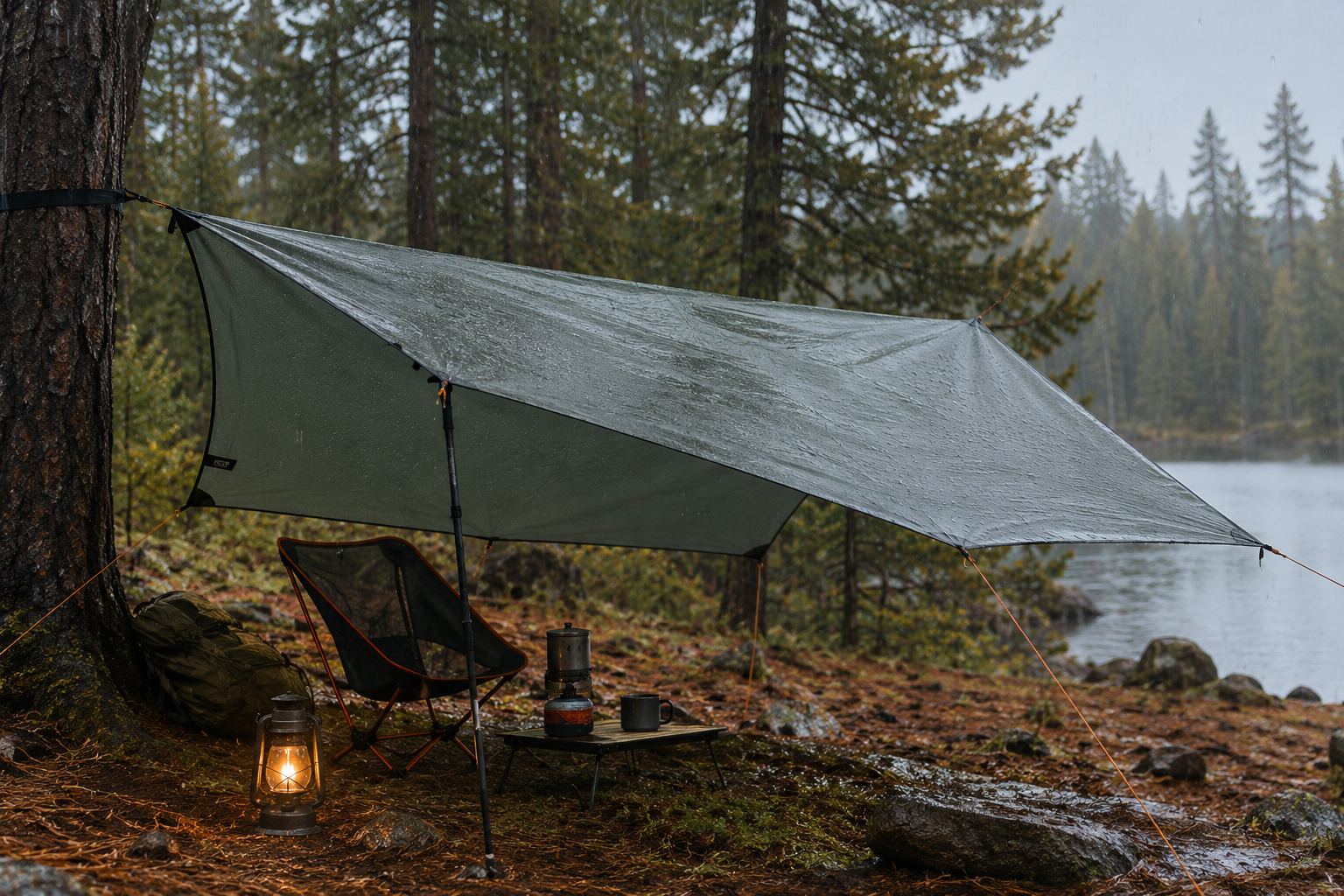
A rain tarp for camping is a lightweight, waterproof sheet of fabric — typically nylon, polyester, or polyethylene — used as a standalone shelter, hammock rain fly, or supplemental rain cover over a tent. Unlike a full tent, a tarp has no floor or enclosed walls, making it lighter and more packable, with the tradeoff of less complete protection from wind, insects, and driving rain.
Quick Comparison: Rain Tarps for Camping
| Category | Product | Price Range | Best For |
|---|---|---|---|
| All-around | Kelty Noah’s Tarp | $60–$150 | Versatile car camping and backpacking |
| Budget | Amazon Basics Waterproof Camping Tarp | $15–$25 | No-frills ground cover or basic shelter |
| Hammock-specific | Wise Owl Outfitters Hammock Rain Fly | $30–$50 | Hammock camping |
| Premium ultralight | Hilleberg Tarp 5 | $200–$260 | Solo ultralight backpacking |
Even at a glance, the range here is dramatic: the Amazon Basics Waterproof Camping Tarp anchors the budget end for casual campers who just need basic protection, while the Hilleberg Tarp 5 sits at the premium end for backpackers who count every ounce and demand serious weather resistance. We’ll cover all seven picks, including three not shown above, in detail next.
💬 Bookmark this guide — you’ll want to compare hydrostatic head ratings again before your next trip.
Top 7 Rain Tarps for Camping
Here are 7 real, currently available rain tarps for camping, ranging from budget ground covers to premium ultralight shelters.
1. Kelty Noah’s Tarp — best all-around versatile tarp
The Kelty Noah’s Tarp is a longtime favorite in the camping community, available in multiple sizes (commonly 9’x9′, 12’x12′, and 16’x16′) to suit anything from a solo hammock setup to a full group shelter. It uses a catenary cut, coated polyester taffeta construction with taped seams, and its distinctive four-point diamond shape allows for a genuinely wide range of pitch configurations depending on available trees or poles.
What most buyers overlook is how much the catenary cut actually matters in practice — this curved-edge construction pulls the fabric taut without sagging, which prevents the pooling water that flat-cut tarps are prone to collecting mid-panel during sustained rain. Based on comparing this to flat-cut budget alternatives, that single design detail is a meaningful reason experienced backpackers keep choosing this tarp decades after its original release, even as cheaper alternatives have flooded the market.
Reviews consistently praise the tarp’s performance through genuinely severe weather, including reports of surviving high winds and hail, with the main recurring caveat being that guy-out loops can tear under extreme tension if not reinforced or handled carefully during setup.
Pros:
- ✅ Catenary cut prevents water pooling better than flat-cut tarps
- ✅ Available in multiple sizes for solo to group use
- ✅ Taped seams provide reliable wet-weather protection
Cons:
- ❌ Diamond shape limits usable interior space compared to rectangular tarps
- ❌ Some reviewers report guy-out loops tearing under high tension
Priced around $60–$150 depending on size, the Kelty Noah’s Tarp remains one of the most trusted, versatile choices for campers who want one tarp that handles multiple use cases well.
2. Amazon Basics Waterproof Camping Tarp — best no-frills budget option
For casual campers who need reliable basic protection without paying premium prices, the Amazon Basics Waterproof Camping Tarp delivers exactly that: a 7.5′ x 9.5′ rip-stop polyethylene tarp with lamination on both sides, reinforced edges, and grommets for secure tie-downs. It’s built primarily as a ground cover or tent footprint, though it works as a basic overhead shelter for fair-weather trips as well.
What most buyers overlook is that polyethylene tarps like this one trade the premium waterproofing and tear resistance of nylon or silnylon for genuine affordability and simplicity — this isn’t the tarp you want for a multi-day mountain expedition, but for a weekend car camping trip or as a dedicated ground cloth under a tent, it performs reliably well beyond what its low price would suggest. Based on comparing this to more technical backpacking tarps, the reinforced edges and double-sided lamination here specifically address the failure points — torn grommets and delamination — that cheaper tarps in this price range often struggle with.
Reviews consistently highlight the surprising durability for the price, with buyers specifically praising its performance as a tent footprint and its reliability handling light-to-moderate rain during casual camping trips.
Pros:
- ✅ Genuinely affordable entry point into camping tarps
- ✅ Reinforced edges and double-sided lamination resist common failure points
- ✅ Effective as a ground cover, footprint, or basic overhead shelter
Cons:
- ❌ Polyethylene construction is heavier and less packable than nylon options
- ❌ Not built for serious backcountry or extreme weather conditions
At $15–$25, the Amazon Basics Waterproof Camping Tarp is the practical pick for casual campers and anyone who wants a dedicated, affordable ground cover.
3. Wise Owl Outfitters Hammock Rain Fly — best hammock-specific rain protection
Purpose-built for hammock campers, the Wise Owl Outfitters Hammock Rain Fly weighs just 26 ounces and carries a 3000mm hydrostatic head waterproof rating with taped seams — genuinely solid protection for its weight class. It ships as a complete kit, including guy lines, aluminum stakes, and a waterproof carry bag, so there’s no need to source separate hardware before your first trip.
What most buyers overlook is how much the multiple attachment points on this tarp actually expand its usefulness beyond pure hammock duty — the same tarp doubles effectively as a standalone rain fly, sun shade, or emergency ground shelter, giving hammock campers a genuinely multi-purpose piece of gear rather than something that only works in one configuration. Based on comparing this to hammock-specific tarps at similar price points, the 3000mm HH rating here holds up well against sustained rain, a real step up from budget polyethylene alternatives.
Reviews consistently praise the reliable waterproofing through multiple days of heavy backcountry rain, with the ripstop nylon construction specifically cited as handling wind well without the tearing some cheaper hammock tarps experience.
Pros:
- ✅ 3000mm hydrostatic head rating with taped seams
- ✅ Complete kit includes guy lines, stakes, and carry bag
- ✅ Multiple attachment points enable hammock, standalone, or sun-shade use
Cons:
- ❌ Coverage can feel tight for larger hammock setups
- ❌ Heavier than dedicated ultralight backpacking tarps
Typically priced around $30–$50, the Wise Owl Outfitters Hammock Rain Fly is the strongest pick specifically for hammock campers who want reliable, complete-kit protection at a reasonable price.
4. Free Soldier Waterproof Portable Tarp — best budget multi-purpose option
With 19 separate attachment points, the Free Soldier Waterproof Portable Tarp offers genuinely exceptional configuration flexibility for its price — quickly convertible between hammock rain fly, awning, or ground sheet depending on your needs that day. It’s made from 210T ripstop polyester with 2500mm PU waterproofing, measures 8′ x 10′ when finished, and weighs about 1.2kg, packing into a compact stuff sack with four guy lines and tensioners.
What most buyers overlook is that the sheer number of attachment points here isn’t just a marketing number — it’s the specific feature that allows this tarp to adapt to genuinely different pitch configurations depending on available anchor points, wind direction, or rain angle, which matters enormously when you’re setting up in an unfamiliar campsite without ideal trees or terrain. Based on comparing this to the Wise Owl option above, this tarp trades a somewhat lower hydrostatic head rating for broader configuration versatility and a lower price point.
Reviews consistently praise the heat-sealed seams and reinforced ridgeline for resisting leaks under sustained rain, with the military-style aesthetic and UV protection also frequently mentioned as practical bonuses for extended outdoor use.
Pros:
- ✅ 19 attachment points allow highly flexible pitch configurations
- ✅ 2500mm PU waterproofing with heat-sealed seams
- ✅ Compact packed size for its 8’x10′ finished coverage
Cons:
- ❌ Lower waterproof rating than premium hammock-specific tarps
- ❌ Military-style aesthetic may not suit every camper’s preference
Typically priced around $30–$50, the Free Soldier Waterproof Portable Tarp offers excellent configuration versatility for budget-conscious backpackers.
5. DD Hammocks 3×3 Tarp — best ultralight backpacking tarp
At just 1.1 pounds while covering 100 square feet, the DD Hammocks 3×3 Tarp delivers a genuinely impressive coverage-to-weight ratio, making it a favorite among long-distance hikers who count every ounce without wanting to sacrifice real usable shelter space. Its rectangular shape and numerous grommet and loop points accommodate essentially every standard tarp pitch configuration, from a simple A-frame to more complex wind-resistant setups.
What most buyers overlook is how much genuine versatility a well-designed rectangular tarp offers over more specialized shapes — testers have successfully deployed this specific tarp as a ground cloth, an overhead rain fly, and even an improvised windscreen, meaning one piece of gear covers scenarios that might otherwise require carrying multiple specialized items. Based on comparing this to diamond-shaped alternatives like the Kelty Noah’s Tarp, the straightforward rectangular shape here trades some of that catenary-cut water-shedding elegance for more predictable, easier-to-visualize pitch geometry, especially useful for less experienced tarp campers still learning different setups.
Reviews consistently describe this as proven, reliable gear across extensive trail use, including specific praise for its performance across both the Appalachian Trail and Pacific Northwest testing conditions, with thousands of positive reviews backing its reputation.
Pros:
- ✅ Excellent 100 sq ft coverage at just 1.1 lbs
- ✅ Numerous grommet and loop points support diverse pitch configurations
- ✅ Proven reliability across extensive long-distance trail use
Cons:
- ❌ Rectangular shape lacks the catenary cut’s water-shedding advantage
- ❌ Premium ultralight materials cost more than basic polyethylene tarps
Priced around $70–$90, the DD Hammocks 3×3 Tarp is the pick for weight-conscious backpackers who want proven versatility without an extreme premium price.
6. Hilleberg Tarp 5 — best premium ultralight shelter
The Hilleberg Tarp 5 represents the top tier of this category: an unconventional five-sided tarp weighing just 11.3 ounces including guylines and tensioners, made from Hilleberg’s proprietary Kerlon 1000 fabric — a triple-silicone-coated nylon with a 5000mm hydrostatic head, more than three times more waterproof than most double-wall backpacking tents. Designed primarily for a single person with room for gear, its unusual pentagonal shape sets it apart from the standard four-sided rectangles and six-sided hexagons common in this category.
What most buyers overlook is that Hilleberg’s fabric quality genuinely justifies the price premium in ways that are hard to appreciate until you’ve used cheaper silnylon in serious conditions — the material’s exceptional tear resistance means you’re not just paying for a lighter tarp, you’re paying for one that survives being pitched aggressively taut in real wind without the seam and fabric failures that lower-grade silnylon eventually develops. Based on comparing this to the DD Hammocks and Kelty options above, the Tarp 5 sacrifices raw coverage area for weight and material quality, making it a specialist’s choice rather than an all-purpose family camping tarp.
Reviews consistently describe surviving severe windstorms and unexpected weather without failure, with testers specifically noting the tarp kept a hammock dry during a genuinely dangerous storm when other campers’ gear did not hold up as well.
Pros:
- ✅ Exceptional 5000mm hydrostatic head rating on premium Kerlon 1000 fabric
- ✅ Just 11.3 oz including guylines and tensioners
- ✅ Proven tear resistance and durability in severe weather
Cons:
- ❌ Significant price premium over other options in this lineup
- ❌ Designed for one person with gear, not larger groups
Typically priced around $200–$260, the Hilleberg Tarp 5 is the pick for serious solo backpackers who prioritize material quality and weight above nearly everything else.
7. Rab Siltarp 2 — best compact tarp for two to three people
The Rab Siltarp 2 strikes a genuinely useful middle ground in this lineup: a 2.4m x 3m (roughly 8’x10′) rectangular tarp weighing just 494 grams, made from siliconized 30D Cordura ripstop nylon with a PU coating and a 2000mm hydrostatic head rating. Its 16 reinforced guy points, including one central lifter point, support a wide range of pitch configurations for two to three people or a solo camper with substantial gear.
What most buyers overlook is how much the siliconized Cordura construction here balances weight against genuine durability — this fabric is noticeably tougher against abrasion and puncture than the ultra-thin cuben fiber or basic silnylon used in some competing lightweight tarps, at a modest weight penalty that most backpackers won’t notice in the field. Based on comparing this to the solo-focused Hilleberg Tarp 5, the Siltarp 2’s larger coverage area and multi-person capacity make it the better choice for anyone backpacking with a partner or wanting extra basecamp shelter space, while still staying well within ultralight weight territory.
Reviews consistently praise the quick setup and genuine packability, with the reinforced guy points specifically noted as holding up well to repeated pitching in variable mountain conditions without the fraying some competitors experience.
Pros:
- ✅ 494g weight with genuine 2-3 person coverage
- ✅ 16 reinforced guy points support versatile pitch options
- ✅ Durable siliconized Cordura resists abrasion better than thinner fabrics
Cons:
- ❌ Lower hydrostatic head than the premium Hilleberg option
- ❌ Higher price than budget rectangular tarps of similar size
Typically priced around $120–$150, the Rab Siltarp 2 is the strong middle-ground pick for backpackers who need real multi-person coverage without going fully premium.
Product Comparison at a Glance
| Product | Weight | Size/Coverage | Waterproof Rating | Price Range | Best For |
|---|---|---|---|---|---|
| Kelty Noah’s Tarp | Varies by size | 9’x9′ to 16’x16′ | Taped seams | $60–$150 | All-around versatility |
| Amazon Basics Waterproof Tarp | Heavier (PE) | 7.5’x9.5′ | Reinforced/laminated | $15–$25 | Budget ground cover |
| Wise Owl Hammock Rain Fly | 26 oz | Hammock-sized | 3000mm HH | $30–$50 | Hammock camping |
| Free Soldier Waterproof Tarp | 1.2 kg | 8’x10′ | 2500mm PU | $30–$50 | Configuration flexibility |
| DD Hammocks 3×3 Tarp | 1.1 lbs | 100 sq ft | Not specified | $70–$90 | Ultralight backpacking |
| Hilleberg Tarp 5 | 11.3 oz | Solo + gear | 5000mm HH | $200–$260 | Premium solo ultralight |
| Rab Siltarp 2 | 494 g | 2.4m x 3m | 2000mm HH | $120–$150 | 2–3 person coverage |
A clear pattern emerges here: hydrostatic head rating and weight climb together with price, but not always in lockstep — the DD Hammocks 3×3 delivers excellent weight-to-coverage value at a mid-range price, while the true premium tier represented by Hilleberg commands its cost specifically through fabric quality and tear resistance, not just raw waterproof numbers.
How to Choose the Right Rain Tarp for Camping
- Match hydrostatic head rating to expected conditions. Casual, fair-weather trips are fine with 2000mm-range tarps; anyone expecting sustained heavy rain should prioritize 3000mm or higher, like the Wise Owl Hammock Rain Fly or Hilleberg Tarp 5.
- Decide between rectangular and diamond/pentagon shapes. Rectangular tarps like DD Hammocks or Rab Siltarp 2 offer more predictable, easier-to-learn pitch geometry; catenary-cut diamond shapes like Kelty Noah’s Tarp shed water more efficiently once you understand the setup.
- Weigh coverage against pack weight honestly. Solo ultralight backpackers benefit from the Hilleberg Tarp 5’s minimal weight; group or basecamp use justifies the extra weight of larger tarps like the Kelty Noah’s 16’x16′.
- Prioritize hammock-specific attachment points if that’s your setup. The Wise Owl Hammock Rain Fly and Free Soldier Waterproof Tarp are both purpose-built with hammock hanging in mind, unlike general-purpose ground tarps.
- Consider material durability, not just weight. Siliconized Cordura on the Rab Siltarp 2 resists abrasion better than ultra-thin cuben fiber alternatives, a real advantage for repeated rough-terrain use.
- Factor in whether you need a complete kit or already own hardware. Options like the Wise Owl Hammock Rain Fly ship with stakes and guy lines included; others may require separately sourcing hardware.
- Don’t overspend on premium tarps for casual car camping. The Amazon Basics Waterproof Camping Tarp handles weekend trips and ground-cover duty perfectly well without paying for backcountry-grade materials you won’t need.
Getting Started: Pitching Your First Rain Tarp
The most common tarp pitch is the basic A-frame: string a ridgeline between two anchor points (trees, trekking poles, or a vehicle), drape the tarp over it, and stake out the corners at an angle that creates tension without excessive sag. Aim for a taut pitch — a loose tarp collects water in low points and flaps loudly in wind, while proper tension sheds rain efficiently and holds up better in gusty conditions.
Before your first trip, practice your pitch at home if possible, since figuring out knots, guy-line tensioners, and stake angles is far easier without wind, rain, or fading daylight working against you. Consider your rain and wind direction when choosing your final orientation — angling the tarp’s lowest edge into the prevailing wind and rain direction, rather than perpendicular to it, meaningfully improves protection in genuinely bad weather.
A common first-time mistake is under-staking a tarp, assuming a few anchor points are sufficient; using all available guy-out points, especially on tarps like the Free Soldier with 19 attachment points or the Rab Siltarp 2 with 16, genuinely improves stability and wind resistance compared to a minimal three- or four-point pitch. Pack a tarp slightly damp only when absolutely necessary, and dry it fully before long-term storage, since prolonged moisture exposure can degrade coatings and encourage mildew on both nylon and polyethylene tarps alike.
✨ Ready to stay dry on your next trip? Check current pricing and availability on the picks above before you head out. ⛺
Real-World Scenarios: Matching the Tarp to Your Trip
The casual weekend car camper: Someone camping at a drive-up site who mainly wants a reliable ground cover or basic backup shelter is well served by the Amazon Basics Waterproof Camping Tarp, without paying for backcountry-grade performance a car camping trip doesn’t need.
The hammock camper: Anyone sleeping in a hammock benefits specifically from purpose-built options like the Wise Owl Outfitters Hammock Rain Fly or Free Soldier Waterproof Portable Tarp, both designed around hammock-compatible attachment points rather than generic ground-shelter geometry.
The thru-hiker or ultralight backpacker: For anyone counting every ounce over hundreds of trail miles, the Hilleberg Tarp 5 or DD Hammocks 3×3 Tarp deliver the weight savings and proven field durability that longer trips genuinely demand.
The backpacking pair or small group: Two people sharing a shelter, or a solo backpacker who wants extra basecamp space, get the most practical coverage from the Rab Siltarp 2 or a larger Kelty Noah’s Tarp, both sized well beyond strict solo coverage.
Common Mistakes to Avoid
The most common mistake is buying based on price or weight alone without checking hydrostatic head rating — a tarp that looks great on paper can leak through in sustained rain if its waterproof rating doesn’t match the conditions you’ll actually encounter.
A second frequent error is under-staking a pitch, using only the minimum guy points needed to hang the tarp rather than the full set of available attachment points, which meaningfully reduces stability in wind and rain. A third mistake is choosing a tarp shape without understanding its pitch requirements — diamond and pentagon shapes like the Kelty Noah’s Tarp or Hilleberg Tarp 5 require more setup familiarity than straightforward rectangular tarps, and learning an unfamiliar pitch for the first time during an actual storm is a frustrating way to find that out.
Finally, many campers pack a tarp away wet after a trip and forget about it until the next outing, which can lead to mildew, coating degradation, and unpleasant odors — always dry a tarp fully before long-term storage, even if that means a brief unpacking session at home after your trip.
Rain Tarp vs. Full Tent
| Factor | Rain Tarp | Full Tent |
|---|---|---|
| Weight | Significantly lighter | Heavier, especially double-wall designs |
| Protection level | Rain and partial wind only | Full weather, insect, and privacy protection |
| Setup complexity | Requires trees, poles, or anchor points | Generally self-supporting |
| Airflow/condensation | Excellent, minimal condensation | More prone to interior condensation |
| Best suited for | Ultralight trips, hammock camping, supplemental shelter | Primary shelter in variable or harsh conditions |
The core trade-off is weight and packability versus complete protection. A tarp genuinely can’t match a tent’s defense against biting insects, driving horizontal rain, or extreme cold, but it saves substantial weight and pack space while offering superior airflow that reduces the condensation buildup common inside enclosed tents. Many experienced backpackers carry both, using a tarp as supplemental rain protection over a tent vestibule or as the primary shelter only in conditions where its limitations are less relevant.
Camping Safety and Emergency Shelter
A rain tarp isn’t just a comfort item — it’s genuinely recognized as critical safety gear. The National Park Service lists a tent, space blanket, tarp, or bivy among its Ten Essentials specifically for emergency shelter, noting that shelter is one of the most important elements in a survival situation, protecting against severe weather and exposure. The NPS also specifically recommends packing a tarp or extra rainfly as helpful gear for wet climates, even when camping in developed frontcountry sites with an established tent.
Staying dry matters beyond simple comfort, too. According to the CDC, hypothermia can occur even at relatively mild temperatures if a person becomes chilled from wet clothing or exposure, and prevention specifically includes keeping dry and getting out of wet conditions as quickly as possible. A reliable rain tarp — whether as a primary shelter or a supplemental rain barrier over a tent entrance — is a genuinely practical tool for reducing that exposure risk on any trip where rain is a realistic possibility.
Problem → Solution: Fixing Common Roadblocks
Problem: Your tarp keeps sagging and pooling water in the middle. Solution: Switch to a catenary-cut tarp like the Kelty Noah’s Tarp, or increase tension and add a center lifter point if your current tarp, like the Rab Siltarp 2, includes one.
Problem: You’re hammock camping and your ground-style tarp doesn’t fit well. Solution: Switch to a purpose-built hammock rain fly like the Wise Owl Outfitters Hammock Rain Fly or Free Soldier Waterproof Portable Tarp, both designed around hammock-compatible attachment points.
Problem: Your tarp is too heavy for a multi-day backpacking trip. Solution: Downsize to a genuine ultralight option like the Hilleberg Tarp 5 or DD Hammocks 3×3 Tarp, both under 1.2 lbs.
Problem: You need shelter for two people, not just one. Solution: Size up to a larger tarp like the Rab Siltarp 2 or a bigger Kelty Noah’s Tarp, rather than trying to squeeze two people under solo-sized coverage.
Problem: You’re setting up in unfamiliar terrain without ideal anchor points. Solution: Choose a tarp with many attachment points, like the 19-point Free Soldier Waterproof Tarp, which adapts to more varied pitch configurations than tarps with fewer guy-out options.
Frequently Asked Questions
❓ What's a good hydrostatic head rating for a rain tarp?
❓ Can a tarp replace a tent for camping?
❓ What size rain tarp do I need for camping?
❓ Are polyethylene tarps as good as nylon tarps for camping?
❓ How many guy points does a rain tarp need?
Conclusion
A rain tarp for camping earns its place in a pack far beyond simple rain protection — it’s officially recognized emergency shelter gear, and the right one genuinely changes how comfortable and safe a wet trip turns out to be. Casual campers and anyone needing a reliable ground cover do well with the budget-friendly Amazon Basics Waterproof Camping Tarp, hammock campers should look specifically at the Wise Owl Outfitters Hammock Rain Fly or Free Soldier Waterproof Portable Tarp, weight-conscious backpackers get real value from the DD Hammocks 3×3 Tarp, and anyone wanting the best material quality money can buy should consider the Hilleberg Tarp 5. The Kelty Noah’s Tarp and Rab Siltarp 2 round out the lineup as genuinely versatile middle-ground options.
Start by being honest about your trip type — casual car camping, hammock backpacking, or serious ultralight thru-hiking — since that single factor narrows this list down quickly to the right pick for your next adventure.
✨ Don’t miss these exclusive deals! 🔍 Stay dry on your next adventure with this curated lineup of rain tarps. Click a highlighted item to check current pricing and availability. These picks will help you find reliable shelter for whatever the weather brings!
Recommended for You
- 5 Best Hammock Porch Swings in 2026: Hands-On Field Test
- Suspended Tent Guide: 5 Best Tree Tents Tested for Comfort in 2026
- Cotton Rope Hammock: 7 Best Picks for Ultimate Backyard Comfort (2026)
Disclaimer: This post contains affiliate links. As an Amazon Associate, I earn from qualifying purchases made through these links, at no additional cost to you.
✨ Found this article helpful? Share it with someone who needs it! 💬🤗