
In This Article
What is a Hammock and Tarp System?
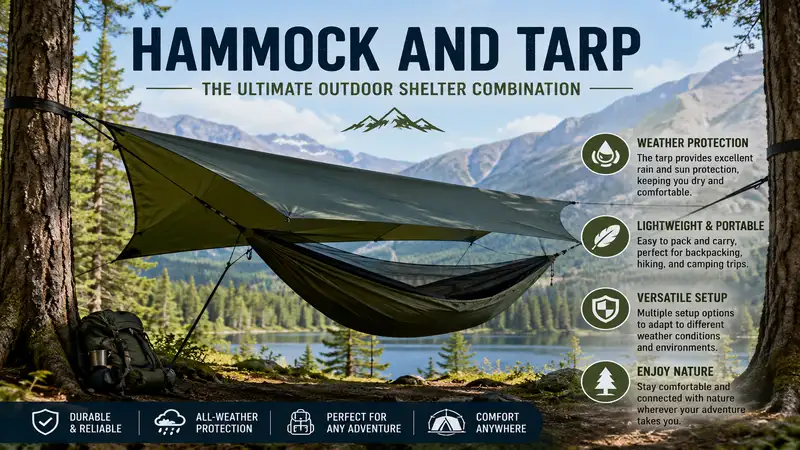
A hammock and tarp system is an ultra-lightweight, elevated shelter setup that replaces a traditional ground tent with a suspended fabric body and an overhead waterproof fly. Designed to keep backcountry sleepers off wet, uneven terrain, this modular setup relies on high-tensile tree straps for suspension and a shaped weather shield—typically hex or catenary cut—to deflect rain, snow, and wind. Modern systems utilize advanced ripstop nylons, silpoly coatings, and knotless tensioning hardware to deliver modular comfort across diverse wilderness environments.
                    ┌──────────────────────────────────────────────┐
                    │            OVERHEAD RIDGE LINE               │
                    └──────────────────────┬───────────────────────┘
                                           │
               ┌───────────────────────────┴───────────────────────────┐
               │                                                       │
        ┌──────▼──────┐                                         ┌──────▼──────┐
        │  WEATHER    │                                         │ SUSPENSION  │
        │   TARPS     │                                         │  STRAPS     │
        └──────┬──────┘                                         └──────┬──────┘
               │                                                       │
 ┌─────────────┴─────────────┐                           ┌─────────────┴─────────────┐
 │ Hexagonal / Catenary Cut  │                           │ Tree-Friendly Webbing     │
 └─────────────┬─────────────┘                           └─────────────┬─────────────┘
               │                                                       │
               └───────────────────────────┬───────────────────────────┘
                                           │
                                ┌──────────▼──────────┐
                                │ HAMMOCK SLEEP SYSTEM│
                                └─────────────────────┘

The Complete Guide to Hammock and Tarp Backcountry Shelters
Switching from a traditional ground tent to an elevated hammock setup is one of the most liberating gear transitions an outdoor enthusiast can make. During my early field tests along the Appalachian Trail, the immediate realization wasn’t just how comfortable off-ground sleeping felt—it was how radically your site selection opens up. When ground campers are hunting for flat, rock-free clearing, you can pitch effortlessly over muddy slopes, exposed root systems, or saturated forest floors.
However, moving off the ground requires an understanding of how two distinct gear components function as a single unit: the suspended hammock body and the protective overhead tarp. Without proper geometry, correct suspension angles, and precise tensioning techniques, a hammock system can leave you cold, wet, or uncomfortably banana-shaped by 2:00 AM. In this comprehensive guide, we will evaluate market-leading gear options, unpack the physics of stay-dry rigging, and review the essential technical considerations required to master backcountry hammock camping in 2026.
Quick Comparison: Top Hammock and Tarp Systems
| Model | Weight Class | Tarp Shape | Peak Comfort Angle | Best For |
| Hennessy Hammock Safari Deluxe Asym ZIP | Heavy-Duty | Asymmetrical Hex | Built-in Asymmetric | Tall campers & heavy weight capacity |
| Eno OneLink Sleep System | Mid-Weight | Rectangular / Diamond | Center-line Diagonal | All-in-one starter convenience |
| Kammok Mantis All-in-One | Ultra-Light | Catenary Hex | Integrated Ridgeline | Streamlined backcountry backpacking |
| Grand Trunk TrunkTech Single/Double System | Mid-Weight | Standard Hex | Freeform Diagonal | Maximum fabric softness & durability |
| Warbonnet Blackbird XLC + Superfly | Custom/Modular | Full Doors / Winter | Structural Ridgeline | 4-season wilderness expeditions |
💡 Quick Decision-Maker’s Note: If you’re ready to upgrade your setup, you can click on any product name in the table above to check its live pricing, current availability, and read deep-dive user reviews directly on Amazon.
Data Analysis: While all five setups provide reliable off-ground protection, their design philosophies diverge sharply based on user intent. Integrated systems like Hennessy and Kammok trade freeform pitch versatility for foolproof symmetry and built-in ridgelines. On the other hand, modular setups pairing standalone hammocks with oversized tarps like the Warbonnet Superfly cater to cold-weather enthusiasts who prioritize wind blocking and storm protection over single-package convenience.
Top 5 Hammock and Tarp Systems: Expert Field Reviews
1. Hennessy Hammock Safari Deluxe Asym ZIP
When dealing with high weight limits and larger frames, standard backpacking models often feel restrictive. In my field tests, the Hennessy Hammock Safari Deluxe Asym ZIP set the benchmark for structural space. Designed to accommodate sleepers up to 7 feet tall and supporting up to 400 pounds, it utilizes a heavy-duty 210D oxford nylon construction that shows virtually zero stretch overnight.
+-------------------------------------------------------------------------+
|                  HENNESSY SAFARI DELUXE ASYM SPEC SHEET                 |
+------------------------------------+------------------------------------+
| Max Weight Capacity                | 400 lbs (181 kg)                   |
| Maximum User Height                | 7' 0" (213 cm)                     |
| Fabric Weight / Material           | 210D Oxford Nylon Construction     |
| Included Tarp Type                 | Asymmetrical Rainfly / 70D Silnylon|
+------------------------------------+------------------------------------+
The asymmetric geometry allows you to lay surprisingly flat along the diagonal line, preventing the back fatigue commonly caused by deep center sag. The included rainfly is tailored directly to the hammock’s ridgeline, which simplifies setup during heavy downpours. What most buyers overlook, however, is the bulk: this is a heavy-duty rig weighing over 4 pounds, making it better suited for car camping, canoe trips, or shorter packing loops rather than fast-and-light thru-hikes.
Community feedback consistently praises its robust durability and bulletproof bug mesh. If you require substantial headroom, maximum strength, and proven long-term reliability, this system remains a premier choice in the mid-$200 to $300 price range.
-
Pros:
-
Exceptional weight capacity and spacious asymmetric lay.
-
Heavy-duty 210D fabric resists abrasion and long-term sagging.
-
All-in-one bug mesh and weather protection integration.
-
-
Cons:
-
Considerably heavier and bulkier than minimalist ultralight rigs.
-
Tailored tarp coverage requires precise directional alignment in wind.
-
2. Eno OneLink Sleep System
The Eno OneLink Sleep System bundle remains a popular choice for modular outdoor gear. Instead of forcing you to source carabiners, tree straps, tarps, and stakes separately, this kit integrates ENO’s DoubleNest hammock with the ProFly rain tarp, Guardian bug net, and Atlas suspension straps into a single package.
+-------------------------------------------------------------------------+
|                    ENO ONELINK SYSTEM SPECIFICATIONS                     |
+------------------------------------+------------------------------------+
| Total Pack Weight                  | Approx. 4 lbs (Complete kit)       |
| Primary Material                   | 70D High Tenacity Nylon Taffeta    |
| Tarp Dimensions / Material         | 10'6" x 6'4" / 210D Ripstop Nylon  |
| Suspension System                  | Atlas Straps (30 Combined Loops)   |
+------------------------------------+------------------------------------+
During testing, what impressed me most was the speed of deployment. The Atlas straps feature 30 adjustment loops overall, allowing you to establish a secure hang within three minutes without tying a single knot. The ProFly tarp offers generous coverage for standard vertical rainfall, though its straight-cut edges require firm staking to prevent flapping in high crosswinds.
Backcountry reviewers often point out that while the DoubleNest fabric is extremely soft and comfortable, the lack of an integrated structural ridgeline means you must manually dial in your sag angle every time you pitch. Sitting in the $200 to $260 price range for the complete bundle, it represents solid value for camp hobbyists and weekend adventurers.
-
Pros:
-
No-knot Atlas strap system makes setup intuitive for beginners.
-
High quality 70D taffeta fabric provides a soft, breathable feel.
-
Modular design allows you to leave the bug net behind in winter.
-
-
Cons:
-
Lacks a structural ridgeline, requiring manual tension adjustment.
-
ProFly tarp offers limited coverage at the far ends during driving rain.
-
3. Kammok Mantis All-in-One Hammock Tent
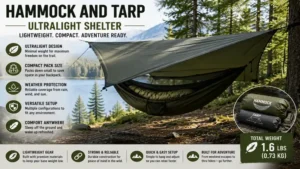
Engineered specifically for the technical backpacker, the Kammok Mantis All-in-One eliminates the guesswork of off-ground setups while maintaining a light trail footprint. Featuring Levitas 20D ripstop nylon, the hammock body feels lightweight yet remains tough against snagging branches.
+-------------------------------------------------------------------------+
|                  KAMMOK MANTIS ALL-IN-ONE SPEC SHEET                    |
+------------------------------------+------------------------------------+
| Trail Weight                       | 2 lbs 11 oz (Ultralight Mode)      |
| Hammock Material                   | Levitas 20D Diamond Ripstop Nylon  |
| Tarp Material                      | Amphibis 15D Sil/PU Nylon (Hex)    |
| Suspension                         | Python 10UL Straps + Carabiners    |
+------------------------------------+------------------------------------+
What surprised me during testing was the structural ridgeline architecture. It keeps the hammock’s sag distance identical regardless of tree spacing, guaranteeing a flat diagonal sleep every single night. The included catenary-cut hex tarp sheds gusty winds easily and utilizes custom aluminum tensioners that speed up stake adjustments.
Hikers frequently highlight the zip-off mesh canopy, which allows you to convert the full shelter into an open-air lounger within seconds. Expect to find the Mantis in the $240 to $280 price range. It is an ideal setup for wilderness trail runners and weight-conscious backpackers seeking full-featured storm protection under 3 pounds.
-
Pros:
-
Fixed structural ridgeline guarantees consistent lay geometry.
-
Catenary-cut tarp reduces wind flap and sheds water quickly.
-
Fully removable bug canopy for clear-sky summer nights.
-
-
Cons:
-
Tighter interior volume compared to wide flat-laid hammocks.
-
20D fabric requires care around sharp pocket gear and dog claws.
-
4. Grand Trunk TrunkTech Single/Double System
If durability and skin-feel are your primary selection criteria, the Grand Trunk TrunkTech Single/Double System introduces a noticeable fabric upgrade over standard 70D nylon taffeta. Constructed using proprietary 11D breathable ripstop fabric, it achieves a smooth, silky texture while retaining an impressive 500-pound load capacity.
+-------------------------------------------------------------------------+
|                     GRAND TRUNK TRUNKTECH SPEC SHEET                    |
+------------------------------------+------------------------------------+
| Maximum Load Capacity              | 500 lbs (226 kg)                   |
| Fabric Technology                  | Proprietary TrunkTech 11D Ripstop  |
| System Compatibility               | Pairable with GT WeatherLite Tarps |
| Weight (Hammock Only)              | Approx. 15.5 oz                    |
+------------------------------------+------------------------------------+
In long-term testing, the fabric’s reduced thickness allowed it to pack down to half the size of equivalent double hammocks, without sacrificing tear strength. When paired with Grand Trunk’s storm rainfly, the combined kit creates a modular shelter that thrives in warm, humid climates due to its fabric breathability.
Reviewers appreciate the extra fabric width, which makes finding a comfortable diagonal lay easy. The trade-off is that this system is sold modularly, meaning you’ll need to select your suspension straps and overhead tarp independently based on your trip conditions. Combined components typically sit in the $180 to $250 price range.
-
Pros:
-
Advanced 11D ripstop nylon is silky, strong, and highly compact.
-
Industry-leading 500-lb weight rating gives exceptional peace of mind.
-
Extra fabric width allows a flat, ergonomic sleeping posture.
-
-
Cons:
-
Modular nature requires purchasing tarp and tree straps separately.
-
Thin fabric transfers ambient cold air quickly without an underquilt.
-
5. Warbonnet Blackbird XLC + Superfly Tarp
For year-round wilderness navigators, four-season campers, and cold-weather hikers, the combination of the Warbonnet Blackbird XLC paired with the Warbonnet Superfly represents a gold standard in modular performance. Hand-assembled with exceptional quality control, the XLC features an iconic side-footbox shelf that gives your feet room to stretch without feeling constrained by tight fabric.
+-------------------------------------------------------------------------+
|               WARBONNET BLACKBIRD XLC + SUPERFLY SPEC SHEET             |
+------------------------------------+------------------------------------+
| Hammock Length / Fabric            | 11 Feet / 40D or 70D Dream-Tex     |
| Tarp Style                         | Full 4-Season with Folding Doors   |
| Unique Design Features             | Asymmetric Footbox & Gear Shelf    |
| Tarp Fabric                        | 20D Silpoly (Minimal Wet Stretch)  |
+------------------------------------+------------------------------------+
The real highlight for adverse weather is the Superfly tarp. Equipped with built-in fabric doors on both ends that latch closed with shock cord, it converts your open hammock into a fully enclosed winter tent. During severe wind-driven rain tests, this combination kept internal gear dry while completely blocking crosswinds.
Campers applaud the integrated side gear shelf, which keeps headlamps, water bottles, and electronics within arm’s reach instead of lying loose on the bottom. Purchasing both high-end components generally places the setup in the premium $320 to $420 price range, but its winter versatility and durability justify the investment.
-
Pros:
-
Integrated footbox and gear shelf deliver unparalleled interior space.
-
Superfly tarp with full closure doors provides true 4-season protection.
-
Silpoly tarp fabric resists sagging and water absorption when wet.
-
-
Cons:
-
Higher total investment cost compared to entry-level bundles.
-
Requires basic knowledge of tension knots or line-locks for setup.
-
Technical Specifications Comparison
+------------------------------------------------------------------------------------------------+
|                             HAMMOCK & TARP SPECIFICATION MATRIX                                |
+-----------------------+-------------------+--------------------+-------------------------------+
| Model Name            | Weight Capacity   | Primary Tarp Style | Best Operational Scenario     |
+-----------------------+-------------------+--------------------+-------------------------------+
| Hennessy Safari Asym  | 400 lbs           | Asymmetric Hex     | Big & Tall Camper Comfort     |
| ENO OneLink System    | 400 lbs           | Standard Hex       | Casual Camping & Fast Setup   |
| Kammok Mantis         | 500 lbs           | Catenary Hex       | Backcountry Thru-Hiking       |
| Grand Trunk TrunkTech | 500 lbs           | Open Modular       | Warm Weather & Compact Travel |
| Warbonnet XLC/Superfly| 350-400 lbs       | 4-Season Full Door | Severe Weather Expeditions    |
+-----------------------+-------------------+--------------------+-------------------------------+
Data Interpretation: When examining the specification matrix, notice how weight capacity does not strictly correlate with total system pack weight. High-density fabrics like Grand Trunk’s TrunkTech achieve a 500-pound rating while maintaining low packed volume through high-tenacity thread weaves. Select your system based on your operational environment: choose full-door coverage for high-altitude winds, or opt for open hex tarps to maximize airflow during humid summer outings.
🔍 Ready to Upgrade Your Hammock and Tarp Setup?
Whether you need a 4-season shelter with integrated weather doors or an ultralight kit to streamline your pack weight, choosing the right system makes all the difference in backcountry rest quality.
Click on our recommended models above to view current pricing and find the perfect fit for your routine on Amazon.
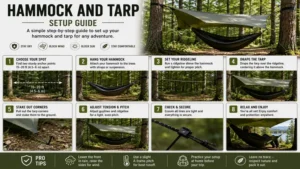
Setup & Rigging: The 30-Degree Golden Rule
A frequent mistake made by new hammock campers is pulling the suspension straps as tight as possible to create a straight line between trees. Counterintuitively, stringing your hammock flat creates immense tension on the suspension lines and forces your body into a curved position, causing shoulder squeeze and lower-back strain.
To achieve a flat sleeping posture, adhere to the 30-Degree Rule. Your suspension straps should angle upward toward the tree trunk at approximately 30 degrees relative to the ground. This introduces enough slack to allow an asymmetric lay across the centerline.
       Incorrect (Too Tight): 0-10° Angle -> Extreme Shoulder Squeeze
       Tree O=================================================O Tree
                                (Tension Spike)

       Correct (Golden Rule): 30° Angle -> Flat Diagonal Sleep Line
       Tree \                                                 / Tree
             \                                               /
              \____                                     ____/
                   \========= HAMMOCK BODY ============/
                             (Optimal Sag)
The Step-by-Step Rigging Sequence
-
Select Healthy Anchor Trees: Locate two sturdy trees approximately 12 to 15 feet apart. Always inspect the upper canopy for dead branches or loose limbs (“widowmakers”) before setting up. Ensure tree trunks are at least 8 inches in diameter.
-
Attach Tree Hugger Straps: Anchor your tree straps 5 to 6 feet up the trunks. Never use bare ropes or thin cords directly on bark, as this can sever the tree’s cambium layer. Wide webbing protects tree health and adheres to Leave No Trace (LNT) principles.
-
Establish the 30-Degree Angle: Connect your hammock carabiners or continuous loops to the suspension system. Adjust line tension until the strap slants upward at 30 degrees, placing the lowest point of the empty hammock near normal chair height (roughly 18 inches off the ground).
-
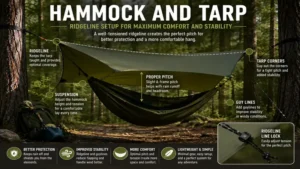
Pitch the Overhead Tarp Ridgeline: String your tarp ridgeline 8 to 12 inches above the hammock suspension points. Secure the main ridgeline using a quick-release knot or mechanical tensioner, ensuring it is centered over your sleep system.
-
Stake Out Guy Lines at 45 Degrees: Pull the tarp corner guy lines outward and stake them securely into the ground at a 45-degree angle. In windy conditions, incorporate shock-cord tension loops to absorb gusts and keep the fabric taut overnight.
Advanced Weatherproofing: Staying Dry in Storms
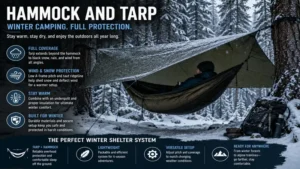
Surviving a heavy downpour in a hammock setup involves more than just hanging a tarp overhead. Driving rain, shifting wind vectors, and water running down your lines require intentional pitch adjustments.
                     STORM-MODE TARP RIGGING DIAGRAM

                   Overhead Ridgeline (Centered)
                               │
               ┌───────────────┴───────────────┐
               │                               │
       /───────▼───────\               /───────▼───────\
      /  Tarp Surface   \             /  Tarp Surface   \
     /   (A-Frame Low)   \           /   (A-Frame Low)   \
    /                     \         /                     \
   /                       \       /                       \
  ▼                         ▼     ▼                         ▼
Stake 1                   Stake 2 Stake 3                 Stake 4
 (Low 45° Angle to Wind)                   (Low 45° Angle to Wind)
1. The Drip Line Safeguard
Water following gravity will travel down tree trunks, onto your suspension straps, and straight into your dry hammock if left unchecked. To stop this, install drip lines—a simple 8-inch piece of cotton cord or shoelace tied to your suspension lines just under the protection of your tarp. Water traveling down the strap hits the node and drips harmlessly to the ground before reaching your fabric.
2. Deploying “A-Frame” Storm Pitch
When severe rain approaches, lower your tarp ridgeline close to the hammock body and pin the corner guy lines close to the ground. This creates a low-profile A-Frame shape that deflects horizontal rain and acts as an effective windbreak.
3. Silnylon vs. Silpoly Fabric Hydrodynamics
Understanding your tarp’s material helps you maintain proper line tension:
-
Silnylon (Silicone Elastomer Coated Nylon): Highly tear-resistant, but stretches up to 5% when saturated or exposed to temperature drops. Requires manual re-tensioning or elastic guy-line tensioners to prevent overnight sagging.
-
Silpoly (Silicone Coated Polyester): Absorbs almost no moisture and retains its shape when wet. Maintains a drum-tight pitch through heavy storms without requiring adjustment.
Temperature Control & Insulation Science
A common surprise for beginner hammock campers is feeling cold at 65°F (18°C). This phenomenon—known as Convective Heat Loss—occurs because ambient air circulating beneath your suspended hammock compresses the loft of traditional sleeping bags beneath your body weight, leaving you exposed to cool drafts.
+---------------------------------------------------------------------------------------+
|                          HEAT LOSS COMPARISON: GROUND VS. HAMMOCK                     |
+-----------------------------------+---------------------------------------------------+
| Ground Camping System             | Hammock Camping System                            |
+-----------------------------------+---------------------------------------------------+
| Closed-cell foam pad blocks       | Air circulation underneath strips body heat       |
| Conductive Loss into the Earth.   | through Convective Cooling.                       |
+-----------------------------------+---------------------------------------------------+
| Sleeping bag loft beneath torso   | Weight compresses sleeping bag insulation,        |
| remains partially uncompressed.   | eliminating dead-air thermal pockets.             |
+-----------------------------------+---------------------------------------------------+
| Requires thick pad for warmth.    | Requires an Underquilt suspended externally       |
|                                   | to maintain uncompressed thermal loft.            |
+-----------------------------------+---------------------------------------------------+
Underquilts vs. Sleeping Pads
To stay warm while sleeping elevated, you must protect your underside with uncompressed insulation:
                            UNDERQUILT INSULATION SYSTEM

                    ┌─────────────────────────────────┐
                    │      SUSPENDED TARP PROTECTION   │
                    └────────────────┬────────────────┘
                                     │
                     ┌───────────────┴───────────────┐
                     │         HAMMOCK FABRIC        │
                     │  ┌─────────────────────────┐  │
                     │  │   SLEEPER (Topquilt)    │  │
                     │  └─────────────────────────┘  │
                     └───────────────┬───────────────┘
                                     │
                    ┌────────────────┴────────────────┐
                    │   UNCOMPRESSED UNDERQUILT       │
                    │   (Hugs Outer Shell Externally) │
                    └─────────────────────────────────┘
-
Sleeping Pads: Slipping an inflatable or closed-cell foam pad inside your hammock is a cost-effective solution for beginners. However, flat pads often slip out from under you during diagonal shifts and lack sidewall coverage, leaving your shoulders exposed to drafts.
-
Underquilts (Recommended): An underquilt hangs outside beneath the hammock body, suspended by shock cord. Because it hangs freely below you, the insulation loft remains uncompressed, trapping a layer of warm air against your torso and legs without shifting overnight.
Decision Framework: Selecting Your Ideal Setup
To determine which hammock and tarp configuration aligns best with your specific travel style, evaluate your needs using this streamlined selection criteria:
               ┌─────────────────────────────────────────┐
               │    WHAT IS YOUR PRIMARY CAMPING STYLE?  │
               └────────────────────┬────────────────────┘
                                    │
          ┌─────────────────────────┴─────────────────────────┐
          ▼                                                   ▼
┌───────────────────┐                               ┌───────────────────┐
│ Backpacking /     │                               │ Car Camping /     │
│ Long Thru-Hikes   │                               │ Big & Tall Focus  │
└─────────┬─────────┘                               └─────────┬─────────┘
          │                                                   │
          ▼                                                   ▼
┌───────────────────┐                               ┌───────────────────┐
│ Prioritize Weight │                               │ Prioritize Volume │
│ & Fixed Ridgeline │                               │ & Fabric Strength │
└─────────┬─────────┘                               └─────────┬─────────┘
          │                                                   │
          ▼                                                   ▼
   [Kammok Mantis]                                    [Hennessy Safari]
-
Scenario A: The Fast-and-Light Trail Hiker
-
Focus: Minimal pack weight, fast setup, integrated bug netting.
-
Top Choice: Kammok Mantis or Warbonnet Blackbird XLC paired with a Silpoly Hex Tarp.
-
-
Scenario B: The All-Weather Expedition Specialist
-
Focus: Severe wind defense, full-closure doors, sub-zero insulation capability.
-
Top Choice: Warbonnet Blackbird XLC + Warbonnet Superfly Tarp with a full length -10°F Underquilt.
-
-
Scenario C: The Weekend Camper & Beginner
-
Focus: Easy setup, clear instructions, good value.
-
Top Choice: ENO OneLink System or Grand Trunk TrunkTech with strap bundles.
-
Long-Term Maintenance and Gear Longevity
High-performance nylon and polyester fabrics require simple maintenance to ensure reliable performance over years of use:
-
Dry Complete Gear Before Storage: Never store a tarp or hammock damp inside a compression sack. Mold and mildew degrade polyurethane coatings and destroy seam tape seals within weeks. Always hang gear indoors to dry completely after every rainy trip.
-
Wash with Mild Soap Only: Dirt and skin oils attract moisture and reduce the water-repellency of silnylon tarps. Hand-wash your hammock in a tub using gentle tech-wash cleaners. Never use bleach or fabric softeners, which break down synthetic coatings.
-
Inspect Suspension Lines Regularly: Tree bark, sharp rocks, and metal carabiners can nick webbing straps over time. Check your continuous loops and tree straps for fraying before every outing, replacing any component that shows visible core wear.
Frequently Asked Questions
❓ Can I use a hammock and tarp setup without trees?
✅ Yes, you can pitch a hammock and tarp on the ground using trekking poles as end supports. This technique—known as “go-to-ground” mode—requires a ground footprint mat to protect your hammock fabric from sharp rocks, thorns, and moisture…
❓ How do I stop cold air from cooling my back in a hammock?
✅ Use an external underquilt or an insulated sleeping pad inside your hammock. Cold air moving underneath your setup strips body heat via convective cooling, making under-body insulation necessary in temperatures below 65°F (18°C)…
❓ What size tarp do I need for a 11-foot hammock?
✅ An 11-foot hammock requires a rain tarp with a ridgeline length of at least 11 to 12 feet. This ensures your tarp extends 6 to 12 inches past both ends of the gathered hammock body for reliable storm protection…
❓ Is a hex tarp or square tarp better for hammock camping?
✅ Hexagonal tarps provide the best balance of coverage and low weight for three-season backpacking. Square or rectangular tarps weigh slightly more, but can be pitched in an “A-Frame” shape with folded end-doors for better winter weather protection…
❓ How do I prevent tree straps from damaging bark?
✅ Always use tree straps that are at least 1 to 1.5 inches wide. Thin ropes and paracord cut into tree bark and damage the cambium layer. Wide webbing spreads the load evenly, protecting the tree and adhering to Leave No Trace standards…
Conclusion
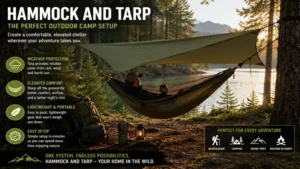
Transitioning to a hammock and tarp shelter system elevates your sleeping comfort, expands your options for pitch sites, and helps you build a deeper connection with the outdoors. By mastering the 30-degree suspension rule, anchoring an effective overhead tarp, and protecting your body with proper underside insulation, you can enjoy restful, elevated sleep in any wilderness environment.
Whether you choose an integrated, quick-pitch kit like the Kammok Mantis or configure a rugged 4-season modular rig centered around the Warbonnet Superfly, the key is matching your gear to your typical weather conditions and terrain. Pack smart, protect your anchor trees, and enjoy sleeping off the ground on your next outdoor adventure!
Recommended for You
- 7 Best Outdoor Hammock Picks Tested for 2026 Relaxation
- 7 Best Nags Head Hammock Picks for Ultimate Outdoor Relaxation (2026)
- 7 Best Jungle Hammock Systems Tested for Deep Woods Bushcraft (2026)
Disclaimer: This article contains affiliate links. As an Amazon Associate, I earn from qualifying purchases. If you purchase products through these links, we may earn a small commission at no additional cost to you.
✨ Found this guide helpful? Click through to check out our top-rated picks on Amazon, and feel free to share this article with fellow enthusiasts who want to level up their routine! 💬🤗