
In This Article
Introduction: Why the ENO Hammock Weight Limit Matters More Than You Think
You’ve found the perfect pair of trees, the creek is doing its soothing thing, and you’re about to sink into your hammock. Then a tiny, nagging question pops up: Will this thing actually hold me? 🤔
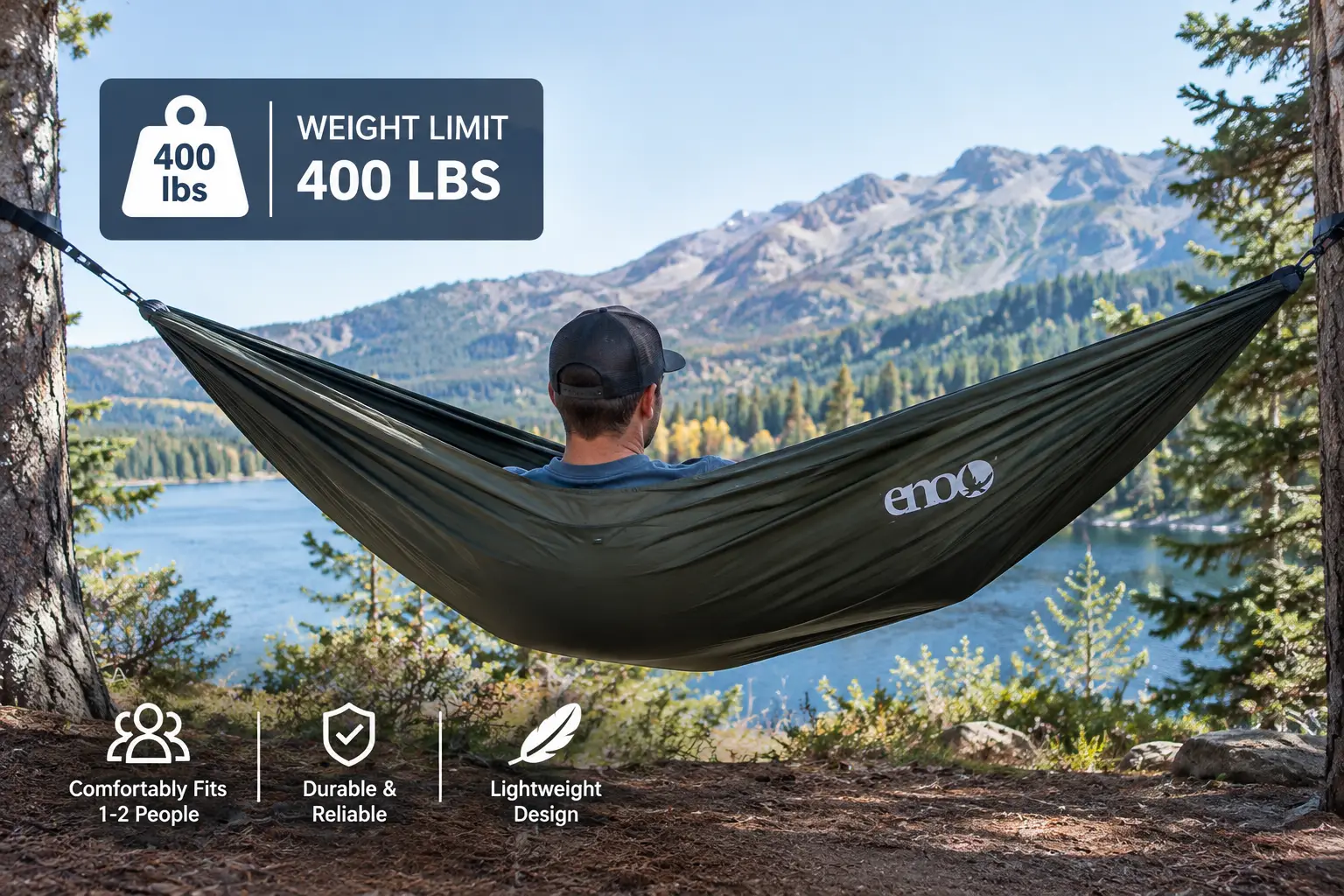
It’s a fair question, and the ENO hammock weight limit is one of the most searched specs in the entire camping-hammock category for good reason. Eagles Nest Outfitters (ENO) makes everything from a 5.8-ounce ultralight trail hammock to a nearly 20-pound backyard lounger, and their capacity ratings range from 250 lb all the way up to 400 lb. That spread surprises a lot of shoppers who assume “an ENO is an ENO.”
Here’s the part most buyers miss: the ENO hammock weight limit printed on the hammock is only one link in a chain. Your straps, your carabiners or toggles, your hang angle, and even the tree all play a role. A 400-lb hammock clipped to 300-lb straps is, practically speaking, a 300-lb system.
In this guide, we break down the real, published capacity of seven current ENO hammocks, explain what those numbers mean in everyday use, and show you how to pair each one with the right suspension. If you’re new to the gear itself, the history and basic design of the hammock is worth a quick skim — modern gathered-end nylon hammocks like ENO’s are a fairly recent twist on a centuries-old idea.
Everything below is based on ENO’s published specifications, retailer spec sheets, and aggregated customer feedback — not invented test stories. Our goal is simple: help you choose a hammock that fits your body, your plans, and your budget, then hang it safely. ✅
What Is the ENO Hammock Weight Limit?
The ENO hammock weight limit is the maximum static load, in pounds, that Eagles Nest Outfitters rates a given hammock to support. Current ENO models range from 250 lb (SkyLoft, SkyLite) to 300 lb (Sub6, SuperSub, JungleNest), 350 lb (TechNest), and 400 lb (SingleNest, DoubleNest, TravelNest, SuperNest).
That’s the short answer. The longer answer is that “static load” means weight that’s sitting still. ENO’s own safety guidance tells users not to jump or swing aggressively, and not to stack hammocks — both of which create forces well beyond simply lying in place. So think of the rating as a ceiling for calm, normal use, not a target to hit.
A second nuance: every rating applies to the hammock only. ENO sells most hammocks without straps, and their strap ratings differ (more on that in the weakest-link section below). Before you trust any number, check the hammock and the suspension.
Quick Comparison: ENO Hammock Weight Capacity at a Glance
| Hammock | Weight Limit | Hammock Weight | Fabric | Best for |
|---|---|---|---|---|
| ENO SingleNest | 400 lb | 16 oz | 70D nylon | SingleNest: solo loungers on a budget |
| ENO DoubleNest | 400 lb | 19 oz | 70D nylon | DoubleNest: tall users and couples |
| ENO TravelNest + Straps Combo | 400 lb | 28 oz (with straps) | 70D nylon | TravelNest: first-time buyers |
| ENO TechNest | 350 lb | 18 oz | 40D recycled ripstop | TechNest: weight-conscious campers |
| ENO JungleNest | 300 lb | 20 oz | 40D ripstop + mesh | JungleNest: bug-heavy backcountry trips |
| ENO Sub6 | 300 lb | 5.8 oz | 30D ripstop | Sub6: ultralight thru-hikers |
| ENO SuperNest SL | 400 lb | 15 lb 8 oz | Outdoor mesh | SuperNest SL: backyards and patios |
Looking at the table, the 400-lb club (SingleNest, DoubleNest, TravelNest, SuperNest SL) all share heavier fabrics or a rigid frame, while the lighter backpacking models drop to 300–350 lb. That’s the core trade-off in the ENO lineup: every ounce you shave tends to cost you capacity. If you’re over roughly 250 lb, the 400-lb tier gives you a comfortable margin; if you’re a lighter hiker counting grams, the Sub6 or TechNest makes more sense.
💬 One click helps other shoppers make an informed choice too! 😊
Top 7 ENO Hammocks by Weight Limit: Expert Analysis
1. ENO SingleNest — the 400-lb classic that started it all
The ENO SingleNest is the hammock most people picture when they hear “ENO,” and it carries the brand’s top-tier 400-lb rating at just 16 ounces. ENO’s current spec lists a 9.5-foot body made from 70-denier nylon, and that heavier denier is the quiet reason it can carry so much: thicker fibers resist abrasion and tearing better than the 30D–40D fabrics used in ENO’s ultralight models.
On paper, this means a 220-lb camper gets nearly 200 lb of headroom — a buffer that also absorbs the extra load from a gear bag or a dog hopping in. Based on comparing the specs, the SingleNest is best for solo users under about 6 feet who want a durable, do-everything hang without paying for extras. Taller users may find it narrow for flat diagonal lying, which is where the DoubleNest earns its place.
Reviews consistently describe the SingleNest as easy to set up and impressively packable, while the most common caveat is that it’s “just a hammock”: no bug net, no rainfly, and straps are sold separately.
Pros:
- ✅ Top 400-lb rating at only 16 ounces
- ✅ Tough 70D nylon resists everyday abrasion
- ✅ Compatible with all ENO straps and stands
Cons:
- ❌ Straps sold separately, which raises total cost
- ❌ Narrower body feels snug for taller users
Expect to pay roughly $50–$70 depending on color — strong value for a 400-lb hammock you can stuff in a daypack.
2. ENO DoubleNest — extra fabric, same 400-lb ceiling
The ENO DoubleNest is the best-selling “room for two” option, and here’s the detail that confuses buyers: it has the same 400-lb weight limit as the SingleNest. Extra width doesn’t equal extra capacity.
What you do get is more fabric — retailer specs list roughly 9’6″ × 6’4″ — at a still-modest 19 ounces. In practice, that wider body lets a single person lie flatter on a diagonal, which many hammock campers find far more comfortable for a full night. The 70D FreeWave nylon and anodized aluminum hardware match the SingleNest, so durability is essentially identical.
Who’s it for? Tall solo campers, parents lounging with a small child, or couples with a combined weight comfortably under 400 lb. GearJunkie’s hands-on DoubleNest review noted the 400-lb capacity, the triple-stitched seams, and how quickly it packs into its attached stuff sack — useful outside confirmation of ENO’s specs.
Aggregated reviews are broadly positive about comfort and setup speed. The most frequent nuance is that two adults fit, but they’ll be pressed together — great for a sunset, less so for sleeping.
Pros:
- ✅ Wider body enables a flatter diagonal lay
- ✅ Same 400-lb rating at only 19 ounces
- ✅ Durable 70D nylon with triple-stitched seams
Cons:
- ❌ Two adults fit, but sleeping together is cramped
- ❌ Extra fabric can feel floppy for small users
Typically in the $65–$85 range — the best all-around value if you’re tall or plan to share.
3. ENO TravelNest Hammock + Straps Combo — the everything-included 400-lb kit
The ENO TravelNest Hammock + Straps Combo solves the most common rookie mistake: buying a hammock and forgetting straps. According to ENO’s strap guide, it’s their only bundle that ships with straps included, and the whole system carries a 400-lb rating.
Specs list a 9′ × 5′ hammock in 70D FreeWave nylon, plus 8-foot, 1-inch polyfilament straps with 10 combined attachment points, at a combined 28 ounces. That “combined” detail matters: because the hammock and straps are rated together at 400 lb, you don’t have to worry about a mismatched weakest link.
Based on the specs, the TravelNest is best for first-time buyers, festival-goers, and anyone gifting a hammock to someone who won’t research suspension systems. ENO also notes it’s one solid fabric piece without side panels, so it sits closer to the SingleNest in size.
We found relatively few detailed US customer reviews for the TravelNest compared with the long-running Nest models, so we can’t summarize a large body of owner feedback. What’s verifiable is the spec sheet and the strong track record of the 70D fabric it shares with the SingleNest.
Pros:
- ✅ Straps included, rated together at 400 lb
- ✅ Ten attachment points make adjusting simple
- ✅ Shares proven 70D fabric with core Nests
Cons:
- ❌ Fewer owner reviews than older ENO models
- ❌ 8-foot straps may fall short on big trees
Usually around $55–$70 — arguably the best-value entry point, since straps alone often cost $30 or more.
4. ENO TechNest — lighter fabric, 350-lb rating
The ENO TechNest is where ENO starts trading capacity for weight savings. It uses 100% recycled UltraWave 40D ripstop nylon with a PFC-free water-repellent finish and a 9.5-foot body, rated to 350 lb at 18 ounces.
Here’s what that 40D fabric means in practice. Ripstop weaving stops small tears from spreading, which partly compensates for the thinner yarn — but it’s still lighter-duty than 70D, which explains the 50-lb drop from the DoubleNest. GearJunkie’s launch coverage pointed out that the TechNest is about 5% longer than the classic Nests and adds a larger mesh cargo pocket that fits a book or tablet.
Who’s it for? Campers under roughly 250 lb who want a roomy, lighter hang with sustainability credentials (the fabric is bluesign-approved). If you’re near the upper end of the rating or plan to share, the DoubleNest is the safer pick.
Customer feedback we could verify is limited; some major US retailers have marked certain TechNest colorways as discontinued, so availability on amazon.com may vary.
Pros:
- ✅ Recycled, bluesign-approved ripstop fabric
- ✅ Longer 9.5-foot body with big cargo pocket
- ✅ Water-repellent finish sheds light moisture
Cons:
- ❌ 350-lb rating is lower than classic Nests
- ❌ Availability varies as colorways are retired
Generally roughly $70–$100 depending on stock — fair value if you want features without ultralight compromises.
5. ENO JungleNest — bug-free sleep, 300-lb limit
The ENO JungleNest is built for overnight backcountry trips, with an integrated, stowable bug net held up by a DAC Featherlite spreader bar. It’s rated to 300 lb at 20 ounces.
The 10-foot body and structural ridgeline are the stars here. A ridgeline fixes the sag of the hammock regardless of how tight your straps are, which means you get a consistent, comfortable lay every time — a big deal when you’re setting up in the dark. The fabric is 40D NewWave ripstop nylon with SkyWeave Lite mesh overhead, and it uses aluminum toggles designed to pair with ENO’s Helios straps.
That toggle design is why the 300-lb ceiling matters: the Helios straps are also rated at 300 lb, so the system is balanced. Based on the specs, this is the pick for campers under about 250 lb who sleep in mosquito country.
On REI, the JungleLink system that bundles this hammock with Helios straps and a rainfly held a 4.7-out-of-5 average from a small sample (under 20 reviews when we checked). One reviewer specifically wished it had a higher weight capacity — a fair warning for bigger campers.
Pros:
- ✅ Built-in bug net with tent-like headroom
- ✅ Structural ridgeline gives a consistent sag
- ✅ 10-foot body allows a flat diagonal lay
Cons:
- ❌ 300-lb limit excludes many larger campers
- ❌ Toggles need Helios straps or added carabiners
Typically priced well above $100 — check the current price — and worth it if bugs are your biggest overnight problem.
6. ENO Sub6 — the lightest ENO, rated to 300 lb
The ENO Sub6 is ENO’s lightest hammock at just 5.8 ounces, and it still carries a 300-lb rating. That’s an impressive strength-to-weight ratio, made possible by 30D ripstop nylon and Dyneema-fiber line — Dyneema being an ultra-high-molecular-weight polyethylene famous for its strength relative to weight.
On paper, the Sub6 measures 9′ × 4′ and packs to about 5″ × 6.5″. In practice, the narrow 4-foot width is the trade-off: there’s less fabric to spread out in, which makes the diagonal lay harder for taller users. It’s designed around aluminum toggles and the Helios suspension, though ENO notes you can add carabiners to use Atlas straps.
Who’s it for? Thru-hikers, bikepackers, and fastpackers under about 250 lb who count every ounce. It’s not the right choice for a heavier camper, for sharing, or for kids who like to swing.
Owner reviews we found consistently praise how fast it sets up with Helios straps, but several note the fabric is thin — one reviewer said you can almost see through it — and recommend avoiding sharp objects. That matches what 30D fabric implies.
Pros:
- ✅ Only 5.8 ounces yet rated to 300 lb
- ✅ Packs smaller than a water bottle
- ✅ Dyneema line adds strength without weight
Cons:
- ❌ Thin fabric needs careful handling
- ❌ Narrow 4-foot width limits comfort
Usually roughly $60–$90 — excellent value per ounce saved, poor value if you don’t actually backpack.
7. ENO SuperNest SL — 400-lb backyard luxury
The ENO SuperNest SL is a different animal: a spreader-bar backyard hammock with a breathable mesh body, rated to 400 lb and weighing 15 lb 8 oz. ENO says its curved, anodized-aluminum spreader bar contours the hammock in two directions to improve comfort, safety, and stability.
That last part is significant. Traditional flat spreader-bar hammocks are notorious for flipping because they keep your center of gravity high. The 3D contour is ENO’s answer, and it’s paired with removable pillows and hanging pockets for patio-style lounging.
What the spec sheet implies but doesn’t emphasize: this is not a portable hammock. It needs a minimum hanging distance of about 14 feet, it’s not adjustable, and it’s only compatible with ENO’s SoloPod XL stand or Apollo straps (both 400-lb rated). If you’re shopping for camping, look elsewhere.
Verified reviews are thinner than for the camping Nests. The original quilted SuperNest has positive owner comments about material quality, but we couldn’t confirm a substantial body of US reviews specific to the SuperNest SL, so treat it as a promising but less-proven option.
Pros:
- ✅ 400-lb rating with a rigid, contoured frame
- ✅ Breathable mesh stays cool in summer heat
- ✅ Pillows and pockets add patio comfort
Cons:
- ❌ Needs about 14 feet of hanging distance
- ❌ Heavy and not built for travel
Generally in the $200–$300 range — premium pricing that makes sense only for a permanent backyard setup.
✨ Don’t miss these exclusive deals!
🔍 Take your hammock setup to the next level with this carefully curated lineup. Click a highlighted item to check current pricing and availability. These picks will help you get safe, comfortable hangs the whole family will enjoy!
Detailed Comparison of the Top 7
| Model | Weight Limit | Body Length | Suspension Type | Price Range* | Best for |
|---|---|---|---|---|---|
| ENO SingleNest | 400 lb | 9.5 ft | Carabiners | ~$50–$70 | SingleNest: everyday solo use |
| ENO DoubleNest | 400 lb | ~9.5 ft | Carabiners | ~$65–$85 | DoubleNest: tall users, couples |
| ENO TravelNest + Straps Combo | 400 lb | 9 ft | Carabiners + straps included | ~$55–$70 | TravelNest: beginners |
| ENO TechNest | 350 lb | 9.5 ft | Carabiners | ~$70–$100 | TechNest: eco-minded campers |
| ENO JungleNest | 300 lb | 10 ft | Toggles | $100+ | JungleNest: overnight bug protection |
| ENO Sub6 | 300 lb | 9 ft | Toggles | ~$60–$90 | Sub6: ultralight hiking |
| ENO SuperNest SL | 400 lb | 14’6″ hang | Spreader bar | ~$200–$300 | SuperNest SL: backyard lounging |
*Prices vary — check the current price at the time of purchase.
The pattern is clear: carabiner-equipped models (SingleNest, DoubleNest, TravelNest, TechNest) work with every ENO strap, while toggle models (JungleNest, Sub6) are designed around the 300-lb Helios straps. If you want maximum capacity and maximum strap flexibility, the classic Nests win. If you want a feature-rich overnight shelter, accept the 300-lb ceiling of the JungleNest and match it with appropriate straps.
ENO Hammock Straps Weight Limit: The Weakest-Link Rule
This is the section most articles skip, and it’s the most important one for safety. Your setup is only as strong as its weakest rated component — usually the straps.
| Strap | Weight Limit | Weight | Best for |
|---|---|---|---|
| Atlas | 400 lb | 9 oz | Pairs with SingleNest, DoubleNest, TechNest |
| Atlas XL | 400 lb | 13 oz | Wide-spaced trees with any carabiner Nest |
| Helios | 300 lb | 4.3 oz | Sub6, JungleNest (toggle models) |
| Helios XL | 300 lb | 6.3 oz | Ultralight setups with distant trees |
| Apollo | 400 lb | 19 oz | SuperNest SL and backyard hangs |
| Atlas EXT (extender) | 400 lb | 7 oz | Adding 10 ft to existing straps |
The takeaway: pairing a 400-lb DoubleNest with 300-lb Helios straps creates a 300-lb system, no matter what the hammock tag says. If you’re a larger camper, Atlas or Apollo straps keep your full 400-lb rating intact. Conversely, ultralight hikers well under 300 lb lose nothing by choosing Helios with a Sub6 — they just need to respect that ceiling.
Owner feedback on REI and other retailers reflects this trade-off: Helios users love the low weight and fine-tuning adjustment, while a recurring comment is that Atlas webbing feels more durable on rough bark. Neither is “better” — they serve different priorities.
How to Set Up Your ENO Hammock for Maximum Safety 🛠️
Getting the most out of your ENO hammock weight limit starts with a proper hang. Here’s a practical first-use routine built around ENO’s published safety and setup instructions:
- Pick living, sturdy trees. Choose healthy trees roughly 10–15 feet apart for standard Nests (ENO’s TravelNest guidance cites this range). Look up for dead branches before you commit.
- Wrap straps once around the trunk. Use the widest part of the strap against the bark. Don’t wrap multiple times — it adds friction damage without adding strength.
- Aim for a gentle sag, not a tight line. A rough target many hammock users follow is about a 30-degree angle between strap and horizontal. We explain why in the hang-angle section below.
- Keep it low. ENO states you should never hang your hammock higher than 18 inches off the ground. That height keeps a fall survivable if something gives.
- Clear the ground. Remove rocks, sticks, and anything sharp beneath the hammock.
- Test before trusting. Press down with your hands, then sit in the middle before lying back. Watch the straps and hardware for slipping.
- Inspect every time. Check carabiners, rope, and straps for fraying, snags, or discoloration. ENO says to stop using any gear that looks off.
Common first-month mistakes: hanging the hammock “bowstring tight” (which multiplies strap tension), leaving it outdoors for weeks (UV and weather degrade nylon), and untying the end knots — ENO explicitly warns against that.
Maintenance schedule: inspect before each trip, hand-wash with mild soap only when needed, air-dry fully, and store indoors out of sunlight. Done consistently, this preserves the fabric strength your rating depends on.
Which ENO Fits You? Three Real-World Scenarios 🎒
Scenario 1 — The 260-lb weekend camper. Marcus (a hypothetical example) car-camps a few weekends a year, weighs about 260 lb, and wants a comfortable afternoon nap spot. A 300-lb hammock would technically hold him, but with only 40 lb of margin before adding gear or a heavy jacket. The DoubleNest with Atlas straps gives him 140 lb of headroom and a wider body for lying diagonally. Budget: under $120 total for hammock and straps.
Scenario 2 — The 150-lb thru-hiker. A hiker tackling a multi-month trail counts ounces obsessively. The Sub6 plus Helios straps comes in around 10 ounces total and still leaves 150 lb of margin under the 300-lb ceiling. For buggy sections, upgrading to the JungleNest adds a built-in net while keeping the same balanced 300-lb system.
Scenario 3 — The family backyard. A family wants a hammock that stays up all summer for reading and lounging. Kids climbing in and out means unpredictable loads, so a high rating and stable design matter most. The SuperNest SL on a SoloPod XL stand offers 400 lb, a contoured frame that resists flipping, and no tree required. Budget: considerably higher, but it doubles as patio furniture.
Notice the pattern: the right hammock isn’t the one with the highest number — it’s the one whose rating comfortably exceeds your real-world load, including gear and how you’ll actually use it.
Troubleshooting: Common Weight-Related Problems and Fixes
Problem 1: “My hammock sags almost to the ground when I get in.” Fabric and straps stretch under load. Hang a few inches higher than your final target (still within the 18-inch guidance once weighted), and retest. A structural ridgeline, like the one on the JungleNest, solves this consistently.
Problem 2: “My straps slip down the tree.” Usually caused by a too-flat hang angle or smooth bark. Increase the sag so the straps pull more downward than sideways, and reposition on rougher bark.
Problem 3: “I’m close to the limit and nervous.” Move up a tier. If you’re near 300 lb with a Sub6, switch to a 400-lb carabiner model like the SingleNest with Atlas straps. Margin is the cheapest safety upgrade you can buy.
Problem 4: “Two of us keep rolling into the middle.” That’s physics, not a defect. Use a DoubleNest for the extra width, keep combined weight well below 400 lb, or consider two separate hammocks — ENO even sells a Fuse tandem system designed for side-by-side hangs.
Problem 5: “The fabric feels thinner than I expected.” That’s typical of 30D–40D models like the Sub6 and TechNest. Keep sharp objects (keys, pocket knives, dog claws) out of the hammock, and carry a repair kit.
How to Choose an ENO Hammock by Weight Limit
- Add up your real load. Body weight plus clothing, a sleeping bag, and anything you’ll keep in the hammock. Your number is usually 10–30 lb more than you think.
- Leave a margin. Aim for a rating at least 50–100 lb above your real load; this buffers stretch, small bounces, and wear.
- Match the straps. Confirm the strap rating meets or exceeds the hammock’s. Helios caps you at 300 lb; Atlas and Apollo go to 400 lb.
- Decide on solo vs. shared use. Sharing calls for the DoubleNest and a combined weight well under 400 lb.
- Weigh pack weight against capacity. Lighter fabrics (30D–40D) mean lower ratings; heavier 70D fabric means more capacity.
- Consider your environment. Bugs point to the JungleNest; backyards point to the SuperNest SL.
- Check compatibility. Toggle models need Helios straps or added carabiners; spreader-bar models need specific stands or straps.
ENO DoubleNest Weight Limit vs SingleNest Weight Limit: What’s Really Different?
This is one of the most common points of confusion. The ENO DoubleNest weight limit and the ENO SingleNest weight limit are identical: both are rated at 400 lb. Same fabric family (70D nylon), same hardware approach, same compatibility with every ENO strap and stand.
So what are you paying extra for with the DoubleNest? Fabric. The added width changes how the hammock carries weight, not how much. With more fabric, you can lie at a sharper diagonal, which flattens your body and reduces the “banana” curve that bothers some back sleepers. Weight spreads across a wider area, which many people find more comfortable over a full night.
The SingleNest counters with lower weight (16 vs. 19 ounces), a smaller packed size, and a lower price. For a short user who mainly naps, the extra fabric of the DoubleNest can even feel excessive — it wraps around you like a cocoon.
Here’s a practical rule: if you’re over about 6 feet tall, plan to share occasionally, or want to sleep overnight, pick the DoubleNest. If you’re shorter, mostly lounging, and value pack size, the SingleNest delivers identical strength for less. Either way, pairing it with 400-lb Atlas straps preserves the full rating.
Can Two People Fit in an ENO Hammock?
Yes — with conditions. The question isn’t really “can two people fit” but “can two people stay under the weight limit and still be comfortable.”
On capacity, the math is simple. The 400-lb Nest models can technically hold two adults whose combined weight — plus anything else in the hammock — stays under 400 lb. Two 180-lb adults leave just 40 lb of margin, which is thin once you add phones, blankets, or a moment of shifting around. Two lighter adults, or one adult and a child, are far more comfortable fits.
On comfort, gathered-end hammocks naturally push occupants toward the center. That’s cozy for a sunset chat, less so for a full night. Most hammock campers who travel as pairs eventually run two separate hammocks.
What you should never do: put two people in a 300-lb Sub6 or JungleNest. These are explicitly built for solo use, with thinner fabrics that leave little room for doubled-up loads. And because ENO warns against swinging aggressively, two people bouncing together is the fastest way to exceed the static rating in a moment.
Bottom line: for sharing, the DoubleNest is the right shape, and Atlas or Apollo straps keep the full 400-lb system rating. Keep the combined weight conservatively under the limit, and treat it as a lounge, not a bed for two.
What to Expect: How Hang Angle Multiplies the Load ⚡
Here’s the physics that turns a “400-lb hammock” into a bigger engineering story. When you lie in a hammock, your weight is split between two straps — but the force on each strap depends on the angle.
At roughly a 30-degree angle between strap and horizontal, each strap carries about your full body weight, not half. Pull the hammock tighter to a 15-degree angle and each strap carries roughly twice your body weight. Hang it nearly flat, and the force climbs dramatically, which is why “bowstring tight” hangs stress straps, carabiners, and trees far more than a relaxed sag.
What this means in practice:
- ✅ A saggy hang is a safer hang. The classic 30-degree target balances comfort and strap tension.
- ✅ Ratings assume reasonable use. A rated hammock pulled flat and bounced on is facing loads its rating never contemplated.
- ✅ Trees feel it too. Higher tension means more pressure on bark — another reason to avoid tight hangs.
This is the hidden reason two people with identical weights can have very different experiences with the same ENO hammock weight limit: setup technique changes the real forces involved more than most buyers realize.
Common Mistakes to Avoid When Buying an ENO Hammock
1. Reading only the hammock rating. As covered above, straps can lower your system limit. A DoubleNest on Helios straps is a 300-lb system.
2. Buying “just enough” capacity. A 290-lb camper on a 300-lb hammock has no margin for gear, stretch, or wear. Size up.
3. Assuming bigger means stronger. The DoubleNest and SingleNest share a 400-lb rating. Width is about comfort, not capacity.
4. Forgetting that most ENO hammocks don’t include straps. Budget for them — unless you choose the TravelNest combo.
5. Choosing ultralight when you don’t backpack. The Sub6 is a marvel for thru-hikers, but casual campers trade capacity and durability for weight savings they’ll never need.
6. Ignoring toggles vs. carabiners. Toggle models like the JungleNest are designed for Helios straps; using other straps requires added carabiners.
7. Buying for the backyard without measuring. The SuperNest SL needs about 14 feet of hanging distance. Measure before you order.
Long-Term Cost, Wear, and Maintenance
A hammock’s weight limit is a spec for new gear in good condition. Over years of use, sunlight, moisture, and abrasion slowly degrade nylon — so how you care for it affects how much of that rating you keep.
Total cost of ownership. The SingleNest plus Atlas straps typically lands around $85–$110 together. The TravelNest combo lands lower because the straps are included. Ultralight setups (Sub6 plus Helios) cost about the same as a classic Nest setup but save over a pound. A SuperNest SL setup with a stand is a several-hundred-dollar investment — closer to patio furniture than camping gear.
Wear patterns to watch. ENO’s guidance says to inspect for snags, fraying, and discoloration before every use. Discoloration matters because UV exposure is one of the main enemies of synthetic fabric. ENO also recommends storing gear indoors, since weather exposure “quickly” degrades it.
Warranty and repairs. ENO’s HangTough guarantee covers certain repairs, such as fraying or untied end knots and detached stuff sacks, while small holes are meant to be fixed at home with a repair kit. That makes a well-maintained ENO a long-lived purchase.
Value verdict. For most people, a 400-lb classic Nest with Atlas straps delivers the best capacity-per-dollar in the lineup. Ultralight and specialty models cost similar or more for lower ratings — worth it only when their specific features solve a real problem for you.
Safety, Standards, and Responsible Hammocking 🌲
There’s no single federal standard dedicated to camping hammock capacity in the US, so manufacturer ratings and instructions are your primary reference. ENO’s guidance includes a few non-negotiables: hang no higher than 18 inches, don’t let children use hammocks unattended, don’t jump or swing aggressively, don’t stack hammocks, and don’t modify the hammock or untie its knots.
Responsible hammocking also protects the trees that hold you up. The Leave No Trace Center’s hammock camping guidelines recommend tree-friendly webbing at least 1 inch wide, a single wrap around the trunk, a loose rather than tight hang, living trees only, and camps set at least 200 feet from water sources. Every ENO strap in our weakest-link table meets the 1-inch minimum width.
Two additional practical points:
- Check local rules. Some parks and campgrounds restrict or ban hammocks on certain trees because of repeated bark damage. A portable stand is the workaround where allowed.
- Supervise kids closely. Children love to swing, and swinging creates dynamic forces that exceed static ratings. Treat any child’s use as supervised use, regardless of the hammock’s capacity.
Following these rules isn’t just about compliance — they’re the conditions under which ENO’s weight ratings are meant to apply.
ENO Hammocks vs Traditional Alternatives
| Feature | ENO Nest Hammocks | Rope/Spreader-Bar Hammocks | Backpacking Tent |
|---|---|---|---|
| Typical capacity | 300–400 lb | Varies widely by model | Not applicable |
| Packed weight | ~6–20 oz | Several pounds | Often 2–4+ lb |
| Ground needed | None | None (needs stand or posts) | Flat, clear ground |
| Setup speed | Minutes | Slow, often permanent | Moderate |
| Best for | SingleNest, DoubleNest, Sub6 users who travel | Backyard-only lounging | Treeless terrain |
Compared with traditional rope or flat spreader-bar hammocks, ENO’s gathered-end designs pack dramatically smaller and set up faster, while still offering clearly published capacities. The trade-off is that they require trees or a stand. The SuperNest SL bridges both worlds with a contoured spreader bar, while a tent remains the better choice above treeline or in open desert.
FAQ: ENO Hammock Weight Limit
❓ What is the weight limit on an ENO DoubleNest?
❓ Do ENO Helios straps reduce my hammock's capacity?
❓ Which ENO hammock is best for heavy people?
❓ Is the ENO TravelNest strong enough for adults?
❓ Can I leave my ENO hammock up outside all season?
Conclusion: Choose the Margin, Not Just the Maximum
The ENO hammock weight limit isn’t a single number — it’s a system. The hammock might be rated to 400 lb, but your straps, hang angle, and maintenance habits decide how much of that strength you actually get.
For most campers, the classic 400-lb Nests are the sweet spot. The SingleNest is the lightest, most affordable path to full capacity; the DoubleNest adds the width taller users and couples need; and the TravelNest combo removes the guesswork by bundling straps rated together. If you’re counting ounces, the Sub6 and JungleNest offer smart 300-lb systems when paired with Helios straps, while the TechNest splits the difference at 350 lb. And if your “campsite” is a patio, the SuperNest SL brings 400-lb stability without needing trees.
Whatever you choose, remember the three rules from this guide: leave at least a 50–100 lb margin above your real load, match your straps to your hammock, and hang with a gentle sag no higher than 18 inches. Do that, and you can stop wondering whether your hammock will hold — and start enjoying the view. 🌄
🏕️ Ready to hang with confidence?
🔍 Click any highlighted hammock above to check current pricing and availability on Amazon, pair it with the right straps, and turn your next trip into the most relaxing one yet!
Recommended for You
- Winter Hammock Tent Guide 2026: 7 Best Picks to Stay Warm
- Indoor Hammock Holder: 7 Best Stands & Mounts That Won’t Fail (2026)
- Truck Hammock Mount: 7 Best Picks That Actually Hold Up (2026)
Disclaimer: This post contains affiliate links. As an Amazon Associate, I earn from qualifying purchases made through these links, at no additional cost to you.
✨ Found this article helpful? Share it with someone who needs it! 💬🤗