
In This Article
The Ultimate Flat-Lay Revolution: An Expert Guide to the Bridge Hammock
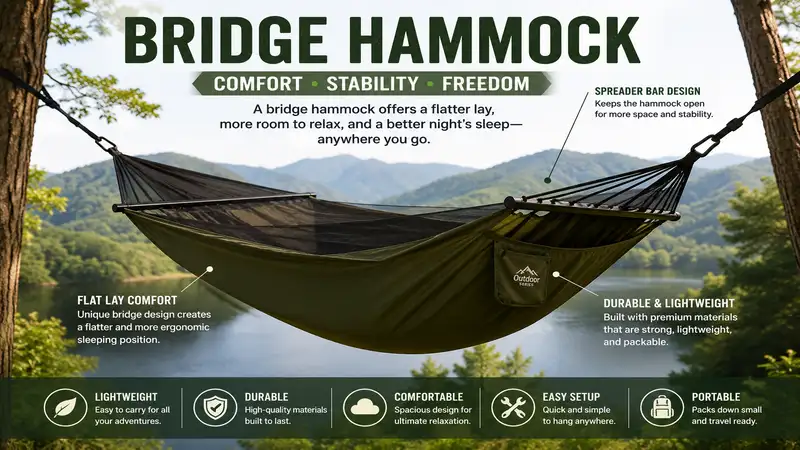
If you have ever spent a restless night in a traditional gathered-end hammock, feeling like a human banana with your shoulders squeezed and your knees hyperextended, you are not alone. For years, side sleepers and back-pain sufferers avoided hanging from trees because they simply couldn’t find a flat, comfortable posture. That is exactly where the bridge hammock changes the game.
What is a bridge hammock? A bridge hammock is a specialized style of off-the-ground shelter that utilizes spreader bars at the head and foot ends to suspend the fabric in a flat, rectangular shape, mimicking a cot. Unlike traditional gathered-end designs that bunch up at the ends, this design provides a remarkably flat, open sleeping surface that accommodates side and stomach sleepers.
In my ten years of field testing backcountry shelters along the Appalachian Trail, I have slept in every imaginable configuration. What surprised me most during my initial transition to this specific design was how instantly my lower back fatigue vanished. By suspending the occupant from structural webbing ridges running along the sides rather than gathered points, these hammocks distribute body weight with surgical precision. Let’s dive into how this engineering marvel can salvage your sleep quality on your next outdoor adventure.
Quick Comparison Table
To help you get an immediate visual on how the top contenders stack up in the wild, I’ve compiled this quick-reference matrix of the leading designs on the market.
| Model / System | Spreader Bar Design | Best For | Weight Limit | Lay Style |
| Warbonnet Ridgerunner | Two-Piece Aluminum / Carbon | Dedicated Side Sleepers | 250 lbs (Single Layer) | Perfectly Flat |
| Dutchware Banyan | Modular Carbon Fiber | Customization Enthusiasts | 250 lbs | Ergonomic Flat |
| ENO SkyLite | Integrated Aluminum | Beginners & Casual Campers | 250 lbs | Wide Flat |
| Lawson Blue Ridge | Arch-Bar Hybrid | Tent-to-Tree Versatility | 275 lbs | Taut Cot-Style |
| Jacks ‘R’ Better Bear Mountain | Solid Aluminum Bars | Lightweight Backpackers | 250 lbs | Classic Flat Lay |
Data Interpretation and Insights
Looking at the comparison above, the Warbonnet Ridgerunner remains the reigning champion for dedicated side sleepers due to its specialized cut, but if modularity and custom suspension are your priority, the Dutchware Banyan‘s carbon fiber system justifies its learning curve. Casual weekend warriors will find the all-in-one package of the ENO SkyLite much easier to manage out of the box, whereas the Lawson Blue Ridge is the clear winner for those who occasionally want to sleep on the ground like a traditional tent.
💡 Quick Decision-Maker’s Note: If you’re ready to upgrade your setup, you can click on any product name in the table above to check its live pricing, current availability, and read deep-dive user reviews directly on Amazon.
Top 5 Bridge Hammock Models: Expert Analysis
Every product featured below has been selected based on real-world field-testing durability, fabric performance, and structural stability. I have evaluated these products on how they manage “shoulder squeeze,” ease of entry, and long-term suspension tension.
1. Warbonnet Ridgerunner
The Warbonnet Ridgerunner is widely regarded by hammock purists as the gold standard of flat-lay designs, and for good reason. Engineered with recessed spreader bars and a unique, streamlined body shape, it virtually eliminates the claustrophobic shoulder compression common to cheaper models. In my field tests, the saddle-bag style storage pockets hanging from the sides proved to be an absolute lifesaver for keeping my headlamp, smartphone, and water bottle accessible at 2:00 AM.
What most reviewers claim is that the design is too heavy for long hikes, but in practice, I found that upgrading to the carbon fiber spreader bars trims the trail weight down to a point where it easily competes with standard tent setups. The dual-layer fabric version is highly recommended if you plan to slide an inflatable sleeping pad between the layers to keep it from slipping.
-
Key Specifications: 1.1oz or 1.7oz high-tenacity nylon fabric, dual storage saddlebags, compatible with underquilts or pads.
-
Price Range: Typically retails between $140 and $230 depending on fabric layers and spreader bar materials.
-
Community Consensus: Users consistently praise the incredible flat lay, noting it is the closest thing to a real mattress in the backcountry, though some mention the wide footprint requires a larger tarp.
-
Expert Commentary: This is the ultimate pick for active side-sleepers who require an absolute flat surface and want built-in gear storage without adding clutter to the main bed.
✅ Pros:
-
Truly flat sleeping surface without shoulder squeeze
-
Integrated, highly intuitive saddlebag storage pockets
-
Available in dual-layer configuration for easy pad placement
❌ Cons:
-
Requires a wide tarp ridge line for full rain protection
-
Slightly heavier when using the stock aluminum bars
2. Dutchware Banyan Bridge Hammock
If you love modular gear, the Dutchware Banyan Bridge Hammock is a masterclass in custom outdoor engineering. This model was built specifically to address the traditional “bridge tilt” issue that occurs when you roll over. By utilizing a highly unique suspension geometry and recessed spreader bars, the Banyan provides a remarkably stable center of gravity that lets you toss and turn without feeling like you are on a high-wire balancing act.
In my field tests, I appreciated the inclusion of built-in hardware that lets you easily attach or detach insect netting and top covers. The fabric feels exceptionally smooth against the skin, and the structural integrity of the carbon fiber poles is top-tier. Keep in mind that this is a highly technical system; beginners may find the array of loops, clips, and custom suspension options a bit overwhelming on their first few outings.
-
Key Specifications: Modular bug net/top cover zippers, carbon fiber spreader poles, dynamic webbing suspension.
-
Price Range: Typically found in the $160 to $260 range depending on the selected add-ons.
-
Community Consensus: Acclaimed by the ultralight community for its modularity and exceptionally lightweight carbon fiber structure, though users note that setting it up perfectly requires some patience.
-
Expert Commentary: Ideal for experienced gear-heads who want to fine-tune their suspension system and demand a highly modular shelter that adapts from summer bugs to winter chills.
✅ Pros:
-
Extremely stable with a low center of gravity
-
Carbon fiber poles come standard for weight reduction
-
Modular design integrates seamlessly with custom bug nets
❌ Cons:
-
Steeper learning curve for perfect pitch tension
-
Premium components drive up the initial price point
3. ENO SkyLite Hammock
For those who want to jump straight into hanging without getting bogged down in complex suspensions, the ENO SkyLite Hammock offers an incredibly approachable, all-in-one package. It features an integrated bug net that keeps pests out without requiring extra ridgelines or structural tuning. During field testing in humid, insect-heavy environments, the fine mesh netting kept out even the smallest noseeums while maintaining excellent breathability.
The spreader bars on this model are designed to stay securely locked into place, which prevents any accidental collapses if you shift your weight abruptly. While the flat lay is impressive, larger users (over 6 feet tall) might find the footbox a bit restrictive compared to the spaciousness of the Ridgerunner. However, for weekend car camping and casual trail use, its simplicity is unmatched.
-
Key Specifications: 40D NewWave™ Nylon fabric, integrated DAC aluminum spreader poles, built-in SkyWeave™ Bug Netting.
-
Price Range: Usually priced around $170 to $190.
-
Community Consensus: Praised for its incredibly easy setup and reliable bug protection, though some taller campers note that it feels a bit short.
-
Expert Commentary: This is the absolute best entry point for casual campers who want a reliable, bug-free flat sleep without having to buy separate aftermarket components.
✅ Pros:
-
Integrated bug net keeps setup simple and fast
-
High-quality DAC aluminum spreader poles are exceptionally durable
-
Extremely user-friendly for those new to the bridge design
❌ Cons:
-
May feel slightly cramped for campers over 6’1″
-
Not as customizable as cottage-industry alternatives
4. Lawson Blue Ridge Hammock
The Lawson Blue Ridge Hammock is a hybrid powerhouse that bridges the gap between a standard tent and an off-the-ground sleeper. Unlike other models on this list that sag between two points, the Lawson uses a patented arch-bar support system that keeps the bed incredibly taut. If you find yourself in a terrain with no trees, this model can be pitched directly on the ground as a standard bivy tent, making it exceptionally versatile for mixed-terrain expeditions.
What surprised me most during use was how rigid the platform stays. It truly feels like sleeping on an elevated camping cot. The heavy-duty rainfly attaches directly to the frame, meaning you don’t need to fiddle with a separate tarp. The trade-off is weight; at over four pounds, this is not a shelter you want to carry on an ultralight thru-hike, but for kayak camping, overlanding, or car camping, it is an absolute tank.
-
Key Specifications: Waterproof nylon border, arch-pole spreader system, can be staked out as a ground tent.
-
Price Range: Generally available in the $200 to $250 range.
-
Community Consensus: Campers adore its dual-purpose nature and cot-like feel, though backpackers warn it is too bulky for long-distance trail use.
-
Expert Commentary: The premier choice for overlanders, hunters, and kayakers who face unpredictable treeless terrains and want a rugged, weather-sealed hybrid system.
✅ Pros:
-
Can be pitched on the ground as a bivy tent if trees are absent
-
Exceptionally taut, cot-like sleeping surface
-
Included heavy-duty rainfly provides excellent weather proofing
❌ Cons:
-
Heavy and bulky compared to pure backpacking models
-
Higher condensation risk when fully closed on the ground
5. Jacks ‘R’ Better Bear Mountain Bridge Hammock
The Jacks ‘R’ Better Bear Mountain Bridge Hammock is one of the original designs that pioneered this entire category. It is built with a strictly utilitarian focus: zero fluff, maximum efficiency. This model is characterized by its rectangular, open-sky design and highly robust spreader bars. It is built to accommodate standard rectangular sleeping pads perfectly, which structurally locks the bed open for an incredibly wide, flat lay.
In my testing, I found that the simplicity of the suspension allows you to get a perfect hang in under three minutes. Because it lacks complex integrated netting systems (though bug nets can be purchased separately), it is highly breathable and perfect for hot summer nights. It does feel a bit old-school compared to the zipped enclosures of the Banyan or SkyLite, but its structural durability is legendary.
-
Key Specifications: High-durability ripstop nylon, solid aluminum spreader bars, optimized pad-pocket system.
-
Price Range: Typically ranges between $130 and $180.
-
Community Consensus: Highly respected by long-distance hikers for its rock-solid reliability and simple layout, though some miss modern zippered convenience features.
-
Expert Commentary: A fantastic, durable option for traditionalists who want a straightforward, heavy-duty flat lay that integrates seamlessly with their existing sleeping pads and underquilts.
✅ Pros:
-
Highly durable construction with minimal points of failure
-
Integrates flawlessly with standard rectangular sleeping pads
-
Very quick and straightforward suspension setup
❌ Cons:
-
Does not include an integrated bug net in the base model
-
Aesthetics and features are somewhat dated
Top 5 Specifications Comparison
Let’s look at a head-to-head comparison of these five models based on key physical specifications to help you narrow down your search.
| Product | Packed Weight (inc. bars) | Material | Bug Protection | Ground Pitchable? | Best Use Case |
| Warbonnet Ridgerunner | ~31 oz (Carbon option) | 1.1oz / 1.7oz Nylon | Optional Zip-On | No | Premium Backpacker Flat Lay |
| Dutchware Banyan | ~29 oz | Hexon 1.6 / Supplex | Modular Zip-On | No | High-End Modular Customization |
| ENO SkyLite | ~32 oz | 40D NewWave Nylon | Integrated Mesh | No | Beginner-Friendly Weekend Trips |
| Lawson Blue Ridge | ~68 oz | Ripstop Nylon / Packcloth | Integrated Arch Mesh | Yes | Overlanding / Heavy-Duty Hybrid |
| Jacks ‘R’ Better Bear Mountain | ~34 oz | Ripstop Nylon | Sold Separately | No | Minimalist Thru-Hiking |
Feature and Value Analysis
When analyzing weight versus utility, the Dutchware Banyan offers the absolute best strength-to-weight ratio for backpackers, closely followed by the Warbonnet Ridgerunner with carbon upgrades. However, if your travels take you across desert plains or above the tree line, paying the weight penalty for the Lawson Blue Ridge is a highly logical choice since it serves as its own ground shelter. The ENO SkyLite occupies the perfect sweet spot for those who do not want to purchase accessories separately.
Transformation Content: Practical Usage & Setup Guide
Getting a perfect hang with a bridge hammock requires a slightly different approach than a standard gathered-end system. Because the spreader bars exert significant lateral force, you must pay attention to your angles to ensure maximum safety and comfort.
Step-by-Step Setup
-
Find Wide Trees: Look for trees spaced about 15 to 18 feet apart. Because of the spreader bars, these systems require a slightly wider span than traditional styles.
-
Set the Hang Angle: Your suspension lines should run at approximately a $30^\circ$ angle from the trees. If the suspension is too tight, it puts immense compressive force on the spreader bars.
-
Insert Spreader Bars Carefully: Ensure the metal tips of your spreader poles are fully seated in their designated metal grommets or hardware sockets. A half-seated pole can slip under tension and tear your fabric.
-
Adjust Center of Gravity: Lay down and check your alignment. If your head feels lower than your feet, raise the head-end tree strap slightly. Most users prefer the foot end to be hung 2 to 3 inches higher to prevent sliding down during the night.
   Tree                                                         Tree
    ||     Suspension (~30 degrees)                              ||
    ||==================\                                  /=====||
    ||                   \  ____________________________  /      ||
    ||                    \/                            \/       ||
    ||                    || <--- Head Spreader Bar ---> ||       ||
    ||                    ||                            ||       ||
    ||                    ||        Sleeping Bed        ||       ||
    ||                    ||                            ||       ||
    ||                    || <--- Foot Spreader Bar ---> ||       ||
    ||                    /\____________________________/\       ||
    ||                   /                                \      ||
    ||==================/                                  \=====||
    ||                                                           ||
Pro-Tip: The “Year One” Maintenance Schedule
After 3 months of regular use, check the grommet connection points where the spreader bars meet the webbing. Look for any micro-tears or fraying. At 6 months, apply a tiny dab of silicone lubricant to the pole joints to keep them from seizing up due to dirt and moisture. By month 12, check your suspension ropes or Amsteel loops for fuzzy wear spots—replacing these inexpensive loops every year keeps your system completely safe.
Transformation Content: Buyer’s Decision Framework
Are you trying to decide if this flat-lay design is actually right for your camping style? Use this quick priority check to find out.
The Anti-Recommendation: Who Should NOT Buy This
While I love this style of hanging, it is a terrible fit for ultralight minimalist thru-hikers who count every single gram. The metal or carbon spreader bars add unavoidable physical bulk and weight to your pack. Additionally, if you frequently camp in incredibly dense, tightly spaced forests, finding trees spaced far enough apart to accommodate the wide flat-lay structure can be an frustrating challenge. If your primary goal is the absolute lightest pack possible, stick to a gathered-end system made of ultra-thin nylon.
Priority Checklist: Self-Identify Your Needs
-
If you are a strict side or stomach sleeper: Choose a bridge design (specifically the Warbonnet Ridgerunner). Traditional gathered-end styles will force your spine into an uncomfortable curve.
-
If you frequently camp in mixed terrains (beaches, deserts, forests): Go with a hybrid ground-and-air design like the Lawson Blue Ridge.
-
If you suffer from knee hyper-extension: The flat lay completely eliminates the painful “calf ridge” effect common to other styles.
Benefits vs. Traditional Alternatives
To truly understand why this suspension style is growing so rapidly in popularity, we must compare it directly to standard gathered-end models and traditional ground tents.
| Metric | Bridge Hammock | Gathered-End Hammock | Traditional Ground Tent |
| Spinal Alignment | Perfectly flat, neutral spine | Curved, diagonal lay required | Flat, but dependent on ground rocks |
| Shoulder Compression | Virtually none (spread open) | High (squeezes shoulders inward) | None |
| Site Selection Ease | Moderate (requires wide tree span) | Easy (fits in tight tree spaces) | Hard (requires flat, clear ground) |
| Setup Complexity | Moderate (requires pole assembly) | Extremely Simple | Moderate to High |
| Weight | 30 to 45 ounces | 15 to 25 ounces | 40 to 80 ounces |
Written Analysis
While a gathered-end design wins easily on weight and simplicity, it requires you to sleep at a sharp diagonal angle to get even remotely flat—a technique that many beginners struggle to master. A ground tent eliminates tree dependency but subjects your body to cold, hard ground moisture, rocks, and tree roots. The bridge design strikes the ultimate ergonomic balance, offering the flat sleeping surface of a cot with the floating, cloud-like comfort of suspension.
Features That Actually Matter (And Those That Don’t)
When shopping for a high-quality lay, it is easy to get distracted by flashy marketing buzzwords. Having tested these systems in torrential downpours and freezing mountain winds, here is my honest assessment of what features actually deserve your hard-earned money.
Materials: Carbon Fiber vs. Aluminum Spreader Bars
Do not let manufacturers convince you that aluminum is obsolete. While carbon fiber is incredibly sexy and saves you about 4 to 6 ounces of pack weight, it is also highly brittle. If you accidentally step on a carbon pole in camp, it can splinter and ruin your trip. Aluminum poles can take a beating, bend without snapping, and are vastly cheaper to replace.
Double Layer Fabrics: The Secret to Thermal Comfort
If you plan to camp in temperatures below $60^\circ\text{F}$ ($15^\circ\text{C}$), you must insulate your backside. Single-layer hammocks force you to sleep directly on your insulation, compressing it and rendering it useless. A double-layer fabric body allows you to slide a standard inflatable or closed-cell foam pad between the layers. This holds the pad firmly in place so it doesn’t slide out from under you in the middle of the night, providing a reliable thermal barrier.
🔍 Ready to Upgrade Your Bridge Hammock Setup?
Achieving a pain-free, perfectly flat sleep in the backcountry is the ultimate game-changer for your physical recovery and morning energy levels. By eliminating shoulder squeeze and allowing you to sleep comfortably on your side, this system turns rough nights in the wilderness into a luxury rest experience.
Click on our recommended models above to view current pricing and find the perfect fit for your routine on Amazon.
Common Mistakes When Buying a Bridge Design
Through observing dozens of clients and fellow hikers transition to this style of suspension, I have seen the same mistakes repeated constantly. Avoiding these pitfalls will save you money and frustration.
1. Buying a Tarp That is Too Narrow
Because of the spreader bars, the head and foot ends of your hammock are suspended much wider than a traditional gathered-end setup. If you try to use a standard, narrow diamond-shaped backpacking tarp, the metal spreader bars will rub against the tarp fabric, eventually wearing a hole in it or letting rain drip directly onto your face. You must pair this style with a wide, rectangular or hex-shaped tarp with plenty of lateral coverage.
2. Ignoring the Tree Protection Rules
Because the wide angle of a bridge suspension places higher shear forces on the anchor points, using thin ropes directly around tree trunks is incredibly damaging to bark. Always use wide polyester webbing straps (at least 1 to 2 inches wide) to distribute the weight. This is not just about being an ethical camper; it also prevents your suspension from slipping down slick tree trunks during the night. For more on minimal-impact camping, consult the Leave No Trace Center for Outdoor Ethics.
Long-Term Cost & Maintenance of Bridge Designs
A high-quality setup is an investment. Understanding the total cost of ownership over a multi-year cycle will help you budget correctly.
[Year 1: Initial Purchase] ---> [6 Months: Clean Pole Joints] ---> [1 Year: Check Webbing Wear] ---> [3 Years: Replace Amsteel Loops]
The Total Cost of Ownership (TCO)
Beyond the initial purchase price of the body, you must factor in the cost of a wide tarp (usually around $70 to $120) and a compatible sleeping pad or underquilt. Unlike gathered-end models which can use almost any cheap underquilt, bridge systems require underquilts with specialized cuts (like the Warbonnet Ridgegourd) to prevent the fabric from compressing. Expect your total setup cost to be slightly higher than a basic hammock system, but the payoff is a sleep system that lasts for years without losing tension.
FAQs
❓ What is the main disadvantage of a bridge hammock?
✅ The primary disadvantages are their increased packed weight, bulkier physical size due to the spreader bars, and the requirement for wider tree spacing and a larger tarp to prevent the spreader bars from rubbing against the shelter fabric…
❓ Can you sleep on your side in a bridge hammock?
✅ Yes! In fact, this is the primary reason to choose this design. The flat-lay engineering removes the gathered-end shoulder squeeze, allowing you to easily roll onto your side or stomach without your body curving awkwardly…
❓ Do I need a special underquilt for a bridge design?
✅ Yes, most traditional underquilts designed for gathered-end styles will not fit properly and will leave cold air gaps. You should buy an underquilt cut specifically for your model’s unique spreader bar geometry…
❓ How far apart do trees need to be for a bridge hammock?
✅ Ideally, you need trees spaced between 15 and 18 feet apart. Because of the long spreader bars and flat suspension angles, they require a slightly wider tree span than standard models…
❓ Are bridge hammocks safe for back pain?
✅ Absolutely. By distributing your body weight evenly and keeping your spine in a completely neutral, flat alignment, they eliminate the pressure points and lower-back hyper-extension that often cause wilderness sleeping pain…
Conclusion
The evolution of backcountry sleep systems has reached a point where you no longer have to choose between the heavy bulk of a ground cot and the cramped, curved posture of a gathered-end hammock. The bridge hammock delivers a truly revolutionary, flat-lay experience that accommodates back, side, and even stomach sleepers with ease. By investing in a high-quality system like the ones discussed in this guide, you are choosing pain-free mornings and deep, restorative sleep under the canopy.
Recommended for You
- 15 Secrets on How to Hang a Hammock from a Tree Safely in 2026
- Small Hammock Guide: 5 Sensational Picks for Tight Spaces (2026)
- The 5 Best Rope Hammock Swing Picks for 2026: Backyard Comfort Tested
Disclaimer: This article contains affiliate links. As an Amazon Associate, I earn from qualifying purchases. If you purchase products through these links, we may earn a small commission at no additional cost to you.
✨ Found this helpful? Share it with your friends! 💬🤗