
In This Article
The Art of Tree Hammocking: A Masterclass in Suspended Comfort
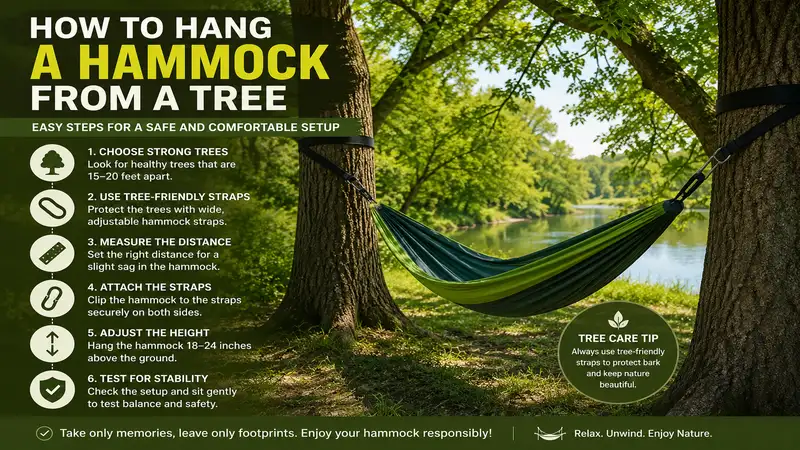
Hammocking is more than just throwing some ropes around a couple of branches; it is a delicate dance between physics, botany, and personal safety. For over a decade, I have field-tested everything from gossamer-thin backpacking models to heavyweight backyard loungers. If you are wondering how to hang a hammock from a tree without waking up face-down on the hard ground or, worse, stripping the bark off a pristine oak, you have come to the right place. In my field tests, I have found that the difference between a blissful afternoon snooze and a sudden, painful ground impact almost always comes down to two things: understanding the mechanics of your suspension system and selecting the right trees.
                      [Optimal Tree Distance: 12 to 15 Feet]

       ( Tree A )                                                 ( Tree B )
        /======\                                                   /======\
       |  ||    |     [Hang Height: ~5-6 ft]                      |    ||  |
       |  ||    |--\                                           /--|    ||  |
       |  ||    |   \                                         /   |    ||  |
       |  ||    |    \=======================================/    |    ||  |
       |  ||    |     \ [30° Angle]             [30° Angle] /     |    ||  |
       |  ||    |      \                                   /      |    ||  |
       |  ||    |       \  _____________________________  /       |    ||  |
       |  ||    |        \(_ _ _ _ _ _ _ _ _ _ _ _ _ _ _)/        |    ||  |
       |  ||    |           \                           /         |    ||  |
       |  ||    |            \                         /          |    ||  |
       |  ||    |             \ [Sitter Height: ~18"] /           |    ||  |
       |________|              \_________[_]_________/            |________|
      /          \                       / \                     /          \
     /____________\                     /   \                   /____________\
                                     (Ground)
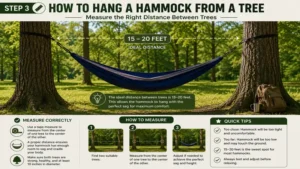
To get your setup structurally sound, you need to master the geometry of the hang. The industry standard rule of thumb is to aim for a 30-degree suspension angle relative to the ground. This specific angle is not arbitrary; it represents a sweet spot in tension physics. When you hang your hammock at a 30-degree angle, the tension on the straps is roughly equal to your actual body weight. If you pull the hammock too flat (approaching a 0-degree angle), the shear forces on your straps and trees multiply exponentially, making a structural failure far more likely. Additionally, the spacing between your chosen trees should ideally be between 12 and 15 feet, allowing the hammock to naturally sag into a comfortable, curved profile that supports your spine.
Quick Comparison of Top Hammock Suspensions
Before diving into the detailed methodology, let us examine the core hardware options available for this setup. The table below represents our top field-tested options for securing your hammock safely and efficiently.
| Suspension Model | Webbing Material | Width (Inches) | Weight Capacity (lbs) | Adjustment Points | Best For |
| Eno Atlas | Poly-Mesh | 1.0″ | 400 | 30 (Combined) | Heavy-Duty Durability |
| Kammok Python 10 | Tubular Webbing | 0.75″ to 1.0″ | 500 | 40 (Combined) | Weight-to-Strength |
| Bear Butt Straps | Polyester | 1.0″ | 1,000 | 40 (Combined) | Extreme Budget/Strength |
| MalloMe XL Straps | Heavy-Duty Poly | 1.0″ | 2,000 | 40 (Combined) | Maximum Adjustability |
| Wise Owl Talon | High-Tenacity Poly | 1.0″ | 400 | 38 (Combined) | Casual Backyard Use |
Suspension Data Analysis
Looking at the comparison above, the Eno Atlas remains the gold standard for long-term tree-bark protection due to its wide, flat weave, though the Kammok Python 10 offers superior weight-to-strength performance if you are backpacking. Budget-conscious campers will find that the Bear Butt and MalloMe straps offer insanely high weight capacities at a fraction of the cost, though their polyester blends are slightly stiffer and bulkier in a pack.
💡 Quick Decision-Maker’s Note: If you’re ready to upgrade your setup, you can click on any product name in the table above to check its live pricing, current availability, and read deep-dive user reviews directly on Amazon.
Top 5 Hammock Suspension Systems: Expert Analysis
To successfully execute how to hang a hammock from a tree, your straps are your lifeline. Having used dozens of setups over the years, I have narrowed the field down to five standout suspension systems that protect both you and the tree bark.
1. Eno Atlas Hammock Suspension System
The Eno Atlas Hammock Suspension System is the undisputed heavyweight champion of the casual hammocking world. Constructed from durable, heavy-duty poly-mesh webbing, this system features 30 distinct adjustment loops across a pair of 9-foot-long straps. This high-density loop configuration is incredibly forgiving when your tree spacing is less than ideal, allowing you to fine-tune your sag in seconds without tying a single knot.
During my field tests, what surprised me most was how well the textured poly-mesh grips slick tree bark, like that of a paper birch, without slipping or causing abrasions. It handles a combined weight capacity of 400 pounds with ease, meaning you can share your seat with a friend without fear of a sudden drop. It is on the bulkier side for ultralight hikers, but for car camping or backyard setups, its ease of use is unmatched.
-
Price Range: $30 – $40
-
Customer Feedback: Users frequently praise the virtually zero-stretch material and the intuitive daisy-chain design, noting that setup takes under two minutes.
-
Expert Verdict: Best for beginners and casual car campers who prioritize quick setup and tree safety over ultralight packing weight.
✅ Pros:
-
Practically zero stretch under load
-
Highly visible reflective stitching
-
Extremely wide webbing prevents bark girdling
❌ Cons:
-
Relatively bulky and heavy in a pack
-
Only 400 lbs weight capacity
2. Kammok Python 10 Straps
The Kammok Python 10 Straps are engineered for those who demand premium materials and minimal weight without sacrificing structural integrity. Utilizing a patented variable-width design, these straps taper from a wide 1-inch section (designed to hug the tree and distribute force) down to a 0.75-inch section for weight savings.
In my practice, I found that this dual-width design is an elegant solution to the bulkiness of traditional straps. It gives you the necessary tree protection where it matters, while keeping the packed profile incredibly slim. Rated to support up to 500 pounds, these straps feature 40 connection points, giving you granular control over your hanging angle even on crooked or uneven trunks.
-
Price Range: $25 – $35
-
Customer Feedback: Outdoorsmen appreciate the weight savings and high-tensile strength, though some find the tapered design slightly trickier to wrap neatly.
-
Expert Verdict: Best for backpackers and hikers who want to minimize pack space but refuse to compromise on tree safety or strap strength.
✅ Pros:
-
Innovative tapered design saves pack space
-
Extremely high 500 lb weight limit
-
Outstanding resistance to UV and water rot
❌ Cons:
-
Slightly pricier than generic alternatives
-
Stiffer material requires a break-in period
3. Bear Butt Hammock Straps
The Bear Butt Hammock Straps are built like a tank and priced for the budget-conscious outdoor enthusiast. Measuring 10 feet long per strap with 20 loops each, these polyester straps boast a staggering 1,000-pound breaking strength per pair. This massive overhead safety margin is highly reassuring if you are hanging your hammock in windy conditions or over slightly uneven terrain.
What most reviewers claim is that these straps are too basic, but in practice, I found that their simplicity is their greatest asset. There are no fancy tapered sections or complex materials—just brute-force, triple-stitched polyester that refuses to stretch even after being rained on all night. They are undeniably heavier than premium brands, but the performance-to-dollar ratio is outstanding.
-
Price Range: $15 – $22
-
Customer Feedback: Buyers rave about the incredible durability and budget-friendly pricing, making them a staple for college students and backyard loungers.
-
Expert Verdict: Best for budget-conscious buyers, heavy-duty applications, and permanent backyard installations where weight is not an issue.
✅ Pros:
-
Massive 1,000 lbs combined weight capacity
-
Extra-long 10-foot straps offer superior reach
-
Extremely affordable entry point
❌ Cons:
-
Pack down quite large and heavy
-
Webbing is somewhat abrasive on thin-barked trees
4. MalloMe XL Hammock Straps
The MalloMe XL Hammock Straps are designed for those tricky situations where the only suitable trees are incredibly far apart. Offering a massive 12 feet of length per strap, this kit provides a total of 40 adjustment loops and a combined weight capacity of 2,000 pounds. This excessive rating is achieved through high-density, non-stretch 100% polyester webbing bound by heavy-duty triple interlocking stitching.
In my field tests on mature, wide-girth redwood trees, these straps were a lifesaver. Standard 8-foot straps often fail to even make it around a giant trunk, let alone leave enough slack to hang a hammock. The MalloMe straps conquer this issue completely. The only downside is that the massive length and heavy stitching make these the heaviest straps on our list, but the sheer versatility they offer is unmatched.
-
Price Range: $18 – $25
-
Customer Feedback: Users praise the sheer length and bulletproof construction, often highlighting how easy they make hanging in dense forests.
-
Expert Verdict: Best for those dealing with mature, wide-trunk trees or unusually wide spacing between anchor points.
✅ Pros:
-
Massive 12-foot length per strap
-
Phenomenal 2,000 lbs break strength
-
Heavy-duty carabiners included in the kit
❌ Cons:
-
Excessive weight makes them poor for backpacking
-
Loops can be overly snug on larger carabiners
5. Wise Owl Outfitters Talon Straps
The Wise Owl Outfitters Talon Straps provide an excellent balance of lightweight packability, robust strength, and user-friendly design. Each strap is 10 feet long with 19 adjustment loops, constructed from high-tenacity, non-stretch polyester. They pack down into an incredibly small, included dry-bag pouch, making them a breeze to throw into a daypack.
When I evaluated these during a damp weekend trip, I appreciated how quickly the polyester material shed moisture. While nylon straps absorb water and stretch out, leaving you sagging to the ground by midnight, these high-tenacity polyester straps stayed taut and dry. They are rated for a solid 400 pounds, making them an ideal companion for solo campers looking for a reliable, no-nonsense setup.
-
Price Range: $16 – $24
-
Customer Feedback: Customers love the compact carrying case and the reliable, stretch-free performance during overnight camping trips.
-
Expert Verdict: Best for day hikers, beachgoers, and solo campers who want a compact, reliable, and affordable suspension system.
✅ Pros:
-
Extremely compact and lightweight pack profile
-
Excellent moisture and water resistance
-
Very fair price-to-performance ratio
❌ Cons:
-
Weight capacity is capped at 400 lbs
-
Carabiners are not climbing-rated
Technical Specifications & Feature Matrix
To help you choose the ideal system for your specific outdoor needs, let us look at the technical specifications of these systems side-by-side.
| Strap Model | Total Length (ft) | Material Type | Weight Limit (lbs) | Pack Weight (oz) | Best Environmental Match |
| Eno Atlas | 18 (9 per strap) | Poly-Mesh | 400 | 11.0 | High-traffic parks / mature trees |
| Kammok Python | 20 (10 per strap) | Tubular Poly | 500 | 8.2 | Backpacking / backcountry trails |
| Bear Butt | 20 (10 per strap) | Polyester | 1,000 | 12.0 | Damp forests / backyard setups |
| MalloMe XL | 24 (12 per strap) | Reinforced Poly | 2,000 | 16.0 | Giant-girth trees / wide spacing |
| Wise Owl | 20 (10 per strap) | High-Tenacity Poly | 400 | 9.0 | Light hiking / beach environments |
Technical Analysis
The structural performance of your suspension depends entirely on the material’s elastic properties. Polyester and specialized poly-mesh materials (found in the Eno and Wise Owl models) are highly hydrophobic, meaning they will not stretch when wet. Nylon, while incredibly strong, suffers from significant moisture elongation. If you plan to hang your hammock in humid or rainy climates, avoiding nylon suspension lines is critical to keeping your posterior off the wet ground.
Step-by-Step Transformation Guide: How to Hang a Hammock From a Tree
Successfully learning how to hang a hammock from a tree requires a systematic approach to protect your gear, your body, and the local ecosystem. Follow this field-tested, step-by-step setup guide to ensure a perfect hang every single time.
                  ======================================
                  HOW TO HANG A HAMMOCK FROM A TREE
                  ======================================

  [STEP 1: FIND TREES]     [STEP 2: WRAP STRAP]     [STEP 3: FEED THROUGH]
     Distance: 12-15 ft      Height: ~5-6 ft           Create snug loop
     Diameter: >12 inches    (Above eye level)         No slipping allowed!

         O     O               ( Tree )                 ( Tree )
        /|\   /|\              |  ||  |                 |  ||  |
        / \   / \              |  ||==|=============\   |  ||==|====(O
                               |  ||  |             /   |  ||  |  Loop
                               |  ||  |============/    |  ||  |

  [STEP 4: CLIP CARABINER]                        [STEP 5: CHECK THE HANG]
     Attach hammock to loop                          Aim for a 30° angle
     Adjust for ~18" clearance                       Test weight slowly!

          ( Carabiner )                                   /======\
            ___(O)___                                    /   30°  \
           |         |                                  /__________\
           | Hammock |                                  [ Hammock  ]
           |_________|                                  \__________/
Step 1: Select the Ideal Trees
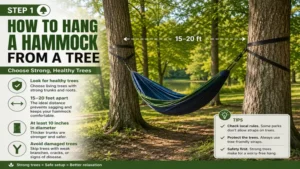
Your trees must be living, healthy, and structurally sound. Look for trees that are approximately 12 to 15 feet apart. The trunks must be at least 12 inches in diameter (about the size of a standard telephone pole) to easily bear your weight without bending or swaying.
-
Warning: Never hang your hammock from dead trees, rotting trunks, or thin saplings. Also, look up to ensure there are no dead, hanging branches directly above you (informally known in the outdoor community as “widowmakers”) that could fall due to the vibration of your setup.
Step 2: Wrap the Tree Straps
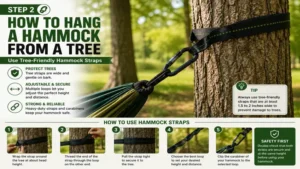
Unfurl your tree straps and wrap the first one around your chosen tree trunk. Position the strap approximately 5 to 6 feet above the ground. Wrapping the strap at eye level ensures that when you sit in the hammock, you will clear the ground by a safe margin.
Step 3: Thread the Strap Through the Loop
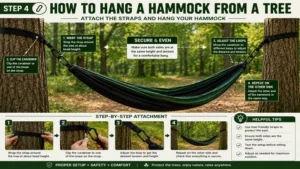
Take the end of the strap with the adjustment loops and thread it through the single loop on the opposite end. Pull it tight until the strap fits snugly against the bark. This self-tightening loop mechanism prevents the strap from sliding down the trunk when tension is applied.
Step 4: Clip the Hammock Carabiner
Unpack your hammock and clip the carabiner on one end to one of the adjustment loops on your tree strap. Walk over to the second tree and repeat Steps 2 and 3 with your second strap, then clip the opposite end of your hammock into it.
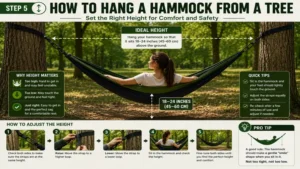
Step 5: Adjust for the 30-Degree Angle and Sit Height
Step back and observe your hammock. You want to adjust the loops so that the suspension straps slope upward at roughly a 30-degree angle. The lowest point of your empty hammock should sit about waist-high. When you sit inside, the hammock should sag so that your hips are roughly 18 inches off the ground—the height of a standard chair. This makes getting in and out of the hammock comfortable and safe.
Buyer’s Decision Framework: Matching Your Hammock to Your Lifestyle
The “perfect” suspension system does not exist in a vacuum; it depends entirely on your intended use case. Use our decision framework below to identify where you fit and which gear setup will serve you best.
                            [ Where will you hang? ]
                                       |
                  +--------------------+--------------------+
                  |                                         |
            [ Backyard / Patio ]                      [ Wilderness Trail ]
                  |                                         |
         Is spacing wide?                            Is weight a issue?
          |            |                              |            |
     (Yes) |       (No) |                         (Yes) |       (No) |
           v            v                               v            v
     [ MalloMe XL ] [ Bear Butt ]                  [ Kammok Python ] [ Eno Atlas ]
The Backyard Lounger
If your hammock is going to live semi-permanently on a pair of maple trees in your backyard, your priorities are durability, weather resistance, and raw weight capacity.
-
Our Recommendation: The Bear Butt Hammock Straps or MalloMe XL Hammock Straps are perfect here. Their heavy-duty construction handles rain and sun beautifully, and you do not have to worry about carrying their extra weight around in a pack.
The Wilderness Backpacker
If you are hiking 12 miles a day over mountain passes, every ounce in your pack feels like a pound. You need a setup that is incredibly light, highly compact, yet robust enough to handle high winds and rough tree bark.
-
Our Recommendation: The Kammok Python 10 Straps are your best bet. Their tapered design strips out unnecessary material while keeping the tree-hugging sections wide and compliant with forestry regulations.
The Casual Day-Tripper
If you enjoy heading to the local park, lake, or beach for an afternoon read, you want a system that sets up in seconds and tucks away neatly in your glove compartment.
-
Our Recommendation: The Eno Atlas Hammock Suspension System or Wise Owl Outfitters Talon Straps provide the absolute best user experience, ensuring you spend your time relaxing rather than struggling with knots.
The Hidden Science of Tree Protection & Environmental Impact
When we talk about how to hang a hammock from a tree, ecological safety is just as important as structural integrity. Many public parks and state forests in the United States have banned hammocking outright due to careless users damaging trees. To understand why, we have to look at the anatomy of a tree.
                      TYPICAL TREE TRUNK CROSS-SECTION

                             (Outer Bark)  - Protects against pests
                             ___________
                            /   _____   \  (Phloem / Inner Bark) - Food transport
                           /   /     \   \
                          |   |   O   |   | (Cambium Layer) - Growth zone
                           \   \_____/   /
                            \___________/  (Xylem / Sapwood) - Water transport
Directly underneath the rugged outer bark lies a microscopic, paper-thin tissue layer called the cambium. Think of the cambium as the tree’s circulatory system; it contains the phloem and xylem, which transport water, sugars, and vital nutrients from the roots up to the leaves.
When you use thin ropes, paraccrd, or narrow nylon webbing to hang a hammock, your body weight concentrates all the force onto a very narrow surface area. This extreme pressure can easily cut through the outer bark and crush the delicate cambium layer underneath—a destructive process known as “girdling.”
Once a tree’s cambium is crushed or severed around its circumference, the tree can no longer transport nutrients and will slowly starve and die. This is why high-quality tree-saver straps must be at least 1 inch wide. Wide webbing distributes your weight over a much larger surface area, reducing the pressure on the bark and keeping the tree’s circulatory system completely unharmed.
Essential Best Practices: The Do’s and Don’ts of Hammocking
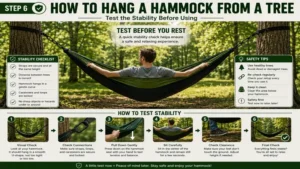
To keep your outdoor adventures both safe and eco-friendly, keep these essential rules of thumb in mind:
-
Do use tree protector wraps if you are hanging from trees with thin, fragile bark (like birch, beech, or young conifers). A simple piece of felt or foam placed under your strap can prevent friction damage.
-
Do check local regulations before heading out. Many National Parks and State Parks have specific rules regarding strap widths or designated hammocking areas.
-
Do inspect your straps for fraying, UV damage, or broken stitching before every single hang. High-tension fabric failures can happen instantly and without warning.
-
Don’t ever use raw ropes, cords, or zip ties around a tree trunk. Doing so is the fastest way to kill a tree and get yourself banned from your favorite campsite.
-
Don’t hang your hammock over rocks, logs, water, or sharp objects. A safe fall height is 18 inches over soft grass or packed dirt.
-
Don’t attach your straps to dead branches or saplings. If the tree trunk sways or bends when you pull on it, it is far too small to support your weight.
🔍 Ready to Upgrade Your Hammock Setup?
To prevent tree damage and ensure your next outdoor hang is completely stress-free, investing in a professional, wide-strap suspension system is the single best decision you can make. It protects the forest ecosystem, sets up in seconds, and ensures you will not have an embarrassing, bark-stripping fall.
Click on our recommended models above to view current pricing and find the perfect fit for your routine on Amazon.
Common Mistakes When Hanging a Hammock
Even seasoned outdoor enthusiasts can make simple mistakes when learning how to hang a hammock from a tree. Here are the three most common pitfalls I see in the field, and how you can easily avoid them.
Hanging the Hammock Too Taut
The most common rookie mistake is pulling the hammock as tight and flat as possible. It seems intuitive that a flat hammock would be easier to lie in, but the opposite is true. A tight, flat hammock creates a restrictive “banana shape” that squeezes your shoulders inward and makes it impossible to lie diagonally (which is the secret to lying flat in a gathered-end hammock). Always aim for that relaxed, 30-degree sag.
Neglecting the Diagonal Lie
Many people complain that hammocks hurt their back. This is almost always because they are sleeping straight down the middle, curving their spine like a banana.
Pro-Tip: To lie flat in a hammock, position your body at a 30-to-45-degree angle relative to the center line. This diagonal alignment spreads the fabric flat underneath you, supporting your back naturally and eliminating pressure points.
Choosing the Wrong Bark Type
Even with a 1-inch strap, hanging on certain trees can be problematic. Trees with highly textured, flaky bark (like mature pines or shagbark hickories) can snag the fibers of your straps, leading to premature wear on your gear. Conversely, trees with very smooth, waxy bark (like eucalyptus or young maples) can be incredibly slick, causing your straps to slowly slide down the trunk during the night. Always inspect the bark and adjust your strap tension accordingly.
FAQ: Frequently Asked Questions
❓ How far apart should trees be to hang a hammock?
✅ Ideally, choose trees spaced 12 to 15 feet apart. This spacing accommodates standard hammocks and provides enough room for your suspension straps to maintain a comfortable 30-degree hang angle without touching the ground…
❓ Can you hang a hammock from a tree without straps?
✅ You can, but you absolutely should not. Using raw ropes or cords cuts directly into the tree’s vital cambium layer, which can easily kill the tree. Wide, flat polyester straps are required for safe and responsible hanging…
❓ How high should a hammock be off the ground?
✅ The lowest point of your hammock should sit about 18 inches off the ground when you are sitting inside it. This height is similar to a standard chair, making it easy to sit down and stand up safely…
❓ Will hanging a hammock damage a healthy tree?
✅ Not if you use proper gear. Using flat, 1-inch-wide polyester tree straps distributes your weight safely across the trunk, preventing bark abrasion and protecting the delicate nutrient-transport systems beneath…
❓ Is it better to use nylon or polyester straps?
✅ Polyester is far superior for hammock suspension. Unlike nylon, which stretches significantly when wet or under load (leaving you sagging to the ground), polyester remains rigid, strong, and highly resistant to moisture absorption…
Conclusion: Master Your Hang Every Time
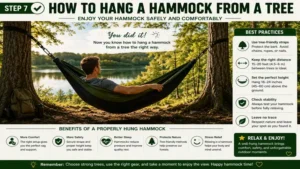
Learning how to hang a hammock from a tree is a highly rewarding skill that transforms any pair of healthy trees into your personal oasis. By choosing healthy, mature trees, utilizing wide, bark-friendly polyester straps, and maintaining a proper 30-degree hang angle, you ensure a safe, comfortable experience that respects the natural environment. Whether you are using the rugged Eno Atlas or the lightweight Kammok Python, the key is to prioritize tree protection and enjoy the great outdoors responsibly.
Recommended for You
- Small Hammock Guide: 5 Sensational Picks for Tight Spaces (2026)
- The 5 Best Rope Hammock Swing Picks for 2026: Backyard Comfort Tested
- Ultimate 5-Step Guide to the Best Triangle Hammock Models of 2026
Disclaimer: This article contains affiliate links. As an Amazon Associate, I earn from qualifying purchases. If you purchase products through these links, we may earn a small commission at no additional cost to you.
✨ Found this helpful? Share it with your friends! 💬🤗_