
In This Article
Why the Right Hammock Stand for Rope Hammock Matters
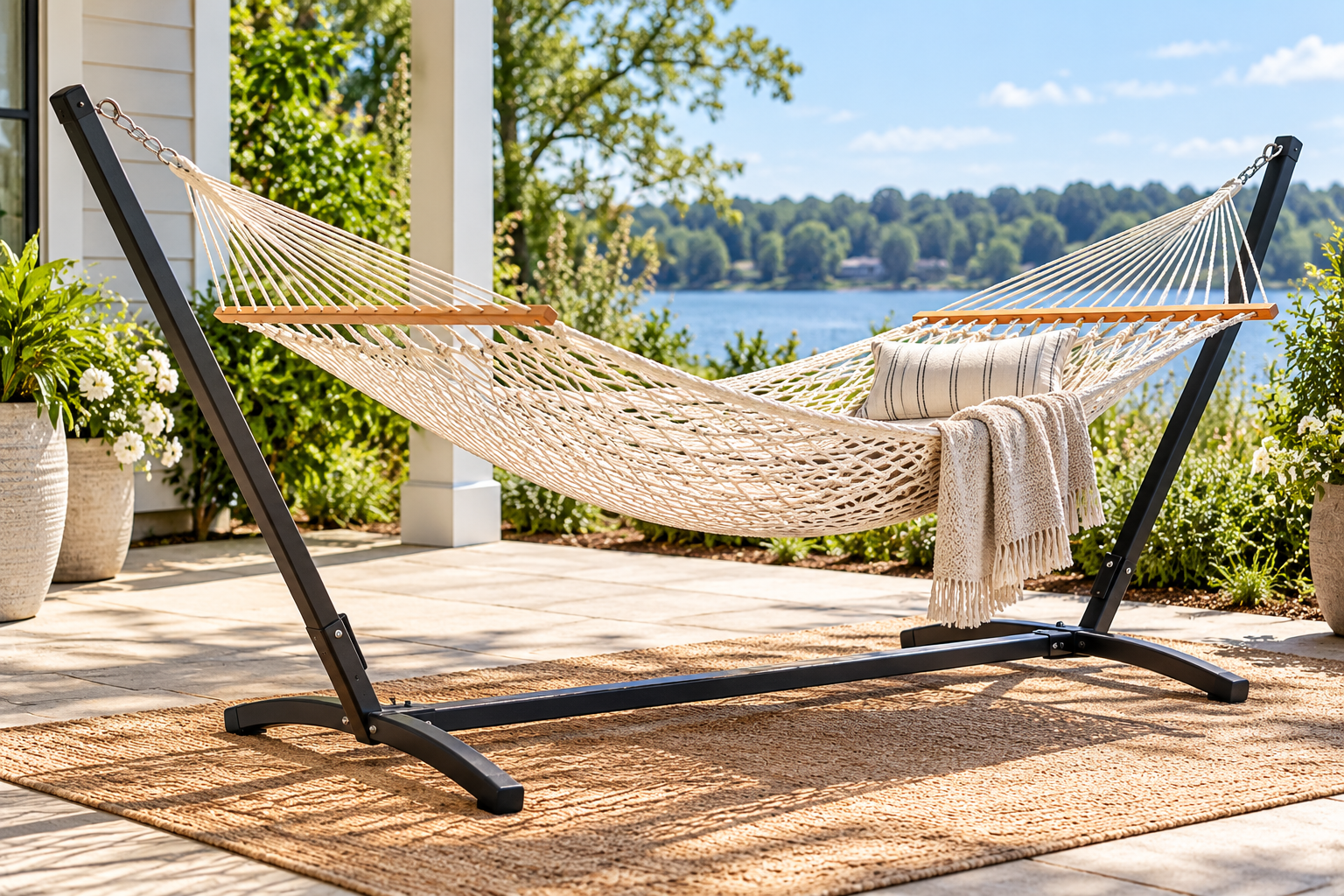
Picture this: you finally bought that classic cotton rope hammock — the one with varnished oak spreader bars that looks like it belongs on a Carolina porch. Then reality hits. Your two “perfect trees” are 22 feet apart, one of them is a skinny maple, and your HOA frowns on sinking posts. That’s exactly where a hammock stand for rope hammock setups earns its keep.
Here’s the catch most shoppers miss: not every stand works with a rope hammock. Traditional rope hammocks almost always use spreader bars, which hold the bed flat and open. That flat bed is wonderful for lounging, but it also raises your center of gravity. Hang it on a short, “space-saving” stand designed for gathered-end fabric hammocks, and you get a hammock that feels tippy, sits too high, or simply doesn’t fit. Choosing a hammock stand for rope hammock use means matching three things: length, weight capacity, and stability.
In this guide, we compare seven real stands — steel beam, steel arc, and wooden arc — using manufacturer spec sheets and aggregated customer feedback from retailer reviews. You’ll get honest analysis, not recycled product listings: who each stand is for, what the numbers mean in your backyard, and where each one falls short. We also cover setup, troubleshooting, maintenance, and safety, so the stand you buy this season is still doing its job years from now.
Whether you’re furnishing a beach house deck, a suburban patio, or a lakeside lawn, you’ll leave knowing exactly which size and style fits your hammock — and your space.
What Is a Hammock Stand for Rope Hammock?
A hammock stand for rope hammock use is a freestanding frame, usually 14 to 15 feet long, built to hold a spreader-bar rope hammock about 11 to 14 feet in total length. It replaces trees or posts, and its long base and wide feet counter the higher, flatter bed that spreader bars create.
The rope hammock itself has a long history — the hammock originated in Central and South America centuries before it showed up on American porches — but the spreader-bar version popular in the US is a much later design. That design detail is the whole reason stand selection matters.
Most rope hammock stands fall into three families:
- Steel center-beam stands — a straight base beam with two angled uprights. Practical, affordable, and often the strongest per dollar.
- Steel arc stands — a curved, continuous frame with a sleeker look and a slightly lower-slung feel.
- Wooden arc stands — laminated wood (often larch or pine) bent into an arc. Beautiful, heavier, and more maintenance-hungry.
A good rule of thumb: measure your hammock’s total length (end ring to end ring), then choose a stand rated to accept that length, ideally with a little adjustment room via chains.
Quick Comparison: 7 Rope Hammock Stands at a Glance
| Stand | Type | Fits Hammock Length | Weight Capacity | Price Range | Best for |
|---|---|---|---|---|---|
| Pawleys Island TRI-BEAM | Steel beam | 12–14 ft | 600 lb | $200–$260 | Classic Pawleys-style rope hammocks, heavy use |
| Vivere 15 ft. 3-Beam | Steel beam | 10–15 ft | 450 lb | $150–$200 | Best all-around value |
| Sunnydaze 15 ft. Steel Stand | Steel beam | 10–15 ft | 400 lb | $100–$150 | Tight budgets |
| Algoma 15 ft. Two-Point Center Beam | Steel beam | ~12–13 ft | 500–550 lb (by listing) | $100–$180 | Budget buyers who want higher capacity |
| Vivere 15 ft. Steel Arc | Steel arc | Spreader-bar hammocks | 450 lb | $200–$260 | Modern patios |
| Petra Leisure 14 ft. Wooden Arc | Wood arc | ~12–14 ft | 450 lb | $250–$300 | Natural-wood looks |
| SUNCREAT 14 ft. Wooden Stand | Wood arc (larch) | ~12–14 ft | 475 lb | $250–$300 | Wood fans wanting extra capacity |
Prices are approximate ranges at the time of writing; check current pricing on Amazon.
Looking at the table, the Pawleys Island TRI-BEAM is the clear pick if you own a genuine Pawleys rope hammock or simply want the highest rated capacity, while the Vivere 15 ft. 3-Beam hits the sweet spot of fit range and price. If you’re watching every dollar, the Sunnydaze 15 ft. Steel Stand gets you a properly sized frame at the lowest cost, but its 400 lb rating makes it better suited to one adult than two.
💬 One click helps other shoppers make an informed choice too! 😊
Top 7 Hammock Stands for Rope Hammocks: Expert Analysis
1. Pawleys Island 15 ft. TRI-BEAM Steel Hammock Stand — strongest rated frame here
If durability is your top priority, this is the stand built by the company that popularized the American rope hammock. The Pawleys Island TRI-BEAM uses 2-inch-diameter, 12-gauge steel tubing with a 600 lb capacity — the highest in this roundup. In practice, that headroom means two adults can share the hammock without hovering near the frame’s limit, which reduces long-term stress on joints.
Pawleys says the stand is made in the USA, uses 360-degree welds at key connections, and assembles with steel spring pins rather than loose bolts. It accepts hammocks between 12 and 14 feet in total length, which covers the classic 13-foot Pawleys rope hammock. Finishes include black, taupe, bronze, and forest green, all powder-coated.
Our analysis: this is the stand for someone who already invested in a premium rope hammock and wants a frame that matches it. It’s heavy (roughly 60–66 lb), so it’s not something you’ll casually move around the yard every weekend.
Aggregated reviews on Pawleys’ site consistently describe the stand as very sturdy and easy to assemble, and several buyers say it fits Pawleys hammocks perfectly. A minority mention scratches from shipping or a defective powder coat that required a return.
Pros:
- ✅ Highest weight capacity in this roundup
- ✅ Made in the USA with welded connections
- ✅ Spring-pin assembly is quick and tool-free
Cons:
- ❌ Heavy and awkward to relocate often
- ❌ Fits a narrower 12–14 ft hammock range
Expect to pay in the $200–$260 range; for heavy, long-term use, the Pawleys Island TRI-BEAM justifies its premium.
2. Vivere 15 ft. 3-Beam Steel Hammock Stand — best balance of fit and price
The Vivere 15 ft. 3-Beam (model 15BEAM) is a long-running bestseller for one reason: it accepts most spreader-bar hammocks from 10 to 15 feet, so it works with nearly any rope hammock you’re likely to own.
Its steel tubing measures about 1-7/8 inches in diameter, and Vivere rates it at 450 lb. That’s comfortably above a typical two-person hammock’s practical load, though not as roomy as the Pawleys Island TRI-BEAM. Assembly is tool-free, and plastic caps cover tube ends so you don’t snag clothes or shins.
Here’s what to weigh: the wide 10–15 ft fit range is the real selling point. If you’re not sure of your hammock’s exact length — or you might upgrade hammocks later — this stand forgives your guesswork better than models with a tighter range.
We couldn’t verify a large pool of US customer reviews specific to this exact model, so we won’t characterize its review sentiment beyond saying retailers widely list it as a top seller. What we can say from the spec sheet is that its dimensions (180 x 48 x 48 inches) match the industry-standard footprint for rope hammocks.
Pros:
- ✅ Very wide 10–15 ft hammock fit range
- ✅ Solid 450 lb rating for two people
- ✅ Tool-free assembly with capped tube ends
Cons:
- ❌ Lower capacity than premium American-made stands
- ❌ Fifteen-foot footprint demands a large patio
Typically priced in the $150–$200 range, the Vivere 15 ft. 3-Beam is our best-value pick.
3. Sunnydaze 15 ft. Heavy-Duty Steel Hammock Stand — lowest cost of entry
On a tight budget, the Sunnydaze 15 ft. Steel Stand (model HS15) gets you the right size without the premium price. It accommodates hammocks from 10 to 15 feet and measures 180 x 48 x 48 inches — the same footprint as pricier stands.
Sunnydaze rates the stand at 400 lb, built from roughly 1.5-inch square and 1.75-inch round steel tubing with capped ends and rubber leg caps. Those leg caps matter more than they sound: they keep moisture and grit out of the tubes, which slows rust from the inside.
Honest analysis: 400 lb is fine for one adult or a parent and small child, but two larger adults will be close to the limit once you account for the dynamic load of climbing in. Think of it as a solo lounger’s stand.
Aggregated reviews on retailer sites generally call it sturdy and easy to put together. Some note how much space it takes up, and one reviewer warns against trying three adults at once — sensible advice for any stand in this class.
Pros:
- ✅ Lowest price for a full 15-foot frame
- ✅ Broad 10–15 ft hammock compatibility
- ✅ No-tool assembly with heavy-gauge chains
Cons:
- ❌ 400 lb rating limits two-adult use
- ❌ Thinner tubing than premium competitors
Usually in the $100–$150 range, the Sunnydaze 15 ft. Steel Stand is excellent value for solo loungers.
4. Algoma 15 ft. Two-Point Center Beam Hammock Stand — high capacity on a budget
Algoma has made hammocks and stands for decades, and the Algoma 15 ft. Two-Point Center Beam (model 4780 series) is its classic answer for rope hammocks. It’s sized for Algoma’s 13-foot two-point hammocks, which puts it right in the rope hammock sweet spot.
The frame is 100% tubular steel with a powder-coated finish in bronze, beige, or green, and assembles with snap pins. Capacity varies by retailer listing: one lists 550 lb, while a similar Algoma 15-foot stand is listed at 500 lb. Either way, that’s more than most budget stands offer — just confirm the figure on the specific listing before buying.
Our take: this is the sleeper pick for budget-minded couples. You get capacity closer to premium stands at a price closer to the Sunnydaze 15 ft. Steel Stand. The trade-off is a narrower fit range — it’s designed around 12–13 ft hammocks rather than a 10–15 ft span.
We found only a small number of verifiable reviews, which describe the Algoma stands as easy to snap together and sturdy. That’s encouraging but not a large sample.
Pros:
- ✅ 500–550 lb rating at a budget price
- ✅ Snap-pin assembly needs no tools
- ✅ Three powder-coated color options
Cons:
- ❌ Capacity figures differ between retailer listings
- ❌ Limited pool of verifiable customer reviews
Expect roughly $100–$180; the Algoma 15 ft. Two-Point Center Beam offers strong capacity-per-dollar value.
5. Vivere 15 ft. Steel Arc Hammock Stand — modern look, steel toughness
Want the elegant curve of a wooden arc without the upkeep? The Vivere 15 ft. Steel Arc (model 15ARCS) delivers it in powder-coated steel, available in black or oil-rubbed bronze.
It measures about 184 inches long, 50 inches wide, and 50 inches tall, with a 450 lb rating. Vivere designed it specifically for spreader-bar hammocks, and it assembles without tools, with rubber caps on the ends.
What most buyers overlook with arc stands: the continuous curve spreads the hammock’s pull along the frame differently than a beam stand, and many people find the look less “industrial” on a finished patio. The extra 4 inches of length versus standard beam stands, though, means you need slightly more clearance.
We couldn’t verify meaningful US review volume for this model, so treat it as a spec-driven recommendation. On paper, it matches the Vivere 15 ft. 3-Beam on capacity and offers a more design-forward profile.
Pros:
- ✅ Sleek arc design suits modern patios
- ✅ Weather-resistant powder-coated steel frame
- ✅ 450 lb rating handles two people
Cons:
- ❌ Longer footprint than standard beam stands
- ❌ Few verifiable customer reviews available
Typically in the $200–$260 range, the Vivere 15 ft. Steel Arc costs more for style, not strength.
6. Petra Leisure 14 ft. Wooden Arc Hammock Stand — warm natural-wood aesthetic
If your porch furniture is wood and steel feels wrong, the Petra Leisure 14 ft. Wooden Arc brings a warm, furniture-grade look. It’s water-treated laminated wood (listings describe European larch) available in natural, teak, and coffee stains.
The stand is rated at 450 lb, and its 14-foot length suits most rope hammocks in the 12–14 ft range. Wood absorbs vibration differently than steel, so many people find the swing feels quieter — no metal creaks at the hooks.
Our analysis: this is a “living room outdoors” stand. It belongs on a covered porch or patio where it’s shielded from constant rain and sun. Left fully exposed year-round, any wooden stand needs periodic refinishing.
Aggregated reviews praise its looks and sturdiness, and several say assembly is manageable solo but easier with a second person to line up screw holes. A recurring complaint is that the factory finish is thin and may not hold up to constant weather exposure.
Pros:
- ✅ Beautiful arc in three stain options
- ✅ Quiet, solid feel compared with steel
- ✅ 450 lb rating suits two adults
Cons:
- ❌ Thin factory finish needs extra sealing
- ❌ Heavier and slower to assemble than steel
Expect around $250–$300 for the stand alone; the Petra Leisure 14 ft. Wooden Arc is worth it for covered spaces.
7. SUNCREAT 14 ft. Wooden Hammock Stand — extra capacity in larch wood
The SUNCREAT 14 ft. Wooden Stand is built from larch wood and rated at 475 lb — a little more headroom than the Petra Leisure 14 ft. Wooden Arc. It ships with chains and carabiners, and SUNCREAT also sells an adjustable 12–14 ft variant.
Those chains and carabiners matter for rope hammocks specifically: they let you fine-tune hang height and tension without hunting for extra hardware. Larch is a naturally resinous softwood, which gives it better weather resistance than plain pine, though it still benefits from a sealant.
Who’s it for? Buyers who want the wooden look but expect two adults in the hammock regularly. The extra 25 lb of rated capacity isn’t huge, but it’s a meaningful margin when you consider people dropping into the hammock rather than easing in.
We couldn’t verify a substantial body of US customer reviews for this specific stand, so we’re not summarizing sentiment. Our recommendation rests on its specs and the included adjustment hardware.
Pros:
- ✅ Highest capacity of the wooden stands here
- ✅ Chains and carabiners included for tuning
- ✅ Adjustable 12–14 ft version available
Cons:
- ❌ Limited verified review data
- ❌ Wood requires seasonal sealing outdoors
Usually priced around $250–$300, the SUNCREAT 14 ft. Wooden Stand suits couples who want wood with a margin.
✨ Ready to stop hunting for the perfect two trees?
🔍 Take your backyard relaxation to the next level with this carefully curated lineup. Click a highlighted stand to check current pricing and availability — the right frame turns your rope hammock into the spot everyone fights over!
Spreader Bar Hammock Stand Specs Compared
Every rope hammock with wooden bars needs a true spreader bar hammock stand — not a short, compact frame. Here’s how the seven models stack up on the specs that affect daily use.
| Stand | Frame Material | Footprint (L x W) | Approx. Stand Weight | Assembly | Best for |
|---|---|---|---|---|---|
| Pawleys Island TRI-BEAM | 12-gauge steel, 2″ tube | 15 ft x 4 ft | 60–66 lb | Spring pins | Permanent, heavy-use setups |
| Vivere 15 ft. 3-Beam | Steel, 1-7/8″ tube | 15 ft x 4 ft | ~60 lb (packaged) | Tool-free | Unknown or changing hammock sizes |
| Sunnydaze 15 ft. Steel Stand | Steel, 1.5″–1.75″ tube | 15 ft x 4 ft | ~37–50 lb | Tool-free | Solo loungers on a budget |
| Algoma 15 ft. Two-Point Center Beam | Tubular steel | 15 ft | Varies by listing | Snap pins | Budget couples |
| Vivere 15 ft. Steel Arc | Steel, arc | ~15.3 ft x 4.2 ft | Not verified | Tool-free | Design-focused patios |
| Petra Leisure 14 ft. Wooden Arc | Water-treated larch | ~14 ft | Not verified | Screws, 2 people helpful | Covered porches |
| SUNCREAT 14 ft. Wooden Stand | Larch wood | ~14 ft | Not verified | Screws | Wood lovers wanting more capacity |
The pattern is clear: steel beam stands dominate on capacity per dollar, while wooden and arc stands charge extra for appearance. The Pawleys Island TRI-BEAM‘s thicker 12-gauge, 2-inch tubing explains its 600 lb rating, whereas the Sunnydaze 15 ft. Steel Stand‘s lighter tubing explains both its lower price and lower limit. If you’ll move your stand seasonally, a lighter steel frame is easier on your back than any wooden arc.
How to Set Up a Rope Hammock Stand in About 20 Minutes
Setting up a rope hammock stand is easy once you know the sequence. Here’s a practical walkthrough that works for nearly every model in this guide.
🛠️ Step-by-step setup
- Pick level ground first. A slope of even a few inches shifts weight toward one upright. A patio, deck, or flat lawn works best; avoid soft, freshly watered soil.
- Lay out all parts and match labels. Most steel stands have numbered tubes. Mixing up uprights is the most common reason a stand looks “crooked.”
- Assemble the base beam, then the uprights. Push spring or snap pins fully through until they click. If a pin won’t seat, rotate the tube slightly rather than forcing it.
- Attach chains or S-hooks at the middle setting. Starting in the middle gives you room to adjust up or down.
- Hang the hammock and check bar height. With nobody in it, the spreader bars should sit roughly at hip height. Once you sit, the bed should sag to a comfortable seat height, around 18–24 inches off the ground.
- Do a gentle load test. Sit in the center first, then slowly lie back. Listen for creaks and check that no feet lift.
📅 First 30 days: common mistakes
- Hanging the hammock too tight. Rope hammocks need some sag; too taut and the bed flips more easily.
- Skipping a re-check after the first week. Rope stretches with use, so readjust chain links after a few sessions.
- Leaving a cotton rope hammock out in the rain every night. Cotton can mildew; bring it in or switch to polyester or DuraCord-style rope for full-time outdoor use.
Which Stand Fits Your Backyard? Three Real-World Scenarios
Specs only go so far. Here’s how the picks map to real situations.
🏖️ Scenario 1: The beach-house deck, two adults, daily summer use
Budget: flexible. Use: daily, often two people, salty air. Pick the Pawleys Island TRI-BEAM. Its 600 lb rating gives two adults plenty of margin, and a quality powder coat is your first line of defense against coastal corrosion. If the deck is covered, the SUNCREAT 14 ft. Wooden Stand is a stylish alternative with 475 lb of capacity.
🏡 Scenario 2: Suburban patio, solo reader, weekends only
Budget: under $150. Use: one adult, a few hours a week. The Sunnydaze 15 ft. Steel Stand fits perfectly. Its 400 lb rating covers one person comfortably, and you’re not paying for capacity you’ll never use. If your partner might join you, step up to the Algoma 15 ft. Two-Point Center Beam for a higher rating at a similar price.
🌿 Scenario 3: Covered porch, design-conscious couple
Budget: $250–$300. Use: evenings and weekends, two people. The Petra Leisure 14 ft. Wooden Arc shines here: covered porches protect the wood finish, and the arc looks like furniture rather than equipment. If maintenance sounds like a chore, the Vivere 15 ft. Steel Arc gives you the same silhouette with less upkeep.
The common thread: match capacity to who actually uses the hammock, and match material to how exposed the spot is. Those two decisions eliminate most buyer’s remorse.
Troubleshooting: Fixing Common Rope Hammock Stand Problems
Even a great stand can feel “off” if it’s set up wrong. Here are five common issues and fixes.
Problem 1: The hammock flips you out. This is usually a height and tension issue, not a stand defect. Lower the chains a link or two so the bed sags more, which drops your center of gravity. Spreader-bar hammocks are inherently tippier than gathered-end styles, so lower is safer.
Problem 2: Your back nearly touches the base beam. The hammock is either too long for the stand or hung too low. Shorten the chains, or confirm your hammock’s total length fits the stand’s range — for example, the Pawleys Island TRI-BEAM is designed for 12–14 ft hammocks.
Problem 3: The stand creaks or squeaks. On steel stands, the noise usually comes from S-hooks rubbing on the upright’s hanging eye. A dab of outdoor-rated grease on the contact point quiets it. On wooden stands, re-tighten bolts after the first few weeks, since wood compresses slightly under load.
Problem 4: One foot lifts when you climb in. Your ground isn’t level, or you’re entering off-center. Move the stand to flatter ground and always sit in the middle of the bed before swinging your legs up.
Problem 5: Rust spots appear at joints. Scratched powder coat lets moisture reach bare steel. Sand the spot lightly, wipe it clean, and touch it up with a matching rust-inhibiting enamel. Catching it early stops rust from spreading under the coating.
How to Choose a Hammock Stand for Rope Hammock Use
Choosing a hammock stand for rope hammock setups comes down to seven checks:
- Measure total hammock length. Measure end ring to end ring, not just the bed. Most spreader-bar rope hammocks need a 14–15 ft stand.
- Check the stand’s stated fit range. Wide ranges (like 10–15 ft) forgive measurement errors; narrow ranges demand precision.
- Confirm the weight rating — and the hammock’s. Your safe limit is the lower of the two, never the higher.
- Pick a material for your exposure. Powder-coated steel for open yards; wood for covered or mild-climate spaces.
- Measure your available footprint. Allow at least 2–3 feet of clearance around a 15-foot frame for getting in and out.
- Consider how often you’ll move it. Lighter steel frames relocate easily; wooden arcs are best left in one spot.
- Look at the hardware. Chains or adjustable hooks make tuning height and tension far easier.
📏 Why a 15 ft hammock stand is the default
A 15 ft hammock stand is the standard because a typical spreader-bar rope hammock runs about 13 feet in total length. The stand needs extra length so the hanging points sit beyond the hammock’s ends, leaving room for chains and a natural sag. Go shorter, and you’ll either hang the hammock too tight or too high — both of which make it less stable. Several models in this guide, including the Vivere 15 ft. 3-Beam and Sunnydaze 15 ft. Steel Stand, use this standard length.
Steel vs. Wooden Arc Hammock Stand: Which Is Right for You?
The steel vs. wooden arc hammock stand debate is mostly about looks, maintenance, and budget — strength is rarely the deciding factor, because all seven picks here are rated at 400 lb or more.
Steel stands win on value and low upkeep. A good powder coating bakes a durable layer onto the steel that resists chipping and moisture better than ordinary paint. That’s why the Pawleys Island TRI-BEAM, Vivere 15 ft. 3-Beam, and Algoma 15 ft. Two-Point Center Beam can live outdoors with only occasional touch-ups. The downside: steel can look utilitarian, and it heats up in direct sun.
A wooden arc hammock stand wins on appearance. Both the Petra Leisure 14 ft. Wooden Arc and SUNCREAT 14 ft. Wooden Stand use larch, a resinous conifer wood valued for its relative durability outdoors. Still, “durable for wood” isn’t the same as “maintenance-free.” Expect to reseal a fully exposed wooden stand periodically, and keep it off standing water.
The middle ground is the Vivere 15 ft. Steel Arc: you get the graceful curve of a wooden arc with steel’s low maintenance. It costs more than a basic beam stand, but less upkeep over a decade can offset that.
Here’s a simple way to decide: if the stand will sit in open sun and rain, choose steel. If it lives on a covered porch and you care about looks, wood is worth it.
Freestanding Stand vs. Trees or Installed Posts
Why buy a stand at all? Here’s how it compares with the traditional alternatives.
| Option | Upfront Cost | Flexibility | Installation | Best for |
|---|---|---|---|---|
| Freestanding stand (e.g., Vivere 15 ft. 3-Beam) | Moderate ($100–$300) | Move anytime | Minutes, no tools | Renters, patios, changing layouts |
| Two healthy trees | Low (straps/hardware) | Fixed location | Easy if spacing fits | Yards with ideal tree spacing |
| Installed wood posts | Moderate to high | Permanent | Digging, concrete, labor | Homeowners wanting a fixed spot |
Trees are cheapest but rarely spaced perfectly — rope hammocks typically need anchor points around 14–16 feet apart. Installed posts are rock-solid but permanent and labor-intensive. A stand like the Vivere 15 ft. 3-Beam wins on flexibility: you can follow the shade, bring the hammock onto a porch during rain, and take it with you when you move.
Common Mistakes to Avoid When Buying a Rope Hammock Stand
Buying a “universal” short stand for a spreader-bar hammock. Many compact 9–10 ft stands are designed only for hammocks without spreader bars. Vivere, for example, specifies that its 9-foot Universal Stand is for non-spreader-bar hammocks. Put a rope hammock with bars on one, and it may not fit or may feel unstable.
Trusting the hammock’s capacity alone. A hammock rated at 450 lb on a stand rated at 400 lb has a 400 lb limit. Always use the lower number.
Ignoring your total footprint. A 15-foot stand plus entry space needs roughly an 18 x 8 ft area. Measure before you buy — not after the box arrives.
Overlooking the hammock’s material. Cotton rope is soft but vulnerable to mildew if left out. If your rope hammock lives outdoors full-time, the stand’s weather resistance matters, but so does the rope’s.
Choosing wood for a fully exposed spot without a maintenance plan. Wooden arcs look stunning in photos, but reviews of the Petra Leisure 14 ft. Wooden Arc specifically flag a thin factory finish. Plan to seal it — or choose steel.
Assuming more expensive means safer. Price often reflects material and looks. A modestly priced Algoma 15 ft. Two-Point Center Beam can carry more rated weight than a pricier steel arc.
Features That Actually Matter (and Ones That Don’t)
Features that matter:
- ⚡ Weight capacity with margin. Aim for at least 100 lb above your typical combined load to account for the extra force of dropping in.
- 📏 Correct fit range. The single most important spec for rope hammocks.
- 🛡️ Finish quality. Powder coating on steel and a real sealant on wood determine lifespan.
- 🔗 Adjustable hardware. Chains with multiple links let you dial in sag and height as the rope stretches.
- 🦶 Capped ends and protective feet. They keep water out of tubes and protect decks from scratches.
Features that matter less than marketing suggests:
- “Portable” claims on 15-foot stands. Any 15-foot frame can be disassembled, but none is truly grab-and-go. If you need portability, a rope hammock is the wrong pairing anyway.
- Exotic color names. Finish quality matters; the color itself is personal taste.
- Bundled accessories. Cup holders, canopies, and bundled pillows are nice extras but shouldn’t drive your choice over capacity and fit.
The bottom line: two specs — fit range and capacity — determine whether you’re happy. Everything else is refinement.
Long-Term Cost and Maintenance
A stand’s sticker price is only part of the story. Here’s how total cost of ownership plays out over roughly five years.
Steel beam stands (Sunnydaze 15 ft. Steel Stand, Vivere 15 ft. 3-Beam, Algoma 15 ft. Two-Point Center Beam, Pawleys Island TRI-BEAM) typically need little more than a can of touch-up enamel and occasional hardware replacement. If you store the stand in a garage during winter, joints and pins last noticeably longer, because freeze-thaw cycles and road-salt air accelerate corrosion.
Steel arc stands like the Vivere 15 ft. Steel Arc have similar costs, though the curved tubes are harder to replace if one gets bent.
Wooden arc stands (Petra Leisure 14 ft. Wooden Arc, SUNCREAT 14 ft. Wooden Stand) cost more upfront and add recurring maintenance: an exterior wood sealant or finish every year or two in exposed locations. The USDA’s Wood Handbook from the Forest Products Laboratory explains how moisture and UV exposure degrade wood surfaces and why finishes need periodic renewal — useful background if you’re deciding whether wood is worth the upkeep.
🧰 A simple maintenance schedule
- Monthly (in season): Check pins, bolts, and hooks; tighten anything loose.
- Each spring: Inspect for rust or finish wear; touch up or reseal.
- Each fall: Clean, dry, and store indoors if possible — especially the rope hammock itself.
Over five years, a well-kept steel stand often costs little beyond its purchase price, while a wooden stand may add a modest yearly finishing cost. Either way, maintenance is far cheaper than replacing a rusted or rotted frame.
Safety, Weight Limits, and Heavy Duty Hammock Stand Standards
There’s no single federal safety standard specifically for residential hammock stands, so manufacturer ratings and common sense do most of the work. That makes reading the specs carefully even more important.
Respect the lower limit. As noted above, your safe capacity is the lower of the stand’s and hammock’s ratings. A heavy duty hammock stand rated at 600 lb, like the Pawleys Island TRI-BEAM, doesn’t make a 350 lb hammock safe for 500 lb.
Account for dynamic load. Dropping into a hammock briefly creates more force than your body weight at rest. Ease in from the center.
Watch the wind. A stand with an empty hammock can act like a sail. At least one shopper review of a different 15-foot steel stand reported it blowing over with the hammock attached. In storms, unhook the hammock or take the stand down.
Supervise kids. Children love to stand, bounce, or swing hard, which loads frames in ways they weren’t designed for. Set clear rules and keep an adult nearby.
Inspect before each season. Look for cracks in wood, bent tubes, worn hooks, and frayed rope. Replace damaged parts with manufacturer hardware rather than hardware-store guesses.
Mind your surface. On decks, rubber feet protect boards; on lawns, a level paver base keeps feet from sinking after rain.
Follow these habits, and any of the seven stands here can deliver years of safe, worry-free swinging.
🌅 Make this season your most relaxing yet
👉 Click any highlighted stand above to check today’s price and availability — your rope hammock deserves a frame that’s as dependable as it is comfortable!
FAQs
❓ What size hammock stand do I need for a rope hammock?
❓ Can I use a 9 ft hammock stand for rope hammock setups?
❓ Is a steel or wooden hammock stand better for outdoor use?
❓ How much weight can a hammock stand for rope hammock use hold?
❓ Can I leave my rope hammock stand outside all year?
Conclusion
The best hammock stand for rope hammock owners isn’t the flashiest one — it’s the one that fits your hammock’s length, carries your real-world load with margin, and suits the spot where it’ll live.
If you want the strongest rated frame and own a classic rope hammock, the Pawleys Island TRI-BEAM is the standout, with a 600 lb rating and American-made construction. For most buyers, the Vivere 15 ft. 3-Beam offers the best balance of a wide 10–15 ft fit range, 450 lb capacity, and fair pricing. On a tight budget, the Sunnydaze 15 ft. Steel Stand works well for solo loungers, while the Algoma 15 ft. Two-Point Center Beam adds capacity for couples without a big price jump.
Prefer style? The Vivere 15 ft. Steel Arc gives you graceful curves with steel’s low upkeep, and the Petra Leisure 14 ft. Wooden Arc and SUNCREAT 14 ft. Wooden Stand bring warm natural wood to covered porches — as long as you’re ready to reseal them.
Whatever you choose, measure first, respect the lower weight limit, set up on level ground, and give the rope a little sag. Do that, and your rope hammock will feel like a vacation every time you sink into it.
🚀 Your perfect hammock spot is one click away!
🔍 Compare the highlighted picks, check current pricing and availability, and choose the stand that turns your backyard into the go-to place for lazy afternoons the whole family will enjoy!
Recommended for You
- Lounger Hammock: 7 Best Picks for Effortless Relaxation (2026)
- How to Tie Hammock Straps: 7 Foolproof Steps + Best Straps 2026
- Haven Tent Review 2026: 7 Best Lay-Flat Hammock Tents Ranked
Disclaimer: This post contains affiliate links. As an Amazon Associate, I earn from qualifying purchases made through these links, at no additional cost to you.
✨ Found this article helpful? Share it with someone who needs it! 💬🤗