
In This Article
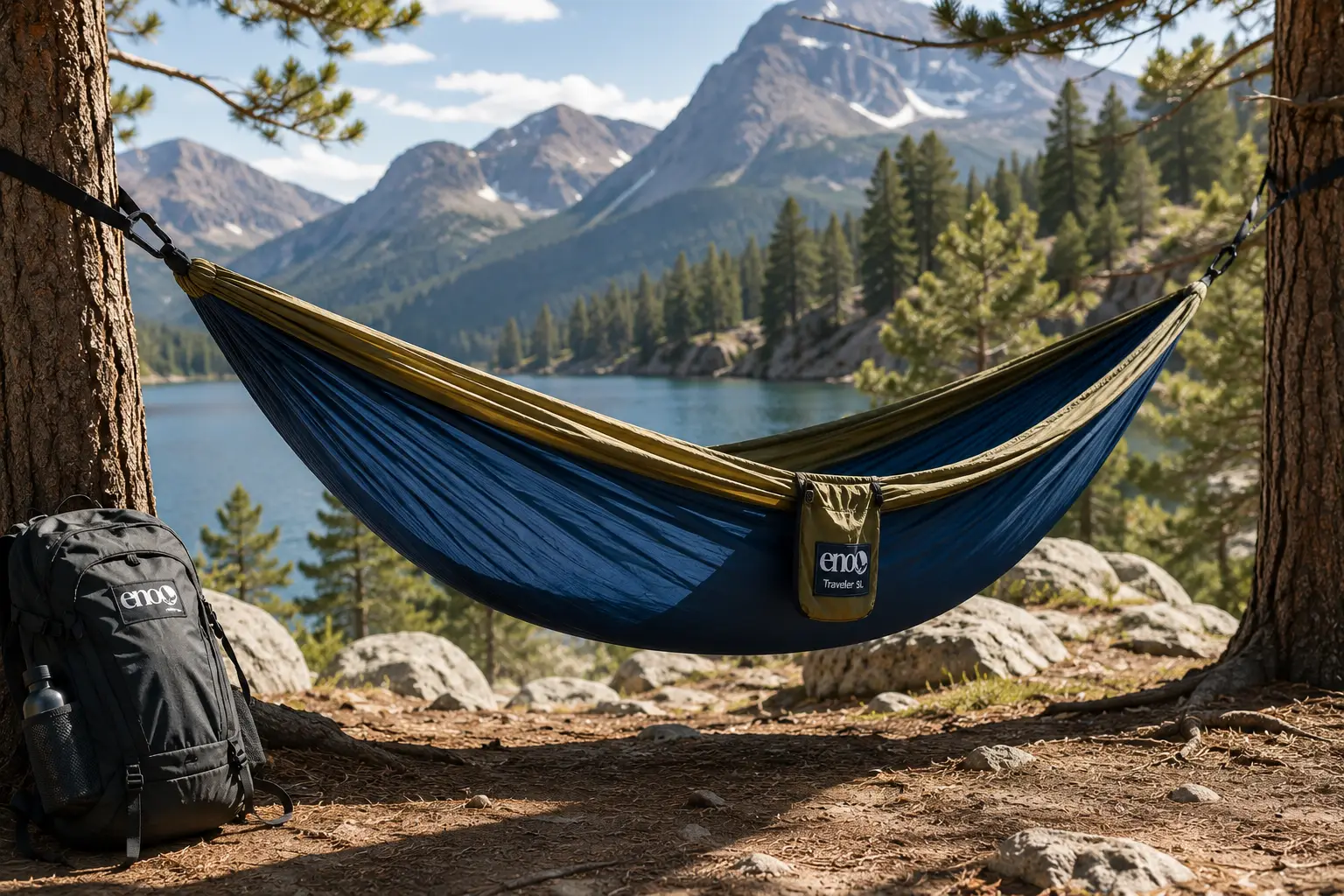
If you’ve searched for the eno traveler hammock, you’re probably picturing that easy, all-in-one setup — hammock and straps in a single stuff sack — that gets you swinging in someone’s backyard, at the trailhead, or on a beach trip in a matter of minutes. An eno traveler hammock is a compact, two-person-capable camping hammock bundled with tree-friendly suspension straps, designed to pack down small and set up without any knots or extra gear purchases. That’s the short definition, but the real question most shoppers have is bigger than any single product: with dozens of similar-looking hammocks on Amazon, which one actually deserves a spot in your pack?
We dug into the spec sheets, aggregated customer reviews, and independent gear tests for seven real, currently available hammocks — from the do-it-all combo that shares the “traveler” name to ultralight backpacking options and a few budget-friendly alternatives. This isn’t a rehash of a product listing. It’s a side-by-side breakdown of who each hammock is actually built for, where it falls short, and what the spec sheet doesn’t tell you. Whether you’re outfitting a first-time backyard hang or building a serious hammock-camping kit for a multi-day trip, this guide will help you buy with confidence instead of guesswork. For a broader primer on sizing and materials before you dive in, REI’s guide to choosing a hammock is a solid starting point.
Quick Comparison: Best Travel Hammocks at a Glance
Before the deep dive, here’s a fast reference if you already know roughly what you’re looking for.
| Category | Pick | Best For |
|---|---|---|
| Best Overall | ENO TravelNest | All-in-one setup with straps included |
| Best Value | Grand Trunk Double Deluxe | Budget-conscious first-time buyers |
| Best Ultralight | Sea to Summit Ultralight Hammock | Thru-hikers counting every ounce |
| Best for Two People | Kammok Roo Double | Couples who want higher weight capacity |
| Best All-in-One Shelter | Hennessy Hammock Expedition Classic | Solo backpackers who want built-in bug and rain protection |
Looking at this table, the pattern that jumps out is that “best” depends entirely on your priority: the ENO TravelNest wins on convenience because it’s the only combo here purpose-built around the “grab and go” pitch, while the Sea to Summit Ultralight Hammock wins on pure pack weight at the cost of comfort and price. If you’re brand new to hammock camping, starting with an inexpensive, complete kit like the Grand Trunk Double Deluxe lets you test the waters before investing in specialized gear.
💬 Bookmark this comparison — it’ll make the next section a lot easier to skim!
Top 7 Travel Hammocks: Expert Analysis
Disclosure: As an Amazon Associate, I earn from qualifying purchases. This post contains affiliate links.
We selected these seven hammocks to cover entry-level, mid-range, and premium price points, along with a few structurally different designs (open hammocks, all-in-one shelters, and ultralight minimalist builds) so you can match the category to your actual trip, not just your budget.
1. ENO TravelNest Hammock + Straps Combo — the true all-in-one grab-and-go kit
The distinguishing benefit here is right in the name: unlike most hammocks on this list, the eno traveler hammock ships with everything you need to hang it the moment it arrives. Built from ENO’s FreeWave 70-denier nylon, the 9′ x 5′ hammock body pairs with 8-foot, 1″-wide “No-Knots-Needed” straps that offer ten combined adjustment points, so you’re not fumbling with rope or aftermarket hardware. Stainless steel carabiners connect the two pieces, and both pack into one integrated stuff sack about the size of a large water bottle.
What most buyers overlook with this model is that the included strap system is what actually justifies the price gap over a bare hammock — buying an ENO hammock and ENO Atlas straps separately usually costs more than this combo. Based on comparing the specs against ENO’s other hammocks, the TravelNest trades a little bit of width (5 feet versus the DoubleNest’s 6’4″) for a lighter, simpler single-panel build that’s genuinely easier for a first-timer to rig correctly on the first try.
Reviews consistently report that setup takes just a couple of minutes even for people who’ve never hung a hammock before, and multiple reviewers highlight that the pre-attached carabiners eliminate the most common beginner mistake — forgetting compatible hardware. A recurring theme in customer feedback is that the color selection skews toward muted, natural tones rather than bright prints.
Pros:
- ✅ Straps, carabiners, and hammock all included in one box
- ✅ No-Knots-Needed system is genuinely beginner-friendly
- ✅ Packs into a single compact stuff sack for travel
Cons:
- ❌ Heavier than standalone hammocks due to the built-in straps
- ❌ Color options lean toward muted, natural tones only
At the time of writing, the ENO TravelNest typically lists in the $70 to $90 range depending on color; given that it replaces a $75 hammock plus a $30-plus set of straps, it’s a legitimately good value for anyone who doesn’t already own suspension gear.
2. ENO DoubleNest Hammock — the industry benchmark everyone compares against
The DoubleNest earns its spot as the reference point for this entire category — it’s the hammock most other brands measure themselves against in their own marketing copy. Constructed from the same FreeWave 70D nylon taffeta as the TravelNest but with a wider 9’6″ x 6’4″ body and anodized 7075 aluminum hardware, it’s rated to 400 pounds and weighs roughly 19 ounces on its own.
Here’s what to weigh: the DoubleNest does not include hanging straps, which sounds like a downside until you realize it’s also why the hammock itself stays so light and inexpensive. Based on the spec sheet, the extra width compared to the TravelNest translates directly into more diagonal-lay room, which is the technique hammock campers use to sleep flat instead of curled in a banana shape.
Aggregated reviews are overwhelmingly positive on comfort and durability, with the triple-stitched seams frequently singled out as evidence of long-term build quality. What the spec sheet doesn’t say, but reviewer feedback consistently reveals, is that first-time buyers are often caught off guard by the straps-sold-separately model — more than one customer review flags this as an unexpectedly frustrating discovery after the box arrives.
Pros:
- ✅ Widest body among ENO’s core lineup for diagonal sleeping
- ✅ Backed by the largest accessory ecosystem of any brand here
- ✅ Packs to roughly the size of a grapefruit
Cons:
- ❌ Straps and carabiners must be purchased separately
- ❌ Lower 400 lb capacity than newer recycled-fabric competitors
Priced around $75 at most retailers, the ENO DoubleNest is a fair value on the hammock alone, but budget an additional $25 to $35 for straps before you compare total cost against combo kits like the TravelNest.
3. Kammok Roo Double Hammock — the higher-capacity, recycled-fabric alternative
The Roo Double’s standout benefit is weight capacity: at 500 pounds versus the ENO DoubleNest’s 400, it’s rated for heavier combined loads, which matters if you’re hanging with a partner and gear. It’s built from Kammok’s GravitasX 40-denier diamond ripstop nylon — a 100% recycled, bluesign-approved fabric — and weighs just over a pound thanks to a single-panel diamond construction that uses fewer seams than ENO’s three-panel design.
What most buyers overlook is that fewer fabric panels isn’t just a manufacturing shortcut — it reduces the number of stress points where seams can eventually fail, which is part of why Kammok backs the Roo Double with a lifetime warranty rather than the shorter guarantees common elsewhere in this category. Based on comparing the two side by side, the Roo Double is also about 8 inches longer than the DoubleNest, giving taller users more room to fully stretch out.
Reviews consistently describe the fabric as noticeably softer against the skin than standard ripstop nylon, and the Kanga Claw carabiners — rated to support several thousand pounds of force each — get specific praise for feeling more secure than generic hardware. A common thread in customer feedback is that the Roo Double costs more than the ENO DoubleNest at full price, though frequent sales narrow that gap considerably.
Pros:
- ✅ Higher 500 lb weight capacity than most competitors here
- ✅ Made from 100% recycled, bluesign-approved fabric
- ✅ Backed by Kammok’s lifetime warranty
Cons:
- ❌ Full retail price runs higher than the ENO DoubleNest
- ❌ Hanging straps are sold separately, adding to total cost
Expect to pay somewhere between $80 and $95 at regular price, though it’s worth checking current pricing since Kammok runs frequent seasonal sales that can bring it closer to $70.
4. Wise Owl Outfitters DoubleOwl Camping Hammock — the budget pick that still includes straps
The DoubleOwl’s short pitch is simple: it’s one of the few hammocks on this list under $50 that still ships with tree straps and carabiners in the box, closing the value gap with pricier combo kits. The 10′ x 6.5′ double hammock is built from parachute nylon with triple interlocking stitching, holds up to 500 pounds, and comes with a pair of 9-foot straps offering five adjustable loops per side.
What the spec sheet doesn’t say, but the sheer volume of near-perfect review scores suggests, is that Wise Owl has built a loyal budget-conscious customer base by matching the feature set of premium brands at a fraction of the price — you’re trading refined fabric feel and brand cachet, not core functionality. Here’s what to weigh: parachute nylon is a slightly heavier, less breathable fabric than ENO’s FreeWave or Kammok’s GravitasX, so it’s better suited to casual backyard and car-camping use than serious thru-hiking where every ounce counts.
Reviews consistently report high satisfaction with the price-to-quality ratio, and several reviewers specifically call out the hammock as a reliable gift for first-time campers. A recurring critique in aggregated feedback is that the straps’ five fixed loops offer less fine-tuned height adjustment than the continuous webbing systems on the ENO TravelNest or Grand Trunk.
Pros:
- ✅ Straps and carabiners included at an entry-level price
- ✅ 500 lb capacity matches or beats pricier competitors
- ✅ Backed by an unusually high volume of five-star reviews
Cons:
- ❌ Parachute nylon feels heavier and less breathable than premium fabrics
- ❌ Strap adjustment loops are less flexible than continuous webbing systems
Typically priced in the $35 to $45 range, the DoubleOwl offers arguably the best dollar-for-feature ratio on this list for anyone testing whether hammock camping is worth a bigger investment.
5. Hennessy Hammock Expedition Classic — the full shelter system for serious backpackers
Unlike every other entry here, the Expedition Classic isn’t just a hammock — it’s a complete sleep system with an attached bug net and a detachable rainfly, positioning it as a genuine tent replacement rather than a lounging accessory. The asymmetric 100″ x 52″ diagonal hammock body uses a patented structural ridgeline that maintains the same comfortable curve regardless of how far apart your anchor trees happen to be, addressing one of the most common complaints about basic gathered-end hammocks.
Based on comparing the specs, the tradeoff for that added functionality is a lower 250-pound weight limit and a 6-foot height limit, making this a solo-user hammock rather than a two-person lounger like the others on this list. What sets it apart is the bottom-entry design: you climb in through a self-sealing slit in the floor rather than over the side rail, which keeps rain and bugs out but does require a short learning curve before your first overnight trip.
Reviews consistently describe the asymmetric ridgeline as a genuine comfort upgrade over symmetric hammocks, with multiple long-term users reporting they prefer it over ENO-style open hammocks for multi-night backcountry trips specifically because of the integrated weather protection. A common critique is that the bottom-entry mechanism feels awkward on the first one or two attempts, though most reviewers say it becomes second nature quickly.
Pros:
- ✅ Integrated bug net and rainfly eliminate separate purchases
- ✅ Patented ridgeline delivers a consistently flat sleeping position
- ✅ Includes complimentary tree-friendly suspension straps
Cons:
- ❌ 250 lb weight limit is lower than double-hammock competitors
- ❌ Bottom-entry design has a real learning curve for first-time users
Given the added shelter components, expect to pay in the $130 to $170 range — a legitimate premium, but one that can replace both a tent and a hammock for a solo backpacker.
6. Grand Trunk Double Deluxe Parachute Nylon Hammock — the cheapest complete kit on this list
The Double Deluxe’s calling card is price-to-inclusion ratio: it’s the least expensive hammock here that still bundles carabiners and straps, undercutting even the Wise Owl DoubleOwl in most sales cycles. Built from 210T 70D parachute nylon with triple-lock stitched seams, the extra-wide 10’6″ x 6’6″ body carries a 400-pound rating and comes with two nautical-grade carabiners plus 5-foot tree-friendly straps.
Here’s what to weigh: at 28 ounces including hardware, this is one of the heavier options on the list relative to its capacity, which matters for backpackers but is largely irrelevant for backyard or car-camping use — precisely the audience Grand Trunk seems to be targeting with the price point. Based on the spec sheet, the 5-foot strap length is noticeably shorter than the 8-foot straps on the ENO TravelNest, which can be limiting if your available trees are spaced far apart.
Reviews consistently praise the value proposition, with several long-term users specifically noting that the included suspension system performs comparably to hammocks that cost twice as much. A recurring complaint in aggregated feedback is that the stock straps run short for anything beyond typical backyard tree spacing, pushing more serious campers toward an aftermarket strap upgrade.
Pros:
- ✅ Includes carabiners and straps at the lowest price point here
- ✅ Extra-wide 10’6″ x 6’6″ body suits two people comfortably
- ✅ Triple-lock stitching adds durability at this price tier
Cons:
- ❌ Included straps are shorter than most competitors’ suspension systems
- ❌ Heavier per pound of capacity than premium ripstop alternatives
At a typical $35 to $50, the Double Deluxe is hard to beat if your primary use case is backyard lounging or occasional car camping rather than backcountry trips.
7. Sea to Summit Ultralight Hammock — the lightest option for ounce-counting backpackers
The Ultralight’s entire identity is built around a single number: 5.4 ounces, making it one of the lightest hammocks sold in the US market and a favorite among thru-hikers who track every gram in their pack list. The nylon body compresses into an integrated stuff sack roughly the size of a soda can, and the aluminum buckle ends are designed to pair specifically with Sea to Summit’s own ultralight suspension system, sold separately.
What most buyers overlook is that this hammock’s minimalism is a deliberate tradeoff, not an oversight — the narrower body and thinner, semi-transparent fabric shave weight at the direct expense of the diagonal-lay comfort you’d get from a wider double hammock. Based on comparing specs, the 300-pound capacity is also notably lower than the 400-to-500-pound range common elsewhere on this list, reflecting its focus on solo ultralight use rather than lounging with a partner.
Reviews consistently describe it as excellent for its intended niche — fast-and-light thru-hikers — while cautioning that broader-shouldered users or anyone planning extended overnight sleeps may find the narrow width constraining. A common theme is that the proprietary buckle system, while quick to use, locks you into Sea to Summit’s own straps rather than letting you mix and match suspension gear from other brands.
Pros:
- ✅ Among the lightest hammocks available at just 5.4 ounces
- ✅ Compresses to roughly the size of a soda can
- ✅ Reflective suspension webbing improves nighttime visibility
Cons:
- ❌ Suspension straps are sold separately and brand-proprietary
- ❌ Narrower body makes overnight sleeping less comfortable for some users
The hammock alone typically runs $80 to $90, with the full hammock-and-suspension set closer to $130 to $140 — a premium justified only if shaving ounces is a genuine priority for your trip.
Full Product Comparison Table
| Product | Capacity | Packed Weight | Price Range | Best For |
|---|---|---|---|---|
| ENO TravelNest | 400 lbs | ~28 oz | $70–$90 | Beginners wanting an all-in-one kit |
| ENO DoubleNest | 400 lbs | ~19 oz | ~$75 | Buyers who already own straps |
| Kammok Roo Double | 500 lbs | ~17–18 oz | $80–$95 | Couples wanting higher capacity |
| Wise Owl DoubleOwl | 500 lbs | ~24 oz+ | $35–$45 | Budget-conscious first-timers |
| Hennessy Expedition Classic | 250 lbs | ~2 lb 9 oz–2 lb 12 oz | $130–$170 | Solo backpackers needing full shelter |
| Grand Trunk Double Deluxe | 400 lbs | ~28 oz | $35–$50 | Backyard and car camping on a budget |
| Sea to Summit Ultralight | 300 lbs | ~5.4 oz | $80–$140 (with suspension) | Ounce-counting thru-hikers |
Scanning this table, the clearest divide is between hammocks that come bundled with straps (ENO TravelNest, Wise Owl DoubleOwl, Hennessy Expedition Classic, Grand Trunk Double Deluxe) and those sold as a hammock body only (ENO DoubleNest, Kammok Roo Double, Sea to Summit Ultralight). If this is your first hammock purchase, prioritizing a combo kit almost always works out cheaper than buying pieces separately, while experienced campers who already own a strap system can save money going hammock-only.
Getting Started: Your First 30 Days with a Travel Hammock
Buying the hammock is the easy part — getting comfortable with it takes a little practice most Amazon listings never mention. In your first week, set the hammock up in your backyard or a local park before committing to an overnight trip; this lets you dial in your preferred hang angle without the pressure of finding a campsite in the dark. REI’s guide to hanging a hammock recommends aiming for roughly a 30-degree angle between the strap and the tree, with the lowest point of the hammock sitting about 18 inches off the ground.
The single most common beginner mistake is sleeping straight along the hammock’s centerline, which forces your body into an uncomfortable curved “banana” shape. Instead, lie diagonally — most experienced hammock campers position their body at roughly a 30-degree angle across the fabric, which flattens the lay dramatically and is the real secret behind hammock camping’s reputation for comfort. By week two or three, experiment with a foam or inflatable sleeping pad underneath you if temperatures drop below 60°F, since the fabric beneath your body compresses and loses almost all insulating value — a detail that catches nearly every first-time hammock camper off guard the first cool night out.
By the end of your first month, you should also have a maintenance routine: shake out debris after each use, hand-wash with mild soap when the fabric gets visibly dirty, and always air-dry completely before storing to prevent mildew, particularly with lower-denier ultralight fabrics like the one on the Sea to Summit Ultralight Hammock.
Real-World Scenarios: Which Hammock Fits Your Trip?
Different trips call for genuinely different gear, and matching your use case to the right hammock avoids a lot of buyer’s remorse. Consider three common profiles:
The weekend backyard lounger wants a comfortable, inexpensive setup for reading and relaxing without any backpacking requirements. For this use case, the Grand Trunk Double Deluxe or Wise Owl DoubleOwl make the most sense — both bundle straps at a low price, and the extra ounces that matter to a backpacker are irrelevant here.
The thru-hiker counting every ounce is planning a multi-week trip where pack weight directly affects daily mileage and fatigue. The Sea to Summit Ultralight Hammock is purpose-built for exactly this scenario, though it’s worth pairing with a lightweight underquilt if nighttime temperatures dip, since the minimal fabric offers essentially no insulation on its own.
The couple planning a long weekend car-camping trip wants comfort and shared space more than minimal weight, with a budget in the $80 to $150 range for the full kit. Here, the Kammok Roo Double or ENO TravelNest both deliver — the Roo Double for its higher weight capacity, the TravelNest for its simpler all-in-one setup that doesn’t require assembling a separate strap system.
Buyer Decision Framework: Which Hammock Should You Choose?
If you’re still torn between two or three options, run through this simple priority checklist:
If you’ve never owned a hammock before, choose a combo kit with included straps — like the ENO TravelNest or Wise Owl DoubleOwl — because eliminating a second purchase and compatibility guesswork matters more than shaving ounces at this stage.
If pack weight is your single biggest constraint, choose the Sea to Summit Ultralight Hammock, accepting the tradeoffs in comfort and capacity that come with it.
If you need a genuine tent replacement for solo backcountry trips, choose the Hennessy Hammock Expedition Classic for its integrated bug net and rainfly, understanding you’ll sacrifice the ability to share it with a second person.
If budget is your primary filter, choose the Grand Trunk Double Deluxe, which delivers the lowest all-in-cost while still including hanging hardware.
If you want the best possible weight capacity for two adults, choose the Kammok Roo Double over the ENO options, since its 500-pound rating and recycled fabric construction both edge out the competition on paper.
How to Choose an ENO Traveler Hammock
Picking the right hammock comes down to a handful of concrete decision points, not marketing buzzwords. Here’s the process we’d recommend:
- Decide single vs. double body width first. Even solo campers usually prefer a double-width hammock because the extra fabric makes a proper diagonal lay possible.
- Check whether straps are included. Combo kits like the ENO TravelNest or Grand Trunk Double Deluxe save money if you don’t already own suspension gear.
- Match weight capacity to your real use case. A 400-pound rating is plenty for solo use, but two adults plus gear can approach 500 pounds quickly.
- Weigh packed weight against your trip type. Backyard and car-camping hammocks can afford to be heavier; backpacking and thru-hiking trips reward every shaved ounce.
- Consider whether you need integrated shelter. If you’re sleeping outdoors in bug or rain-prone regions, an all-in-one system like the Hennessy Expedition Classic may replace a tent entirely.
- Confirm strap width and material. Straps at least 1 to 1.5 inches wide protect tree bark far better than thin rope or cord, a detail Coastal Carolina University’s tree-safe hammocking guidelines specifically calls out.
- Compare total cost, not sticker price. A $75 hammock plus $30 straps often costs more than a $85 combo kit that includes both.
Common Mistakes to Avoid When Buying a Travel Hammock
The most frequent mistake buyers make is purchasing a hammock without checking whether straps are included, then feeling blindsided by an unexpected add-on purchase — this is one of the most common complaints in aggregated reviews of the ENO DoubleNest specifically. A second common error is sizing down to save weight or money without considering that a double-width hammock is dramatically more comfortable for solo sleeping too, thanks to the diagonal-lay technique.
Buyers also frequently underestimate insulation needs, assuming that because a hammock “looks warm” wrapped around your body, it will keep you as warm as a sleeping pad on the ground — in reality, the compressed fabric beneath you conducts heat away quickly, and temperatures below roughly 60°F require an underquilt or pad. Finally, many first-time buyers choose a hammock based purely on price without checking the weight capacity math: two adults with gear can easily approach 400 pounds combined, which rules out lower-capacity options like the Sea to Summit Ultralight Hammock for shared use.
ENO Traveler Hammock vs. Traditional Camping Tent
For anyone deciding between hammock camping and a traditional tent, the tradeoffs are more nuanced than either camp likes to admit.
| Factor | Hammock Camping | Traditional Tent |
|---|---|---|
| Setup Time | Typically 2–5 minutes once practiced | Often 5–15 minutes depending on tent size |
| Pack Weight | As low as 5–28 oz (hammock only) | Usually 2–6 lbs for a solo backpacking tent |
| Comfort on Uneven Ground | Excellent — ground condition is irrelevant | Requires flat, cleared ground |
| Weather Protection | Requires separate rainfly/bug net unless integrated | Fully enclosed by design |
| Environmental Impact | Minimal — no ground clearing needed | Can compact vegetation and soil |
| Suitable Terrain | Requires two sturdy anchor points (usually trees) | Works on open, flat terrain without trees |
The clear takeaway is that hammocks win decisively on pack weight and low-impact camping, which is why backpackers gravitate toward options like the Sea to Summit Ultralight Hammock, but they lose ground on versatility — a hammock is useless in treeless terrain like alpine tundra or desert basins, where a tent remains the only practical option. For backpackers who split time between forested and open terrain, an all-in-one shelter system like the Hennessy Hammock Expedition Classic offers a reasonable middle ground, since its integrated rainfly closes much of the weather-protection gap with a traditional tent.
Long-Term Cost and Maintenance
Sticker price only tells part of the ownership story. A budget combo kit like the Grand Trunk Double Deluxe costs less upfront, but buyers who camp frequently in variable weather often end up purchasing a separate rainfly and bug net over time, narrowing the price gap with pricier all-in-one systems like the Hennessy Hammock Expedition Classic. Conversely, premium fabric hammocks like the Kammok Roo Double carry a higher purchase price but are backed by lifetime warranties, which can make them cheaper over a five-to-ten-year ownership window if a seam or buckle ever fails.
Maintenance costs stay low across this entire category compared to tents — there are no poles to replace and no floor seams to reseal — but denier and fabric quality directly affect how long a hammock resists UV degradation and abrasion. Higher-denier fabrics like the ENO and Kammok lines generally outlast thinner, budget-oriented parachute nylon under heavy, frequent use, which is worth factoring in if you expect to hammock camp dozens of times per season rather than a handful.
Safety, Regulations, and Standards
Hammock safety is less regulated than many outdoor products, but a few practical standards matter. The Consumer Product Safety Commission tracks hammock-related recalls, most commonly tied to strap buckle or stitching failures rather than the hammock fabric itself — a reminder to inspect hardware regularly, particularly on budget kits where included straps may use lighter-duty buckles than standalone premium straps.
Beyond product recalls, responsible hammock hanging carries its own set of best practices for both personal safety and tree health. Straps at least 1 to 1.5 inches wide distribute weight across more bark surface area and reduce the risk of girdling a tree over repeated use, while narrow rope or cord — never included with any hammock on this list, thankfully — can cut into bark and cause lasting damage. Most experienced campers recommend keeping the lowest point of the hammock no more than about 18 inches off the ground, so that even a worst-case strap or carabiner failure results in a short fall rather than a serious injury.
Features That Actually Matter (and Ones That Don’t)
Cutting through marketing language, a few features genuinely affect your experience. Weight capacity and fabric denier matter because they directly determine durability and who can safely use the hammock. Included straps matter because they change the real total cost of ownership, not just the sticker price. Packed size matters if you’re backpacking, but is largely irrelevant for backyard or car-camping use.
On the other hand, a few frequently advertised features matter less than marketing copy suggests. Exotic print patterns and color options have zero impact on comfort or durability. Extremely high weight-capacity numbers (600-plus pounds) rarely matter in practice, since the vast majority of buyers use these hammocks solo or as a couple, well under any of the capacities listed in this guide. And while brand-name recognition carries some value in resale and warranty confidence, several lesser-known and budget brands in this comparison — particularly the Wise Owl DoubleOwl — deliver comparable core functionality to premium names at a fraction of the price.
Frequently Asked Questions
❓ Does the ENO Traveler Hammock come with straps included?
❓ What is the weight capacity of the ENO TravelNest hammock?
❓ Can you sleep overnight in an ENO Traveler Hammock?
❓ How much does an eno hammock with straps typically cost?
❓ Is the ENO Traveler Hammock worth it compared to cheaper alternatives?
Conclusion
Choosing the right travel hammock ultimately comes down to matching the product to your actual trips rather than chasing the single “best” option in isolation. If convenience and brand reliability top your list, the ENO TravelNest remains a strong, well-rounded pick precisely because it solves the straps-sold-separately problem that trips up so many first-time buyers of the ENO DoubleNest. If your priority shifts toward higher weight capacity or eco-conscious materials, the Kammok Roo Double justifies its higher price tag. Ounce-counting backpackers should look toward the Sea to Summit Ultralight Hammock, while anyone wanting a genuine tent replacement should strongly consider the Hennessy Hammock Expedition Classic. And if budget is the deciding factor, both the Wise Owl DoubleOwl and Grand Trunk Double Deluxe prove that a complete, functional hammock kit doesn’t have to break $50.
Whichever option you land on, take the time to practice hanging it before your first real trip, learn the diagonal-lay technique early, and always inspect your straps and carabiners before each use. A good hammock, properly cared for, can deliver a decade or more of backyard afternoons and backcountry nights — a small upfront research effort like reading this guide pays for itself many times over. For a deeper walkthrough of overnight-specific setup, REI’s guide to hammock camping covers ridgelines, underquilts, and rain protection in more detail.
✨ Ready to find your perfect hang? 🎒 🌳 Compare current prices on the picks above and pick the one that matches your next trip — comfort, capacity, and convenience are all just a click away!
Recommended for You
- Best Portable Hammock Stand: 7 Top Picks for 2026 (Reviewed)
- Ultralight Hammock Stand: 7 Best Picks for 2026 (Tested)
- Hammock in a Bag: 7 Best Picks for Effortless Camping (2026)
Disclaimer: This post contains affiliate links. As an Amazon Associate, I earn from qualifying purchases made through these links, at no additional cost to you.
✨ Found this article helpful? Share it with someone who needs it! 💬🤗