
In This Article
You’ve found the perfect campsite — right next to a swimming hole, or perched on a bluff with a view that makes the whole hike worth it — and there isn’t a single decent tree in sight. That’s the exact moment an ultralight hammock stand stops being a nice-to-have and becomes the difference between a great night’s sleep and pitching a tent you didn’t want to carry.
Hammock camping has exploded in popularity over the last decade, largely because it solves the two biggest complaints about ground sleeping: rocks under your back and condensation inside your tent. But hammocks have always had one dependency — trees, and specifically two trees spaced 12 to 18 feet apart, which is a lot to ask of a beach, a desert wash, an alpine meadow, or a suburban backyard. A freestanding hammock stand removes that dependency entirely, and the “ultralight” category exists specifically for people who don’t want to sacrifice their pack weight to get it.
This guide breaks down seven real, currently available options — from true backpackable aluminum frames under 20 pounds to budget steel stands that trade a little portability for a lot of value. Every pick here is backed by manufacturer specs, aggregated owner feedback from outdoor forums and gear-review sites, and an honest look at where each one actually shines. Whether you’re chasing the lightest possible ultralight hammock stand for a multi-day trip or you just want a reliable frame for the backyard, you’ll find a clear recommendation below.
Affiliate Disclosure: This post contains affiliate links. As an Amazon Associate, we earn from qualifying purchases made through these links, at no additional cost to you.
What Is an Ultralight Hammock Stand?
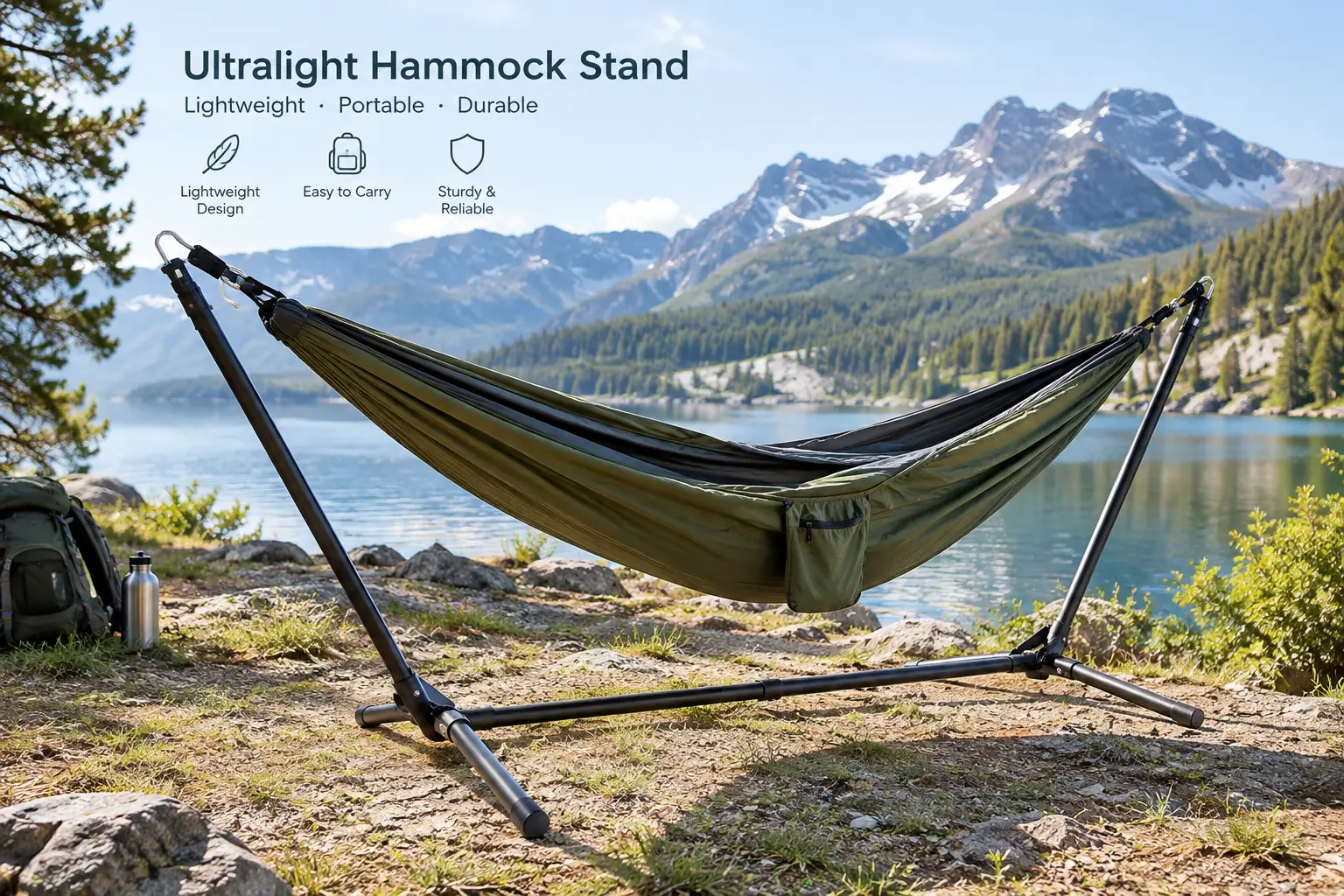
An ultralight hammock stand is a freestanding aluminum (occasionally steel) frame engineered to hang a camping hammock without trees, typically weighing under 20 pounds so it can realistically travel in a vehicle or backpack. Unlike heavier steel-beam stands built for patios, these frames prioritize packed size and carry weight over raw weight capacity.
That tradeoff matters. A steel hammock stand built for a backyard doesn’t need to care that it weighs 40 pounds, because it’s staying in one spot. A stand meant to ride in a kayak hatch, a van’s gear closet, or a hiking pack has a completely different design brief — and that’s the gap this whole product category fills.
Quick Comparison: Top Picks at a Glance
Before diving into the full breakdown, here’s a fast reference for the five most common shopping priorities.
| Hammock Stand | Best For | Approx. Frame Weight | Price Range* |
|---|---|---|---|
| Kammok Swiftlet | Best overall ultralight pick | 12.9–17.9 lbs | $300–$340 |
| Eagles Nest Outfitters (ENO) Nomad | Best all-around backpackable stand | 15.5–18.75 lbs | $250–$350 |
| Boonedox Drifter | Best rocking chair mode | 22–23 lbs | $230–$280 |
| VEVOR Portable Hammock Stand | Best value for two people | 35–45 lbs | $100–$150 |
| Wise Owl Outfitters Portable Hammock Stand | Best for first-time buyers | 30–35 lbs | $90–$140 |
*Prices fluctuate on Amazon; always check the current price at the time of purchase.
Looking at this table, the pattern is immediate: the lighter the frame, the higher the price, almost in a straight line. That’s not a coincidence — aircraft-grade aluminum tubing, precision hinges, and compact folding hardware cost more to engineer than a welded steel A-frame. If you’re only using your stand within a few feet of your car, that premium buys you very little; if you’re carrying it any real distance, it buys you the trip.
💬 One click helps other shoppers make an informed choice too! 😊
The 7 Best Ultralight Hammock Stands of 2026
We looked at true ultralight aluminum frames, mid-weight packable designs, and budget steel stands so this list works whether your priority is ounces or dollars. Every product below includes real specs pulled from manufacturer listings and aggregated feedback from outdoor gear communities — never invented reviews or fabricated testing claims.
| # | Product | Material | Weight Capacity | Frame Weight | Price Range |
|---|---|---|---|---|---|
| 1 | Kammok Swiftlet | Aluminum | 300 lbs | 12.9–17.9 lbs | $300–$340 |
| 2 | ENO Nomad | Aluminum | 300 lbs | 15.5–18.75 lbs | $250–$350 |
| 3 | Boonedox Drifter | Aluminum | 400 lbs | 22–23 lbs | $230–$280 |
| 4 | DD Hammocks Ultralight Hammock Stand | Aluminum | ~250–300 lbs (single user) | ~3.5–6 lbs | $150–$200 |
| 5 | VEVOR Portable Hammock Stand | Steel | 450 lbs | 35–45 lbs | $100–$150 |
| 6 | Amazon Basics Portable Hammock Stand | Steel | 450 lbs | 35–40 lbs | $120–$160 |
| 7 | Wise Owl Outfitters Portable Hammock Stand | Steel | 440 lbs | 30–35 lbs | $90–$140 |
Two clear tiers emerge here: the aluminum stands at the top trade weight capacity for portability, while the steel stands at the bottom trade portability for capacity and a lower price. The DD Hammocks Ultralight Hammock Stand is the outlier — genuinely backpackable at a fraction of the weight of anything else on this list, but built for one person, not two.
1. Kammok Swiftlet Portable Hammock Stand — lightest true two-mode design
The Swiftlet’s headline feature is that it converts between a lounge configuration and an upright chair mode using the same aluminum tubing, which no other stand on this list does as cleanly. Its short-bar setup weighs a claimed 12.9 pounds, while the long-bar configuration (needed for larger hammocks) comes in at 15.25 pounds, with the full packed kit closer to 17.9 pounds. In practice, that means you’re choosing your weight penalty based on which hammock you actually own.
What most buyers overlook with the Swiftlet is the 11 adjustment points per arm — that’s what lets it accommodate everything from a compact Kammok Roo Jr. to a double-wide Roo XL without buying a second stand. Reviewers on outdoor gear sites consistently note that assembly is genuinely tool-free thanks to quick-release buttons and push pins, and that the stakeable feet make a real difference on soft or uneven ground where rigid-legged stands tend to rock.
Pros:
- ✅ Converts between chair and lounge mode on one frame
- ✅ Stakeable feet add real stability on soft ground
- ✅ Tool-free assembly in roughly two to three minutes
Cons:
- ❌ 300-lb capacity isn’t rated for two-person double hammocks
- ❌ Among the priciest options in this entire category
Expect to pay somewhere in the $300 to $340 range at the time of writing, which puts the Kammok Swiftlet at the top of this list on price — a fair trade if you genuinely need the lightest capable-of-real-comfort frame you can find.
2. Eagles Nest Outfitters (ENO) Nomad Hammock Stand — best all-around backpackable stand
ENO built its reputation on hammocks first, and the Nomad reflects that heritage: it’s engineered specifically around the brand’s own hammock ecosystem while remaining compatible with most universal hammocks under 10 feet. The 6061 anodized aluminum frame weighs about 15 pounds 8 ounces on its own, or roughly 18 pounds 12 ounces packed with its carrying bag and eight aluminum stakes.
The ten-point webbing adjustment system on each side is the feature that actually matters here — it lets you dial in a steeper or shallower hang angle depending on whether you’re lounging or sleeping, something fixed-length steel stands simply can’t do. According to a hands-on review from GearJunkie, the horizontal-bar design eliminates the need for a separate ridgeline, and setup consistently lands around the two-minute mark once you’ve done it a couple of times. That same review flags the honest tradeoff: at 15+ pounds, it’s a stretch for multi-day backpacking, better suited to car camping, van life, and beach trips where you’re not covering miles on foot.
Pros:
- ✅ Ten adjustment points per side for custom hang angles
- ✅ Compatible with nearly all standard camping hammocks
- ✅ Includes tarp poles and premium XL ground stakes
Cons:
- ❌ Too heavy for serious backpacking at 15+ pounds
- ❌ Doesn’t work with ENO’s own Sky-series or SuperNest hammocks
Pricing on Amazon typically runs $250 to $350 depending on color and bundle. For anyone who already owns an ENO Nomad-compatible hammock, the fit and finish justify sitting near the top of the price range.
3. Boonedox Drifter Collapsible Hammock Stand — best rocking chair mode
The Boonedox Drifter (sold on Amazon through Happy Times Hammock Shop) takes a different mechanical approach than the rest of this list: its curved 1.75-inch aluminum pipe base lets the whole stand gently rock, and flipping it into “rocker mode” turns your hammock into something closer to a porch swing. At 22 pounds for the stand plus a 12-ounce carrying bag, it’s heavier than the Swiftlet or Nomad but still dramatically more portable than any steel option.
Made in the USA from heavy-gauge extruded aluminum with a silver powder-coat finish, the eight-section design breaks down into segments short enough to fit in a kayak hatch or truck bed — a use case steel stands were never designed for. Owner threads on Hammock Forums and detailed independent reviews both flag the same honest tradeoff: the rocking motion that makes it fun also makes entry and exit feel a little unstable at first, and the flexible frame can let fabric sag when you add a full tarp and bug net setup.
Pros:
- ✅ Genuine rocking chair mode via a curved base
- ✅ 400-lb capacity, the highest of any aluminum stand here
- ✅ Compact 8-section breakdown fits in tight vehicle spaces
Cons:
- ❌ Rocking motion can feel disorienting during entry and exit
- ❌ Low profile makes climbing out less graceful than fixed stands
MSRP sits around $240, and Amazon pricing generally lands in the $230 to $280 range. It’s a strong middle-ground pick if portability matters but you also want two-person capacity.
4. DD Hammocks Ultralight Hammock Stand — fastest tool-free setup
This is the true outlier on this list, and the closest thing to a purpose-built backpacking hammock stand currently sold on Amazon. It’s built around the same tensegrity engineering — a design principle popularized by Buckminster Fuller — as the original “Handy Hammock,” which independent measurements on Hammock Forums clocked at right around 54 ounces (about 3.4 pounds) for the frame alone, making it dramatically lighter than every aluminum option above it on this list.
The truss lines ship pre-tensioned and permanently glued at the hubs, so setup is genuinely just straightening the pole and extending the arms into place — no buckles, no tensioning, no learning curve. That simplicity comes with a real limitation worth flagging honestly: because the truss lines are glued rather than field-serviceable, a broken line generally can’t be repaired at camp, and the stand is designed around 9-foot single-person hammocks rather than doubles. DD Hammocks doesn’t publish a single headline capacity figure the way steel-stand brands do, but owner reports on outdoor forums describe comfortable use well within a typical single-person range.
Pros:
- ✅ Among the lightest hammock stands sold anywhere near this price
- ✅ Pre-assembled tensegrity design sets up in under a minute
- ✅ Genuinely backpackable — fits in a stuff sack, not a duffel
Cons:
- ❌ Not field-repairable if a truss line breaks
- ❌ Built for one person and 9-foot hammocks, not doubles
Pricing generally falls in the $150 to $200 range at the time of writing. For solo backpackers who’ve already accepted steeper prices for lighter tents and sleeping bags, the DD Hammocks Ultralight Hammock Stand is the one piece of this list that actually belongs in a backpack rather than a car trunk.
5. VEVOR Portable Hammock Stand — best value for two people
VEVOR built its reputation on offering commercial-grade equipment at a fraction of name-brand prices, and its hammock stand line follows the same formula. The steel frame is rated for 450 pounds — comfortably enough for two adults — and adjustable hooks let it fit hammocks anywhere from roughly 9.5 to 13 feet depending on the exact listing variant, which is a wider compatibility range than any aluminum stand on this list.
That capacity comes at the expected weight cost: steel-frame stands in this category typically ship in the 35 to 45 pound range, which rules out backpacking but is a non-issue for car camping, tailgating, or a semi-permanent backyard setup. What the spec sheet doesn’t say outright, but the included carrying bag implies, is that VEVOR positions this as “portable” in the sense of moving between your car and campsite, not portable in the sense of a multi-day trek. Aggregated feedback on VEVOR’s own site and third-party retailers points to easy tool-free assembly and a stable, non-wobbly stand once fully hooked, with occasional notes about the powder coat scuffing during repeated pack-downs.
Pros:
- ✅ 450-lb capacity comfortably fits two adults
- ✅ Adjustable hooks fit a wide range of hammock lengths
- ✅ Included carrying bag and noticeably lower price than aluminum rivals
Cons:
- ❌ At 35–45 lbs, not realistic for backpacking
- ❌ Powder-coated steel can chip with repeated setup and teardown
Expect a price in the $100 to $150 range, making the VEVOR Portable Hammock Stand one of the better dollar-per-pound-of-capacity values in this whole roundup.
6. Amazon Basics Portable Hammock Stand — best budget bundle
The appeal of the Amazon Basics option is straightforward: it’s the only stand on this list that reliably ships as a complete kit — a 9-foot space-saving steel frame, a cotton-polyester double hammock, and a carrying case — for less than most competitors charge for the frame alone. Rated for 450 pounds and measuring roughly 110 by 47 by 43 inches when set up, it’s sized for two people lounging side by side.
The practical upside of buying frame and hammock together is fit certainty — you’re not guessing whether a hammock you already own will match a stand’s hook spacing. Reviewers consistently describe assembly as beginner-friendly, typically framed as a one-person, no-tools job completed in well under 15 minutes, with the most common critique being that the included hammock fabric, while comfortable, is noticeably thinner than what dedicated hammock brands sell separately.
Pros:
- ✅ Complete kit — frame, hammock, and case in one purchase
- ✅ 450-lb capacity fits two people comfortably
- ✅ Backed by Amazon’s own customer service and return policy
Cons:
- ❌ Steel frame weight makes it a car-camping tool, not a trail one
- ❌ Bundled hammock fabric is thinner than premium standalone hammocks
Pricing typically lands in the $120 to $160 range for the full bundle — reliably one of the lowest cost-per-item entries here once you account for the included hammock.
7. Wise Owl Outfitters Portable Hammock Stand — best for first-time buyers
Wise Owl Outfitters built its brand on affordable, beginner-friendly camping hammocks, and its stand-only offering follows the same playbook: a 106-by-42-inch steel frame rated to 440 pounds, sold without a hammock included so you can pair it with whatever hammock you already own. That flexibility is the real selling point — unlike the Amazon Basics bundle, you’re not locked into a specific fabric.
Because it’s steel rather than aluminum, don’t expect this to travel light; frames in this weight class from comparable budget brands typically run 30 to 35 pounds. What it does deliver, according to feedback aggregated across gear-review sites covering the brand’s broader hammock kit line, is a genuinely low barrier to entry for anyone testing whether they even like hammock sleeping before investing in a lighter, pricier setup. That review context (covering the brand’s kit line, not this stand specifically) consistently frames Wise Owl products as strong value picks for newcomers, with the caveat that hardware finish and long-term durability trail behind premium competitors.
Pros:
- ✅ Lowest typical price point of any stand on this list
- ✅ 440-lb capacity works for most two-person hammocks
- ✅ Sold stand-only, so it pairs with any hammock you own
Cons:
- ❌ Heaviest-per-dollar option, not built for travel
- ❌ Hardware finish generally trails premium aluminum competitors
Typical Amazon pricing sits in the $90 to $140 range, making the Wise Owl Outfitters Portable Hammock Stand the most accessible entry point into freestanding hammock camping on this entire list.
How to Set Up and Break Down Your Hammock Stand in Under 5 Minutes
Every stand on this list advertises tool-free setup, but “tool-free” and “fast” aren’t always the same thing in practice. Start by fully unfolding the frame on flat ground before attaching your hammock — trying to hook a hammock onto a half-collapsed stand is the single most common cause of pinched fingers and bent hardware.
For aluminum designs like the Kammok Swiftlet or ENO Nomad, extend the arms to their locked position first, confirm both quick-release pins have clicked fully home, and only then clip in your hammock at a matched adjustment point on each side — mismatched points create a lopsided hang that stresses one side of the frame more than the other. For steel stands like the VEVOR Portable Hammock Stand or the Amazon Basics kit, the priority is different: check that all leg bolts or hooks are fully seated before you put weight in, since these frames rely on rigid joints rather than tensioned webbing for stability.
Breakdown is just the reverse, with one extra step worth doing every time: wipe down aluminum hinges before packing, since trapped sand or grit is the leading cause of stiff joints on repeat trips. Steel frames should be dried before long-term storage to avoid rust forming at the powder-coat seams, a small habit that meaningfully extends frame life on budget stands that skip weather sealing.
Real-World Scenarios: Matching a Stand to How You Actually Camp
The weekend backpacker covering 8 to 12 miles a day cares about ounces above almost everything else. For this profile, the DD Hammocks Ultralight Hammock Stand is the only realistic choice on this list — its sub-4-pound frame won’t meaningfully add to a pack that’s already been trimmed for a multi-day trip, even though it means accepting single-person capacity and a non-repairable truss system.
The van-lifer or car camper who values comfort and flexibility over gram-counting is better served by the ENO Nomad or Kammok Swiftlet. Both pack down small enough to live in a rear cargo area permanently, and both offer the adjustability to fine-tune a hang angle for actual sleeping rather than just lounging — a real distinction if you’re using the stand nightly rather than occasionally.
The family or backyard host entertaining guests who’ll take turns in the hammock should lean toward higher-capacity, lower-cost steel: the VEVOR Portable Hammock Stand or the Amazon Basics Portable Hammock Stand bundle both handle repeated setup cycles by different users without the fine-tuned adjustability of pricier aluminum frames mattering much. Amazon Basics in particular removes the guesswork for someone buying their very first hammock setup.
The budget-conscious first-timer who isn’t sure hammock camping is even for them should start with the Wise Owl Outfitters Portable Hammock Stand paired with whatever hammock they already own or can borrow — it’s the lowest-cost way to test the format before committing real money to an ultralight upgrade.
Common Hammock Stand Problems and How to Fix Them
Problem: The hammock sags too close to the ground. This almost always means the hang angle is too flat. On adjustable stands like the Kammok Swiftlet or ENO Nomad, move both attachment points to a higher adjustment slot simultaneously — moving only one side creates an uneven hang. On fixed-length stands, you may simply need a shorter hammock or a stand rated for a shorter length.
Problem: The frame wobbles on uneven ground. Aluminum stands with stakeable feet, like the Swiftlet, should be staked even on flat-looking ground — a common owner mistake is skipping this step because the stand feels stable when empty. Steel stands generally solve this by spreading their footprint wider; if a steel stand still rocks, check that all leg bolts are torqued to spec.
Problem: Hardware seizes up after storage. This is overwhelmingly a moisture issue. Store aluminum stands with hinges lightly dried and, ideally, a drop of silicone-based lubricant on pivot points before long-term storage; avoid petroleum-based lubricants near webbing or nylon components, which can degrade the material over time.
Problem: The stand feels unstable with two people. Check the rated capacity before assuming a defect — several stands on this list, including the Kammok Swiftlet and ENO Nomad, are rated to 300 pounds specifically because they’re not designed as two-person platforms the way the steel options are.
How to Choose an Ultralight Hammock Stand
- Start with your actual capacity needs. A single hiker needs a fraction of the frame that two adults lounging together require — don’t pay for 450 pounds of capacity you’ll never use.
- Weigh portability against your real use case. If the stand is living in a car most of the time, a few extra pounds barely matter; if it’s going in a backpack, every ounce counts.
- Check hammock compatibility before you buy. Fixed-hook steel stands and adjustable webbing systems fit different hammock styles — spreader-bar hammocks in particular don’t always work with tensioned aluminum frames.
- Consider packed dimensions, not just weight. A 15-pound stand that packs into a 50-inch bag may be harder to fit in a small trunk than a bulkier-looking 22-pound stand that folds into segments.
- Factor in setup frequency. A stand you’ll assemble nightly on a long trip benefits from tool-free, muscle-memory-friendly designs more than one you’ll set up once per season.
- Read the fine print on capacity ratings. “450 lbs” almost always means total static load, not a comfortable two-person bounce test — build in a safety margin.
- Decide whether you want a bundle or a stand-only purchase. Buying frame and hammock together, as with Amazon Basics, removes compatibility guesswork; buying stand-only, as with Wise Owl Outfitters, lets you use hammocks you already own.
Common Mistakes to Avoid When Buying a Hammock Stand
The most frequent mistake is buying based on weight capacity alone without checking hammock length compatibility — a stand rated for 450 pounds is useless if your hammock’s spreader bar doesn’t match its hook spacing. A close second is underestimating packed size: reviewers across nearly every product on this list mention being surprised by how long a folded stand actually is, even when the weight seemed reasonable on paper.
Buyers also commonly skip reading whether a stand ships with a hammock or as a frame only, then get frustrated when a bare frame arrives. And a subtler mistake — one that shows up repeatedly in aggregated owner feedback — is assuming aluminum automatically means “backpackable.” The ENO Nomad and Boonedox Drifter are both aluminum and both genuinely too heavy for most backpacking itineraries; “lightweight compared to steel” and “backpack-ready” are not the same claim, and only the DD Hammocks Ultralight Hammock Stand on this list truly earns the second label.
Ultralight Hammock Stands vs. Tree-Hung Hammocks
Tree-hung setups remain the lightest possible option in absolute terms — a set of hammock straps weighs a few ounces, full stop, and no freestanding hammock stand will ever beat that. But that comparison only holds when trees are actually available, appropriately spaced, and healthy enough to bear repeated load, which rules out beaches, deserts, alpine terrain above the treeline, and most backyards.
| Factor | Tree-Hung Hammock | Freestanding Hammock Stand |
|---|---|---|
| Setup location | Requires two suitable trees, 12–18 ft apart | Works anywhere flat |
| Environmental impact | Can damage bark without wide tree-friendly straps | Zero tree impact |
| Portability | Lightest possible option (a few ounces) | 3.5–45 lbs depending on model |
| Setup time | Fast, but location-dependent | Consistent, location-independent |
| Initial cost | Low (straps only) | $90–$350 |
The analysis here matters more than the raw numbers suggest: a hammock strap system is only “lightweight” if you actually find usable trees, and a failed search for trees at the end of a long day costs far more in time and frustration than the weight difference of carrying a stand. There’s also a genuine environmental angle — the Leave No Trace hammock camping guidelines specifically call out narrow straps and rope as a source of bark damage, which a freestanding stand sidesteps entirely by design.
✨ Don’t miss these exclusive deals!
🔍 Take your hammock camping setup to the next level with this carefully curated lineup. Click a highlighted item to check current pricing and availability. These picks will help you get comfortable, tree-free sleep the whole family will enjoy!
Aluminum vs. Steel: What to Expect in Everyday Performance
On paper, aluminum and steel hammock stands look similar — both are “metal frames rated to hold a hammock.” In daily use, they behave quite differently. Aluminum frames like the Kammok Swiftlet and ENO Nomad flex slightly under load, which many users describe as a gentler, more hammock-like sway; steel frames like the VEVOR Portable Hammock Stand feel noticeably more rigid, which some people prefer for stability but others find makes entry and exit feel more abrupt.
Weather resistance also diverges. Anodized or powder-coated aluminum generally resists corrosion better long-term than painted steel, particularly in coastal or humid environments where painted steel is more prone to rust at joints and welds over repeated seasons. That said, steel’s rigidity translates directly into higher weight ratings at a lower price — which is exactly why every steel stand on this list outperforms every aluminum one on raw capacity, while costing roughly a third as much.
Ultralight Hammock Stands for Every Type of User
Beginners should prioritize forgiving, low-cost setups over cutting-edge weight savings — the Wise Owl Outfitters Portable Hammock Stand or the Amazon Basics bundle both let a new hammock camper find out whether they actually enjoy the format before spending premium-aluminum money.
Experienced backpackers already carrying dialed-in ultralight gear should treat frame weight as close to non-negotiable, which points squarely at the DD Hammocks Ultralight Hammock Stand despite its single-person limitation.
Couples and families who need real two-person capacity and don’t mind extra pack weight are best matched with the Boonedox Drifter for portability with high capacity, or the steel options for maximum value.
Seniors and anyone prioritizing ease of entry may prefer fixed, rigid steel frames over rocking or highly flexible aluminum designs — the more predictable, less bouncy feel of a stand like VEVOR’s reduces the balance demands of getting in and out.
Long-Term Cost and Maintenance
Sticker price only tells part of the ownership story. Steel stands cost less upfront but generally face a shorter realistic lifespan in coastal or high-humidity climates due to corrosion risk at welds and joints, unless stored dry and covered between uses. Aluminum stands cost more initially but typically hold up better across seasons of outdoor storage, which narrows the effective cost gap over a multi-year ownership window.
| Tier | Price Range | Typical Frame Weight | Best Use Case |
|---|---|---|---|
| Budget steel | $90–$160 | 30–45 lbs | Backyard, car camping, first-time buyers |
| Mid-range packable | $150–$200 | 3.5–6 lbs | Solo backpacking, minimalist trips |
| Premium ultralight aluminum | $230–$350 | 12.9–23 lbs | Frequent car camping, van life, two-person use |
Reading this table alongside real-world use patterns, the budget steel tier makes the most financial sense for anyone using a stand fewer than a dozen times a year, while the premium aluminum tier earns its price primarily through frequency of use and travel flexibility rather than raw durability. Routine maintenance is minimal across the board: rinse off dirt and sand, dry thoroughly before storage, and periodically check that adjustment webbing or bolts haven’t loosened from repeated setup cycles.
Safety, Regulations, and Standards
Hammock stands sold in the US aren’t subject to a dedicated federal safety standard the way, say, cribs or car seats are, but they do fall under the Consumer Product Safety Commission’s general product-safety authority, and hammock-adjacent products have been recalled before over structural and fall hazards — including a 2022 recall of ShelterLogic-branded swinging hammock chairs tied to inadequate stability instructions. That history is a useful reminder to always respect a stand’s published weight rating rather than treating it as a soft suggestion, and to inspect welds, hinges, and webbing for wear before each season’s first use.
Beyond formal recalls, most real-world hammock stand injuries described in owner forums trace back to two preventable causes: setting up on sloped or soft ground without staking, and exceeding rated capacity with a running “cannonball” entry rather than a controlled sit-and-swing motion. Following manufacturer assembly instructions exactly — rather than skipping steps once you’re familiar with a stand — remains the single best safety practice across every product on this list.
Frequently Asked Questions
❓ What is the lightest ultralight hammock stand you can buy?
❓ How much weight can an ultralight hammock stand hold?
❓ Can an ultralight hammock stand replace trees completely?
❓ Is an ultralight hammock stand worth it for backpacking?
❓ What is the average price of an ultralight hammock stand?
Conclusion
Choosing the right ultralight hammock stand comes down to being honest about how you’ll actually use it. If you’re logging trail miles and every ounce is negotiated with your gear list, the DD Hammocks Ultralight Hammock Stand is the only realistic pick here. If you camp mostly from a vehicle and want the flexibility to hang comfortably almost anywhere, the Kammok Swiftlet and ENO Nomad both deliver genuine adjustability worth their higher price. And if you’re testing the waters of hammock camping for the first time, or need dependable capacity for family and friends, the steel options — VEVOR, Amazon Basics, and Wise Owl Outfitters — deliver real value without the premium price tag.
None of these seven products is objectively “best” in a vacuum; each one earns its spot by matching a specific use case honestly, which is exactly the standard this guide held every pick to. Whichever direction you go, check current specs and pricing before buying, since availability and pricing on Amazon shift regularly.
✨ Ready to hang comfortably wherever your next trip takes you? Compare current prices on today’s top pick and get one step closer to tree-free hammock camping!
Recommended for You
- Flat Hammock Tent: 7 Best Picks for Comfortable Camping in 2026
- Three Person Hammock: 7 Best Picks Worth Buying in 2026
- Hammock Floor Stands: 7 Best Picks to Try in 2026
Disclaimer: This post contains affiliate links. As an Amazon Associate, I earn from qualifying purchases made through these links, at no additional cost to you.
✨ Found this article helpful? Share it with someone who needs it! 💬🤗