
In This Article
Introduction: Why Your Hammock Rainfly Matters More Than Your Hammock
Here’s a truth most first-time hangers learn the hard way: a hammock without a roof is a lawn chair with ambitions. The moment a 2 a.m. storm rolls through, your sleep quality depends almost entirely on one piece of fabric strung above you — your hammock rainfly.
The good news? Choosing the right hammock rainfly in 2026 is easier than ever, because the market has settled into a few clear categories: compact diamond and asym flies for fair-weather minimalists, hex tarps for all-around coverage, and tarps with doors for wind, cold, and sideways rain. The bad news is that sizes, fabrics, and waterproof ratings are labeled inconsistently, and a tarp that looks huge on a product page can still leave your hammock’s ends exposed.
In this guide, we compare seven real tarps you can find on amazon.com — from budget workhorses to premium silnylon shelters — using published spec sheets and the recurring themes in owner reviews. We’ll translate every number into what it means at camp: how much coverage you actually get, how much weight you carry, and which hammock tarp suits your trips. If you’re brand new to hanging, REI’s step-by-step guide to hammock camping is a great primer on how the tarp fits into the full system.
Transparency note: this post contains affiliate links. If you buy through them, we may earn a small commission at no extra cost to you.
What Is a Hammock Rainfly?
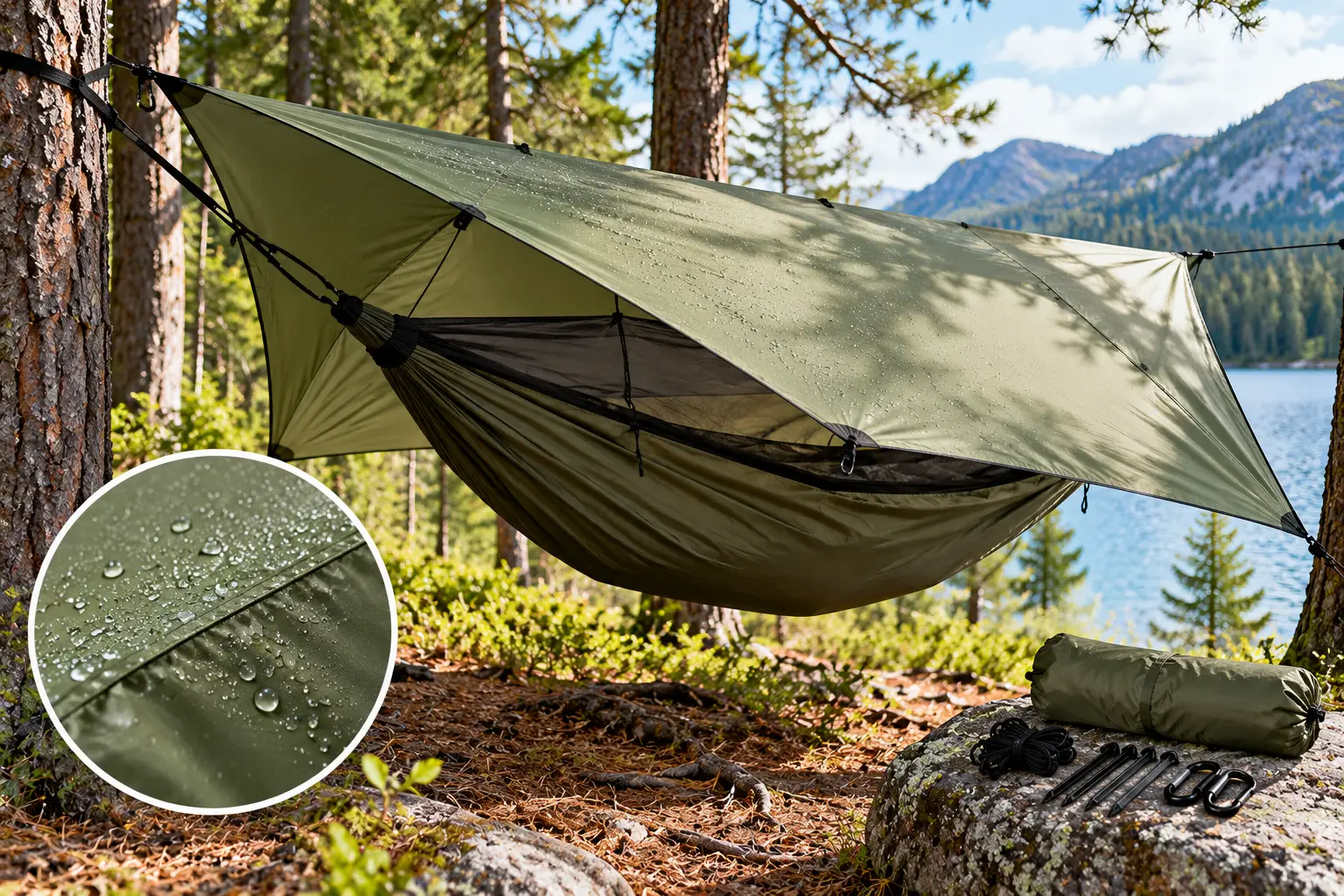
A hammock rainfly is a waterproof tarp hung over a camping hammock on a ridgeline and staked out with guy lines, so rain sheds off its sides instead of soaking you. Unlike a tent fly, it has no floor or poles; its length, shape, and pitch angle decide how well it blocks rain and wind.
In practice, that means three things matter most: the fly must be longer than your hammock (by at least a foot on each end), wide enough to drop below the hammock’s sides, and made of fabric that won’t sag or leak when soaked. Everything else — doors, tie-outs, color — is a refinement on top of those three basics.
Quick Comparison: 7 Hammock Rainfly Picks at a Glance
| Tarp | Size (L x W) | Fabric | Approx. Weight | Price Range | Best for |
|---|---|---|---|---|---|
| Kammok Kuhli | 12′ x 9′ | 40D ripstop nylon, Sil/PU + DWR | ~20.5 oz | $160–$185 | Kammok Kuhli: all-around, three-season use |
| ENO ProFly Rain Tarp | 10’6″ x 6’4″ | 70D ripstop nylon, 1000mm PU | ~22 oz | $75–$90 | ENO ProFly Rain Tarp: beginners, fair-weather trips |
| ENO ProFly Sil Rain Tarp | 10’6″ x 6’4″ | 30D silnylon, 1000mm PU | ~18 oz | $115–$135 | ENO ProFly Sil Rain Tarp: weight-conscious hikers |
| ENO HouseFly Rain Tarp | 10’8″ x 8’10” | 30D silnylon, 1000mm PU, 4 doors | ~29 oz | $140–$175 | ENO HouseFly Rain Tarp: wind, cold, storms |
| Hennessy Hammock Hex Rainfly 70D | 143″ x 120″ | 70D PU-coated polyester ripstop | ~27 oz | $70–$85 | Hennessy Hammock Hex Rainfly 70D: big coverage on a budget |
| Wise Owl Outfitters Rain Fly (Standard) | 11′ x 9′ | Ripstop nylon, 3000mm PU, taped seams | ~26 oz | under $50 | Wise Owl Outfitters Rain Fly (Standard): first tarp, car camping |
| Onewind 12′ Hammock Tarp with Doors | 12′ x ~10′ | 20D ripstop silnylon | ~20–30 oz (by kit) | $80–$120 | Onewind 12′ Hammock Tarp with Doors: cold-weather value |
Prices are approximate ranges at the time of writing and change often — check the current price on Amazon.
Reading across the table, the real dividing line isn’t price — it’s the size-to-weight ratio. The Kammok Kuhli gives you a 12-foot ridgeline at roughly the same weight as the much smaller ENO ProFly Rain Tarp, which is why it lands as our all-around pick. Budget buyers should note that the Hennessy Hammock Hex Rainfly 70D and the Wise Owl Outfitters Rain Fly (Standard) buy you generous coverage for less money, but you pay in ounces and pack bulk.
💬 One click helps other shoppers make an informed choice too! 😊
Top 7 Hammock Rainfly Picks: Expert Analysis
Every pick below is a real, currently listed tarp. Our commentary is based on comparing manufacturer spec sheets and the recurring themes in owner reviews — not on invented test results. Where review data is thin, we say so.
1. Kammok Kuhli — best all-around coverage per ounce
The Kammok Kuhli earns the top spot because it delivers a full 12-foot ridgeline without the weight penalty you’d expect from a tarp that size.
Its 144 x 108-inch body is cut from 40D diamond ripstop nylon with a Sil/PU coating and DWR finish, and it weighs roughly 20.5 ounces. In practice, 12 feet of length means an 11-foot hammock gets about 6 inches of overhang at each end — enough to stop rain from wicking down your suspension. The 10 Hypalon-reinforced guy-out points let you pitch it as an A-frame, a lean-to, or a low storm pitch without fear of tearing a corner in gusts.
Who is it for? Three-season backpackers who want one tarp that works from spring showers to fall storms. The knotless tensioners also make it friendly for beginners who haven’t learned a trucker’s hitch yet.
Owner reviews on REI consistently report that the Kammok Kuhli stays taut and dry through thunderstorms, hail, and strong wind, and several owners mention buying a second one for family members.
Pros:
- ✅ Full 12′ ridgeline covers most camping hammocks
- ✅ Ten reinforced tie-outs for flexible pitches
- ✅ Knotless setup is fast even in the rain
Cons:
- ❌ No doors for wind-driven winter weather
- ❌ Premium price compared with budget hex tarps
Price range: around $160–$185; strong value if you’ll use it 10+ nights a year.
2. ENO ProFly Rain Tarp — easiest first tarp for ENO owners
The ENO ProFly Rain Tarp is the classic entry point because it pairs seamlessly with the hammocks most Americans already own.
It measures 10’6″ x 6’4″, uses tough 70D ripstop nylon with a 1000mm PU coating, and weighs about 22 ounces. That heavier 70D fabric shrugs off branch snags better than thin silnylon, while the six guy points and built-in LineLoc tensioners mean no knots are needed. ENO also includes four aluminum stakes, so it’s usable out of the box.
The catch is coverage. A 6’4″ width doesn’t drop very far below a hammock’s sides, so it shines in vertical rain but struggles when wind pushes water sideways. It’s a smart buy for summer car camping, festivals, and short trips with a decent forecast.
On REI, the tarp holds a 4.6-out-of-5 average across 88 reviews; owners praise the minutes-long setup, though some report the tensioners slipping and others say they’d bring a bigger tarp for prolonged sideways rain.
Pros:
- ✅ Durable 70D fabric resists snags and abrasion
- ✅ No-knot setup with stakes included
- ✅ Compact and simple for first-time hangers
Cons:
- ❌ Narrow width leaves sides exposed in wind
- ❌ Tensioners can slip under heavy load
Price range: about $75–$90; good value for fair-weather and beginner use.
3. ENO ProFly Sil Rain Tarp — lightest of the ENO lineup
The ENO ProFly Sil Rain Tarp keeps the ProFly’s footprint but trims weight for backpackers counting ounces.
ENO lists it at 18 ounces — 4 ounces lighter than the standard ProFly — thanks to 30D silicone-impregnated nylon with a 1000mm PU coating, double-stitched seams, and the same 10’6″ x 6’4″ cut. Silnylon packs smaller and sheds water beautifully, but it stretches when cold and wet, so plan to re-tension the guy lines before bed and again at midnight if temperatures drop.
This is the pick for thru-hikers and weekend backpackers who already own an ENO hammock, hike mostly in the warmer months, and want the lightest name-brand option. If you sleep in exposed or windy terrain, though, the narrow cut is the same limitation as the standard version — lighter doesn’t mean bigger.
The ENO ProFly Sil Rain Tarp has a much smaller review base than the standard ProFly, so long-term durability data is thinner; the reviews that exist mostly praise the weight savings and pack size.
Pros:
- ✅ Saves 4 ounces over the standard ProFly
- ✅ Packs small enough for a side pocket
- ✅ Sealed, double-stitched seams
Cons:
- ❌ Silnylon sags when wet and needs re-tensioning
- ❌ Same narrow coverage as the heavier version
Price range: roughly $115–$135; worth it only if ounces truly matter to you.
4. ENO HouseFly Rain Tarp — storm-ready with four doors
The ENO HouseFly Rain Tarp turns an open-sided tarp into something close to a hanging shelter, thanks to four stowable doors.
At 10’8″ x 8’10” and about 29 ounces, it’s built from 30D silnylon with a 1000mm PU coating, a 10-point anchor system, reflective cord, and eight aluminum stakes in the box. Those doors (two at each end) can be crisscrossed shut against wind and rain or buckled back for open-air lounging. That’s the difference between a breezy 40°F night and a genuinely cozy one, because blocking end-wind also protects the warmth trapped by your underquilt.
It’s the right call for shoulder-season and winter campers, anyone hanging along exposed ridges or coastlines, and people who want privacy for changing clothes.
Reviews consistently describe staying dry in pouring and even hurricane-driven rain, and owners love the reflective guy lines at night. The recurring criticisms are the weight and that some wish the doors closed more completely or that the whole tarp were a bit larger.
Pros:
- ✅ Four doors block wind and blowing rain
- ✅ Generous coverage with eight stakes included
- ✅ Reflective cords reduce nighttime trip hazards
Cons:
- ❌ Heaviest ENO tarp at roughly 29 ounces
- ❌ Overkill for most summer trips
Price range: about $140–$175; excellent value if you camp in cold or stormy seasons.
5. Hennessy Hammock Hex Rainfly 70D — huge hex coverage for less
The Hennessy Hammock Hex Rainfly 70D gives you some of the biggest coverage in this lineup at one of the lower price points.
It measures 143 inches on the centerline by 120 inches wide in a symmetrical hex shape and weighs about 27 ounces. The fabric is 70D polyurethane-coated polyester ripstop — and that word polyester matters: polyester stretches far less than nylon when wet, so the fly holds its shape through an all-night soaking with less fiddling. The wide hex can be staked low on both sides in a storm or angled out to create a covered cooking area.
It works with all Hennessy hammocks and most other brands. Hennessy recommends tying it directly to trees because of wind load, and some retailers note it’s bulky enough to need an extra pair of snakeskins.
Owner feedback on REI centers on sleeping through multiple thunderstorms without moisture getting in, and long-term users report years of service without regret.
Pros:
- ✅ Nearly 12′ x 10′ coverage at a budget price
- ✅ Polyester sags less than nylon when wet
- ✅ Doubles as a group or kitchen shelter
Cons:
- ❌ Heavier and bulkier than silnylon rivals
- ❌ Minimal tie-outs: two per side
Price range: around $70–$85; outstanding coverage per dollar.
6. Wise Owl Outfitters Rain Fly (Standard) — best budget workhorse
The Wise Owl Outfitters Rain Fly (Standard) is the tarp we’d hand a friend who isn’t sure hammock camping will stick yet.
It’s an 11′ x 9′ ripstop nylon fly with a 3000mm PU coating and taped seams, and the kit includes four aluminum stakes, six 10-foot guy lines, a stake bag, and a waterproof carry bag. The Standard version weighs about 26 ounces; a Lite version drops to roughly 18.9 ounces. A 3000mm rating is triple the hydrostatic head of the ENO tarps on paper — though remember that seam quality and pitch angle matter more than the number once rain gets heavy.
It suits car campers, scouts, and weekend hangers. Ultralight hikers will find it heavy, and one gear-review site specifically frames it as a value tarp rather than a gram-shaver.
Aggregated reviews praise its durability and price, with multi-year owners reporting dozens of nights a season. Common complaints: the supplied guy lines are short for thick trees, and some owners upgrade the cordage.
Pros:
- ✅ Full kit with stakes and guy lines
- ✅ 3000mm coating with taped seams
- ✅ Generous 11′ x 9′ coverage
Cons:
- ❌ Heavy for its size by backpacking standards
- ❌ Stock guy lines may be too short
Price range: typically under $50; the best entry-level value here. Tip: check the listing weight to confirm whether you’re buying the Standard or Lite cut.
7. Onewind 12′ Hammock Tarp with Doors — winter protection without the premium price
The Onewind 12′ Hammock Tarp with Doors brings the door-equipped design of pricier tarps into a more accessible price tier.
It measures roughly 12′ x 10′ and is made from 1.1-ounce 20D ripstop silnylon. Onewind’s bundled spec lists a silicone face with a PU back coating rated at 4000mm and a tarp fabric weight around 20 ounces, climbing toward 30 ounces with all hardware. The kit includes aluminum stakes, reflective 10-foot guy lines, line adjusters, and carabiners with pre-attached door cords. In fair weather, you fold the doors back; in snow or sleet, you close them to create a nearly enclosed space.
It’s ideal for cold-weather hangers and paddlers who want ENO HouseFly Rain Tarp-style protection on a tighter budget.
On hammock-camping forums, owners repeatedly say they prefer this door-equipped Onewind tarp over basic budget flies, and Amazon-sourced reviews describe it holding up for years in downpours and driving rain.
Pros:
- ✅ Closable doors for wind, snow, and sleet
- ✅ Lightweight 20D silnylon for its size
- ✅ Complete kit with reflective guy lines
Cons:
- ❌ Door setup adds steps for beginners
- ❌ Silnylon needs re-tensioning in cold rain
Price range: roughly $80–$120; a strong value for four-season use.
🏕️ Ready to stay dry on your next trip?
🔍 Each of these tarps solves a different problem — weight, coverage, wind, or budget. Click a highlighted product name to check current pricing and availability, and pick the one that matches the weather you actually camp in!
Want to see how these tarps pair with popular hammocks? REI’s roundup of the best hammocks and hammock accessories is a useful cross-reference for matching tarp length to hammock length.
How to Set Up a Hammock Rainfly in 10 Minutes (Step by Step)
A great tarp pitched badly will leak; a budget tarp pitched well usually won’t. Here’s the routine that works for nearly every hammock tarp in this guide.
Before You Leave Home
- ✅ Practice in your yard first. Pitch it twice in daylight so the first real attempt isn’t in the dark and the rain.
- ✅ Pre-attach your guy lines to every tie-out and store them coiled. Untangling cord with cold, wet fingers is how setups fail.
- ✅ Seal seams if the maker recommends it. Most tarps here ship seam-sealed or taped, but check before your first trip.
At Camp: The 6-Step Pitch
- Hang the tarp first, not the hammock. If rain starts mid-setup, you’re working under cover.
- Run a taut ridgeline between the same two trees, roughly 12–18 inches above where your hammock will hang.
- Center the tarp on the ridgeline so equal overhang sits at both ends.
- Stake the four corners at a 45-degree angle, pulling the sides down to just below the hammock’s lowest edge.
- Tension evenly — tight enough that the fabric drums when flicked, but not so tight that a gust rips a stake loose.
- Add drip lines — a short cord or tie on each hammock suspension, just inside the tarp. Water running down the straps drips off here instead of reaching you.
The First 30 Days: Common Mistakes
Pitching too high is the number-one error; it looks airy but invites sideways rain. Second: forgetting that nylon and silnylon tarps loosen as they get cold and wet, so recheck tension before bed. Third: stuffing a soaking tarp into its sack and forgetting it in the trunk — mildew starts fast. Treat these three habits as part of the gear.
Which Hammock Tarp Fits Your Trips? 3 Real-World Scenarios
Specs only matter in context. Here’s how we’d match tarps to three common camper profiles.
Scenario 1: The Summer Weekend Beginner
Budget: under $100 · Use: 4–8 nights a year, state parks and car camping.
You already own a double-wide camping hammock and you mostly camp when the forecast looks friendly. Choose the Wise Owl Outfitters Rain Fly (Standard) if you want maximum coverage per dollar, or the ENO ProFly Rain Tarp if you own an ENO hammock and value the no-knot setup. Weight barely matters when the car is 50 feet away, so the extra ounces of the Wise Owl Outfitters Rain Fly (Standard) are a fair trade for 11 feet of length.
Scenario 2: The Three-Season Backpacker
Budget: $120–$190 · Use: 15–25 nights a year, Appalachian or Pacific Northwest trails.
You carry everything on your back and rain is likely, not possible. The Kammok Kuhli is the best match: 12 feet of coverage, ten tie-outs for storm pitches, and about 20.5 ounces. If you’d rather save weight and mostly hike in summer, the ENO ProFly Sil Rain Tarp cuts ounces — but accept less side protection.
Scenario 3: The Cold-Weather or Coastal Hanger
Budget: $80–$175 · Use: late fall through early spring, ridgelines, lakeshores.
Wind is your real enemy, because it strips heat from beneath your hammock. Doors are non-negotiable. The ENO HouseFly Rain Tarp is the polished option with eight stakes and reflective cords; the Onewind 12′ Hammock Tarp with Doors gives similar door protection for less money. Either one, pitched low with the doors closed, turns a blustery night into a sheltered one.
Hammock Rain Fly Problems and How to Fix Them
Even a well-chosen hammock rain fly can misbehave. These are the five complaints that show up most often in owner reviews and hammock forums — and the fixes that actually work.
Problem 1: Water creeps down the straps and soaks the hammock ends. ✅ Fix: Tie drip lines on both suspensions and make sure the tarp extends at least 6 inches past each hammock end. Short tarps like the ENO ProFly Rain Tarp make drip lines essential, not optional.
Problem 2: The tarp sags overnight. ✅ Fix: Nylon and silnylon stretch when wet and cold. Re-tension before bed, or pick polyester like the Hennessy Hammock Hex Rainfly 70D, which holds its shape better.
Problem 3: Wind-driven rain blows in from the side. ✅ Fix: Drop the windward side lower — almost to the ground — and pitch the ridgeline lower. For frequent windy trips, upgrade to a tarp with doors.
Problem 4: Guy lines slip loose. ✅ Fix: Back up slippery tensioners with a simple taut-line hitch, or swap the stock cord for a thicker, grippier line. Several Wise Owl Outfitters Rain Fly (Standard) owners mention doing exactly this.
Problem 5: Condensation drips on you. ✅ Fix: Open the doors or raise one side slightly to boost airflow, and avoid pitching directly over still water.
How to Choose the Best Hammock Rain Fly: 7 Steps
- Measure your hammock first. Your tarp’s ridgeline should be at least 12 inches longer than the hammock body. An 11-foot hammock wants a 12-foot tarp.
- Match the shape to your weather. Diamond and asym flies suit fair weather; hex tarps suit mixed conditions; a hammock tarp with doors suits wind and cold.
- Decide on fabric. Polyester holds shape when wet; nylon is stronger per ounce; silnylon is lightest but stretches.
- Read the waterproof rating realistically. Around 1000–3000mm is plenty for a pitched tarp, because rain runs off rather than pressing through.
- Count the tie-outs. More reinforced points (8–10) mean more pitch options, especially for storm mode.
- Weigh the full kit, not just the fabric. Stakes, guy lines, and stuff sacks can add 4–10 ounces.
- Set a budget by nights per year. Under 10 nights? A value tarp is fine. Over 20? A premium tarp pays off.
Hammock Tarp Shapes Compared: Diamond vs. Asym vs. Hex vs. Doors
| Shape | Typical Weight | Side Coverage | Best for |
|---|---|---|---|
| Diamond / asym | Lightest | Minimal | Summer minimalists |
| Rectangle | Moderate | Good, easy to pitch | Car camping, versatility (Wise Owl Outfitters Rain Fly (Standard)) |
| Hex / catenary | Moderate | Very good, less flapping | Three-season trips (Kammok Kuhli, Hennessy Hammock Hex Rainfly 70D) |
| Hex with doors | Heaviest | Near-total enclosure | Winter and storms (ENO HouseFly Rain Tarp, Onewind 12′ Hammock Tarp with Doors) |
The pattern is simple: every step down the table adds ounces but closes off more of the sky. Hex tarps sit in the sweet spot for most people because their angled ends block more end-wind than a rectangle of similar weight, while catenary-cut edges reduce flapping noise. Only add doors if you regularly camp below freezing or in exposed, windy spots.
Hammock Rainfly vs. a Hardware-Store Poly Tarp
A blue poly tarp from the hardware store costs a fraction of any rain fly for hammock use, so why bother? Here’s the honest comparison.
| Factor | Purpose-Built Hammock Rainfly | Hardware-Store Poly Tarp |
|---|---|---|
| Weight (approx. 11′ x 9′) | ~18–29 oz | Often 2–4 lb |
| Packed size | Water-bottle size | Bulky, stiff roll |
| Noise in wind | Quiet to moderate | Loud crinkling |
| Tie-outs | Reinforced, 6–10 points | Grommets that can tear |
| Best for | Backpacking, frequent use | Emergency backup, short car trips |
The poly tarp wins on price and nothing else. Purpose-built flies weigh far less, pack smaller, and use reinforced tie-outs that survive gusts that would rip a grommet loose. If you camp more than a couple of nights a year, the upgrade earns its keep in comfort alone.
Features That Actually Matter (and Ones That Don’t)
Matters a lot: length, pitch-ability, and tie-out quality. These three decide whether you stay dry. A long tarp with reinforced points beats a short one with fancy fabric every time.
Matters somewhat: fabric type and packed size. Silnylon saves weight and space; polyester saves you midnight re-tensioning; 70D fabrics resist snags.
Matters less than marketing suggests: very high hydrostatic-head numbers (a 5000mm claim doesn’t mean a 3000mm tarp leaks), “ultralight” labels on 26-ounce tarps, and survival-bracelet freebies. Check whether seams are sealed or taped — that detail matters more than any headline rating.
Long-Term Cost and Care
A hammock rainfly is one of the longest-lived pieces in your kit if you treat it right. Divide price by nights: a $175 tarp used 20 nights a year for five years costs under $2 a night; a $45 tarp replaced after two seasons can cost more per night.
Care routine:
- ✅ Dry the tarp fully within 24 hours of a wet trip.
- ✅ Rinse with plain water; avoid detergents that strip DWR coatings.
- ✅ Store loosely, not compressed, in a cool, dry place.
- ✅ Inspect guy lines and stake loops every season and replace frayed cord.
- ✅ Use tarp sleeves (“snakeskins”) to cut setup time and reduce fabric abrasion.
Safety, Regulations, and Standards
No tarp protects you from lightning. The National Weather Service’s lightning safety guidance for people outdoors is blunt: if you can’t reach a substantial building or hard-topped vehicle, you are not safe — you can only reduce risk. Check forecasts before you hang, avoid isolated tall trees and ridgetops during storms, and have a bail-out plan.
Always inspect anchor trees and the branches above your tarp for dead limbs, use wide tree-friendly straps, and follow the rules of the park you’re visiting — many U.S. parks publish site-specific guidance, such as the National Park Service’s lightning safety advice for New River Gorge. Finally, keep stoves and campfires well away from nylon and silnylon; most tarps are not fire-retardant unless the maker says so.
FAQ: Hammock Rainfly Questions Shoppers Ask Most
❓ Can I use a hammock rainfly without a hammock?
❓ Do I need a hammock tarp with doors for summer camping?
❓ Can two hammocks share one rain fly?
❓ Are budget hammock rain flies on Amazon worth buying?
❓ How long does a hammock rainfly last?
Conclusion: The Right Hammock Rainfly Is the One That Matches Your Weather
There’s no single “best” hammock rainfly — there’s the best one for the nights you actually camp. If you want one tarp that handles most of the year, the Kammok Kuhli offers the strongest balance of length, weight, and pitch options. If your budget is tight, the Wise Owl Outfitters Rain Fly (Standard) and the Hennessy Hammock Hex Rainfly 70D give you real coverage for far less money. ENO loyalists will feel right at home with the ENO ProFly Rain Tarp or the lighter ENO ProFly Sil Rain Tarp.
And if cold wind and sideways rain are part of your plans, doors change everything: the ENO HouseFly Rain Tarp is the polished choice, while the Onewind 12′ Hammock Tarp with Doors delivers similar protection at a friendlier price.
Whichever you choose, remember that technique matters as much as gear. Pitch low in bad weather, tie drip lines, re-tension silnylon before bed, and dry your tarp after every wet trip. Do that, and even a modest hammock tarp will keep you dry for years.
✨ Don’t miss these top-rated picks!
🔍 Take your hammock camping to the next level with this carefully curated lineup. Click a highlighted tarp to check current pricing and availability. These picks will help you sleep dry, warm, and storm-proof on every adventure!
Recommended for You
- Triangle Camping Hammock: 7 Best Picks That Won’t Sag (2026)
- Tarp with Doors: 7 Best Storm-Proof Picks Worth Buying in 2026
- Rain Fly Camping: 7 Best Tarps That Keep You Dry in 2026
Disclaimer: This post contains affiliate links. As an Amazon Associate, I earn from qualifying purchases made through these links, at no additional cost to you.
✨ Found this article helpful? Share it with someone who needs it! 💬🤗