
In This Article
Why a Military Hammock Still Beats Sleeping on the Cold, Wet Ground
Picture this: it’s 2 a.m., the ground is soaked, and something with far too many legs is exploring your sleeping bag. Now picture the alternative. You’re suspended about 18 inches above all of it, zipped inside a fine-mesh cocoon, while a tarp sheds rain over your head. That’s the promise of a military hammock, and it’s exactly why soldiers, bushcrafters, hunters, and preppers keep packing one.
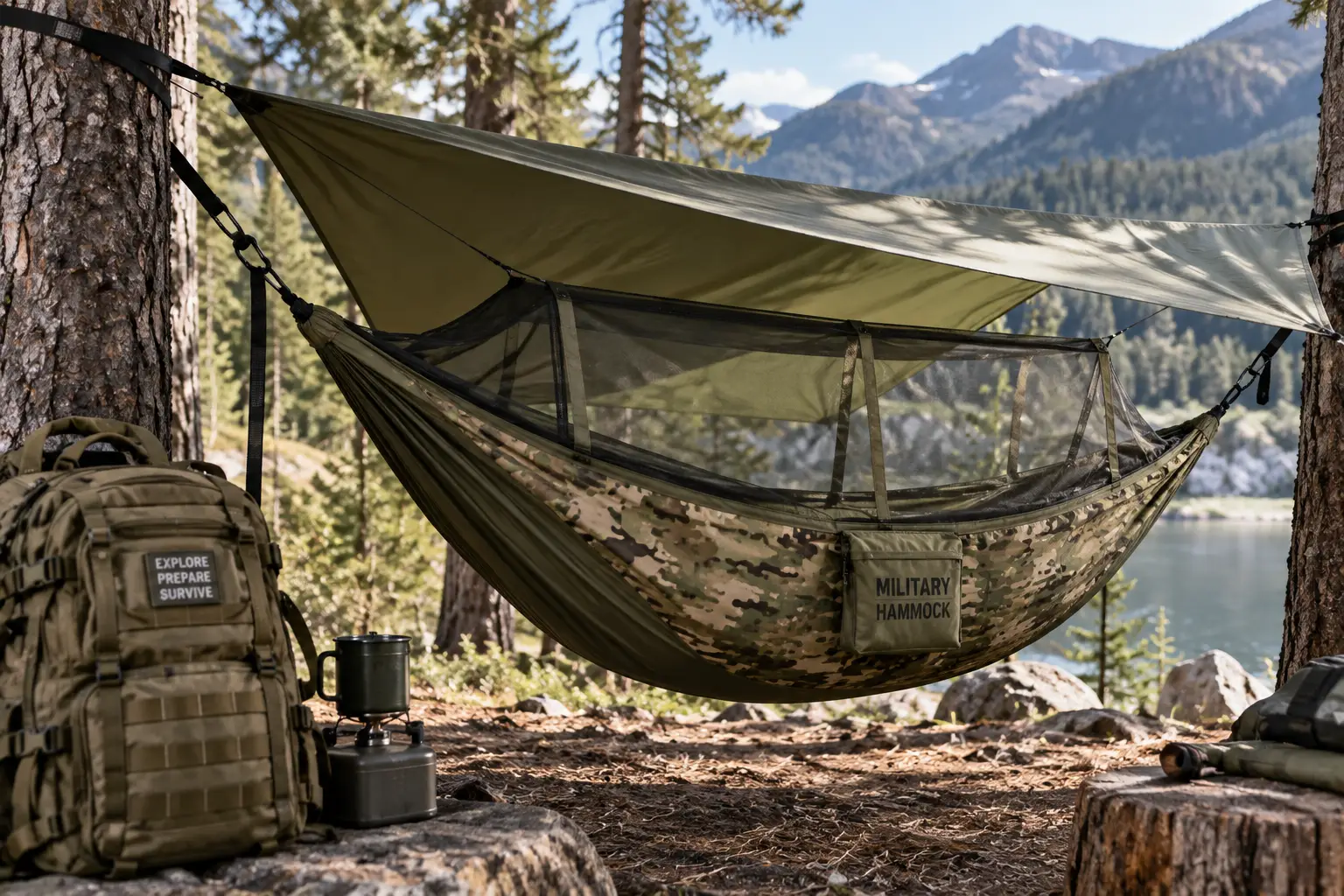
A military hammock isn’t just a backyard lounger dyed olive drab. The best ones borrow directly from jungle-warfare lessons: integrated bug nets, tough ripstop or parachute nylon, fast suspension systems, and muted colors that disappear into the tree line. The broader practice of hammock camping has gone mainstream, yet gear built to military-style standards still stands apart when the weather turns ugly.
In this guide, you’ll find seven real options available on amazon.com, ranging from a sub-$60 GI-style classic to a premium asymmetric shelter the manufacturer says is used by soldiers and military units. For each one, we translate the spec sheet into plain English, summarize what independent reviewers and real buyers consistently report, and flag the compromises that product pages tend to gloss over. You’ll also get a first-night setup plan, a problem-solving guide, and a no-nonsense framework for choosing the right military hammock for your body, budget, and climate.
What Is a Military Hammock?
A military hammock is a rugged, field-ready hanging shelter designed for sleeping off the ground in harsh conditions. It typically combines durable ripstop or parachute nylon, an integrated mosquito net, a rain fly or tarp compatibility, and a fast tree-strap suspension, usually in olive drab, coyote brown, or camouflage colors.
Military Hammock Quick Comparison: 2026 Picks at a Glance
Before diving into the details, here’s a scannable overview of the seven picks. Price ranges reflect what we saw at the time of writing; prices may vary, so always check the current listing.
| Product | Capacity | Bug Net | Rain Fly Included | Price Range | Best For |
|---|---|---|---|---|---|
| DD Hammocks Frontline Hammock | 275 lb | Yes | No | $80–$120 | DD Frontline: best all-rounder |
| Hennessy Hammock Jungle Expedition Zip | 250 lb | Yes | Yes | $220–$300 | Hennessy Jungle Expedition Zip: heavy-bug jungles |
| ENO JungleLink Hammock System | 300 lb | Yes | Yes | $200–$260 | ENO JungleLink: complete plug-and-play kit |
| Snugpak Jungle Hammock | 400 lb | Yes | No | $50–$80 | Snugpak Jungle Hammock: budget, bigger users |
| Rothco Jungle Hammock | 220 lb | Yes | Attached roof | $40–$60 | Rothco Jungle Hammock: bug-out bags |
| OneTigris KOMPOUND | 330 lb | Yes | No | $60–$90 | OneTigris KOMPOUND: cool, damp nights |
| Night Cat Camping Hammock Tent | 440 lb | Yes | Yes | $60–$100 | Night Cat Hammock Tent: heavy-duty camo kit |
Looking at the table, the DD Hammocks Frontline Hammock hits the sweet spot between price, versatility, and a proven field record, while the Hennessy Hammock Jungle Expedition Zip and ENO JungleLink Hammock System justify their higher prices by including rain protection and a refined suspension. If capacity is your top concern, the Snugpak Jungle Hammock and Night Cat Camping Hammock Tent carry the most weight for the least money.
One thing the table can’t show: “rain fly included” doesn’t mean “storm-ready.” Several of the bundled flies are compact, so if you camp where sideways rain is normal, budget for a larger tarp regardless of which military hammock you choose.
💬 One click helps other shoppers make an informed choice too! 😊
Top 7 Military Hammocks for 2026: Expert Analysis
Each pick below was chosen for real-world field suitability, verified specs, and a distinct use case. No two serve exactly the same buyer.
1. DD Hammocks Frontline Hammock — best all-round field hammock
Designed in the UK and popular with British service members, the DD Hammocks Frontline Hammock is the benchmark most other military-style hammocks get measured against.
The hammock body weighs about 30 oz and measures 8.8 by 4.6 feet, rated for users up to 6’5″ and 275 lb. In practice, that means most adults can lie on a slight diagonal without the fabric squeezing their shoulders. Its double-layer base lets you slide a foam or inflatable pad between the layers, so the pad stays put instead of migrating out from under your hips at 3 a.m. That’s a genuine fix for one of hammock camping’s most annoying problems. The net zips open on both sides, and two 60 cm spreader poles lift it off your face; flip the whole hammock over and the net hangs underneath, turning it into an open lounger.
Based on comparing the specs, this is the pick for anyone who wants one military hammock for both jungle heat and chilly shoulder seasons. About 10 meters of webbing comes pre-fitted, so there are no knots to learn. On the manufacturer’s review page, one buyer reports roughly seven years of military exercises with the hammock still in near-original shape, while taller users (even around 6’1″) mention wanting more room. DD’s XL and King Size variants address exactly that.
Pros:
- ✅ Double layer holds a sleeping pad securely in place
- ✅ Reversible design doubles as a net-free lounger
- ✅ Pre-fitted webbing makes setup nearly foolproof
Cons:
- ❌ Tarp is sold separately, adding to total cost
- ❌ Taller sleepers may prefer the XL size
Expect it in roughly the $80–$120 range (check the current price), which is strong value for a field-proven design.
2. Hennessy Hammock Jungle Expedition Zip — built for the buggiest terrain
Hennessy’s own listing says its hammocks are used by soldiers and military units, and the Hennessy Hammock Jungle Expedition Zip is the version aimed squarely at mosquito-heavy country.
The key upgrade is a double bottom made of two layers of tightly woven 40D nylon, which the brand describes as 100% mosquito-proof. That matters because single-layer hammocks let insects bite straight through the fabric you’re lying on, which is a surprisingly common complaint in swampy areas. The layers also hold an optional pad on the correct diagonal. You get 30D no-see-um mesh, a 70D polyester rain fly, 1,500 lb-test suspension ropes, a heavy-duty #10 YKK side zipper, and complimentary tree-hugger webbing straps. The patented asymmetric cut and structural ridgeline aim to give you the same flat diagonal lay every night, even if your hang isn’t perfect. Packed weight is about 3 lb.
This one suits jungle trekkers, river guides, and Gulf Coast campers. Its limits are 6 ft and 250 lb, so bigger users should look elsewhere. Independent reviews of the closely related Expedition Asym Zip (from CleverHiker and Trailspace) praise the comfort-for-price ratio but note it feels more cramped than some other 10-foot hammocks, the included fly isn’t ideal for heavy storms, the rope suspension is bulky, and there are no dedicated underquilt attachment points.
Pros:
- ✅ Double 40D bottom blocks bites from below
- ✅ Structural ridgeline delivers a consistent hang every time
- ✅ Complete kit includes fly, ropes, and tree straps
Cons:
- ❌ 6 ft and 250 lb limits exclude bigger users
- ❌ Included rain fly is small for serious storms
It typically runs roughly $220–$300 at the time of writing; that’s premium, but you’re buying a proven, complete system.
3. ENO JungleLink Hammock System — most complete out-of-the-box kit
If you’d rather buy one box and be done, the ENO JungleLink Hammock System bundles a JungleNest hammock, Helios suspension straps, and a DryFly rain tarp.
The JungleNest body is 10 feet long and rated to 300 lb, giving you room to lie flat on either diagonal, which is more length than several military-style competitors offer. The Helios straps use ENO’s Microtune adjustment, so you fine-tune tension instead of picking a fixed loop, and there are no knots to tie. The DryFly tarp uses an 8-point guy system for stability in wind. The full kit weighs 3 lb 3 oz and packs to about 10.5 x 9.5 x 4.75 inches, roughly the size of a loaf of bread.
Here’s what to weigh: the colorways lean civilian rather than camo, so this is the pick for backpackers who want military-grade bug and rain protection without the tactical look. OutdoorGearLab found it one of the heavier shelter systems in its test group, but also the only one that included every accessory needed for setup, stakes included, and praised how intuitive it is to pitch.
Pros:
- ✅ Tarp, straps, and stakes all included
- ✅ 10-foot body allows a flatter diagonal lay
- ✅ Knot-free Microtune straps adjust in seconds
Cons:
- ❌ Heavier than a piece-by-piece ultralight setup
- ❌ No true tactical camo colorway
Expect roughly $200–$260; it’s solid value once you price a comparable tarp and straps separately.
4. Snugpak Jungle Hammock with Mosquito Net — best budget pick for bigger users
The Snugpak Jungle Hammock with Mosquito Net proves you don’t need to spend big for a real jungle setup, and its 400 lb rating is unusually high at this price.
It’s made from 20D parachute nylon with no-see-um mesh at roughly 1,000 holes per square inch, measures about 9 ft by 4 ft 8 in, and weighs roughly 28–32 oz depending on the listing. For context, the CDC’s guidance on mosquito nets recommends nets with 156 holes per square inch; this mesh is far finer, which matters for sand flies and no-see-ums that slip through coarser netting. The Suspension Attachment System uses 550 paracord with pre-tied knots and tree protectors, plus two steel carabiners, so you can hang between awkwardly spaced trees without learning a single knot.
This is a smart buy for heavier campers, budget-conscious bushcrafters, and anyone building a first kit. On a UK military retailer’s review page, buyers describe weeks of use in Belize with no bites and easy setup in the dark, while others mention the integrated net can be tricky to position and that a longer body would allow a flatter lay.
Pros:
- ✅ 400 lb capacity at an entry-level price
- ✅ Very fine mesh stops even tiny biting insects
- ✅ Knot-free paracord suspension adapts to tree spacing
Cons:
- ❌ No tarp included, so budget for one
- ❌ 9-foot length limits a truly flat lay
At roughly $50–$80, it offers outstanding value per pound of capacity.
5. Rothco Jungle Hammock — classic GI-style all-in-one
Inspired by classic US military field gear, the Rothco Jungle Hammock is the old-school design: canvas bottom, attached roof, and mosquito netting in between.
The heavy-duty cotton canvas bottom adds structure and supports up to 220 lb, while the water-resistant roof connects permanently to the mesh and base, and a two-way zipper handles entry. On paper, that means zero separate pieces to lose; everything hangs as one unit with the included ropes and clews. The trade-off shows in the dimensions: 78 x 20 inches flat. That’s short and narrow by modern standards, so taller sleepers won’t get a comfortable diagonal lay, and canvas takes longer to dry than synthetic ripstop.
This military hammock is best viewed as a bug-out-bag shelter, a first jungle hammock for a younger scout (with adult supervision), or a nostalgic piece for car camping, not a long-trail bed. It comes in olive drab and woodland camo, making it a genuine camo hammock option on a tight budget. We couldn’t verify a large, consistent body of customer reviews for this specific model, so lean on the specs: if you’re taller than about 5’10” or near the 220 lb limit, a larger pick will serve you better.
Pros:
- ✅ Roof, net, and bottom integrated in one piece
- ✅ Woodland camo option for low-visibility camps
- ✅ Lowest entry price in this lineup
Cons:
- ❌ Short, narrow body cramps taller adults
- ❌ Canvas adds weight and dries slowly
Expect roughly $40–$60, which is hard to beat for a complete, if basic, shelter.
6. OneTigris KOMPOUND Camping Hammock — best for cool, damp nights
The OneTigris KOMPOUND Camping Hammock adds something most military-style hammocks skip: a zip-on internal cover designed to trap warmth.
It measures 8.5 x 4.2 ft, carries 330 lb, and uses 210T nylon taffeta with YKK zippers. The internal cover closes off the top of the hammock; the brand says it helps keep your blanket in place and reduces frost from condensation on your sleeping bag. In practice, think of it as a windbreak for shoulder-season nights. Elastic side ropes hold the walls open to fight that claustrophobic cocoon feeling and dampen rocking. You also get a lantern attachment point, an adjustable net ridgeline, two 12 kN carabiners, and 9.2-ft tree-friendly straps, and the storage bag doubles as a small sling.
It suits hunters, fall campers, and stealth campers, with OD green, camo, and coyote brown colors available. The 4.2 ft width is narrower than the DD Hammocks Frontline Hammock or the Night Cat Camping Hammock Tent, so broad-shouldered users may feel hemmed in. Honest note: we couldn’t confirm a large, consistent body of customer reviews, so this analysis rests on the spec sheet. Also remember that no internal cover insulates your back; pair it with an underquilt (OneTigris sells its own) once nights dip into the 50s.
Pros:
- ✅ Internal cover adds wind and condensation protection
- ✅ Elastic side ropes reduce claustrophobia and sway
- ✅ OD green, camo, and coyote colorways
Cons:
- ❌ Narrower body than several competitors
- ❌ No tarp included for rain protection
Expect roughly $60–$90, a fair price for the added cold-weather versatility.
7. Night Cat Camping Hammock Tent — heavy-duty camo all-in-one
The camouflage Night Cat Camping Hammock Tent packs a hammock, bug net, and rain fly into one budget-friendly package rated for a whopping 440 lb.
It’s built from 70D nylon, which is noticeably thicker than the 20D fabric on the Snugpak Jungle Hammock. That translates to better abrasion resistance around branches and gear, at a weight cost. The whole package weighs about 4.2 lb and measures roughly 9 x 4.5 x 1.6 ft when set up. Aluminum poles slide through sleeves to hold the net off your face; pull them and flip the hammock over for a classic open hang. The brand also markets it for use as a ground tent or a swing, which adds flexibility when trees are scarce.
This is the pick for heavier users and car campers who want a camo all-in-one without premium pricing. At more than 4 lb, it’s the heaviest option here, so long-distance backpackers should favor the DD Hammocks Frontline Hammock or Snugpak Jungle Hammock. An independent 2026 roundup from The Atlas Heart named it the best military hammock with a mosquito net; beyond that, we couldn’t verify a consistent body of customer reviews, so weigh the spec sheet accordingly.
Pros:
- ✅ 440 lb capacity handles heavier users with gear
- ✅ Rain fly, net, and poles all included
- ✅ Thick 70D fabric resists snags and abrasion
Cons:
- ❌ Heaviest pick in this lineup at over 4 lb
- ❌ Long packed length eats pack space
Expect roughly $60–$100, excellent value for an all-inclusive camo shelter.
Military Hammock Spec Sheet Showdown
| Product | Approx. Weight | Size | Main Fabric | Best For |
|---|---|---|---|---|
| DD Hammocks Frontline Hammock | 30 oz (body) | 8.8 x 4.6 ft | Polyester, double layer | Four-season versatility |
| Hennessy Hammock Jungle Expedition Zip | 3 lb (kit) | 10 x 4.9 ft fabric | Double 40D nylon | Mosquito-heavy jungles |
| ENO JungleLink Hammock System | 3 lb 3 oz (kit) | 10-ft body | 40D nylon | All-in-one convenience |
| Snugpak Jungle Hammock | 28–32 oz | 9 x 4.7 ft | 20D parachute nylon | Budget + high capacity |
| Rothco Jungle Hammock | Not published | 78 x 20 in | Cotton canvas + nylon | Bug-out bags |
| OneTigris KOMPOUND | Not verified | 8.5 x 4.2 ft | 210T nylon taffeta | Cool nights |
| Night Cat Camping Hammock Tent | 4.2 lb (kit) | 9 x 4.5 ft | 70D nylon | Heavier users |
Comparing weight to what’s in the box tells the real story: the Hennessy Hammock Jungle Expedition Zip and ENO JungleLink Hammock System include a fly at around 3 lb, while the DD Hammocks Frontline Hammock and Snugpak Jungle Hammock are lighter only because you still need to add a tarp. The Night Cat Camping Hammock Tent buys its capacity and toughness with extra ounces, so match fabric weight to how far you’ll actually carry it.
⚡ Ready to hang with confidence?
🔍 Take your camping setup to the next level with this carefully curated lineup. Click a highlighted item to check current pricing and availability. These picks will help you sleep dry, bite-free, and off the ground, night after night!
How to Set Up a Military Hammock: Your First-Night Game Plan
Even the best military hammock sleeps badly if it’s hung badly. Follow this sequence and you’ll skip most rookie mistakes.
Before your first trip
- ✅ Practice at home or in a park. Pitch it three times in daylight before relying on it in the dark.
- ✅ Check every strap, knot, and carabiner. Look for fraying or bent gates before each outing.
Hanging it right
- Pick two healthy, live trees roughly 12–15 feet apart, with no dead branches overhead.
- Wrap wide tree straps high enough to create about a 30-degree angle between the suspension and the ground. REI’s expert advice on hanging a hammock recommends that angle and a hammock bottom roughly 18 inches off the ground.
- Build in sag. A banana-shaped hang, not a tight bowstring, lets you lie diagonally and flatter.
- Pitch your tarp first if rain is possible, so your gear stays dry while you finish setup.
- Lie diagonally, head slightly off-center, to flatten your back.
Your 30-day maintenance routine
After each trip, air the hammock out fully before storing it; packing it damp invites mildew, especially on canvas like the Rothco Jungle Hammock. Inspect zippers and brush out grit, since sand is the top zipper killer. Every month, check seams around suspension points, where stress concentrates. Store loosely in a dry closet, not compressed in its stuff sack.
The most common first-month mistake? Hanging too tight. Almost every “this is uncomfortable” moment in week one traces back to a flat, tight pitch that folds the fabric around you like a taco.
Military Jungle Hammock Scenarios: Which Pick Fits Your Mission?
Specs only matter in context. Here are three realistic buyer profiles and the military jungle hammock that fits each best.
Scenario 1: The Florida swamp paddler
You kayak through mangroves two or three weekends a month, and no-see-ums are the enemy. Your budget stretches to about $300 for a shelter you’ll use for years. The Hennessy Hammock Jungle Expedition Zip is your match: its double 40D bottom stops bites through the fabric, the ridgeline makes riverbank setups consistent, and everything packs into a small dry bag. Add a larger aftermarket tarp if summer thunderstorms are routine.
Scenario 2: The deer hunter on a budget
You spend a few cold fall weekends in the woods each year and want a camo hammock that doesn’t stand out, all for under $100. The OneTigris KOMPOUND Camping Hammock fits here, since its internal cover blocks wind on 40-degree mornings. Pair it with an underquilt, and you’ll stay warm enough to be alert at first light.
Scenario 3: The 260-lb weekend bushcrafter
You camp once a month, often car-accessible, and weight capacity is non-negotiable. The Night Cat Camping Hammock Tent gives you 440 lb of rated capacity with a fly included, while the Snugpak Jungle Hammock (400 lb) is the lighter choice if you’ll hike farther than a mile or two. Either way, you get plenty of safety margin for gear and movement.
The pattern across all three: start with where you camp and who you are, then pick the military jungle hammock that removes your single biggest pain point, whether that’s bugs, cold, or capacity.
Problem → Solution: Fixing the 5 Most Common Hammock Headaches
Even veterans hit these snags. Here’s how to fix them fast.
Problem 1: “My back is freezing, even in a warm sleeping bag.”
Solution: Your body weight compresses the insulation beneath you, so it stops working. That’s called cold butt syndrome. Slip a closed-cell pad into a double-layer model like the DD Hammocks Frontline Hammock, or hang an underquilt beneath the hammock.
Problem 2: “The net keeps touching my face.”
Solution: Tighten the ridgeline or spreader poles. Products like the Night Cat Camping Hammock Tent and the DD Hammocks Frontline Hammock include poles for exactly this reason. On the Snugpak Jungle Hammock, tie off the guy ropes to lift the net higher.
Problem 3: “Rain ran down the straps and soaked me.”
Solution: Tie a short piece of cord around each strap, between the tree and the hammock, as a drip line. Water follows the cord and falls to the ground instead of wicking into your bed.
Problem 4: “I feel like I’m sliding toward the foot end.”
Solution: Your foot end is probably lower than your head end. Raise the foot-end strap about 8–10 inches, then lie diagonally.
Problem 5: “There’s a painful ridge under my calves.”
Solution: That’s usually too little sag. Loosen the suspension so the hammock hangs in a deeper curve. Asymmetric designs like the Hennessy Hammock Jungle Expedition Zip are cut specifically to reduce this pressure.
How to Choose a Military Hammock: 6 Steps That Actually Matter
Use these steps in order, and the right military hammock usually picks itself.
- Start with your body. Check both weight capacity and height fit. Capacity limits run from 220 lb on the Rothco Jungle Hammock to 440 lb on the Night Cat Camping Hammock Tent, and length determines whether you can lie flat.
- Match the bug net to your region. Southern swamps and tropical trips demand no-see-um mesh; the finer the mesh, the fewer surprises at dusk.
- Decide on rain protection. An included fly adds convenience, while a separate tarp gives you more coverage options. Either way, plan for full coverage.
- Think about insulation early. Double-layer bottoms or internal covers affect your cold-weather options for years.
- Weigh your carry distance. A 4-lb kit is fine at the car but punishing on a 10-mile hike.
- Choose color for purpose. Olive drab and camo matter for hunting and stealth camping; bright colors can be a safety advantage in open public areas.
Remember that the cheapest military hammock is rarely the cheapest system once you add a tarp, straps, and insulation, which we break down in the cost section below.
Military Hammock vs Tent vs Cot: Which Shelter Wins?
Traditional tents and cots still have their place. Here’s how a military hammock stacks up against them on the factors that matter most in the field.
| Factor | Military Hammock | Backpacking Tent | Camp Cot |
|---|---|---|---|
| Uneven or rocky ground | Excellent, no flat spot needed | Poor to fair | Fair |
| Ground moisture and crawling bugs | Excellent | Good | Good |
| Packed weight (1 person) | Light to moderate | Moderate | Heavy |
| Cold-weather ease | Needs underquilt | Easier | Needs pad |
| Treeless terrain | Poor (unless it converts to ground use, like the Night Cat Camping Hammock Tent) | Excellent | Excellent |
| Best for | DD Hammocks Frontline Hammock users in wooded terrain | Alpine and desert trips | Car camping |
The table highlights the core trade-off: hammocks dominate in wet, wooded, uneven terrain, while tents win above treeline and in open desert. Cots bring the comfort of elevation but not the portability.
Beyond the table, there’s a comfort argument that doesn’t show up in spec sheets. Many side and back sleepers find a well-hung diagonal lay easier on pressure points than a thin pad on packed dirt. On the flip side, tents let couples share space and give you a private area to change clothes, which a hammock can’t. If you camp in mixed terrain, a hybrid like the Night Cat Camping Hammock Tent or a regular hammock paired with a large tarp that can also pitch as a ground shelter gives you a fallback. Soldiers have long valued exactly that flexibility: a hammock in the jungle, a tarp shelter when there’s nothing to hang from.
Army Hammock with Mosquito Net: Features That Actually Matter (and Ones That Don’t)
Shopping for an army hammock with mosquito net means cutting through a lot of marketing noise. Here’s what deserves your attention.
Features that genuinely matter
- ✅ Mesh density. The whole point of an army hammock with mosquito net is stopping bites. Fine no-see-um mesh, like the roughly 1,000-holes-per-inch netting on the Snugpak Jungle Hammock, blocks tiny sand flies that coarse mesh lets through.
- ✅ Bite protection from below. Mosquitoes can bite through a single thin fabric layer. Double bottoms, like on the Hennessy Hammock Jungle Expedition Zip, solve this.
- ✅ Net-lifting structure. Ridgelines, spreader poles, or aluminum poles keep mesh off your skin, where insects would otherwise bite through it.
- ✅ Zipper quality. A robust double-slider zipper survives years of grit; a cheap one fails first.
Features that matter less than you think
- ❌ Oversized capacity claims beyond your needs. A 440 lb rating is great for heavier users but won’t make a 170 lb camper more comfortable.
- ❌ Endless pockets. Two good pockets beat six flimsy ones.
- ❌ “Tactical” branding alone. Color and a military-sounding name don’t improve mesh or fabric.
The best army hammock with mosquito net is the one that keeps the net off your face and the bugs off your back. If a design gets those two things right, most other features are bonuses.
Tactical Hammock and Camo Hammock Picks for Stealth Camping and Hunting
A tactical hammock isn’t just about looks. For hunters, wildlife photographers, and stealth campers, low visibility genuinely changes the experience.
Why color and pattern matter
A camo hammock breaks up your outline among trees, which helps if you’re observing wildlife at dawn or simply prefer not to draw attention in dispersed camping areas. The DD Hammocks Frontline Hammock in DD’s MultiCam-style print, the woodland version of the Rothco Jungle Hammock, the camo Night Cat Camping Hammock Tent, and the OneTigris KOMPOUND Camping Hammock in OD green or camo all fit this role.
What makes a hammock “tactical” in practice
A true tactical hammock prioritizes fast setup, quiet materials, and durability. Pre-fitted webbing (DD Hammocks Frontline Hammock) and knotted paracord suspension (Snugpak Jungle Hammock) let you rig or strike camp in minutes, even in the dark. Rustle-free fabrics and matte hardware help around game.
A safety reminder
Here’s the flip side most buyers overlook: a camo hammock is hard for others to see, too. During hunting seasons, wear blaze orange when moving through the woods, and never set up where you could be mistaken for game. In busy public campgrounds, a tactical hammock in muted colors can also be a tripping hazard at night, so mark guylines with reflective cord.
Common Mistakes to Avoid When Buying a Military Hammock
Most regrets come from a handful of predictable mistakes.
Mistake 1: Ignoring length
Buyers fixate on weight capacity and forget height. A short body, like the 78-inch Rothco Jungle Hammock, forces a curved, banana-shaped sleep for anyone over roughly 5’10”. Check the height guidance, not just the pound rating.
Mistake 2: Assuming “with rain fly” means storm-proof
Compact bundled flies protect you from light rain, but wind-driven storms need wider coverage. Independent reviewers have made this exact point about the small fly on Hennessy’s Expedition line.
Mistake 3: Forgetting insulation
A military hammock that’s perfect at 75°F can be miserable at 50°F. If you’ll camp in spring or fall, budget for an underquilt or choose a double-layer model from the start.
Mistake 4: Buying on price alone
A $40 hammock plus a $60 tarp plus $30 straps can cost more than an all-in-one kit that includes everything. Compare full systems, not headline prices.
Mistake 5: Skipping tree-friendly straps
Thin rope can damage bark and is prohibited in some parks. Wide webbing is the standard for good reason.
Mistake 6: Overlooking packed size
A long packed shape, like the Night Cat Camping Hammock Tent, may not fit in a small daypack. Measure your pack before you order.
Long-Term Cost and Maintenance of a Military Hammock
The sticker price is only the opening bid. Here’s what a complete, three-season setup realistically costs over time.
| Product | Hammock Price Range | Likely Add-Ons | Approx. System Cost | Best For |
|---|---|---|---|---|
| Rothco Jungle Hammock | $40–$60 | Straps, underquilt | $100–$160 | Occasional, short users |
| Snugpak Jungle Hammock | $50–$80 | Tarp, underquilt | $140–$230 | Budget + capacity |
| DD Hammocks Frontline Hammock | $80–$120 | Tarp, pad or underquilt | $170–$280 | Best long-term value |
| ENO JungleLink Hammock System | $200–$260 | Underquilt | $260–$360 | Convenience seekers |
| Hennessy Hammock Jungle Expedition Zip | $220–$300 | Pad or larger tarp | $260–$400 | Heavy-bug regions |
Add-on costs are rough estimates based on typical price ranges for entry-level to mid-range accessories, so treat them as planning figures and check current prices. The takeaway: mid-priced hammocks that need a tarp end up close to all-in-one kits, so the DD Hammocks Frontline Hammock wins on long-term value mostly through versatility and durability rather than a low starting price.
Maintenance is cheap but important. Hand-wash synthetic hammocks in cool water with mild soap, air-dry in shade, and replace worn suspension before it fails; suspension is the part that wears out first. Canvas models need thorough drying to avoid mildew. Treat a well-maintained military hammock as a multi-year investment: user reports of the DD Hammocks Frontline Hammock surviving years of military exercises show what careful use can deliver.
Safety, Regulations, and Standards for Hammock Camping
Hammocks are low-impact and comfortable, but they come with specific safety and land-use rules.
Respect the weight rating
Every product here lists a maximum capacity, and the listings carry warnings to anchor securely to stable supports and not overload. Your rating should cover your body weight plus anything you bring inside: sleeping bag, boots, pack. Leave a margin, especially with older suspension.
Choose trees carefully
Hang only from live, sturdy trees, and inspect overhead for dead limbs, often called “widowmakers.” Keep your hammock low; about 18 inches off the ground reduces fall injuries.
Follow Leave No Trace and local rules
The Leave No Trace Center’s hammock camping guidance recommends straps at least 1 inch wide, hanging on the thickest part of the trunk, and camping at least 200 feet from water, trails, and other campsites in the backcountry. Some city and state parks restrict or ban hammocks on trees, so check regulations before you hang.
Supervise children
Manufacturers such as DD Hammocks advise that children be supervised in hammocks. Enclosed designs with zippers and nets should never be used by young kids unattended.
Bug protection beyond the net
In regions with mosquito-borne illness, a net is only one layer. Permethrin-treated clothing and gear, plus an EPA-registered repellent, add protection when you’re outside the hammock at dusk.
Military Hammock FAQ
❓ Is a military hammock good for side sleepers?
❓ Can you use a military hammock without trees?
❓ How much should I spend on a military hammock?
❓ Can two people sleep in one military hammock?
❓ Is a military hammock worth it for hunting trips?
Conclusion: Choose the Military Hammock That Solves Your Biggest Problem
A great military hammock does three things well: it keeps you off the ground, keeps bugs off your skin, and keeps rain off your head. Every pick in this guide does at least two of those out of the box, and each one excels at a different mission.
If you want one do-it-all shelter, the DD Hammocks Frontline Hammock is the smartest long-term buy thanks to its double layer, reversible net, and proven durability. For heavy-bug jungles and swamps, the Hennessy Hammock Jungle Expedition Zip justifies its premium with a bite-proof double bottom. Prefer a single box with everything included? The ENO JungleLink Hammock System delivers. On a budget, the Snugpak Jungle Hammock offers 400 lb of capacity, the Rothco Jungle Hammock gives you a classic GI-style all-in-one, the OneTigris KOMPOUND Camping Hammock handles cool nights, and the Night Cat Camping Hammock Tent brings heavy-duty camo coverage for bigger users.
Whichever you choose, practice your setup at home, invest in tree-friendly straps, and plan for insulation before the first cold night. Get those basics right, and your hammock will likely be the most comfortable bed you’ve ever slept in outdoors.
🎯 Your next great night outdoors starts here!
🏕️ Click any highlighted hammock above to check current pricing and availability on Amazon. Pick the one that fits your mission, hang it right, and enjoy dry, bite-free sleep wherever the trail takes you!
Recommended for You
- Hammock Posts DIY: 7 Proven Essentials for a Rock-Solid 2026 Build
- Do It Yourself Hammock: 7 Best DIY Kits & Supplies (2026)
- Hammock Weight Limit: 7 Best Heavy-Duty Picks for 2026
Disclaimer: This post contains affiliate links. As an Amazon Associate, I earn from qualifying purchases made through these links, at no additional cost to you.
✨ Found this article helpful? Share it with someone who needs it! 💬🤗