
In This Article
What is a Jungle Hammock? Understanding Deep-Woods Sleeper Systems
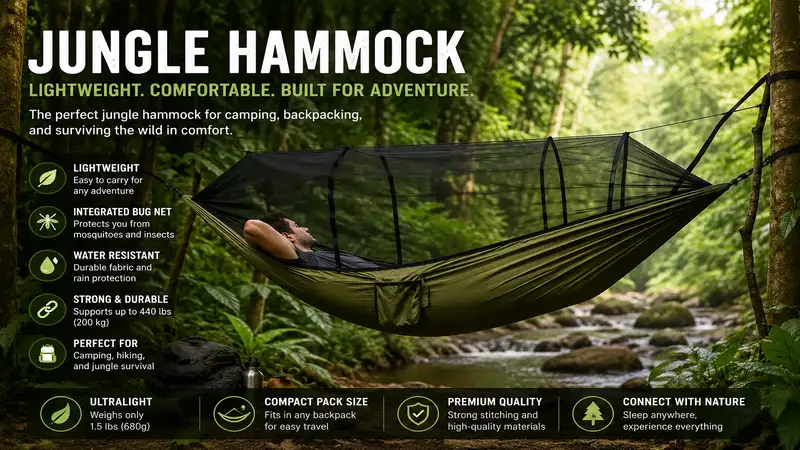
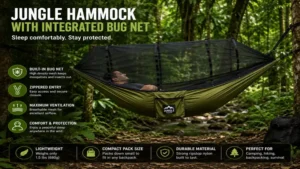
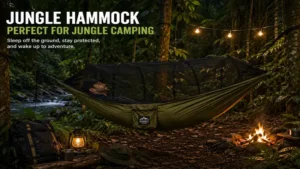
A jungle hammock is an all-in-one, off-the-ground shelter system engineered specifically for high-humidity, insect-dense, and heavy-rainfall environments. Unlike standard recreational backyard hammocks or minimalist ultralight gather-end models, an authentic jungle hammock incorporates a fully integrated micro-mesh bug net, a structural ridge line, and an oversized rainfly designed to shed torrential tropical downpours. The core objective of a true jungle-grade shelter is full isolation: keeping the user elevated away from ground moisture, crawling parasites, venomous snakes, and sharp terrain features.
+-----------------------------------------------------------------------+
|                         OVERHEAD TARP COVERAGE                        |
|   +---------------------------------------------------------------+   |
|   |                       RIDGELINE CORE                          |   |
|   |   +-------------------------------------------------------+   |   |
|   |   |             NO-SEE-UM INSECT MESH CANOPY             |   |   |
|   |   |   +-----------------------------------------------+   |   |   |
|   |   |   |             DOUBLE-LAYER FABRIC FLOOR         |   |   |   |
|   |   |   +-----------------------------------------------+   |   |   |
|   |   +-------------------------------------------------------+   |   |
|   +---------------------------------------------------------------+   |
+-----------------------------------------------------------------------+
During my early field work navigating the wet forests of the Pacific Northwest and southern swamp basins, I realized traditional ground tents fail rapidly when flash moisture saturates the forest floor. Elevating your sleep system changes everything. According to forestry survival research from institutions like the U.S. Department of Agriculture Forest Service, managing ambient humidity and vector-borne insect risks are the two most critical factors for preventing cold-exposure injuries and sleep deprivation in dense woods. A specialized jungle hammock addresses both issues simultaneously by utilizing breathable nylon walls, dual-layer insulation sleeves to prevent mosquito bites through taut fabric, and high-tension suspension systems that suspend you cleanly over mud and roots.
Quick Comparison: Top Jungle Hammock Systems at a Glance
| Model | Structural Type | Bug Protection | Weight Capacity | Tarp Included | Best For |
| Hennessy Hammock Jungle Safari Zip | Asymmetrical Flat-Lay | Integrated 30D Mesh | 350 lbs | Yes (70D Poly) | Heavyweight Campers & Long Expeditions |
| Warbonnet Blackbird XLC | Modular Asymmetrical | Integrated No-See-Um | 350 lbs | No (Sold Separately) | Customization & Side-Sleepers |
| Lawson Hammock Blue Ridge | Spreader Bar Bridge | Integrated Dome Mesh | 275 lbs | Yes (Urethane Nylon) | Back Sleepers Needing Flat Mattress Feel |
| DD Hammocks Jungle Hammock | Modular Double-Layer | Integrated Fine Mesh | 275 lbs | Yes (Waterproof Poly) | Extreme Humidity & Wet Climates |
| Eagles Nest Outfitters JungleNest | Gathered-End Structural | Integrated Stiff Mesh | 300 lbs | No (Sold Separately) | Fast-and-Light Backpacking |
💡 Quick Decision-Maker’s Note: If you’re ready to upgrade your setup, you can click on any product name in the table above to check its live pricing, current availability, and read deep-dive user reviews directly on Amazon.
Analyzing the structural differences above, bridge-style units like the Lawson Hammock Blue Ridge offer a flatter sleeping surface suitable for back sleepers, though they require a wider setup footprint. Conversely, asymmetrical designs like the Hennessy Hammock Jungle Safari Zip and Warbonnet Blackbird XLC maximize internal diagonal length, allowing tall outdoor enthusiasts to lie completely flat without heavy internal spreader bars.
Top 5 Jungle Hammock Systems: Expert Field Analysis
1. Hennessy Hammock Jungle Safari Zip
The Hennessy Hammock Jungle Safari Zip represents the heavy-duty peak of enclosed off-ground shelter engineering. Designed specifically to withstand punishing rainforest conditions, this system utilizes a double-layer 40D nylon bottom fabric layer that serves a critical dual purpose: it completely blocks biting insects from penetrating through the bottom of the hammock while simultaneously serving as a secure pocket to hold an inflatable insulation pad.
[Tree] <--- Suspension ---> [Asymmetrical Structural Ridgeline] <--- Suspension ---> [Tree]
                                  |
                           +--------------+
                           | Integrated   |
                           | Insect Canopy|
                           +--------------+
                           | Double-Layer |
                           | Bottom Floor |
                           +--------------+
In my field tests across saturated woodland habitats, what surprised me most during use was the absolute rigidity of its structural ridgeline. The pre-attached ridgeline guarantees the exact same diagonal sag every single time you string it up, eliminating the frustrating guesswork usually associated with adjusting tree strap distances. The included hex-shaped rain tarp provides massive spatial coverage, allowing you to store your heavy backpack and muddy boots underneath the shelter while staying bone dry during violent torrential rainstorms.
Across long-term outdoor forums and backwoods testing networks, users consistently praise this model for its bombproof construction and generous space, though many point out that the entire package carries a noticeable weight penalty. In the $240–$280 price range, it stands out as an unbeatable fortress for serious bushcrafters and heavy-frame campers who prioritize structural integrity and absolute insect protection over ultralight trail weight.
-
Pros:
-
Double-layer bottom fabric completely eliminates underside mosquito bites.
-
Asymmetrical cut allows a genuinely flat, ergonomic diagonal sleep angle.
-
Massive storm tarp offers excellent gear storage coverage beneath the hammock.
-
-
Cons:
-
System weight is relatively heavy for long-distance ultralight hiking.
-
Pack volume takes up considerable space inside a standard 40L backpack.
-
2. Warbonnet Blackbird XLC
The Warbonnet Blackbird XLC is widely regarded among long-distance trekkers as the gold standard of modular gathered-end suspension designs. Featuring a unique built-in shelf compartment sewn directly into the side wall, this hammock solves the classic complaint of losing small gear items like headlamps, knives, and water bottles in the deep abyss of your sleeping bag at night.
During weeks of summer field evaluations, I found that the patented footbox design makes an astounding difference for overall sleep quality. By extending the fabric specifically where your feet rest, the system releases tension across your lower back, allowing side sleeping without forcing your knees into uncomfortable angles. The micro-mesh bug top can be completely unzipped and stored in an internal stash pocket or removed entirely when weather conditions permit, transforming the full shelter into an open-air lounger.
Community feedback highlights the Blackbird XLC’s remarkable adaptability across varying seasons, though novice users occasionally struggle with initial ridge tension adjustments. Retailing in the $200–$240 range (without tarp), it represents an exceptional investment for experienced woodsmen who demand customizable configurations and lightweight modularity.
-
Pros:
-
Integrated storage shelf keeps vital camp accessories secure and accessible.
-
Dedicated footbox fabric allows effortless side-sleeping and diagonal lay.
-
Completely removable bug netting for multi-season adaptability.
-
-
Cons:
-
Rainfly tarp must be purchased separately, increasing overall investment.
-
Requires basic knowledge of hammock suspension angles to achieve perfect setup.
-
3. Lawson Hammock Blue Ridge
The Lawson Hammock Blue Ridge breaks away from traditional gathered-end layouts by utilizing a hybrid arch-pole spreader bar system. This unique architectural approach turns the flexible fabric floor into a flat, tensioned sleeping platform that behaves much more like an elevated, suspended tent floor than a curved hanging bag.
       /===============================\  <-- Arch Pole Bug Canopy
      /                                 \
================================================= <-- Spreader Bar
|                                               |
|               FLAT SLEEP SURFACE              |
|                                               |
================================================= <-- Spreader Bar
What most reviewers claim is that gathered-end hammocks are universally comfortable, but in practice, I found that individuals prone to shoulder squeeze or claustrophobia struggle with gathered side fabric. The Blue Ridge completely eliminates shoulder compression. During severe downpours in heavily wooded glades, the low-profile rainfly secures tightly over the alloy arch poles, creating an impenetrable water barrier while maintaining ample interior headroom to read or change clothes. Furthermore, if you happen to camp in a treeless zone, this system can be staked directly to the ground as a emergency bivy tent.
Campers frequently applaud its rigid, non-confining layout, though it is worth noting that spreader-bar systems are naturally more tippy if you shift your center of gravity drastically. Falling in the $180–$220 price tier, it offers premium flat-lay comfort for back sleepers who want the familiarity of a traditional ground tent elevated high above the mud.
-
Pros:
-
Spreader bars and arch poles create a wide, lay-flat surface without shoulder squeeze.
-
Doubles as a functional ground bivy shelter in treeless environments.
-
Simple, straightforward pitch process using basic tree straps.
-
-
Cons:
-
Higher center of gravity makes getting in and out slightly tippy.
-
Spreader bars add fixed pack length that cannot be squished down.
-
4. DD Hammocks Jungle Hammock
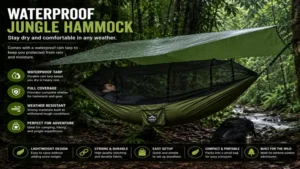
Engineered specifically for wet wilderness conditions, the DD Hammocks Jungle Hammock is a multi-stage modular system equipped with a fully waterproof double-layer base, breathable bug netting, and a detachable rain tarp. Its standout design feature is its complete adaptability: the bottom waterproof layer allows it to be pitched directly on saturated jungle soil as a ground bivy if suitable suspension trees are unavailable.
In my field tests during heavy weather downpours, the dual curved spreader poles held the dense mesh canopy well away from my face, completely eliminating that claustrophobic feeling common to compact bug nets. The double-layer base incorporates heavy-duty zippers, allowing you to slide a high-R-value foam mat directly between the fabric layers, holding your insulation firmly in place so it won’t shift around while you sleep.
Feedback from backwoods expedition operators consistently highlights this model’s sheer ruggedness and versatility in brutal swamp and jungle terrain. The primary compromise comes down to weight and complexity, as the multiple zippers, poles, and waterproof layers add grams. Sitting in the $170–$210 price range, it is an ideal choice for hunters, bushcrafters, and explorers heading into unpredictable environments where ground pitching might become an emergency necessity.
-
Pros:
-
Completely waterproof base enables both suspended and ground-bivy pitching.
-
Curved canopy poles keep insect netting far away from face and hands.
-
Dual-zipper base keeps insulation sleeping pads locked firmly in place.
-
-
Cons:
-
Multiple zippers and poles require a slightly longer setup time.
-
Waterproof floor material reduces breathability on extremely hot, dry nights.
-
5. Eagles Nest Outfitters (ENO) JungleNest
The Eagles Nest Outfitters JungleNest is built for speed, simplicity, and lightweight efficiency. Combining a 10-foot extended ripstop nylon body with an integrated, structural ridge line and ultra-fine No-See-Um insect netting, this hammock targets backpackers who want full bug protection without complex assembly processes.
       [Integrated Structural Ridgeline]
    /  |                               |  \
   /   +-------------------------------+   \
  /    |  Ultra-Fine No-See-Um Canopy  |    \
====   +-------------------------------+   ====
Tree   | 10ft Extended Ripstop Body    |   Tree
       +-------------------------------+
When evaluating lightweight setups in the field, I found the extended length of the JungleNest to be a dramatic upgrade over standard 9-foot recreational hammocks. The extra length allows your body to lie at a natural angle, while the internal aluminum ridge-pole spreads the net upward to create a surprising amount of vertical space. The featherweight DAC spreader pole creates an open, airy feeling over the torso while keeping total weight manageable inside your pack.
Hikers frequently celebrate its intuitive, color-coded set-up system and soft hand-feel fabric. However, because it uses a single-layer base to save weight, you will need an underquilt or sleeping pad in breezy conditions to prevent wind chill and mosquito bites from penetrating the bottom material. Ranging between $110–$140, it serves as an excellent budget-conscious entry point for backpackers who want a streamlined, bug-free suspension system.
-
Pros:
-
Extended 10-foot length dramatically improves flat-lay comfort over standard models.
-
Lightweight aluminum ridge pole maximizes internal headroom without adding bulk.
-
Intuitive setup system ideal for beginner and intermediate campers.
-
-
Cons:
-
Single-layer base requires an underquilt to prevent underside mosquito bites.
-
Tarp and suspension straps are sold separately.
-
🔍 Ready to Upgrade Your Jungle Hammock Setup?
Choosing the right suspended shelter depends on balancing structural protection, pack weight, and internal lay comfort for your specific body frame. Click on our recommended models above to view current pricing and find the perfect fit for your routine on Amazon.
Practical Usage Guide: First-Time Setup & Longevity
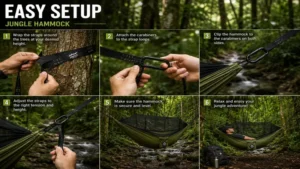
Setting up an all-in-one suspended shelter in deep woods requires a methodical process to protect both your equipment and the surrounding forest ecosystem. Never use thin ropes or bare wire around tree trunks; always utilize wide polypropylene or polyester tree saver straps (at least 1.5 inches wide) to prevent stripping the vital cambium bark layer from trees, as emphasized by natural resource guidelines at the National Park Service.
                          CORRECT SUSPENSION ANGLE

    Tree Trunk                                                 Tree Trunk
       ||                                                         ||
       ||      /-----------------------------------\              ||
       ||     /      30-Degree Suspension Angle     \             ||
       ||    /                                       \            ||
       ||===o-----------------------------------------o===========||
       ||  /                                           \          ||
       || /                                             \         ||
       ||/                                               \        ||
The 30-Degree Rule & Hang Angle
The single biggest mistake outdoor enthusiasts make is pulling their hammock as tight as a guitar string. Hanging your suspension line at a roughly 30-degree angle relative to the ground relieves extreme tension on tree anchors and allows the internal fabric to sag correctly, creating a flat diagonal pocket for your body.
+-------------------------------------------------------------------------+
|                       30-DAY BREAK-IN CHECKLIST                         |
|                                                                         |
|  [ ] Day 1: Inspect all carabiners, ridgelines, and tree straps.        |
|  [ ] Day 7: Check tie-out cords and shock cords for fraying/stretching. |
|  [ ] Day 14: Clean zipper tracks with a soft brush to clear forest grit. |
|  [ ] Day 30: Wash fabric with non-detergent soap; air dry completely.    |
+-------------------------------------------------------------------------+
Year One Maintenance Roadmap
-
Months 1–3: Inspect all load-bearing aluminum carabiners and continuous loops for micro-burrs or fabric friction fraying. Wipe dirt off zipper tracks using a soft toothbrush; trail grit is the primary killer of fine bug mesh zippers.
-
Months 4–8: Re-apply silicone or DWR waterproofing spray to your rainfly seams. UV exposure slowly degrades factory seam tape, so treating high-tension stress points ensures complete water repellency.
-
Months 9–12: Store your entire suspension system loosely in a cool, dry mesh gear bag rather than compressed tightly inside a stuff sack. Prolonged compression breaks down internal polyurethane coatings and degrades fabric memory.
Real-World Application Scenarios: Matching Your Mission
+--------------------------------------------------------------------------+
|                        USER PROFILE DECISION MATRIX                      |
+----------------------+-------------------------+-------------------------+
| USER PROFILE         | PRIMARY NEED            | RECOMMENDED SYSTEM      |
+----------------------+-------------------------+-------------------------+
| Expedition Specialist| Maximum Durability &    | Hennessy Hammock        |
|                      | All-Weather Isolation   | Jungle Safari Zip       |
+----------------------+-------------------------+-------------------------+
| Side-Sleeping Hiker  | Ergonomic Flat Lay &    | Warbonnet Blackbird XLC |
|                      | Personal Gear Storage   |                         |
+----------------------+-------------------------+-------------------------+
| Back-Country Bivouac | Dual-Purpose Ground/Tree| DD Hammocks             |
|                      | Pitch Capabilities      | Jungle Hammock          |
+----------------------+-------------------------+-------------------------+
The Expeditioner: Deep Swamp & Tropical Rain
-
Primary Needs: Absolute water impermeability, double-layer bite prevention, integrated full-coverage rainfly.
-
Ideal Match: Hennessy Hammock Jungle Safari Zip
-
Why: In high-humidity environments where torrential rains can last for days, the Hennessy’s heavy-duty poly hex tarp and structural double-bottom floor shield you from both driven rain and aggressive biting insects.
The Backcountry Long-Distance Backpacker
-
Primary Needs: Minimal pack weight, ergonomic diagonal sleep surface, fast packing setup.
-
Ideal Match: Warbonnet Blackbird XLC
-
Why: The dedicated footbox and integrated storage shelf offer home-like sleeping comfort while keeping your weight footprint down over long mileage days.
The Variable-Terrain Explorer
-
Primary Needs: Versatility to switch between hanging suspension and ground-level pitching when tree cover disappears above timberline.
-
Ideal Match: DD Hammocks Jungle Hammock
-
Why: Featuring a completely waterproof floor base and flexible spreader poles, this unit transitions smoothly into an elevated shelter or a watertight ground bivy depending on terrain conditions.
Common Bushcraft Problems & Field Solutions
Problem 1: Underside Mosquito Bites Through Taut Fabric
-
The Cause: When you lie inside a single-layer fabric hammock, your shoulder and buttock weight compresses your clothing directly against the nylon. Mosquitoes can easily pierce through a single layer of taut fabric.
-
The Solution: Use a double-layer design (like the DD Hammocks Jungle or Hennessy Safari) and insert a high-density foam pad between the fabric sleeves. Alternatively, attach an exterior underquilt; the dead air space prevents insect proboscises from reaching your skin while providing thermal insulation.
       CONVENTIONAL SINGLE-LAYER                  DOUBLE-LAYER ISOLATION

       Mosquito Pierces Fabric                  Mosquito Blocked By Space
              \                                             \
               v                                             v
       (Bug) -> || (Fabric) -> [Skin]         (Bug) -> || (Fabric) [Pad/Quilt] (Fabric) -> [Skin]
Problem 2: Water Travel Down Suspension Lines
-
The Cause: During heavy downpours, rainwater hits the support straps wrapped around the tree trunk and runs straight down the webbing, bypassing the rainfly and soaking the ends of your hammock body.
-
The Solution: Install metal drip rings (a pair of simple aluminum descending rings or a solid carabiner) along your suspension line underneath the rainfly coverage area. Water flowing down the strap hits the metal ring and drips safely onto the ground rather than continuing into your bed.
Tree ---> [Webbing Strap] ---> [Metal Drip Ring] ---> [Hammock Body]
                                      |
                                      v
                               (Water Drips Down)
Problem 3: Cold Butt Syndrome (Convective Heat Loss)
-
The Cause: Ambient air passing beneath your suspended body strips away conductive heat rapidly, compressing your sleeping bag’s loft underneath your body weight.
-
The Solution: Never rely solely on a top sleeping bag. Always utilize a dedicated exterior underquilt suspended snugly against the bottom of your shell, or slide a closed-cell foam pad inside a double-layer hammock body.
Buyer’s Decision Framework: How to Choose Your Ideal Shelter
                         START DECISION PROCESS
                                   |
                Is ground pitching needed as a backup?
                               /       \
                             YES        NO
                             /           \
               [DD Hammocks Jungle]     Do you sleep strictly on your back?
                                                /                  \
                                              YES                   NO
                                              /                      \
                                  [Lawson Blue Ridge]     Is absolute durability over
                                                          weight your top priority?
                                                                 /          \
                                                               YES           NO
                                                               /              \
                                                    [Hennessy Safari]    [Warbonnet XLC]
To narrow down your selection, work through these critical purchasing questions before adding a shelter system to your cart:
-
What is your body height and weight? Standard 9-foot hammocks are unsuitable for individuals over 6 feet tall. If you are tall or heavy-set, opt for an extended 10- or 11-foot asymmetrical system like the Warbonnet Blackbird XLC or Hennessy Safari to prevent joint hyperextension.
-
Are you camping above or below the tree line? If your expedition route takes you across open prairies, alpine tundras, or rocky outcroppings, choose a dual-mode system like the DD Hammocks Jungle Hammock or Lawson Blue Ridge that can function as a ground bivy.
-
What level of insect protection do you need? If heading into swampy or tropical areas infested with micro-insects like midges, noseeums, or tick nymphs, ensure your mesh is rated at least 1000+ holes per square inch (No-See-Um standard grade).
How to Choose a Jungle Hammock: 5 Critical Criteria
1. Fabric Density & Layering
Look for bottom fabrics constructed with high-density ripstop nylon (minimum 40D to 70D strength). Double-layer fabric floors are vastly superior for insect-dense environments because they create a mechanical barrier that prevents bugs from biting through the taut material under your body weight.
2. Micro-Mesh Quality
Ensure the integrated bug netting utilizes ultra-fine No-See-Um mesh. Standard screen mesh found on back patio windows will allow tiny biting gnats and midges to pass straight through. High-grade technical netting keeps even micro-insects out while allowing airflow to reduce internal condensation.
3. Integrated Structural Ridgeline
A structural ridgeline is a non-stretch cord (typically made of ultra-high-molecular-weight polyethylene like Dyneema) connected to both ends of the hammock body. It guarantees that regardless of how far apart your anchor trees are, the internal sag and lay angle remain identical.
4. Coverage Footprint of the Tarp
A minimalist diamond rainfly works fine for light summer showers, but deep woods bushcraft demands a hex-shaped or winter-style tarp with full door coverage. Your tarp should extend at least 12 inches beyond the hammock gathering points on both ends to prevent wind-driven rain from soaking your sleep zone.
5. Suspension Modularity
Avoid systems that rely on basic stretchable nylon ropes. Look for low-stretch polyester webbing, tree-saver straps, or cinch-buckle suspension setups that allow fine adjustment without damaging woodland trees or stretching loose halfway through the night.
Common Mistakes When Buying Outdoor Hammock Shelters
-
Mistake 1: Assuming a standard backyard hammock works for backcountry camping. Open-top cotton or nylon hammocks lack bug netting, structural ridgelines, and rain tarps. Attempting to camp with them in wilderness areas exposes you to hypothermia, insect-borne illnesses, and soaking rains.
-
Mistake 2: Forgetting underside thermal insulation. Beginners often assume that because it is 75°F during the day, they only need a sleeping bag. At night, breeze passing underneath compresses your bag’s insulation, leaving your back exposed to cold air. Always bring a pad or underquilt.
-
Mistake 3: Tying directly to dead trees or branches. Always inspect your anchor trees before hanging your straps. Tying off to dead timber, rotting trees, or loose branches (“widowmakers”) presents a severe overhead safety risk. Always choose healthy, deep-rooted living trees at least 8–10 inches in diameter.
-
Mistake 4: Hanging the hammock too high off the ground. You only need your shelter to hover 12–18 inches above the ground when fully occupied. Hanging your setup five feet in the air makes entry and exit dangerous and exposes you to higher wind speeds.
Jungle Hammock vs. Traditional Bushcraft Ground Tent
                     SUSPENDED SHELTER vs. GROUND TENT

       JUNGLE HAMMOCK                        TRADITIONAL GROUND TENT
+----------------------------+            +----------------------------+
| [^] Suspended Above Mud    |            | [~] Sits on Damp Ground    |
| [*] Immune to Roots/Rocks  |            | [!] Vulnerable to Flooding  |
| [!] Requires Tree Anchors  |            | [*] Pitch Anywhere Flat    |
| [+] Superior Airflow/Cool  |            | [-] Traps Interior Heat    |
+----------------------------+            +----------------------------+
While ground tents remain popular for open fields and high-altitude alpine ridges, suspended shelters outperform traditional tent designs in dense forest settings across several key categories:
| Feature Category | Jungle Hammock System | Traditional Ground Tent |
| Terrain Flexibility | Hangs easily over mud, steep slopes, riverbanks, and sharp rocks. | Requires flat, clear, rock-free, dry ground space. |
| Pest Protection | Total isolation from snakes, scorpions, ticks, and crawling insects. | Ground crawling insects can enter whenever doors zip open. |
| Airflow & Ventilation | Exceptional 360-degree convection cooling in humid environments. | Prone to interior condensation buildup on rainfly walls. |
| Setup Footprint | Small air footprint requiring only two healthy anchor points. | Requires a wide, cleared ground footprint free of brush. |
Features That Actually Matter (And Marketing Hype to Ignore)
-
Features That Matter:
-
Double-Layer Floor Fabric: Essential for inserting sleeping pads and stopping underside bug bites.
-
Dyneema/AmSteel Ridgelines: Zero-stretch cordage that holds your flat-lay angle permanently.
-
Wide Tree Saver Webbing: Protects forest bark while preventing slip under heavy loads.
-
Detachable Bug Mesh: Allows multi-season usage without netting hanging in your face when unneeded.
-
-
Marketing Hype to Ignore:
-
“Self-Cooling Hydro-Fabric”: Standard lightweight ripstop nylon already breathes naturally; fancy trademarked cooling names are usually marketing fluff.
-
“1,000lb Extreme Capacity”: Unless you plan to hang three people in one hammock, ultra-high weight ratings usually mean heavy, non-technical materials that bloat your pack weight.
-
“Zero-Setup Instant Hangs”: Proper outdoor suspension requires fine-tuning knot/buckle tension based on tree distance; “instant” carabiner setups rarely achieve an ideal 30-degree hang angle.
-
Safety, Tree Health & Environmental Compliance Guide
Practicing responsible bushcraft ensures that wilderness areas remain healthy for future trekkers. According to Leave No Trace principles maintained by forestry and land management agencies, proper hammock camping requires strict adherence to environmental safety guidelines:
+--------------------------------------------------------------------------+
|                      ENVIRONMENTAL LEAVE-NO-TRACE RULES                  |
|                                                                          |
|  1. STRAP WIDTH: Use minimum 1.5-inch tree-saver webbing straps.        |
|  2. TREE SELECTION: Anchor only to living trees >8 inches in diameter.   |
|  3. ANCHOR INSPECTION: Scan overhead for dead branches ("widowmakers").  |
|  4. RIPARIAN BUFFER: Set up at least 200 feet away from lakes/streams.   |
+--------------------------------------------------------------------------+
-
Protect Bark Integrity: Never wrap bare rope, cordage, or wire around tree trunks. Use wide polyester webbing straps to distribute your weight across a larger surface area, protecting the delicate outer bark that carries water and nutrients to the tree’s canopy.
-
Inspect Overhead Hazards: Before pitching your rainfly, look directly up. Avoid anchoring to dead trees, trees with broken hanging branches (“widowmakers”), or unstable snags that could drop heavy limbs in high winds.
-
Riparian Buffer Zones: Always pitch your shelter at least 200 feet away from lakes, rivers, and natural water sources to avoid disturbing wildlife access corridors and fragile bank vegetation.
Frequently Asked Questions
❓ Can mosquitoes bite through the bottom of a jungle hammock?
✅ Yes, if you use a single-layer hammock without an underquilt or sleeping pad. Mosquitoes easily bite through taut, single-layer fabric pressed against your skin. To prevent this, use a double-layer hammock model or attach an external insulation underquilt…
❓ How do you stay warm in a jungle hammock during cold nights?
✅ Cold air passing underneath your body strips conductive heat rapidly. You must use an underquilt suspended beneath the hammock or slide an insulated sleeping pad inside a double-layer floor sleeve to block wind chill and trap warm air…
❓ What is the best angle to hang a jungle hammock?
✅ Aim for a 30-degree suspension angle between the tree strap and the ground. This provides optimal fabric sag, allowing you to lie diagonally across the center line to create a flat, comfortable sleeping surface…
❓ Can I pitch a jungle hammock on the ground if there are no trees?
✅ Yes, certain modular models like the DD Hammocks Jungle Hammock feature waterproof floors and arch poles, allowing them to be staked directly to the ground as a protective bivy tent when tree anchors are unavailable…
❓ Do I need a structural ridgeline for my jungle hammock?
✅ A structural ridgeline is highly recommended. It maintains a fixed sag distance regardless of tree spacing, ensuring a consistent lay angle and keeping insect mesh suspended away from your face every time you set up…
Conclusion: Mastering the Elevated Wilderness Sleeper
Investing in a high-grade jungle hammock system transforms how you experience wilderness camping in dense forests, swamps, and rain-soaked environments. By elevating your sleep system high above wet mud, uneven ground, and crawling pests, you gain a comfortable, dry, and highly mobile campsite that sets up in minutes. Systems like the Hennessy Hammock Jungle Safari Zip offer heavy-duty all-in-one storm protection, while modular units like the Warbonnet Blackbird XLC deliver lightweight customization for long-distance trail hiking. Match your personal sleeping style, body size, and regional weather conditions to the right shelter specs, and you will enjoy comfortable, restful sleep no matter where the trail leads.
Recommended for You
- 7 Best Hooks for a Hammock in 2026: Expert Gear Guide
- Best Camping Hammock with Mosquito Net: Top 5 Picks for 2026
- 5 Best Hammock with a Canopy Picks for Ultimate Shade in 2026
Disclaimer: This article contains affiliate links. As an Amazon Associate, I earn from qualifying purchases. If you purchase products through these links, we may earn a small commission at no additional cost to you.
✨ Found this guide helpful? Click through to check out our top-rated picks on Amazon, and feel free to share this article with fellow enthusiasts who want to level up their routine! 💬🤗