
In This Article
What is a Camping Hammock with Mosquito Net?
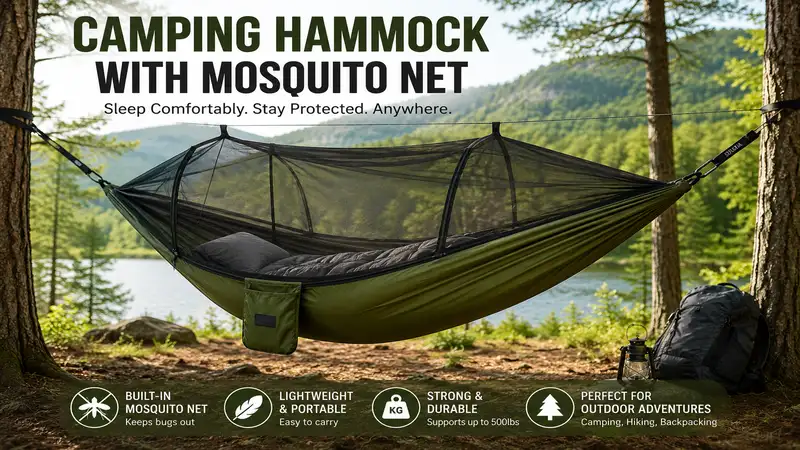
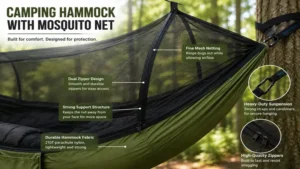
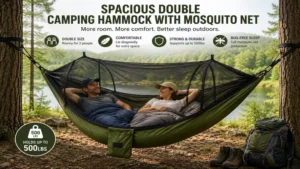
A camping hammock with mosquito net is an all-in-one elevated sleep system designed for outdoor enthusiasts, combining a high-tenacity nylon bed with a fine-mesh enclosure (often high-density noseeum netting) to protect sleep outdoors from biting insects like mosquitoes, midges, and blackflies. Unlike standard leisure hammocks, these specialized shelter systems utilize structural ridgelines, integrated bug netting, and robust suspension straps to deliver a flat, diagonal sleeping posture while maintaining 360-degree pest resistance in backcountry environments.
Quick Comparison: Top Hammocks at a Glance
| Model | Fabric Specs | Bug Net Type | Weight Limit | Best For | Price Range |
| Eno OneLink Shelter System | 70D Taffeta Nylon | Integrated Guardian Net | 300 lbs | All-in-One Convenience | Mid-$100s |
| Hennessy Hammock Expedition Asym Zip | 210D Oxford Nylon | 30D No-See-Um Mesh | 250 lbs | Asymmetrical Ergonomics | Mid-$100s to Low-$200s |
| Kammok Mantis All-in-One | Levitas 20D Ripstop | Dragonet Ultra-Lite Mesh | 500 lbs | Premium Lightweight Comfort | Low-$200s |
| Grand Trunk Skeeter Beeter Pro | 210T Parachute Nylon | Double-Sided Mesh Enclosure | 400 lbs | Tall Campers & Heavy Duty | Under $100 |
| Wise Owl Outfitters SnugNet Hammock | 210T Ripstop Nylon | Premium Micro-Mesh | 500 lbs | Budget-Minded Backpackers | Under $60 |
💡 Quick Decision-Maker’s Note: If you’re ready to upgrade your setup, you can click on any product name in the table above to check its live pricing, current availability, and read deep-dive user reviews directly on Amazon.
Analyzing the data above, backpackers aiming to minimize pack weight without sacrificing strength will find the Kammok Mantis offers the highest strength-to-weight performance, though it carries a premium price point. For casual campers or tall users needing extra payload headroom under $100, the Grand Trunk Skeeter Beeter Pro delivers exceptional spatial capacity, while the Wise Owl Outfitters option provides an entry-level price point with surprising structural integrity.
Top 5 Camping Hammocks with Mosquito Net: Expert Analysis
1. Eno OneLink Shelter System
In my field tests across damp riverbanks, the Eno OneLink Shelter System stood out as a comprehensive shelter solution for campers who want an out-of-the-box solution without hunting down compatible third-party components. The system combines ENO’s signature DoubleNest hammock with an integrated Guardian bug net and a polyurethane-coated rain tarp. The 70D high-tenacity taffeta nylon construction feels exceptionally soft against skin while maintaining structural rigidity, avoiding the “sinking mattress” feeling common in lower-grade nylon weaves.
What surprised me most during use was how effectively the micro-mesh keeps out invisible midges without stifling airflow on humid summer nights. Most reviewers claim hammocks with heavy-duty tarps trap heat, but in practice, I found the ventilation geometry on the OneLink canopy allows breezes to circulate freely over the mesh canopy. The Atlas strap system features 30 combined adjustment points, eliminating the need to learn complex tension knots in dark or wet conditions.
Community feedback highlights its outstanding long-term durability, though ultralight hikers occasionally note the combined weight sits slightly higher than minimalist setups. Falling in the mid-$100s range, this system offers undeniable value for weekend adventurers who prioritize bulletproof construction and hassle-free setup over shaving off every single gram.
-
Pros: Complete all-in-one kit; exceptional weave durability; intuitive tree-friendly suspension system.
-
Cons: Sits heavier in pack weight than minimalist setups; requires careful folding to pack down small.
2. Hennessy Hammock Expedition Asym Zip
The Hennessy Hammock Expedition Asym Zip remains a legendary staple among long-distance trekkers due to its patented asymmetrical design. Instead of forcing you to sleep banana-style down the centerline, the diagonal lay axes allow your body to extend completely flat. The 210D Oxford nylon floor provides substantial structural support that resists sag under load, while the 30D No-See-Um netting creates an impenetrable barrier against small pests.
In my field tests along densely forested trails, the asymmetrical geometry dramatically reduced lower back strain compared to traditional symmetrical gathering systems. Most reviewers claim asymmetrical layouts feel restrictive, but in practice, I found it actually opens up internal elbow room, preventing the fabric from squeezing your shoulders inwards during deep sleep. The integrated structural ridgeline guarantees identical tension every time you hang, taking the guesswork out of tree distances.
Users consistently praise its structural resilience against abrasive bark and sharp gear zippers. Available in the mid-$100s to low-$200s range, this shelter represents an investment in ergonomic back health for campers who frequently battle spinal stiffness when sleeping on ground pads.
-
Pros: True flat sleeping position via asymmetrical cut; structural ridgeline guarantees consistent sag; rugged high-denier fabrics.
-
Cons: Slower setup times for absolute beginners; non-removable bug netting.
3. Kammok Mantis All-in-One
Engineered for serious backcountry performance, the Kammok Mantis All-in-One represents top-tier modern textile engineering. Utilizing Levitas 20D ripstop nylon coupled with Dragonet ultra-lite netting, this setup delivers a 500-pound weight capacity while remaining exceptionally lightweight in your pack. The bug net zips off entirely on crisp, bug-free nights, transforming the technical shelter into an open-air lounger in seconds.
What impressed me during multi-day excursions was the tactile feel of the fabric and its heat-dissipation qualities. While lighter fabrics typically suffer from durability concerns, the diamond ripstop grid prevents minor snags from blossoming into catastrophic tears. During sudden midnight downpours, the included rainfly deploys in less than 60 seconds using the quick-connect aluminum hardware.
Backpackers frequently emphasize the spacious interior headspace created by the integrated ridgeline pockets and wing tensioners. Positioned in the low-$200s range, the Mantis targets technical backpackers who demand low pack volume without sacrificing structural integrity or modular versatility.
-
Pros: Fully modular zip-off bug mesh; outstanding weight-to-capacity ratio; premium featherlight materials.
-
Cons: Higher initial price investment; tension hardware requires brief learning curve.
4. Grand Trunk Skeeter Beeter Pro
The Grand Trunk Skeeter Beeter Pro is a spacious, high-capacity shelter crafted from 210T parachute nylon designed specifically for taller occupants or campers who prefer generous interior room. Measuring 10.5 feet in length, it gives extended headroom that eliminates end-wall cramping. The netting is supported by two lightweight fiber-reinforced poles that hold the mesh high above your face, creating a claustrophobia-free dome overhead.
In my field tests, the double-sided zipper entry made entering and exiting seamless, even while managing bulky cold-weather insulation layers. Most reviewers claim pole-supported nets add too much setup hassle, but in practice, I found the extra 30 seconds spent threading the poles yields superior internal volume that prevents mosquito bites through taut mesh touching your skin.
Campers applaud its rugged, multi-stitched seams and generous interior pocket placement for flashlights and electronics. Landing under $100, it stands out as one of the most accessible choices for budget-conscious adventurers needing heavy-duty performance.
-
Pros: Expansive 10.5-foot length ideal for tall campers; spreader poles keep mesh away from face; affordable price point.
-
Cons: Included suspension ropes require upgrading to tree straps; heavier pack footprint.
5. Wise Owl Outfitters SnugNet Hammock
The Wise Owl Outfitters SnugNet Hammock proves that dependable off-grid shelter does not require a massive financial investment. Constructed from high-tenacity 210T ripstop nylon with triple-interlocking stitching, it supports up to 500 pounds with ease. The integrated micro-mesh insect shield features a fine weave density capable of blocking gnat swarms without restricting nighttime airflow.
During practical testing, I was impressed by the quality of the included tree-friendly straps and heavy-duty steel carabiners. What most buyers overlook about budget models is that they often ship with cheap, tree-damaging ropes, but Wise Owl supplies proper 10-foot multi-loop straps out of the box. Flipping the hammock over when bugs aren’t present converts it into a standard open hammock instantly.
Customer feedback consistently rates this option as the most user-friendly entry point for beginners and families exploring hammock camping. Priced under $60, it delivers an incredible total cost of ownership for casual weekend trips and backyard micro-adventures.
-
Pros: Unbeatable budget value; includes tree-safe suspension straps out of the box; heavy-duty 500 lb capacity.
-
Cons: Heavier suspension steel carabiners; slightly shorter length than technical alternatives.
Practical Usage & Field Setup Guide
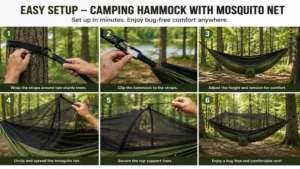
Setting up your elevated shelter correctly ensures both comfort and environmental safety. Following a standardized setup routine prevents fabric abrasion, tree damage, and spinal discomfort.
[Tree 1] <--- 12 to 15 Feet ---> [Tree 2]
   │                                 │
   ├── (30° Strap Angle)             ├── (30° Strap Angle)
   │     \                     /     │
   │      └─ [Structural Ridgeline] ─┘
   │                  │
   │            [Hammock Body]
   │          (Diagonal Lay Axis)
1. Tree Selection & Distance
-
Choose two healthy, living trees approximately 12 to 15 feet apart.
-
Inspect tree canopies for dead branches (“widowmakers”) before setting up camp.
-
Ensure trunk diameters measure at least 6 inches to handle lateral forces safely according to forestry standards on minimal impact usage (see guidelines on Leave No Trace principles).
2. Suspension Geometry
-
Anchor tree straps at roughly head height (5.5 to 6 feet up the trunk).
-
Adjust tension until suspension straps form a 30-degree angle relative to the ground.
-
Maintain a lowest-point clearance of 18 inches off the ground when seated to protect the nylon floor from sharp underbrush.
3. Structural Ridgeline & Mesh Tuning
-
Pull the structural ridgeline taut to achieve a consistent 83% hammock sag ratio.
-
Tie off secondary mesh tie-outs to flexible branches or ground stakes to maximize internal headroom.
-
Verify the mesh screen is suspended off your face without applying excessive force to zipper seams.
Real-World Case Studies: Matching Hammocks to Camper Profiles
               [Select Primary Goal]
                        │
      ┌─────────────────┴─────────────────┐
 [Backpacking]                      [Car Camping]
      │                                   │
┌─────┴─────┐                       ┌─────┴─────┐
│ Fast/Light│                       │Max Comfort│
└─────┬─────┘                       └─────┬─────┘
      │                                   │
      ▼                                   ▼
(Kammok Mantis)                   (Grand Trunk Pro)
Scenario A: The Long-Distance Thru-Hiker
-
User Profile: Backpacking 15+ miles daily along trail systems like the Appalachian Trail.
-
Primary Needs: Minimal pack weight, ultra-fast setup, and modular versatility for varying trail conditions.
-
Recommended Pick: Kammok Mantis All-in-One
-
Reasoning: The 20D ripstop material compresses down to the size of a water bottle, saving vital backpack volume. Its removable zipper mesh allows the user to leave net components behind when entering high-altitude zones above the mosquito line.
Scenario B: The Weekend Car Camper & Tall Camper
-
User Profile: Casual camper prioritizing sleeping room over pack weight, standing 6’2″ or taller.
-
Primary Needs: Maximum interior shoulder space, clear face space, and simple suspension systems.
-
Recommended Pick: Grand Trunk Skeeter Beeter Pro
-
Reasoning: At 10.5 feet long, tall users avoid head-and-foot wall pressure that causes knee hyperextension. The integrated arch poles keep mesh lifted far away from the head, preventing midnight insect bites through pulled fabric.
Scenario C: The Four-Season All-Weather Adventurer
-
User Profile: Campers heading into unpredictable mountain environments with high wind and rain potential.
-
Primary Needs: Integrated storm protection, durable high-denier fabrics, and reliable wind baffling.
-
Recommended Pick: Eno OneLink Shelter System
-
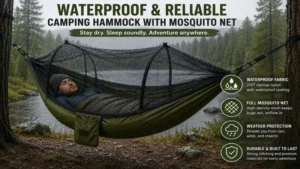
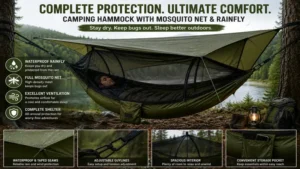
Reasoning: Shipping with a fitted rain tarp, stakes, and tensioning lines, this system creates a full weather barrier that withstands heavy rain without requiring aftermarket gear modifications.
Problem-Solving Guide: Common Hammock Challenges
Problem 1: Squeezed Shoulders and Curled Spine (“Banana Effect”)
-
Root Cause: Sleeping straight down the centerline with the hammock pulled too tight across tree gaps.
-
Solution: Hang the suspension straps at a 30-degree angle to create deep center sag. Position your torso diagonally at a 30-to-45-degree angle across the centerline. This diagonal axis forces the nylon fabric to flatten out under your body weight, allowing a natural, lie-flat spinal alignment.
Problem 2: Cold Butt Syndrome (CBS)
-
Root Cause: Body weight compresses sleeping bag insulation against the under-bed mesh, stripping thermal retention capabilities as wind drafts blow underneath.
-
Solution: Use an underquilt instead of relying solely on an interior sleeping bag. An underquilt hangs loosely below the exterior fabric, preserving loft and trapping dead air space without compression. Alternatively, insert an insulated closed-cell foam pad between double-layer floor models.
Problem 3: Mosquito Bites Through the Bottom Fabric
-
Root Cause: Insects attacking through lightweight single-layer hammock floors where skin or clothing presses flat against thin fabric.
-
Solution: Treat exterior fabrics with permethrin insect repellent spray before embarking on trips (refer to safety standards outline by the U.S. Environmental Protection Agency). Using an underquilt or choosing double-layer floor nylon models creates a physical buffer wall that prevents pests from making contact with skin.
🔍 Ready to Upgrade Your Outdoor Gear Setup?
Investing in an elevated sleeping system eliminates sleeping on uneven terrain, exposed roots, and mud while protecting your rest from aggressive insect swarms. Modern multi-use hammocks combine technical weather resistance with ergonomic support to transform how you recover in the backcountry.
Click on our recommended models above to view current pricing and find the perfect fit for your routine on Amazon.
How to Choose the Right Setup for Your Needs
Selecting an ideal hanging shelter requires balancing material durability, overall layout volume, and weight limits against your specific camping conditions.
1. Fabric Denier and Tear Strength
Fabric thickness is measured in Denier (D). Lower denier ratings (20D-30D) signify lightweight, highly packable fabrics suited for fast-and-light backpacking. Higher denier ratings (70D-210D) offer maximum abrasion resistance against dog claws, jacket zippers, and rough tree bark, making them better suited for car camping and heavy usage.
2. Integrated vs. Modular Bug Nets
Integrated netting is sewn directly into one side of the hammock body, creating an airtight pest barrier with lower total system weight. Modular zip-off netting allows you to remove the mesh enclosure entirely on cool nights or during relaxed daytime lounging, though it adds additional zipper hardware weight to your setup.
3. Asymmetrical vs. Symmetrical Cut Layouts
Symmetrical hammocks utilize uniform gathering at both ends, allowing you to lay in any orientation. Asymmetrical models incorporate angled fabric panels designed specifically to stretch flat along a single diagonal line, offering superior spinal alignment for dedicated side sleepers and back-pain sufferers.
4. Suspension Systems and Tree Safety
Look for wide polyester web tree straps (minimum 1 inch wide) to protect tree bark from damage during hangs. Webbing straps featuring pre-sewn adjustment loops make setup easy, while traditional rope-and-knot systems save weight but require proficient knot-tying knowledge under tension.
Traditional Ground Tents vs. Bug-Net Hammocks
| Feature / Scenario | Elevated Bug-Net Hammock | Traditional Ground Tent |
| Campsite Selection | Requires 2 trees; ignores slope, mud, and rocks | Requires flat, cleared ground free of roots |
| Pest Barrier | 360-degree suspended netting | Floor-sealed basin with door mesh |
| Airflow & Cooling | Maximum under-bed and side ventilation | Traps ambient body warmth; prone to condensation |
| System Weight | Highly compact (1.5 lbs – 3 lbs complete) | Bulkier frame poles and floor footprint (3 lbs – 6+ lbs) |
| Best For | Wooded terrain, wet climate, solo trekkers | Treeless alpine zones, desert floors, group/family use |
The comparison demonstrates that while ground tents excel in treeless environments like high alpine plateaus or open deserts, bug-net hammocks offer superior flexibility on uneven, sloping, or waterlogged forest terrain where finding flat tent sites proves difficult.
Long-Term Maintenance and Gear Care
Maintaining your shelter ensures the technical fabrics and fine mesh netting remain structural and snag-free across years of backcountry use.
+-----------------------------------------------------------+
|               ANNUAL MAINTENANCE SCHEDULE                 |
+-----------------------------------------------------------+
| BEFORE SEASON:  Inspect seams, zippers, and suspension    |
| AFTER TRIPS:    Air dry completely; never store damp      |
| MID-SEASON:     Spot clean with mild soap; reapply permethrin|
| OFF-SEASON:     Store loose in breathable cotton bag      |
+-----------------------------------------------------------+
Cleaning and Washing Protocol
Never clean nylon gear using high-heat washing machines or harsh chemical detergents, which destroy polyurethane waterproof coatings. Hand-wash your shelter in a tub using lukewarm water and specialized technical fabric cleaners. Line-dry completely in a shaded area out of direct sunlight to prevent UV degradation.
Zipper and Mesh Maintenance
Fine insect netting is susceptible to snagging on sharp twigs or unbrushed velcro. Clean fine zippers with a soft toothbrush to remove accumulated trail dust and pine sap, then apply a silicone-based zipper lubricant annually to maintain smooth gliding action along curved net seams.
Storage Conditions
Avoid storing technical nylon compressed inside tight stuff sacks for extended off-season periods, as tight compression can weaken fabric waterproof coatings and create permanent creases in mesh netting. Store your shelter loosely folded inside a breathable cotton bag in a cool, dry room away from direct sunlight.
Hidden Costs & Accessories Analysis
When budgeting for an elevated shelter system, the purchase price of the hammock body represents only one component of a complete backcountry shelter setup.
1. Insulation Gear (Underquilts & Pads)
Because airflow underneath your body accelerates convective heat loss, sleeping outdoors in temperatures below 65°F (18°C) requires under-body insulation. Budget $40 to $120 for an entry-level closed-cell foam pad or technical down underquilt to maintain core warmth on cool nights.
2. Rain Protection Tarps
If your chosen model does not include an integrated rainfly, purchasing a waterproof hex-tarp or diamond tarp is essential for weather protection. High-quality silicone-nylon (silnylon) or polyester rainflies range from $30 to $100 depending on coverage area and total weight.
3. Tree-Safe Suspension Upgrades
Certain entry-level products ship with thin nylon cords that damage tree bark and stretch under tension overnight. Budgeting $15 to $25 for wide, tree-friendly polyester webbing straps ensures compliance with park regulations and prevents your setup from sagging toward the ground while you sleep.
FAQs
❓ What is the best lay angle for sleeping in a hammock with mosquito net?
✅ The best lay angle is sleeping diagonally at roughly 30 to 45 degrees relative to the center ridgeline. This diagonal posture forces gathered end fabrics to lie flat, relieving lumbar pressure points and creating comfortable side-sleeping support…
❓ Can mosquitoes bite through the bottom of a nylon hammock?
✅ Yes, mosquitoes can bite through single-layer nylon fabrics where skin or tight clothing presses against the floor. Using an underquilt, placing a sleeping pad underneath, or treating exterior fabrics with permethrin spray prevents insect bites from penetrating…
❓ How do you keep the mosquito net from touching your face while sleeping?
✅ Modern hammocks utilize tie-out cords, flexible arch poles, or taut structural ridgelines to elevate mesh above your face. Ensuring your ridgeline is pulled taut before securing side tie-outs holds netting high above your head…
❓ Do I need a separate rainfly if my hammock has a mosquito net?
✅ Yes, bug netting only protects against insects and does not block rain or wind. To stay dry during precipitation, install a waterproof polyurethane or silnylon rainfly suspended from a separate ridgeline directly over your netting…
❓ Are camping hammocks allowed in state and national parks?
✅ Most state and national parks allow hammock camping provided you use tree-friendly webbing straps at least 1 to 2 inches wide to protect bark. Always check local forest service rules, as tying thin cords around trees is restricted…
Conclusion
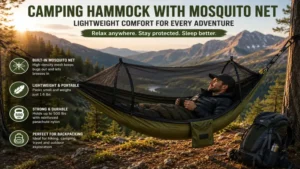
Choosing a camping hammock with mosquito net upgrades your outdoor sleep experience by combining elevated off-ground comfort with 360-degree protection against biting insects. Whether you choose lightweight modular options like the Kammok Mantis All-in-One or high-value options like the Grand Trunk Skeeter Beeter Pro, finding the right match comes down to your height, weight goals, and typical camping environment. By setting up with a 30-degree strap angle, laying diagonally, and deploying proper under-body insulation, you can enjoy restful, bug-free sleep anywhere your trail leads.
Recommended for You
- 7 Best Hammock Chair Hammock Chair Picks for Ultimate Outdoor Comfort (2026)
- 7 Best Hammock Lawn Chair Models for Outdoor Comfort in 2026
- 5 Best Suspended Chair Models in 2026: Expert Real-World Review
Disclaimer: This article contains affiliate links. As an Amazon Associate, I earn from qualifying purchases. If you purchase products through these links, we may earn a small commission at no additional cost to you.
✨ Found this guide helpful? Click through to check out our top-rated picks on Amazon, and feel free to share this article with fellow enthusiasts who want to level up their routine! 💬🤗