
In This Article
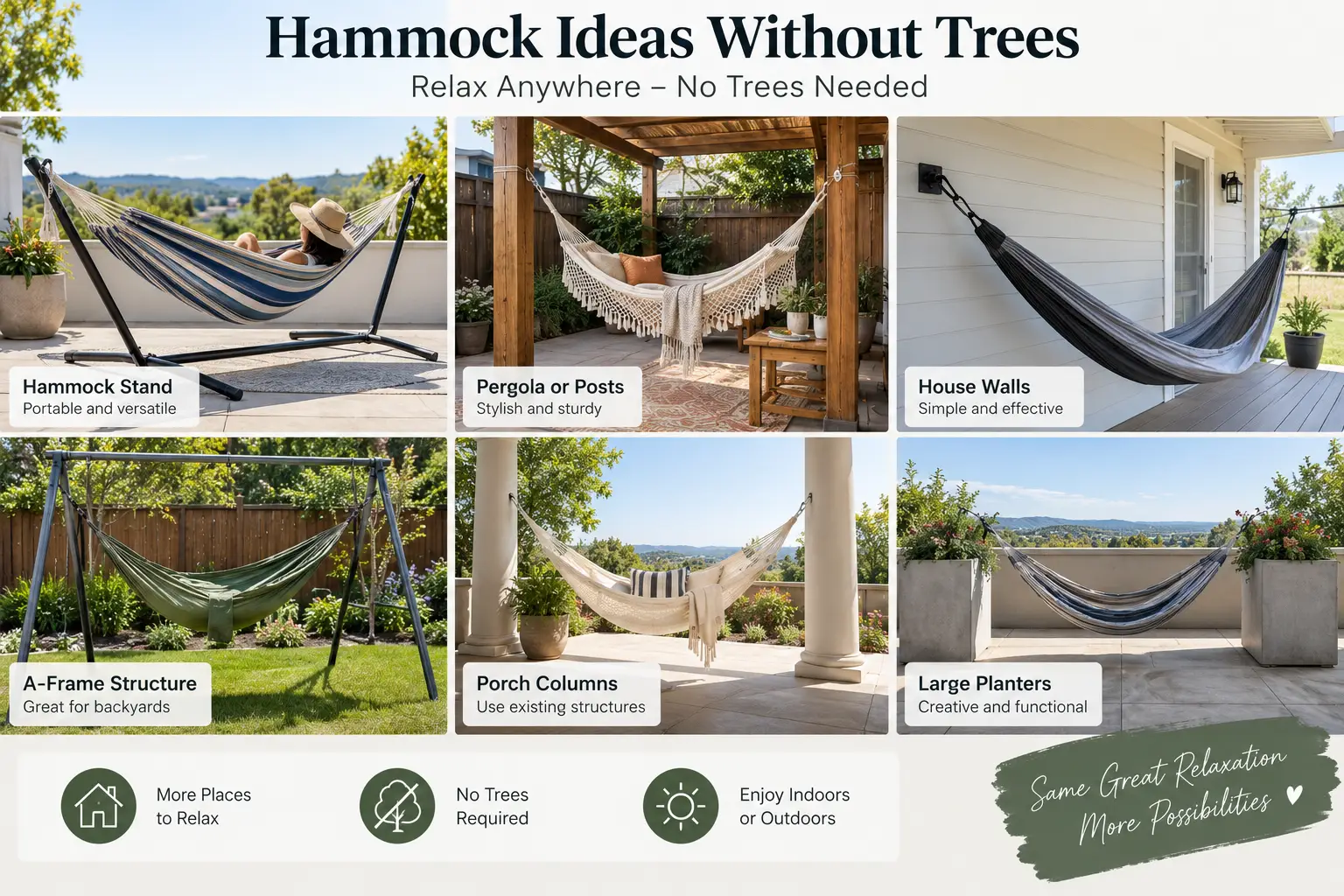
If you’ve always wanted a hammock but your yard doesn’t have two perfectly positioned trees, you’re not out of luck. There are plenty of hammock ideas without trees that let you create a comfortable place to relax without drilling into trees, searching for unusually strong branches, or redesigning your entire outdoor space. Freestanding hammock stands, hammock chairs, portable frames, porch-mounted systems, and even creative indoor setups can all provide the same basic experience of gently supported relaxation without requiring natural trees.
The biggest advantage of going tree-free is flexibility. A traditional hammock depends heavily on the environment around it, while a freestanding setup allows you to decide exactly where the hammock belongs. You can place one beside a pool, on a patio, in a backyard, on a balcony where the dimensions allow it, or in a covered outdoor area. Some lightweight models can even be moved whenever the sun changes position. This makes hammock ideas without trees particularly useful for renters, apartment dwellers, homeowners with small yards, and anyone whose landscape simply isn’t suitable for traditional hammock installation.
This guide breaks down seven practical hammock solutions ranging from simple freestanding stands to premium complete systems and hanging chairs. You’ll get a closer look at how each option works, what kind of space it needs, how easy it is to move, and which type of person is most likely to appreciate it. We’ll also explain how to choose the right stand, how to avoid common installation mistakes, how tree-free hammocks compare with traditional tree-mounted setups, and how to create a comfortable hammock area even when your property has absolutely no suitable trees.
One important note up front: dimensions, weight capacities, materials, and prices vary considerably between hammock systems, and manufacturers frequently update their product ranges. Always check the current product listing and installation instructions before purchasing. The most successful hammock ideas without trees are not necessarily the most expensive ones; they are the setups that match the available floor space, expected weight, desired portability, and way you actually plan to use the hammock.
This post contains affiliate links. As an Amazon Associate, I earn from qualifying purchases made through these links, at no additional cost to you.
What Is a Hammock Without Trees?
A hammock without trees is a hammock setup supported by something other than two natural trees. The most common solution is a freestanding hammock stand, which uses a steel or wooden frame to create two suspension points in a location where no trees are available. Instead of attaching straps around tree trunks, you attach the hammock directly to the stand using hooks, chains, carabiners, or the hardware supplied by the manufacturer.
Most tree-free hammock setups fall into several categories. Traditional freestanding stands support full-size gathered-end hammocks, while spreader-bar hammocks use a more open design that resembles a suspended outdoor bed. Hammock chairs and hanging chairs take up less horizontal space and can be supported by specialized stands with a single overhead attachment point. There are also adjustable universal stands that can accommodate different hammock lengths, which can be useful if you already own a hammock and simply need a way to use it without trees.
The important distinction is that you are replacing the trees with a purpose-built structural support system. This makes the setup considerably more predictable because you control the location, height, and suspension points rather than depending on whatever the landscape happens to provide.
For renters and people living in urban environments, this is one of the most useful hammock ideas without trees because it doesn’t require permanent modifications to the property. A properly sized freestanding stand can simply be assembled, positioned, and moved when necessary.
Quick Comparison: The Best Hammock Ideas Without Trees at a Glance
| Hammock Setup | Support Type | Main Advantage | Price Range | Best For |
|---|---|---|---|---|
| Vivere Double Cotton Hammock with Stand | Steel stand | Complete hammock system | $100–$180 | Couples and backyard lounging |
| Best Choice Products Hanging Rope Hammock with Stand | Steel frame | Affordable complete setup | $70–$130 | Budget buyers |
| Sunnydaze Universal Hammock Stand | Adjustable steel frame | Works with multiple hammock sizes | $80–$150 | Existing hammock owners |
| Sorbus Hanging Rope Hammock Chair with Stand | Single-point stand | Compact footprint | $100–$180 | Balconies and small spaces |
| Lazy Llama Hammock Chair Stand | Freestanding chair frame | Easy indoor/outdoor setup | $100–$170 | Reading and relaxing |
| OnCloud Hammock with Stand | Portable steel stand | Easy relocation | $100–$200 | Flexible outdoor use |
| Yellow Leaf Hammock Throne® | Premium steel base | Luxury furniture-style design | $1,000+ | Premium patios and terraces |
The table immediately shows why there isn’t one perfect answer to hammock ideas without trees. A full-size hammock stand is the closest replacement for a traditional tree-to-tree hammock, while a hammock chair works better when floor space is limited. Adjustable stands are especially useful when you already own a hammock because you can buy the support system separately instead of replacing the entire hammock.
At the premium end, a product such as the Yellow Leaf Hammock Throne® changes the concept completely by combining the hammock and structural base into a piece of outdoor furniture. At the budget end, a simple steel stand can provide almost everything you need without requiring a large investment.
💬 One click helps other shoppers make an informed choice too! 😊
Top 7 Hammock Ideas Without Trees for Every Space
The seven options below cover different ways to enjoy a hammock without depending on trees, with an emphasis on comfort, flexibility, installation, available space, and everyday practicality.
1. Vivere Double Cotton Hammock with Stand — Best All-Around Tree-Free Hammock
The Vivere Double Cotton Hammock with Stand is one of the simplest ways to solve the classic hammock problem because the hammock and stand are designed to work together as a complete system. Instead of purchasing a hammock first and then trying to determine which stand will fit it, you get a coordinated setup that can be positioned almost anywhere with a sufficiently level surface. The steel stand provides the two suspension points normally supplied by trees, while the cotton hammock creates the familiar soft, flexible surface that lets your body settle into a comfortable position.
The double-sized design is particularly appealing for people who want more room than a narrow single hammock provides. Even when only one person is using it, extra width can make it easier to change positions, curl up with a book, or stretch your legs without constantly feeling confined to the center. For two people, the additional capacity and surface area can turn the hammock into a shared relaxation spot, although you should always verify the current weight capacity of the exact model before using it with two adults.
The freestanding construction is what makes this such a useful answer to hammock ideas without trees. You can position it in an open backyard, on a patio, beside a pool, or under a covered outdoor area without searching for suitable trees. If the location becomes inconvenient, the stand can be moved rather than requiring you to leave the hammock permanently attached to one spot.
For someone who wants the most traditional hammock experience without having natural suspension points available, a complete cotton hammock-and-stand combination is one of the easiest solutions to understand and use.
2. Best Choice Products Hanging Rope Hammock with Stand — Best Budget Complete Setup
The Best Choice Products Hanging Rope Hammock with Stand focuses on providing the basic tree-free hammock experience without the price associated with premium outdoor furniture. Its rope hammock construction creates a flexible surface that conforms to the body, while the included steel stand eliminates the biggest obstacle for people searching for hammock ideas without trees.
What makes a budget complete system particularly useful is that it removes compatibility problems. When purchasing a hammock and stand separately, you need to make sure the hammock’s overall length works with the stand’s adjustment range and that the suspension hardware is compatible. A complete package takes much of that guesswork away because the components are designed to be used together.
The rope construction also gives the hammock a distinctly traditional appearance. Instead of looking like an oversized outdoor bed, it has the familiar open weave associated with classic hammocks. This can work especially well in gardens, casual patios, pool areas, and shaded yards where you want the hammock to feel like a relaxed outdoor accessory.
The main compromise is that budget materials and frames may not provide the same refined appearance or long-term durability as premium systems. For occasional summer use, however, a reasonably priced complete hammock stand can be one of the most practical hammock ideas without trees available.
3. Sunnydaze Universal Hammock Stand — Best for Existing Hammocks
The Sunnydaze Universal Hammock Stand is especially useful if you already own a hammock that you love but have nowhere to hang it. Rather than buying another hammock, a universal stand allows you to create the missing suspension points with a dedicated adjustable frame. This can save money and prevent the frustration of replacing a perfectly good hammock simply because your yard lacks suitable trees.
The major attraction of a universal stand is adjustability. Hammocks vary in length, and a stand that works with one hammock may leave another hanging too tightly or too loosely. An adjustable frame allows you to change the suspension distance so the hammock can achieve a more comfortable curve. That flexibility is valuable because the ideal hammock position is rarely completely flat; most people prefer a gentle sag that allows the fabric to cradle the body.
This type of system is also useful when your hammock collection changes over time. You might start with a single cotton hammock, later purchase a spreader-bar hammock, or switch to another model with a different overall length. A flexible stand can potentially accommodate those changes without requiring another frame.
For homeowners who already own a favorite hammock, this is one of the smartest hammock ideas without trees because the stand solves the structural problem while allowing you to keep the hammock you already enjoy.
4. Sorbus Hanging Rope Hammock Chair with Stand — Best for Small Spaces
The Sorbus Hanging Rope Hammock Chair with Stand is a strong alternative for people who don’t have enough room for a full-size horizontal hammock. Instead of stretching several feet across a yard, the hanging chair uses a single suspension point and keeps the seating area relatively compact. The result is closer to a suspended lounge chair than a traditional hammock, but it provides the same gentle movement and cocoon-like feeling.
This format can be particularly useful on smaller patios, apartment outdoor spaces where permitted, sunrooms, bedrooms, and covered porches. Because you sit rather than lie horizontally, the required floor footprint is substantially smaller. That makes hammock chairs one of the most practical hammock ideas without trees for people who want hammock comfort but don’t have a large backyard.
The rope construction also allows the chair to flex around the body. You can sit upright while reading, lean backward while listening to music, or gently rock while enjoying the outdoors. Some models can also be paired with cushions or pillows, which can turn the chair into a more supportive reading space.
The main difference is that you are giving up the ability to lie completely flat. If your primary goal is napping or stretching out, a full hammock with a stand is likely the better choice. If your goal is reading, relaxing, or creating a cozy corner, the hanging-chair format can be considerably more space-efficient.
5. Lazy Llama Hammock Chair Stand — Best for Indoor and Outdoor Flexibility
The Lazy Llama Hammock Chair Stand is designed for people who want the freedom to use a hanging chair without permanently installing a ceiling hook. Its freestanding structure creates a single overhead attachment point, allowing a hammock chair to be positioned wherever the stand can safely sit.
The indoor potential is particularly interesting. A conventional hammock can be difficult to fit into a bedroom or living room because of its length, but a hanging chair can transform a small unused corner into a relaxation zone. Positioned beside a bookshelf or near a window, it can become a dedicated reading chair without requiring permanent modifications to the wall or ceiling.
The same stand can potentially be used outdoors in a sheltered area when conditions allow, giving it more versatility than a permanently installed indoor chair. That flexibility makes this one of the more creative hammock ideas without trees, especially for renters who cannot drill into structural surfaces.
The most important consideration is floor stability. A hanging chair stand needs to sit on a level surface and have enough surrounding clearance for the chair to move naturally. A compact footprint does not mean zero space is required; the chair still needs room to swing without striking furniture, walls, railings, or other objects.
6. OnCloud Hammock with Stand — Best Portable Backyard Option
The OnCloud Hammock with Stand is aimed at people who want a tree-free hammock but don’t want the setup to feel permanently fixed in one location. Its portable frame allows the hammock to become a flexible outdoor relaxation station that can be repositioned as needed.
This is particularly useful during different seasons. In the morning, you might want the hammock in a sunny area, while in the afternoon you may prefer a shaded section of the yard. A portable stand makes those changes possible without reinstalling straps or hardware. You can also move the setup when mowing the lawn, cleaning the patio, preparing for a gathering, or changing your outdoor furniture arrangement.
Portability is one of the most overlooked benefits of hammock ideas without trees. People often assume that removing trees from the equation simply means replacing them with a heavy metal frame, but modern stands vary considerably in weight and portability. A lighter setup can provide more freedom even if it sacrifices some of the visual solidity of a permanent premium stand.
For casual outdoor users who value flexibility more than luxury styling, a portable hammock-and-stand combination can be a particularly sensible middle ground.
7. Yellow Leaf Hammock Throne® — Best Premium Tree-Free Experience
The Yellow Leaf Hammock Throne® represents the luxury end of tree-free hammock design. Instead of simply pairing a hammock with a generic metal stand, the entire system is conceived as a piece of premium outdoor furniture. The handwoven hammock, sculpted hardwood components, and substantial steel base create a visually distinctive structure that can function as the centerpiece of a patio, terrace, pool area, or sophisticated outdoor living space.
The design is particularly interesting because it changes how a hammock can exist within a home environment. A conventional hammock can sometimes look temporary, especially when suspended from ropes or straps between trees. The Hammock Throne is deliberately more architectural, allowing the relaxation experience to coexist with carefully designed outdoor furniture rather than looking like camping equipment placed in the backyard.
Yellow Leaf describes the Throne as using outdoor-oriented materials including marine-grade components, sustainably sourced hardwood, and a steel base. The result is designed for people who want the physical comfort of a hammock combined with the appearance and presence of a high-end lounge chair. (yellowleafhammocks.com)
Of course, this level of design comes with a dramatically higher price than ordinary hammock stands. It is not the sensible choice for someone who simply wants an inexpensive place to nap outdoors. But if the objective is to create a permanent, visually impressive relaxation area without depending on trees, it represents one of the most distinctive hammock ideas without trees.
How the Top 7 Compare Side by Side
| Product | Setup Type | Portability | Space Requirement | Best For |
|---|---|---|---|---|
| Vivere Double Cotton Hammock | Full hammock + stand | Medium | Large | Everyday backyard lounging |
| Best Choice Products Hammock | Rope hammock + stand | Medium | Large | Budget buyers |
| Sunnydaze Universal Stand | Stand only | Medium | Large | Existing hammocks |
| Sorbus Hammock Chair | Chair + stand | Medium | Small–Medium | Small patios and balconies |
| Lazy Llama Chair Stand | Chair stand | Medium | Small–Medium | Indoor/outdoor relaxation |
| OnCloud Hammock | Portable hammock + stand | High | Large | Flexible outdoor use |
| Yellow Leaf Hammock Throne® | Premium throne + base | Low | Large | Luxury outdoor spaces |
The comparison makes one point clear: hammock ideas without trees don’t have to mean sacrificing the hammock experience. The main difference is that the supporting structure becomes part of the system. If you want to lie down, choose a full hammock and stand. If you want to conserve floor space, consider a hanging chair. If you already own a hammock, an adjustable universal stand may be the most economical solution.
How to Set Up Your Tree-Free Hammock for Maximum Comfort
Getting a stand home is only half the job. The position and adjustment of the hammock determine whether the final setup feels relaxing or awkward. Start by placing the stand on a stable, level surface with enough room around it for the hammock to move without hitting walls, furniture, railings, plants, or other obstacles.
Once the stand is positioned, attach the hammock according to the manufacturer’s instructions and check the suspension points before putting your full weight into it. The hammock should generally form a gentle curve rather than being pulled completely tight. A hammock that is stretched too tightly can feel rigid and place unnecessary pressure on the suspension points, while one that hangs excessively low can make getting in and out difficult.
For adjustable stands, make small changes rather than moving the hooks dramatically. Sit in the hammock and notice how your hips, shoulders, and knees are supported. If your body settles too deeply, raise or adjust the suspension slightly. If the hammock feels rigid and restrictive, giving it a little more slack may create a more natural cradle.
Position also affects comfort. A shaded location can make a major difference during hot weather, while a sheltered area protects the hammock from excessive rain and wind. For hammock ideas without trees, the ability to choose the exact location is one of the greatest advantages of the entire setup.
Real-World Scenarios: Which Tree-Free Hammock Fits Your Life?
Consider a homeowner with a medium-sized backyard but almost no mature trees. A full hammock-and-stand system such as the Vivere Double Cotton Hammock is the most straightforward answer because it recreates the traditional hammock experience without requiring landscape changes.
An apartment resident with a compact balcony may have completely different requirements. A full-size hammock could overwhelm the available floor area, while a hanging hammock chair with a compact stand can create a similar relaxation experience while using substantially less horizontal space.
Someone who already owns an expensive hammock doesn’t necessarily need to replace it. An adjustable universal stand can provide the structural support that was missing, allowing the existing hammock to remain part of the setup.
For a person who constantly rearranges their backyard, portability becomes more important. A lighter stand can be moved whenever shade, weather, lawn maintenance, or outdoor gatherings require a different configuration.
Finally, someone designing a high-end outdoor living area may care less about price and more about appearance. In that situation, a premium system such as the Yellow Leaf Hammock Throne® can function as both a relaxation product and a visual centerpiece.
Hammock Ideas Without Trees: Common Problems and Solutions
Problem: You don’t have enough trees in the correct positions. The simplest solution is a freestanding hammock stand. It creates two artificial suspension points and allows you to position the hammock wherever the frame can safely stand.
Problem: Your backyard is too small for a traditional hammock. A hanging hammock chair can provide a similar suspended feeling while requiring substantially less horizontal space.
Problem: You already own a hammock but cannot hang it. An adjustable universal stand is usually more practical than purchasing a completely new hammock-and-stand combination.
Problem: The hammock keeps touching the ground. Adjust the stand height or suspension points according to the manufacturer’s instructions. The hammock should have sufficient clearance even when occupied.
Problem: The hammock feels too tight. Check whether the stand is set too far apart for the hammock length. Adjustability is valuable because different hammock lengths require different suspension distances.
Problem: The setup gets extremely hot in direct sunlight. Move the stand to a shaded area or add a compatible shade structure. One of the advantages of tree-free setups is that you can reposition them as the sun moves.
How to Choose the Right Hammock Without Trees
1. Start with the available space, not the hammock. Measure the area where you want the hammock before buying. A full-size hammock and stand can occupy considerably more room than a product photograph suggests.
2. Decide whether you want to lie down or sit. Full hammocks are better for stretching out and napping, while hanging chairs are more practical for reading, conversation, and smaller spaces.
3. Check the weight capacity. Never assume that all stands support the same amount of weight. The hammock, stand, and hardware should all be appropriate for the intended load.
4. Match the stand to the hammock length. If you’re buying the stand separately, check the manufacturer’s recommended hammock length and adjustment range.
5. Think about portability. If you’ll move the hammock regularly, a lighter stand may be more valuable than a heavier, permanently positioned frame.
6. Consider the material. Steel stands are common because they offer strength and relatively simple maintenance, while wooden stands can provide a warmer furniture-like appearance.
7. Plan for weather exposure. Outdoor fabrics, treated wood, powder-coated steel, and weather-resistant rope are better suited to outdoor environments than delicate indoor materials.
8. Leave adequate clearance. The hammock needs space not only for its static dimensions but also for gentle swinging and safe entry and exit.
Common Mistakes to Avoid When Choosing Hammock Ideas Without Trees
The most common mistake is buying the hammock first and worrying about the stand afterward. Although this can work when the hammock has standardized dimensions, compatibility is not universal. The hammock needs to fit within the stand’s adjustment range, and the suspension hardware needs to be appropriate for the system.
Another mistake is measuring only the hammock itself. A complete tree-free setup includes the stand, suspension points, hammock curve, and movement area. A patio may technically be wide enough for the hammock but still feel cramped once the frame and clearance around it are considered.
Buyers also frequently underestimate the importance of surface level. A stand positioned on uneven ground can feel unstable or place uneven forces on the frame. Before assembly, choose the flattest suitable surface available.
Finally, don’t treat a freestanding stand as indestructible. A heavy steel frame can still move, tip, or become damaged if used improperly, exposed to extreme conditions, or assembled incorrectly. Follow the manufacturer’s instructions and periodically inspect the joints, hooks, bolts, and suspension components.
What to Expect: Everyday Performance
A properly configured tree-free hammock should feel remarkably similar to a conventional hammock once you lie down. The biggest difference is visual rather than physical: instead of seeing tree trunks at either end, you’ll see the stand supporting the suspension points.
In everyday use, the stability of the stand becomes particularly noticeable when getting in and out. A well-positioned frame should remain stable while the hammock moves naturally underneath you. The hammock itself should cradle your body rather than forcing you to balance in the center.
Freestanding systems also make repositioning much easier than traditional tree-mounted hammocks. You can move the entire setup toward shade, away from rain, or into a different part of the yard without removing straps from trees.
For hanging chairs, everyday performance is slightly different. The movement is more vertical and rotational, and your posture remains more upright. This makes them particularly effective for reading, scrolling through a phone, listening to music, or having a drink outdoors rather than sleeping horizontally.
Hammock Ideas Without Trees for Every Household
For a large backyard, a full-size hammock with a steel stand is usually the most natural choice. It recreates the classic hammock experience while giving you complete freedom over placement.
For smaller outdoor areas, a hanging chair with a compact freestanding base is often more practical. It provides the relaxing suspended sensation without requiring the long footprint of a traditional hammock.
For indoor spaces, a freestanding hammock chair stand can create a comfortable reading corner without drilling into the ceiling. This can be especially useful for renters or anyone who doesn’t want permanent modifications to the property.
For families, prioritize a sturdy frame, clearly stated weight capacity, stable feet, and durable fabric. The more frequently the hammock is used, the more important these structural details become.
For premium outdoor spaces, integrated systems such as the Yellow Leaf Hammock Throne® can provide a more polished appearance because the supporting structure is designed to look like furniture rather than a generic metal frame.
Long-Term Cost and Maintenance
Tree-free hammocks have one significant maintenance advantage: you don’t need to maintain the trees used to support them. The tradeoff is that the stand itself becomes another outdoor component that needs occasional attention.
Steel frames should be inspected for rust, damaged coating, loose bolts, and bent components. If the hammock remains outdoors for extended periods, keeping the frame clean and dry can help preserve its finish. Wooden stands require additional attention because prolonged exposure to moisture and sunlight can affect the wood over time.
The hammock fabric or rope should also be checked periodically. Look for fraying, stretched areas, damaged stitching, mildew, or fading. Even weather-resistant materials eventually show wear when exposed continuously to the elements.
If you live somewhere with severe weather, storing the hammock or stand during storms and long periods of non-use can significantly extend its life. One of the easiest hammock ideas without trees is also one of the most practical: choose a system that can be disassembled or moved when conditions change.
Safety, Materials, and Regulations to Know
The primary safety consideration for a tree-free hammock is the structural integrity of the stand and suspension system. Always follow the manufacturer’s weight rating and assembly instructions. Do not exceed the stated capacity, and do not assume that a stand rated for one type of hammock automatically has the same rating when used with another configuration.
Place the stand on a stable, level surface and maintain sufficient clearance around it. Avoid positioning the hammock directly beside sharp furniture edges, glass doors, pools, fire pits, or other hazards.
For hanging chairs, the single suspension point deserves particular attention. Even though the chair is smaller than a full hammock, the suspension system still carries the user’s entire weight and may experience additional force when the chair swings.
Outdoor materials such as powder-coated steel, UV-resistant rope, treated hardwood, and weather-resistant polyester can improve durability, but no material is completely immune to environmental wear. Regular inspection remains important regardless of the product’s advertised weather resistance.
FAQs
❓ What are the best hammock ideas without trees?
❓ Can I use a hammock without attaching it to trees?
❓ What is the best hammock option for a small space?
❓ Can I use my existing hammock without trees?
❓ Are hammocks without trees safe?
Conclusion
The best hammock ideas without trees prove that you don’t need a mature backyard landscape to enjoy the comfort of a hammock. A freestanding stand can create the same basic suspension points as two trees while giving you much greater control over placement. Instead of adapting your hammock to the landscape, you can adapt the hammock area to your lifestyle.
For most people, a complete hammock-and-stand system offers the simplest starting point because the components are designed to work together. If you already own a hammock, an adjustable universal stand can be a more economical solution. If you’re working with limited space, a hanging hammock chair can provide much of the same relaxation experience without requiring a large horizontal footprint.
At the premium end, a purpose-built design such as the Yellow Leaf Hammock Throne® turns the idea into something closer to outdoor furniture, creating a visually striking relaxation area without depending on trees. At the budget end, a basic steel stand paired with a compatible hammock can accomplish the same fundamental goal for considerably less money.
The smartest choice is ultimately the one that matches your space, preferred posture, budget, and willingness to move or maintain the setup. Measure your available area first, verify the weight capacity, check hammock-to-stand compatibility, and think about where the hammock will actually be used throughout the year. Once those factors are clear, finding the right tree-free setup becomes much easier.
✨ Ready to enjoy a hammock without trees? Browse the options above, compare the stand dimensions and weight ratings, and choose the setup that fits your space and relaxation style best.
Recommended for You
- 3 Point Hammock: 7 Best Triangle Picks for 2026
- Wooden Hammock Frame: 7 Best Picks for Your Backyard in 2026
- Best Quilted Hammock 2026: 7 Top Picks (+ Buying Mistakes)
Disclaimer: This post contains affiliate links. As an Amazon Associate, I earn from qualifying purchases made through these links, at no additional cost to you.
✨ Found this article helpful? Share it with someone who needs it! 💬🤗