
In This Article
There’s a specific kind of tired that only a quilted hammock can fix — the pleasant, sun-warmed exhaustion of a Saturday afternoon with nothing on the calendar. If you’ve ever flopped into a rope hammock and immediately regretted it (hello, pressure lines on your back), you already understand why quilted hammocks have taken over so many backyards, porches, and poolside setups across the country.
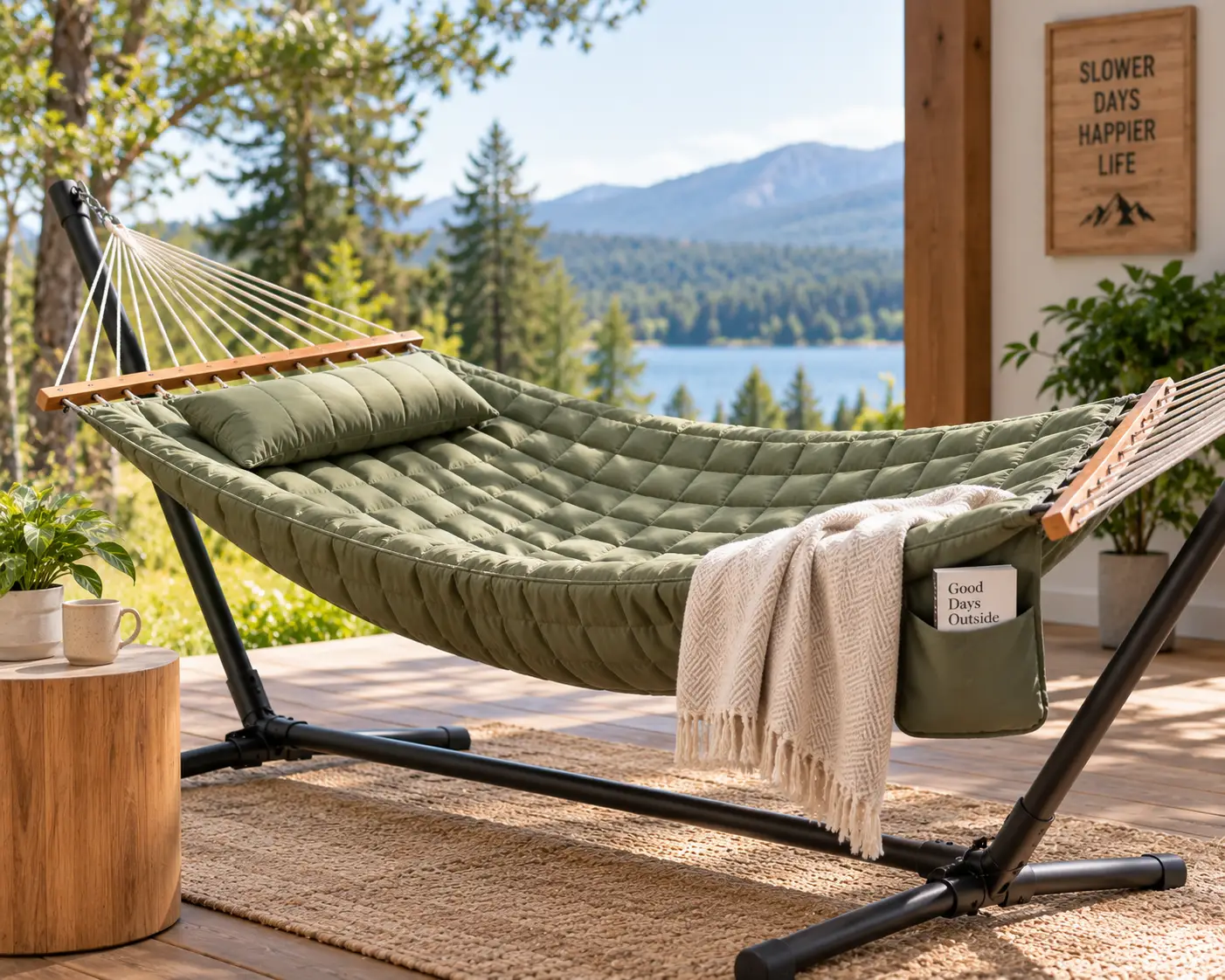
What Is a Quilted Hammock? A quilted hammock is an outdoor hammock built from two layers of fabric with a poly-fill or batting layer stitched between them, creating a soft, mattress-like surface. Unlike open-weave rope hammocks, which press against your skin in strips, a quilted hammock spreads your weight evenly across a padded bed — closer to lying on a cushion than a net.
That comfort comes with trade-offs, though. Quilted hammocks are heavier, slower to dry after rain, and — as we’ll get into — not all “quilted” fabric is created equal. Some use thin batting that flattens within a season; others use Sunbrella-grade acrylic that shrugs off UV rays for years.
This guide breaks down seven real quilted hammocks currently available on Amazon and other major retailers, spanning entry-level fabric-and-rope hybrids up to premium Sunbrella builds with matching stands. We’ll walk through what the specs actually mean for comfort and durability, where each option makes the most sense budget-wise, and the buying mistakes that lead most people to return their first quilted hammock. Whether you’re outfitting a small patio or replacing a worn-out backyard classic, you’ll leave with a shortlist that actually fits how you plan to use it.
This post contains affiliate links, and as an Amazon Associate I may earn a commission on qualifying purchases at no extra cost to you.
Quick Answer: The Best Quilted Hammocks at a Glance
| Category | Pick | Why It Wins |
|---|---|---|
| Best Overall | L.L. Bean Quilted Sunbrella Hammock | Sunbrella fabric holds up to years of sun and rain |
| Best Budget | Sunnydaze Quilted Double Hammock | Full-size quilted bed at the lowest price range |
| Best With Stand | Atesun 2-Person Large Quilted Hammock | Complete kit — no trees or drilling required |
| Best for Extra Features | GAFETE 12ft 2 Person Hammock | Side pocket and oversized pillow included |
If you only remember one thing from this table, remember this: stand-free hammocks like the Sunnydaze Quilted Double Hammock only work if you already have two solid anchor points 12–17 feet apart, while kits like the Atesun 2-Person Large Quilted Hammock solve that problem entirely by including their own frame. Fabric quality is the second lever — Sunbrella-based quilting, as used in the L.L. Bean Quilted Sunbrella Hammock, costs more upfront but resists the fading and mildew buildup that eventually flattens cheaper polyester quilting. We’ll unpack all of this product by product below.
💬 Ready to see the full lineup? Scroll down to compare all 7 quilted hammocks side by side.
7 Best Quilted Hammocks, Reviewed
These seven span entry-level to premium, stand-free to stand-included, so read the “best for” line on each before you scroll to price.
1. Sunnydaze Quilted Double Hammock — most affordable full-size quilted bed
The Sunnydaze Quilted Double Hammock proves you don’t need a premium price tag to get a genuinely padded sleeping surface, and that’s exactly the gap it fills in this lineup.
It ships with a 74″ x 55″ quilted poly-fill bed, a matching pillow, and a 450-pound weight capacity, with no stand included. At 74 by 55 inches, the bed is sized for two adults to lie diagonally — the way most people actually use a double hammock — which is where the real comfort payoff of quilting shows up: diagonal lying flattens the “hammock curl” that makes rope hammocks uncomfortable for anything longer than a nap.
This is the hammock to buy if your yard already has two trees or posts the right distance apart and you don’t want to spend extra on a frame. Reviews consistently report that the quilting holds its loft for at least a season or two of regular outdoor use before the poly-fill starts to compress at high-contact points like the shoulders and hips.
A common theme in customer reviews is that the fabric dries slower than expected after rain, so owners who leave it hung permanently recommend covering it or bringing it in during wet stretches.
Pros:
- ✅ Full-size 74″ x 55″ bed for genuine two-person use
- ✅ Matching pillow included at no extra cost
- ✅ Lowest price point of any quilted option here
Cons:
- ❌ No stand included — needs two solid anchor points
- ❌ Slower to dry than rope-style hammocks after rain
Sunnydaze hammocks in this quilted double line typically sit in the affordable end of the category, often listed in the $60–$100 range at the time of writing — check the current price for your color option, since it varies by pattern. For a first quilted hammock or a secondary spot like a covered porch, it’s a solid value.
2. GAFETE 12ft 2 Person Hammock — most extras for the price
The GAFETE 12ft 2 Person Hammock leans into the small details that make a hammock genuinely convenient to use every day, not just comfortable to sit in once.
It’s built around a hardwood spreader bar rated to 475 pounds, an extra-large removable pillow, a side storage pocket, and steel carabiners for setup. The spreader bar keeps the bed open and flat rather than curling into a cocoon shape, which makes getting in and out noticeably easier — a real plus for anyone who isn’t confident swinging a leg over a swaying rope bed. The side pocket is a small feature that pays off constantly: a place for sunscreen, a phone, or a paperback means fewer trips back inside.
This is the pick for people who actually live in their hammock — reading, scrolling, snacking — rather than treating it as decor. Reviewers note the spreader bar’s hardware finish holding up well outdoors, though a few mention needing to re-tighten the carabiner connections after the first several uses as the fabric settles.
Pros:
- ✅ Side pocket keeps essentials within arm’s reach
- ✅ Oversized removable pillow washes separately
- ✅ Hardwood spreader bar makes entry and exit easier
Cons:
- ❌ Carabiner connections may need re-tightening early on
- ❌ Flat spreader-bar shape feels less “cocoon-like” than rope styles
Expect the GAFETE 12ft 2 Person Hammock to land in the entry-to-mid price range, commonly between $70 and $110 — check the current price, as the Catalina Beach and similar prints can shift. For the feature set, it’s a strong value if convenience matters more to you than premium fabric.
3. Vivere Quilted Polyester Fabric Double Hammock — reversible design doubles your color options
The Vivere Quilted Polyester Fabric Double Hammock comes from a brand that has specialized in outdoor hammocks for two decades, and the reversible fabric is its signature move.
The bed is quilted with poly-fill sandwiched between two layers of polyester, with a coordinating pattern on one side and a solid color on the other, plus a 450-pound capacity and spreader bars for stability. Practically speaking, reversible fabric means you can flip the bed seasonally, or when one side fades or stains, without replacing the entire hammock — a genuinely useful longevity feature that budget competitors don’t offer.
This is the best pick for people who like refreshing their patio look without buying new hardware every year, and it benefits from being made by a specialist brand rather than a generic import, which shows up in the consistency of the stitching. Reviewers frequently mention the compact stuff-sack for storage, though some long-term owners note the end strings are thinner than the fabric itself deserves, worth an occasional check.
Pros:
- ✅ Reversible fabric effectively gives you two hammocks in one
- ✅ Made by an established hammock-specific brand
- ✅ Compatible with a wide ecosystem of Vivere stands and straps
Cons:
- ❌ End strings run thinner than the main fabric
- ❌ Stand sold separately, adding to total cost
The Vivere Quilted Polyester Fabric Double Hammock typically falls in the $100–$150 range — check the current price, since colorway affects listing price. Given the reversible design and brand ecosystem, it’s a reasonable mid-tier value.
4. Lazy Daze Double Quilted Hammock — built specifically to pair with a 13–15 ft stand
The Lazy Daze Double Quilted Hammock solves the single most common complaint in this category before it happens: it’s engineered to fit 13-to-15-foot stands specifically, rather than a vague “universal” length.
It includes a hardwood spreader bar, steel carabiners, a quilted pillow, and a 450-pound capacity. That length-matching detail avoids sagging or ground-dragging, which is what happens when a hammock and stand come from different sizing standards. If you already own — or are planning to buy — a stand in that 13-to-15-foot range, this removes the guesswork entirely.
This is the best fit for anyone building a hammock setup piece by piece rather than buying an all-in-one kit. Aggregated feedback highlights strong stitching at the pillow attachment points as a durability strength, while some owners note the lighter Natural and Beach Stripe colorways show dirt and grass stains faster than darker patterns.
Pros:
- ✅ Sized specifically for 13–15 ft stands, avoiding sag issues
- ✅ Sturdy pillow-attachment stitching
- ✅ Hardwood spreader bar for a flat, stable bed
Cons:
- ❌ Lighter colorways show dirt more visibly
- ❌ Stand not included, so length compatibility must be checked
The Lazy Daze Double Quilted Hammock commonly lists in the $90–$130 range for the hammock alone — check the current price before pairing it with a stand purchase. For buyers assembling a matched setup, it’s a smart, purpose-built mid-range choice.
5. ANOW Heavy-Duty Quilted Hammock with 12-Foot Stand — the no-guesswork complete kit
The ANOW Heavy-Duty Quilted Hammock with 12-Foot Stand exists for one reason: to remove anchor points from the equation entirely.
It ships as a full kit — a 12-foot heavy-duty steel stand, a quilted hammock bed, and balance ropes designed to reduce the tipping sensation new hammock owners often report, all rated to a 450-pound capacity. For renters, apartment patios, or yards without two mature trees, the biggest barrier to hammock ownership usually isn’t the hammock itself — it’s having somewhere sturdy to hang it. This kit ships with its own frame, so that barrier disappears.
It’s a mid-to-high tier pick for buyers who prioritize “unbox and use today” over premium fabric grade. Steel stands trade some of the aesthetic warmth of wood for lower cost and dramatically lower upkeep — no re-staining or sealing required, ever. Reviewers commonly note that two people make assembly noticeably faster than one, and that the balance-rope system meaningfully reduces the wobble first-time hammock owners tend to notice.
Pros:
- ✅ Complete kit — no trees, posts, or drilling required
- ✅ Balance ropes reduce first-use tipping sensation
- ✅ Steel stand needs virtually no maintenance
Cons:
- ❌ Assembly is easier with two people than solo
- ❌ 12-ft steel frame takes up real patio footprint
Expect the ANOW Heavy-Duty Quilted Hammock with 12-Foot Stand to run roughly $140–$190 as a complete combo — check the current price, since stand-included kits fluctuate more than hammock-only listings. For the convenience of a ready-to-use setup, it’s a fair mid-high value.
6. Atesun 2-Person Large Quilted Hammock with Wooden Arc Stand — premium stand kit for a finished backyard look
The Atesun 2-Person Large Quilted Hammock with Wooden Arc Stand was named a top stand-included pick in a recent Forbes Vetted roundup of the best hammocks on the market, and the wooden arc frame is the reason why.
It pairs a quilted fabric bed with a curved wooden stand and an oversized weight capacity, arriving as a complete, ready-to-assemble kit. A wooden arc stand reads as furniture rather than gear — worth the trade-off for anyone whose hammock will be a permanent yard fixture, though wood does require more upkeep than steel, namely occasional sealing or staining to prevent weathering.
This is the pick for buyers who want the stand itself to look intentional, matching existing patio furniture rather than looking bolted-on. Aggregated owner sentiment highlights the finished, cohesive aesthetic once assembled and describes the setup process as manageable solo, though a recurring critique across similar wood-stand quilted models is that the thicker quilted fabric can trap more heat in direct, all-day summer sun than an open-weave design — worth knowing before you commit to a fully sun-exposed spot.
Pros:
- ✅ Wooden arc stand doubles as a patio design piece
- ✅ Complete kit with oversized weight capacity
- ✅ Praised for stability and a finished look
Cons:
- ❌ Wood stand needs periodic sealing or staining
- ❌ Dense quilting can trap heat in full summer sun
As a complete wood-stand kit, the Atesun 2-Person Large Quilted Hammock with Wooden Arc Stand commonly lists in the $200–$280 range — check the current price, as wood-stand kits shift more with lumber costs than steel kits do. For a backyard centerpiece, it’s a premium but justified spend.
7. L.L. Bean Quilted Sunbrella Hammock — the fabric upgrade that changes everything
The L.L. Bean Quilted Sunbrella Hammock was rated the best hammock overall in that same Forbes Vetted testing round, and the reason comes down almost entirely to fabric.
Instead of standard polyester, it uses Sunbrella solution-dyed acrylic fabric — quilted with poly-fill between two Sunbrella layers — paired with a wood spreader bar and a 475-pound capacity. Because Sunbrella fiber is dyed all the way through rather than printed on the surface, it resists fading in a way polyester-quilted hammocks simply can’t match after a summer or two in direct sun, and it sheds water and resists mildew far better, cutting down on the “smells musty by August” complaint common with budget quilted fabric.
Testers praised the balance the quilted Sunbrella design strikes between cushioning and stability, though the same review flagged that the dense quilting can trap heat more than an open-weave alternative — a real consideration if you’re in a hot, humid region. Reviewer sentiment across owners consistently credits the fabric for holding true color after multiple outdoor seasons, with the main recurring complaint being the higher price relative to polyester competitors.
Pros:
- ✅ Sunbrella fabric resists fading far longer than polyester
- ✅ Better mildew and water resistance than budget quilting
- ✅ Rated best hammock overall in independent testing
Cons:
- ❌ Noticeably pricier than polyester-quilted alternatives
- ❌ Dense quilting can trap heat in hot climates
Similar Sunbrella-quilted hammocks from comparable brands commonly list in the $200–$300 range — check the current price at the time of writing, since Sunbrella fabric costs shift with material pricing. If you’re buying once and keeping it outdoors year-round, this is the fabric grade to reach for.
How to Hang and Maintain a Quilted Hammock
Getting a quilted hammock to feel as good as it looks comes down to setup, not luck. Start with anchor points 12 to 17 feet apart if you’re hanging between trees or posts, and make sure whatever you’re anchoring to can bear well over your combined body weight — a trunk at least 6 inches in diameter is the general benchmark cited in Grand Trunk’s hammock safety guidance.
Aim for a gentle sag rather than pulling the hammock taut; a slightly loose hang lets quilted fabric cradle your body instead of stretching flat like a cot. Keep the lowest point of the bed no more than 18 inches off the ground.
Maintenance is where quilted hammocks differ most from rope ones. Because the poly-fill or batting layer holds moisture, quilted fabric takes noticeably longer to dry after rain than an open-weave bed — leaving it hung and wet is the fastest way to develop a mildew smell. In the first 30 days, build the habit of bringing it in or covering it before rain when you can, hand-washing spot stains with mild soap rather than machine-washing, and letting it air-dry fully in shade, since direct sun speeds fading on non-Sunbrella fabrics. Store it dry, loosely folded, in a breathable bag rather than a sealed plastic tote, which traps residual moisture against the quilting.
Real-World Scenarios: Which Quilted Hammock Fits Your Life?
If you’re a renter with a small concrete patio and no trees in reach, a stand-free hammock is a non-starter — you need the frame included. The ANOW Heavy-Duty Quilted Hammock with 12-Foot Stand solves this directly: steel stands set up without drilling into anything, and 12 feet of length works in most standard patio footprints, though it’s worth measuring your space first since a fully assembled stand is wider than it looks in photos.
If you’re outfitting a family backyard where the hammock doubles as a reading nook, snack spot, and occasional kid pile-on, features matter more than fabric grade. The GAFETE 12ft 2 Person Hammock‘s side pocket and oversized pillow earn their keep here — a place to stash sunscreen or a phone means fewer trips inside, and the 475-pound capacity gives real headroom for two adults plus a kid climbing in.
If you’re past the “will I actually use this” phase and ready to invest in a permanent patio centerpiece, spend the extra money on Sunbrella fabric. The L.L. Bean Quilted Sunbrella Hammock costs more than a polyester quilted hammock upfront, but if you’re leaving it outdoors year-round in a sunny climate, the fade resistance alone can outlast two or three budget replacements — making the total cost of ownership lower over five years, even though the sticker price is higher.
Common Problems With Quilted Hammocks (and How to Fix Them)
Sagging bed that drags the ground. This is almost always a length mismatch between the hammock and its stand or anchor distance. Check the manufacturer’s recommended stand length — the Lazy Daze Double Quilted Hammock, for example, is built specifically for 13–15 ft stands — before assuming the hammock itself is defective.
Musty smell developing after a few weeks outside. This comes from moisture trapped in the poly-fill layer. Bring the hammock in after rain and let it fully air-dry before re-hanging, and consider a mildew-resistant fabric if this keeps happening.
Fading color after one summer. Standard polyester quilting fades faster under direct, all-day sun. Either relocate the hammock to partial shade or step up to Sunbrella-grade fabric like the L.L. Bean Quilted Sunbrella Hammock, engineered specifically to resist UV fading.
Feels unstable or tips when getting in. Sit in the center first rather than lying down immediately, and check that spreader bars — present on most of these seven, including the GAFETE 12ft 2 Person Hammock — are seated correctly. Spreader bars exist specifically to prevent the twisting motion that causes tipping.
How to Choose a Quilted Hammock: 6 Things That Actually Matter
- Weight capacity. Look at your combined household weight, not just one person. Most hammocks in this guide are rated 450–475 lbs, giving a comfortable margin for two average adults.
- Bed size. A wider, longer bed (74 inches or more) allows diagonal lying, the position responsible for most of a quilted hammock’s comfort advantage.
- Fabric type. Standard polyester poly-fill is fine for moderate use; Sunbrella acrylic costs more but resists fading and mildew far longer in full sun.
- Stand vs. stand-free. This comes down entirely to whether you already have two solid anchor points 12–17 feet apart — if not, budget for a stand kit from the start.
- Spreader bar vs. spreader-bar-free. A spreader bar keeps the bed flat and open for easy entry; without one, hammocks wrap into a cocoon shape some people prefer for sleeping.
- Small extras. A removable pillow, side pocket, or carrying bag might sound minor, but they’re often what determines whether a hammock gets used weekly or forgotten by midsummer.
✨ Found your favorite so far?
🔍 Take another look at the full lineup above and click through on any highlighted pick to check current pricing and availability before it changes.
Common Mistakes to Avoid When Buying a Quilted Hammock
The most common mistake is buying a hammock and a stand from two different brands without checking length compatibility, which leads directly to the sagging problem covered earlier. A close second is assuming “quilted” automatically means Sunbrella-grade fabric — most budget listings use standard polyester with poly-fill, which is perfectly fine for moderate use but won’t hold up as long under constant sun exposure.
Buyers also tend to treat the printed weight capacity as a hard safety cutoff rather than a practical guideline; it’s not a certified structural rating the way a stand’s weld rating might be, so it’s smarter to buy comfortably above your actual expected combined weight rather than right up to the limit. Finally, leaving a quilted hammock hung and exposed around the clock in a rainy climate shortens its lifespan far faster than it would a rope hammock, simply because the padded layer holds moisture longer.
Quilted Hammock vs. Rope Hammock: Which Should You Buy?
| Feature | Quilted Hammock | Rope Hammock |
|---|---|---|
| Comfort lying flat | Even, cushioned support | Pressure lines from the weave |
| Dry time after rain | Slower (traps moisture) | Fast (open weave) |
| Breathability in heat | Lower, can trap warmth | Higher, airflow through weave |
| Typical weight | Heavier | Lighter, more packable |
| Best setting | Permanent patio or backyard fixture | Camping, frequent travel, humid climates |
The comfort question mostly comes down to how you actually lounge — if you spend more time lying flat reading or napping than gently swaying, the even support of a quilted bed like the Vivere Quilted Polyester Fabric Double Hammock will feel noticeably better than a rope hammock’s pressure lines. If you live somewhere hot and humid, though, the tradeoff runs the other way: rope hammocks breathe, and quilted designs — as testers noted with the L.L. Bean Quilted Sunbrella Hammock — can trap heat against your back on sticky afternoons. For most backyard use in moderate climates, quilted wins on comfort; for tropical porches or frequent travel, rope hammocks still have a real case.
Quilted Hammock With Stand vs. Tree-Hung: What to Expect Day to Day
A quilted hammock with stand, like the ANOW Heavy-Duty Quilted Hammock with 12-Foot Stand or the Atesun 2-Person Large Quilted Hammock with Wooden Arc Stand, changes daily use in a few concrete ways: you can move it around the yard as the sun shifts, you don’t need to inspect tree health before every use, and setup takes minutes instead of scouting anchor points. The tradeoff is footprint — a 12-to-15-foot stand needs real floor space and doesn’t disappear into the landscape the way tree straps do.
Tree-hung quilted hammocks like the Sunnydaze Quilted Double Hammock or Lazy Daze Double Quilted Hammock, on the other hand, free up the ground beneath them and blend into the yard, but you’re locked into wherever your anchor points happen to be, sun exposure included. In practice, most owners of stand-free hammocks report leaving them hung for the whole season rather than taking them down between uses — which circles back to the moisture-management habits covered earlier, since a stand-hung hammock is just as easy to bring down nightly if your yard gets frequent evening dew.
Long-Term Cost and Maintenance of a Quilted Hammock
A budget quilted hammock like the Sunnydaze Quilted Double Hammock costs less upfront, but if it’s used year-round in a sunny, humid yard, expect visible fading and some loss of fill loft within two to three seasons — meaning a realistic five-year cost of ownership might include one full replacement. A premium Sunbrella-fabric option like the L.L. Bean Quilted Sunbrella Hammock costs two to three times more initially, but Sunbrella fabric is commonly backed by multi-year fade warranties, and real-world owner reports suggest the fabric holds its color well beyond that window with basic care.
Stand choice affects long-term cost too: wood stands, like the one on the Atesun 2-Person Large Quilted Hammock with Wooden Arc Stand, need occasional sealing or staining — a small but recurring cost — while steel stands, like the one bundled with the ANOW Heavy-Duty Quilted Hammock with 12-Foot Stand, need essentially none. Run the math on your own use pattern: if it’s staying outside, uncovered, most of the year, premium fabric usually pencils out cheaper per year of service. On a covered porch out of direct sun, a budget option can last just as long, and the fabric-grade premium buys you less.
Safety, Regulations, and Standards for Outdoor Hammocks
Hammock safety in the US isn’t governed by a single mandatory federal standard the way, say, cribs are, but there’s real history behind some of the design choices you’ll see across this list. In the 1990s, the Consumer Product Safety Commission coordinated a recall of millions of thin net mini-hammocks after children became entangled in models built without spreader bars — which is exactly why every quilted hammock in this guide either includes a spreader bar or, in the stand-included kits, a rigid frame that holds the bed open. If young kids are around the hammock, that spreader-bar design isn’t just about comfort; it’s a genuine safety feature.
Beyond that, treat published weight capacities as a practical ceiling rather than a guarantee, inspect stitching and hardware — carabiners, chains, spreader-bar joints — each season for wear, and avoid attaching any hammock to structures not rated to bear that load, such as awnings, gazebo frames, or playset components, which are common places people over-stress a mounting point. None of the seven hammocks above are marketed or intended for unsupervised child use.
Frequently Asked Questions
❓ What is a quilted hammock?
❓ Are quilted hammocks worth the extra cost over rope hammocks?
❓ Do I need a stand for a quilted hammock?
❓ How do you clean a quilted hammock?
❓ How long does a quilted hammock last outdoors?
Conclusion
A good quilted hammock earns its keep by getting used — not by sitting folded in the garage after one uncomfortable weekend. If you’re anchoring between two trees and want the lowest cost of entry, the Sunnydaze Quilted Double Hammock gets you a genuinely padded bed without extra hardware. If your patio needs extras that make daily use easier, the GAFETE 12ft 2 Person Hammock‘s side pocket and pillow combo covers that, and the Vivere Quilted Polyester Fabric Double Hammock adds the flexibility of a reversible design for anyone who likes refreshing their look. Renters and stand-free yards are better served by complete kits like the ANOW Heavy-Duty Quilted Hammock with 12-Foot Stand, while the Lazy Daze Double Quilted Hammock is the smart pick for anyone assembling a matched hammock-and-stand setup piece by piece. Anyone treating this as a permanent backyard fixture should strongly consider stepping up to Sunbrella-grade fabric with the L.L. Bean Quilted Sunbrella Hammock or the Atesun 2-Person Large Quilted Hammock with Wooden Arc Stand — both hold up to real sun exposure in a way budget polyester quilting simply doesn’t.
Whichever quilted hammock you land on, setup and maintenance habits matter as much as the product itself: proper anchor spacing, a gentle sag rather than a taut pull, and getting the fabric dry after rain will add real years to whatever you choose. Start with the pick that matches your actual yard and climate, not just the one with the most reviews, and you’ll get a hammock you’re still using next summer instead of one gathering dust by August.
✨ Ready to upgrade your backyard?
🌤️ Click through on any pick above to check today’s price and availability — your future Saturday-afternoon self will thank you.
Recommended for You
- 7 Best Metal Frame Hammocks of 2026: Sturdy vs. Flimsy Picks
- Hammock Throne: 7 Best Hanging Chairs for Ultimate Relaxation in 2026
- Giant Hammock: 7 Best Extra-Large Hammocks for Relaxing Outdoors in 2026
Disclaimer: This post contains affiliate links. As an Amazon Associate, I earn from qualifying purchases made through these links, at no additional cost to you.
✨ Found this article helpful? Share it with someone who needs it! 💬🤗