
In This Article
What Are Tree Friendly Hammock Straps?
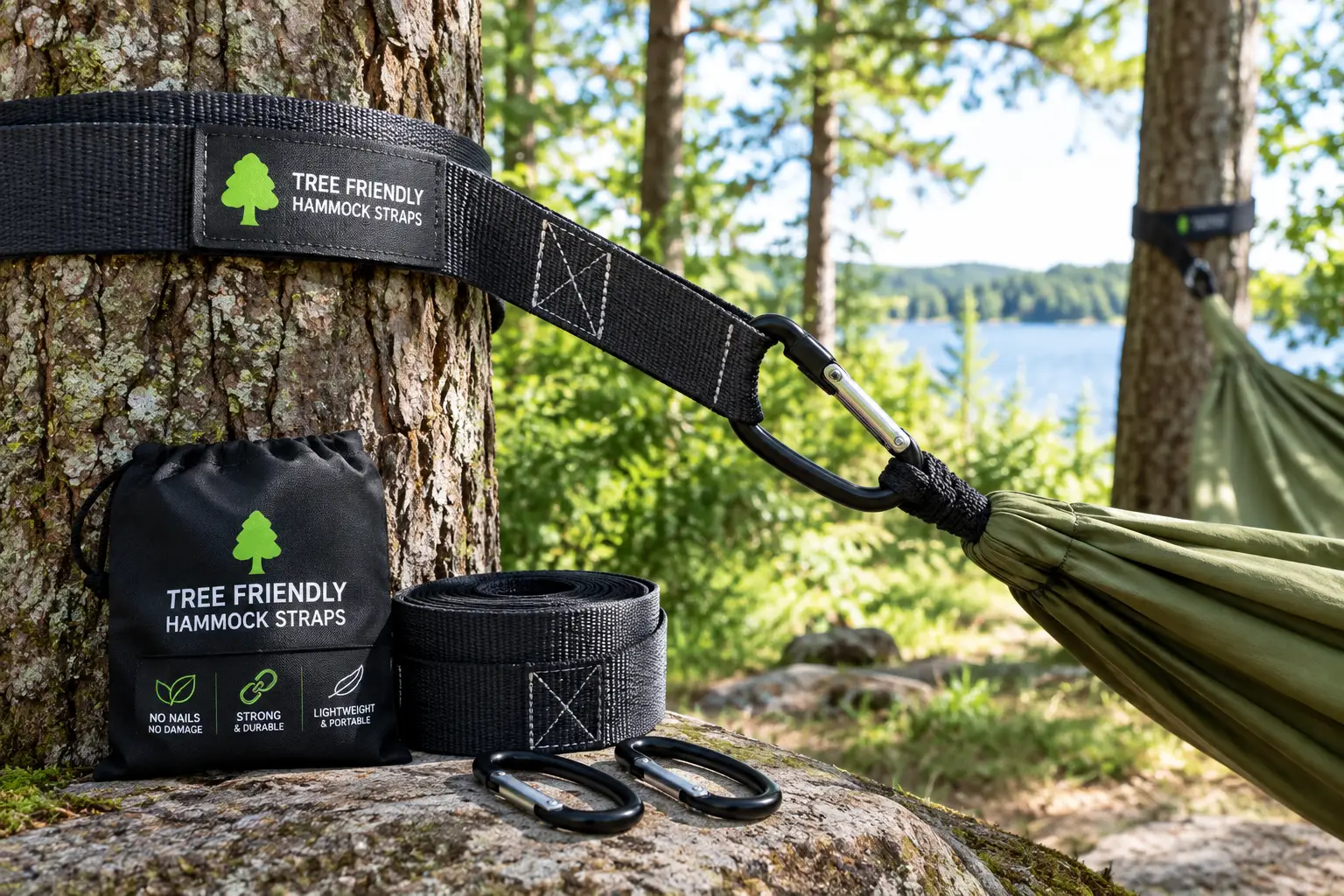
Tree friendly hammock straps are flat webbing straps, usually polyester, that wrap around a trunk to suspend a hammock. Because the webbing is at least about an inch wide where it touches the tree, it spreads the load across the bark instead of cutting into it, protecting the living cambium layer underneath.
Here’s the thing most first-time hangers don’t realize: the hammock gets all the attention, but the straps do all the work. They decide how fast you set up, how level you lie, whether you wake up with your backside on the ground, and — maybe most important — whether the tree you borrowed for the night looks the same when you leave.
That last point isn’t just good manners. As the Hammock camping entry on Wikipedia explains, most hammocks today hang from removable webbing “tree-huggers” precisely because they leave little or no mark, which is why the practice fits so well with Leave No Trace ethics. Rope, paracord, and thin cord do the opposite: they concentrate your weight on a narrow band and can grind through bark over repeated use.
The good news? You don’t need to spend much to get it right. At the time of writing, solid tree friendly hammock straps run from under $25 for budget kits to roughly $60 for ultralight specialty systems. The harder part is choosing among dozens of near-identical listings — and that’s where this guide comes in.
Below, you’ll find seven real, widely available options analyzed on the specs that actually matter: tree-contact width, length, adjustability, weight, and rated capacity. You’ll also get park-rule context, a step-by-step setup routine, and buyer profiles so you can match a strap to the way you actually hang. No invented test stories — just honest comparison of spec sheets and what real owners consistently report.
Quick Comparison: Tree Friendly Hammock Straps at a Glance
| Product | Length (per strap) | Width at tree | Rated capacity | Best for |
|---|---|---|---|---|
| Kammok Python 10 | 10 ft | 1.5 in (tapers to 0.75 in) | 500 lb | Kammok Python 10: best overall |
| ENO Atlas | 9 ft | 1.5 in (tapers to 0.75 in) | 400 lb | ENO Atlas: proven all-rounder |
| ENO Atlas XL | 13 ft 6 in | 1.5 in (tapers to 0.75 in) | 400 lb | ENO Atlas XL: wide-spaced or big trees |
| Wise Owl Outfitters 10 ft Straps | 10 ft | 1 in | ~500 lb (per listing) | Wise Owl Outfitters 10 ft Straps: budget kit with carabiners |
| Foxelli XL Hammock Straps | 10 ft | 1 in | 1,000 lb per strap (brand claim) | Foxelli XL Hammock Straps: max loops for the money |
| ENO Helios Ultralight | 8 ft 1 in | 1 in | 300 lb | ENO Helios Ultralight: toggle hammocks, fine-tuning |
| Kammok Python 10 UL | 10 ft | Variable width | 300 lb | Kammok Python 10 UL: gram-counting backpackers |
Looking at the table, the split is clear: the Kammok Python 10, ENO Atlas, and ENO Atlas XL all use a tapered design that puts 1.5 inches of webbing on the bark and slims down where you clip in, which is the smartest compromise between tree protection and pack weight. The Wise Owl Outfitters 10 ft Straps and Foxelli XL Hammock Straps use a uniform 1-inch width — tree-safe by most park standards, but with less margin on soft-barked trees.
Notice, too, how wildly the capacity numbers vary. A 1,000-lb-per-strap claim doesn’t automatically mean a stronger product than a 400-lb rating; brands don’t all rate the same way (more on that in the features section). For most solo hangers, any strap here comfortably exceeds real-world needs — so width, length, and weight should drive your choice.
💬 One click helps other shoppers make an informed choice too! 😊
Top 7 Tree Friendly Hammock Straps: Expert Analysis
1. Kammok Python 10 — best all-around tree protection
The Kammok Python 10 earns the top spot by pairing the widest tree-contact section in its class with more adjustment points than the famous ENO Atlas.
Each 10-foot strap has 20 daisy-chain loops (40 total), and Kammok’s variable-width webbing runs 1.5 inches at the tree before narrowing to 0.75 inches at the loops. In practice, that means you get bark-friendly contact where it counts without carrying a full-width strap’s bulk. Kammok also weaves the loops into the webbing (“Nano Weave”) rather than bar-tacking them, which cuts weight to roughly 8 ounces for the pair.
Based on comparing the specs, this is the strap for regular campers who want one pair that handles nearly every campsite. The extra foot of length over the ENO Atlas matters more than it sounds: it lets you wrap wider trunks and still reach the ideal hang angle.
Reviews on REI consistently note that owners find them softer and more compact than their older ENO straps, and several point out that the flat, woven loops feel sturdy.
Pros:
- ✅ Wide 1.5-inch section protects bark where it matters
- ✅ 40 total loops give fine height control
- ✅ Covered by Kammok’s lifetime warranty
Cons:
- ❌ Carabiners are not included in the box
- ❌ Costs more than generic Amazon strap kits
Typically in the $30–$40 range (check current price), it’s excellent value for anyone who camps more than a few nights a year.
2. ENO Atlas — the proven, reflective classic
The ENO Atlas is the strap many hammock owners start with, and for good reason: it set the template that most competitors now copy.
Each 9-foot strap is made from 1000D polyfilament webbing and tapers from 1.5 inches at the tree to 0.75 inches at the loops, with 30 combined attachment points and a 400-lb capacity. The whole pair weighs about 9 ounces. Reflective stitching runs the length of the webbing, which sounds minor until you’re hunting for your hang in a dark campground — the strap lights up in your headlamp beam.
Here’s what to weigh: the ENO Atlas is slightly shorter and has fewer loops than the Kammok Python 10, but it’s the easiest to find, it’s compatible with every carabiner-equipped ENO hammock, and its loops are true open loops rather than flat stitched points, so clipping in is quick.
Across REI reviews, owners repeatedly praise the stitching quality, durability over years of use, and dead-simple setup.
Pros:
- ✅ Tapered webbing balances tree protection and weight
- ✅ Reflective stitching improves nighttime visibility
- ✅ Huge owner base and long track record
Cons:
- ❌ 9-foot length limits very wide trunks
- ❌ Fewer loops than the Kammok alternative
Usually around $30–$35, it’s fair value — a safe, no-surprises choice for beginners and festival hangers alike.
3. ENO Atlas XL — longest reach for big trees
The ENO Atlas XL solves the one problem standard straps can’t: trees that are too far apart or too thick to wrap comfortably.
Each strap stretches to 13 feet 6 inches, with 15 attachment points per strap and the same 1.5-to-0.75-inch taper and 400-lb capacity as the standard ENO Atlas. The trade-off is weight, which climbs to about 13 ounces for the pair.
What most buyers overlook is how often campsites force awkward spacing. In established campgrounds, the “perfect” pair of trees is frequently taken, and the remaining ones may be 18 feet apart or have 30-inch trunks. Those extra 4.5 feet per side turn a no-go spot into a usable hang. That makes the ENO Atlas XL ideal for car campers, people hanging in mature Eastern hardwood forests, and anyone using a larger double hammock.
We couldn’t verify a separate, detailed body of reviews for the XL version specifically; it shares the ENO Atlas construction, so owner praise for that strap’s stitching and durability is the closest real proxy.
Pros:
- ✅ Longest strap here for wide tree spacing
- ✅ Same tree-friendly taper as the original
- ✅ Wraps thick trunks without losing hang height
Cons:
- ❌ Heaviest ENO strap option at about 13 ounces
- ❌ Loops spaced farther apart than on Kammok straps
Generally in the $40–$50 range, it’s worth the premium only if big trees or wide gaps are a regular headache.
4. Wise Owl Outfitters 10 ft Straps — budget kit with carabiners included
The Wise Owl Outfitters 10 ft Straps are the “just get me hanging” choice: everything you need comes in one inexpensive package.
You get two 10-foot polyester straps with 38 loops total, two carabiners, and a pouch. The webbing is 1 inch wide — the width Wise Owl says meets most public-park regulations. Current listings describe a capacity of around 500 lb, though you should confirm the exact figure on the listing you buy from, as older versions carried different claims.
Based on the specs, this is the strap for backyard loungers, casual park users, and anyone buying a first hammock on a budget. The included carabiners are a real saving if your hammock doesn’t come with them.
An honest caveat about reviews: outdoor-gear testers have criticized the short straps that ship with some Wise Owl hammocks for limited adjustability, but that criticism applies to a different, shorter product. For these 10-foot straps, we couldn’t verify a detailed breakdown of review themes beyond the listing’s generally positive rating, so weigh the specs more than the hype.
Pros:
- ✅ Carabiners and pouch included in the price
- ✅ 38 loops cover most tree distances
- ✅ Lowest cost of entry on this list
Cons:
- ❌ Uniform 1-inch width offers less bark margin
- ❌ Capacity claims vary between listing versions
Usually in the $15–$25 range, it’s hard to beat for occasional use.
5. Foxelli XL Hammock Straps — most loops for the money
The Foxelli XL Hammock Straps chase one goal: maximum adjustability at a budget price.
The set includes two 10-foot straps with 40 hammock loops plus 2 tree loops, made from triple-stitched, no-stretch polyester webbing. The whole set, including its carry bag, weighs about 0.66 lb (roughly 10.5 ounces). Foxelli claims 1,000 lb per strap; treat that as a strength marketing figure rather than a number to plan around, since brands don’t use one shared rating method.
On paper, this means you can micro-adjust your hang height almost as precisely as with the Kammok Python 10, for noticeably less money. It’s a good fit for families who keep a set in the car for park days and for new campers still learning what hang angle feels right.
Reviews on Foxelli’s own site consistently praise the heavy-duty stitching, the generous number of loops, and quick setup. Keep in mind that brand-site reviews are a curated sample.
Pros:
- ✅ 42 total loops for very fine adjustment
- ✅ No-stretch polyester keeps your height steady overnight
- ✅ Budget-friendly price for a 20-foot combined set
Cons:
- ❌ Carabiners not included per the Amazon listing
- ❌ 1-inch width may fall short of 2-inch park rules
Typically in the $15–$25 range — strong value if you don’t need a tapered, premium strap.
6. ENO Helios Ultralight — fine-tune adjustment in 4.3 ounces
The ENO Helios Ultralight swaps the daisy chain for something smarter: a cord-based Microtune adjustment that works more like a whoopie sling.
A 1-inch polyfilament tree strap is paired with Silverlite cord, bringing the pair to just 4.3 ounces with a 300-lb capacity. Each unit measures 8 feet 1 inch. Instead of choosing the “closest loop,” you slide the adjustment until your hammock sits exactly where you want it. It pairs natively with toggle-style hammocks such as ENO’s Sub series; carabiner hammocks work too.
Here’s what to weigh: that infinite adjustment is wonderful once you learn it, but it adds a small learning curve. And at 8 feet, it’s the shortest strap here, so big trunks or wide gaps can be a problem — ENO sells the Helios XL (13 ft 5 in, 6.3 oz) for that reason.
REI reviewers consistently like the weight savings and wider tension range, while some say it’s less intuitive than the ENO Atlas in the cold and dark, and a few worry about the length on larger trees. A Trailspace reviewer also noted wishing the straps were longer.
Pros:
- ✅ Infinite adjustment beats fixed loops for precision
- ✅ Very light at 4.3 ounces per pair
- ✅ Works directly with toggle-style hammocks
Cons:
- ❌ Shortest length on this list at 8 feet
- ❌ 300-lb capacity rules out most double setups
Usually in the $35–$45 range, it’s worth it for backpackers who hang often.
7. Kammok Python 10 UL — lightest pick at 3 ounces
The Kammok Python 10 UL is for hikers who weigh their gear in grams and still refuse to compromise on tree protection.
It keeps the familiar formula — 10 feet per strap and 20 daisy-chain points each — but switches to SpiraLine ultra-high-molecular-weight polyethylene webbing and a waterproofed ripstop stuff sack, dropping the pair to about 3.0 ounces. Capacity falls to 300 lb, and it works with both carabiner and toggle hammocks.
Based on comparing the specs, this is the rare ultralight suspension that doesn’t make you choose between low weight and simple loop-based setup. The ENO Helios Ultralight is slightly heavier but offers infinite adjustment; the Kammok Python 10 UL is lighter and uses familiar loops. Kammok’s variable-width design carries over, widening at the tree end to offset pressure on the bark.
We couldn’t verify a substantial body of independent reviews for this specific model, so we’re relying on the published specs and the reputation of the standard Kammok Python 10.
Pros:
- ✅ About 3 ounces — lightest option analyzed here
- ✅ Loop-based setup has no learning curve
- ✅ Compatible with toggles and carabiners
Cons:
- ❌ 300-lb capacity limits heavier users and doubles
- ❌ Priciest per ounce saved compared to standard straps
Generally in the $40–$60 range at the time of writing — a splurge that pays off only if weight is your top priority.
Head-to-Head: Weight, Adjustability, and Value Compared
| Product | Approx. weight (pair) | Adjustment | Carabiners included | Price range | Best for |
|---|---|---|---|---|---|
| Kammok Python 10 | ~8 oz | 40 loops | No | $30–$40 | Kammok Python 10: frequent campers |
| ENO Atlas | ~9 oz | 30 loops | No | $30–$35 | ENO Atlas: beginners wanting a proven name |
| ENO Atlas XL | ~13 oz | 30 loops | No | $40–$50 | ENO Atlas XL: big trunks, wide gaps |
| Wise Owl Outfitters 10 ft Straps | Not listed | 38 loops | Yes | $15–$25 | Wise Owl Outfitters 10 ft Straps: first-time buyers |
| Foxelli XL Hammock Straps | ~10.5 oz (with bag) | 40 + 2 loops | No | $15–$25 | Foxelli XL Hammock Straps: families, car kits |
| ENO Helios Ultralight | 4.3 oz | Infinite (Microtune) | No | $35–$45 | ENO Helios Ultralight: toggle-hammock backpackers |
| Kammok Python 10 UL | ~3 oz | 40 loops | No | $40–$60 | Kammok Python 10 UL: ultralight hikers |
Reading across the rows, the value sweet spot is obvious: the Kammok Python 10 gives you the most loops, a tapered tree section, and a lifetime warranty for only slightly more than the ENO Atlas. If budget is the deciding factor, the Wise Owl Outfitters 10 ft Straps win on total cost because carabiners are already in the box, which can save you another $10–$20.
For backpackers, the weight column tells the story. Dropping from roughly 9 ounces to 3–4 ounces is meaningful on a long trail, but you pay for it in capacity — both ultralight options stop at 300 lb, which rules out most two-person hangs.
✨ Don’t miss these tree-safe favorites!
🔍 Take your hammock setup to the next level with this carefully curated lineup. Click a highlighted strap to check current pricing and availability. These picks will help you hang faster, sleep better, and leave every tree just as you found it!
How to Hang Your Hammock Without Hurting the Tree
Owning tree friendly hammock straps is step one; using them correctly is what actually protects the bark. Here’s a first-use routine that works with any strap on this list.
Step-by-step setup 🌲
- Pick healthy, living trees. Look for trunks at least about 12 inches thick where the strap sits, and check overhead for dead branches before you commit.
- Aim for 12–15 feet between trees. That spacing suits most single hammocks; longer straps like the ENO Atlas XL stretch that range.
- Wrap at roughly head height. Pass the strap around the trunk and feed one end through the loop on the other end, so the webbing lies flat.
- Keep the webbing flat — no twists. A twisted strap narrows the contact area, which defeats the whole point of wide webbing.
- Clip in for a ~30-degree angle. Choose a loop that lets the suspension drop at about 30 degrees from horizontal; this gives a comfortable sag and less side pressure.
- Stay low. ENO’s Leave No Trace guidance suggests hanging no higher than about 18 inches off the ground.
Maintenance schedule 🧼
After each trip, shake out grit, which acts like sandpaper against the webbing. Hand wash as needed with mild soap and warm water — Kammok recommends exactly that — then air-dry completely, out of direct sun, before storing.
Common first-30-day mistakes
- Cinching the strap around a tiny sapling “because it looked sturdy.”
- Leaving straps tightened on trees all weekend, even when you’re off hiking.
- Skipping the bark check after takedown — if you see compression marks, add padding or choose a thicker tree next time.
Which Straps Fit Your Trip? Three Real-World Buyer Profiles
Choosing the best hammock straps for trees is easier when you start from how you’ll actually hang. Here are three common profiles, with budget, context, and frequency baked in.
Profile 1: The backyard and park lounger 🌤️
Budget: under $25. Use: a few afternoons a month in local parks or the backyard.
You don’t need ultralight fabrics or lifetime warranties — you need something simple that won’t get you a ranger warning. The Wise Owl Outfitters 10 ft Straps fit perfectly because the carabiners are included, and 38 loops accommodate the unpredictable spacing of park trees. If you already own carabiners, the Foxelli XL Hammock Straps give you even finer adjustment for similar money.
Profile 2: The weekend car camper 🚙
Budget: $30–$50. Use: 10–20 nights a year at established campgrounds, sometimes with a double hammock.
Campgrounds are where tree spacing gets awkward, and state-park strap rules actually get enforced. The Kammok Python 10 is the best hammock straps for trees pick here: its 1.5-inch contact section satisfies more regulations than 1-inch straps, and 40 loops handle odd gaps. If your favorite sites have massive trunks, step up to the ENO Atlas XL.
Profile 3: The ultralight backpacker 🎒
Budget: $35–$60. Use: multi-day trips where every ounce counts.
Your choice comes down to adjustment style. If you like the precision of a whoopie-style system and use a toggle hammock, go with the ENO Helios Ultralight (or its XL version for flexibility). If you’d rather keep familiar loops and save another ounce, the Kammok Python 10 UL is the lighter pick. Either way, confirm the 300-lb limit covers you plus your gear.
Troubleshooting: Common Strap Problems and Fixes
Even the best tree friendly hammock straps can cause frustration if something’s off. Here are the problems buyers mention most, with practical fixes.
Problem 1: “My hammock sags lower overnight.”
Fix: This usually isn’t the strap — polyester webbing is designed to be no-stretch — but the hammock fabric settling or a knot tightening. Hang slightly higher than you want at bedtime. If you’re using older nylon straps, upgrading to polyester (like the Foxelli XL Hammock Straps or Kammok Python 10) removes most stretch.
Problem 2: “The trees are too far apart.”
Fix: Look for longer straps or an extender. The ENO Atlas XL adds 4.5 feet per side over the standard ENO Atlas. Kammok also sells 2-inch-wide Python Extenders, which add reach while offering extra tree protection.
Problem 3: “The strap slides down the trunk.”
Fix: Smooth-barked trees like beech can let straps creep. Wrap the strap a second time around smaller trunks (if length allows) to increase friction and spread pressure, and make sure the webbing lies flat, not twisted.
Problem 4: “I’m between loops — one’s too tight, the next is too loose.”
Fix: Clip into the hammock-side loop on the other strap to shift the balance, or switch to an infinitely adjustable system like the ENO Helios Ultralight.
Problem 5: “I see marks on the bark.”
Fix: Your straps may be too narrow for that species, or the tree is too thin. Move to a thicker trunk, or add padding under the strap — some parks actually require it.
How to Choose Tree Friendly Hammock Straps
If you want a quick answer to how to choose tree friendly hammock straps, run through these seven checks in order.
- Tree-contact width comes first. Look for at least 1 inch, ideally 1.5 inches, at the tree. The Leave No Trace Center’s hammock camping guidance recommends “tree saver” straps of 0.75 to 1.5 inches and warns never to go thinner.
- Match length to your trees. Nine to ten feet per strap covers most sites; choose 13+ feet if you regularly hang from big trunks or wide gaps.
- Check the adjustment system. More loops (30–40) mean finer control; cord-based systems like Microtune offer infinite adjustment with a small learning curve.
- Confirm the material is no-stretch. Polyester and polyfilament webbing hold their length; stretchy nylon can drop you several inches overnight.
- Size capacity to your real load. Add your weight, your gear, and any second person. Solo hangers under 250 lb are fine with 300-lb straps; doubles need 400 lb or more.
- Consider pack weight honestly. Car campers can ignore a few ounces; thru-hikers shouldn’t.
- Verify hammock compatibility. Carabiner hammocks clip into any loop system, while toggle hammocks pair naturally with systems like the ENO Helios Ultralight or need carabiners added.
Get these seven right and you’ll narrow dozens of listings down to two or three genuinely good options in minutes.
Wide Hammock Tree Straps vs Rope, Chains, and Paracord
It’s tempting to grab whatever cord is in the garage. Here’s why wide hammock tree straps beat the alternatives almost every time.
| Suspension method | Tree contact | Stretch | Park acceptance | Best for |
|---|---|---|---|---|
| Wide hammock tree straps (1–1.5 in webbing) | Broad, flat | Minimal | Widely accepted | Nearly everyone |
| Whoopie sling + tree hugger strap | Broad at tree | Minimal | Accepted if hugger is wide | Ultralight tinkerers |
| Rope or paracord | Narrow, concentrated | Moderate to high | Often banned | Emergencies only |
| Chains or screw-in hooks | Metal on bark / hardware in wood | None | Generally prohibited on trees | Posts and stands, never trees |
The table shows the core issue: narrow cord concentrates your full body weight on a thin band of bark, while wide hammock tree straps spread the same load across many times the surface area. Rope also stretches and requires knots, which makes adjustment slow and inconsistent — especially in the dark.
Why width is the whole game
Beneath the bark sits the cambium, the thin growth layer that moves water and nutrients. Compressing or abrading it all the way around a trunk — “girdling” — can damage or even kill sections of the tree. Wider webbing lowers pressure per square inch, so the bark flexes instead of being crushed.
When a whoopie sling makes sense
Whoopie slings are lighter and infinitely adjustable, which is why the ENO Helios Ultralight borrows the concept. But the cord itself should never touch the bark — the tree-side portion must still be wide webbing.
Leave No Trace Hammock Straps: Park Rules, Safety, and Standards
Using leave no trace hammock straps isn’t only an ethical choice — in a growing number of public lands, it’s the rule. There’s no single federal hammock-strap standard, so regulations vary by agency and even by individual park.
What real state rules look like 📋
Minnesota is a clear example. The Minnesota DNR’s hammocking rules require trees at least 12 inches in diameter at the attachment point, straps at least 1 inch wide, one hammock per tree, and no stacking — and staff may require extra padding if bark shows damage.
Wisconsin goes further. According to the Wisconsin DNR’s hammocking and slacklining rules, padding must be used around the trunk, straps must be at least 1 inch wide and lie flat against that padding, rope and paracord are banned, and oak trees are off-limits entirely.
Other parks have been reported to go wider still: hammock communities and Kammok have cited 2-inch minimums in Florida and Texas state parks. Because these rules change, call or check the specific park before you go.
What this means for your purchase
- Tapered 1.5-inch straps (Kammok Python 10, ENO Atlas, ENO Atlas XL) clear most 1-inch rules with margin.
- Uniform 1-inch straps (Wise Owl Outfitters 10 ft Straps, Foxelli XL Hammock Straps) meet 1-inch rules but not 2-inch ones.
- For 2-inch parks, add wide extenders or tree-protection sleeves.
Safety basics ⚠️
Always inspect webbing for fraying before each trip, never hang from dead trees, and stay within your strap’s rated capacity.
Features That Actually Matter (and Ones That Don’t)
Strap listings love big numbers. Here’s how to separate meaningful specs from marketing noise.
Features that matter ✅
- Width at the tree. This is what protects bark and satisfies park rules. It deserves more weight in your decision than any other spec.
- Length. The difference between 8 and 10 feet decides whether you can use half the trees at a campsite.
- No-stretch webbing. Polyester or polyfilament keeps your hang consistent from bedtime to sunrise.
- Loop design. Open loops (like on the ENO Atlas) are easier to clip into; woven flat loops (like on the Kammok Python 10) pack smaller.
- Reflective stitching. A real safety bonus in busy campgrounds where people walk through at night.
Features that matter less than you’d think ❌
- Giant capacity claims. “2,000 lb” sounds reassuring, but ratings aren’t standardized. Some budget kits even list separate “breaking strength” and lower “rated” figures — one popular listing shows 1,200 lb breaking but 500 lb rated. Compare like with like, and treat enormous totals as marketing.
- Loop counts beyond ~30. Past that point, extra loops add fine-tuning you’ll rarely use.
- Included “bonus” accessories. Carabiners are genuinely useful; decorative extras aren’t.
The spec sheet won’t tell you this
Weight listings sometimes include the stuff sack or carabiners and sometimes don’t. The Foxelli XL Hammock Straps figure, for instance, includes its bag. When comparing ultralight options, check exactly what’s being weighed.
Common Mistakes to Avoid When Buying Hammock Straps
Even experienced campers make these errors when shopping for tree friendly hammock straps.
Mistake 1: Buying the cheapest short straps
Straps bundled with low-cost hammocks are often too short, with only a handful of loops. Testers at outdoor gear sites have criticized exactly this problem on bundled straps. If your hammock came with short straps, upgrading to 10-foot versions is the most noticeable improvement you can make for the least money.
Mistake 2: Ignoring your hammock’s connection type
Toggle-end hammocks and carabiner hammocks don’t connect the same way. Buying the ENO Atlas for a toggle hammock means you’ll need carabiners too — not a disaster, just an extra purchase to plan for.
Mistake 3: Assuming “1 inch” is always enough
It’s enough for many state parks, but not for places reported to require 2 inches. If you camp across state lines, a tapered 1.5-inch strap plus an extender gives you flexibility.
Mistake 4: Choosing ultralight for backyard use
Paying a premium for the Kammok Python 10 UL makes no sense if your straps never leave the car. Put the savings toward a better hammock or bug net instead.
Mistake 5: Forgetting to budget for carabiners
Most premium straps don’t include them. A realistic total budget is strap price plus roughly $10–$20 for a quality pair of carabiners, unless your hammock already has them.
Long-Term Cost and Maintenance
Tree friendly hammock straps are one of the cheapest pieces of camping gear you’ll own — but cost per use still varies a lot.
| Strap tier (example) | Price range | Nights per year | Years of use (assumed) | Approx. cost per night | Best for |
|---|---|---|---|---|---|
| Budget (Wise Owl Outfitters 10 ft Straps) | $15–$25 | 10 | 3 | ~$0.50–$0.85 | Casual users |
| Midrange (Kammok Python 10) | $30–$40 | 20 | 5 | ~$0.30–$0.40 | Regular campers |
| Ultralight (Kammok Python 10 UL) | $40–$60 | 25 | 4 | ~$0.40–$0.60 | Backpackers |
These numbers are illustrative assumptions, not measured lifespans, but they reveal something useful: a pricier strap used often can cost less per night than a budget strap used rarely. The Kammok Python 10 also carries a lifetime warranty, which improves its long-term math further if something fails.
Keep straps lasting longer 🔧
- Keep them clean. Grit trapped in webbing slowly abrades fibers.
- Dry before storing. Packing damp straps invites mildew and odor.
- Limit sun exposure. UV gradually weakens synthetic webbing, so don’t leave straps up for weeks.
- Retire damaged straps. Frayed edges, cut fibers, or torn loop stitching mean it’s time to replace — straps are cheap; falls are not.
FAQ: Tree Friendly Hammock Straps
❓ Are premium tree friendly hammock straps worth it over cheap Amazon kits?
❓ Do tree friendly hammock straps come with carabiners?
❓ Can I use hammock straps on posts, porches, or a stand?
❓ What length hammock straps should I buy for camping?
❓ Which hammock straps should I buy for a 2-inch park rule?
Conclusion: Hang Comfortably, Leave Every Tree Healthy
The right tree friendly hammock straps do three jobs at once: they make setup fast, they keep you at a steady, comfortable height all night, and they protect the trees that make hammock camping possible in the first place.
If you want one pair that handles almost everything, the Kammok Python 10 is the strongest all-rounder, with 1.5-inch tree contact, 40 loops, and a lifetime warranty. The ENO Atlas remains a trustworthy, widely available classic, while the ENO Atlas XL earns its place wherever trees are huge or spaced far apart. On a budget, the Wise Owl Outfitters 10 ft Straps and Foxelli XL Hammock Straps get you hanging responsibly for the price of a pizza. And for the trail, the ENO Helios Ultralight and Kammok Python 10 UL shave ounces without cutting corners on tree protection.
Whichever you pick, remember that technique matters as much as gear: choose healthy trunks, keep webbing flat, stay low, and check local rules before you go. Do that, and every campsite you use will look exactly the way you found it.
🌲 Ready to hang the responsible way?
🔍 Upgrade your setup with one of these proven, bark-safe picks. Click a highlighted strap to check current pricing and availability, and get ready for easier setups and better nights outdoors — for you and the trees!
Recommended for You
- Suspension Tent: 7 Best Picks That Won’t Let You Down (2026)
- Hammock Bar Guide 2026: 7 Best Picks That Finally Stop the Sag
- Hammock Chairs for Camping: 7 Best Picks That Rock in 2026
Disclaimer: This post contains affiliate links. As an Amazon Associate, I earn from qualifying purchases made through these links, at no additional cost to you.
✨ Found this article helpful? Share it with someone who needs it! 💬🤗