
In This Article
Hanging Tents for Trees: Why Campers Are Moving Sleep Off the Ground
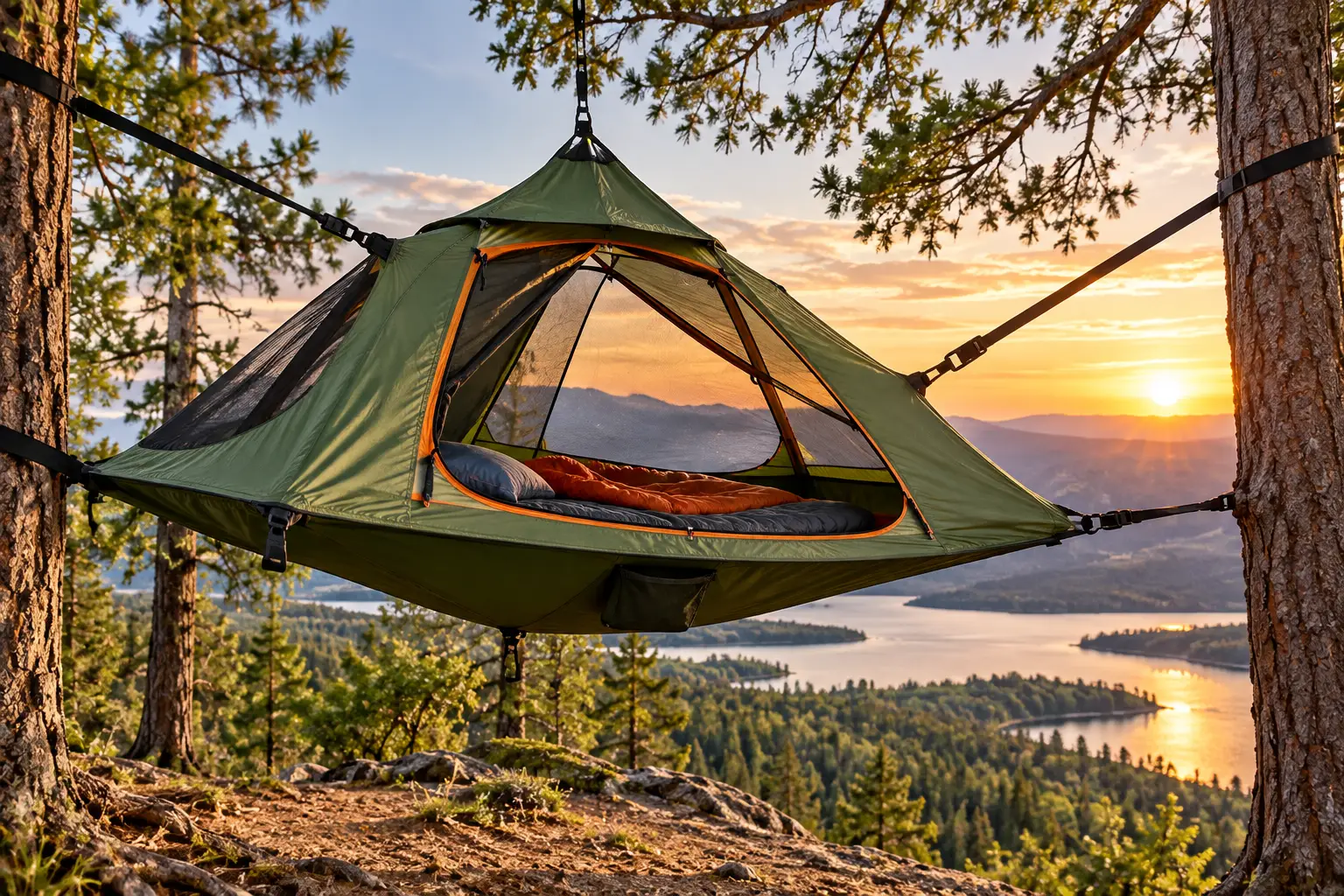
Anyone who has spent a night on a sloped campsite, feeling a root press into their hip at 3 a.m., already understands the appeal of hanging tents for trees. Instead of hunting for a flat, rock-free patch of dirt, you hang your bedroom from the trees themselves — above the puddles, the ants, and the lumpy ground. And the category has grown up fast. What started as a quirky crowdfunding-era novelty now includes three-person “treehouses in a bag,” lay-flat solo pods, and featherweight all-in-one hammock systems.
That variety is exactly why shopping for one feels confusing. A 25-pound, three-anchor tree tent and a 3-pound hammock tent both get sold as hanging tents for trees, yet they solve very different problems for very different campers. This guide sorts through seven real models available to US shoppers, compares their actual spec sheets, summarizes what owner reviews repeatedly report, and then goes further than any product listing: setup advice, buyer scenarios, cost-of-ownership math, and the tree-protection rules that can earn you a ticket if you ignore them.
What Are Hanging Tents for Trees?
Hanging tents for trees are fully enclosed shelters suspended above the ground from tree trunks with webbing straps. They blend a hammock’s off-ground comfort with a tent’s bug netting, rainfly, and gear storage. Designs range from three-point “tree tents” with flat, taut floors to two-point hammock tents shaped by spreader bars or ridgelines.
As the Wikipedia overview of the tree tent points out, the portable format gives you far more freedom in choosing a spot than either a permanent treehouse or a conventional ground tent. In practice, that means riverbanks, rooty forest floors, and slopes suddenly become usable campsites.
Quick Comparison: 7 Hanging Tents for Trees at a Glance
Before diving into the details, here’s the shortlist in one scannable view. Price ranges reflect what we saw at the time of writing — prices shift often, so always check the current listing.
| Model | Type | Capacity | Packed Weight | Price Range | Best for |
|---|---|---|---|---|---|
| Tentsile Stingray V3 | 3-point tree tent | 3 people / 880 lb | ~25 lb | $800–$900 | Families and base camps |
| Tentsile Connect V3 | 3-point tree tent | 2 people / 880 lb | ~21 lb | $550–$650 | Couples who car camp |
| Tentsile Flite+ V3 | 3-point tree tent | 2 people / 485 lb | ~10 lb | $400–$450 | Backpacking couples |
| Haven XL | 2-point lay-flat hammock tent | 1 person / 285 lb | ~6.3 lb (kit) | $330–$420 | Side and stomach sleepers |
| Hennessy Hammock Explorer Deluxe Asym Zip | 2-point asymmetric hammock tent | 1 person / 300 lb | ~3.2 lb | $250–$330 | Tall solo campers |
| Kammok Mantis | 2-point all-in-one hammock tent | 1 person / 500 lb | ~3 lb | $275–$325 | Weight-conscious hikers |
| Lawson Blue Ridge Camping Hammock | Hammock / ground-bivy hybrid | 1 person / 250 lb | ~4.25 lb | $200–$250 | Budget-minded first-timers |
Looking at the table, the split is obvious: the three Tentsile models are multi-person platforms that trade weight for space, while the other four are solo shelters built to ride in a backpack. If you’re hiking more than a mile to camp, the Kammok Mantis and Hennessy Hammock Explorer Deluxe Asym Zip are the realistic options; if you’re camping with kids, only the Tentsile Stingray V3 truly fits the job. The Haven XL sits in its own lane — heavier than a classic hammock, but the only pick here that lets side sleepers lie genuinely flat.
💬 One click helps other shoppers make an informed choice too! 😊
Top 7 Hanging Tents for Trees: Expert Analysis
Each pick below was chosen from real spec sheets and aggregated owner feedback, covering entry-level, mid-range, and premium options. No invented tests, no made-up quotes — just what the numbers and the reviews actually say.
1. Tentsile Stingray V3 — the flying treehouse for families
If you want a genuine treehouse in a bag that swallows a whole family, the Tentsile Stingray V3 is the benchmark every other tree tent is measured against.
Its triangular floor covers roughly 78 square feet with a 4-foot peak height, and the 880-lb total capacity means three adults — or two adults and two kids — plus gear, without anyone doing nervous math before climbing in. A central floor hatch and underfloor storage nets move bulky packs out of the sleeping area, while the 5,000mm-rated rainfly can extend toward the ground to create a sheltered, dry zone underneath. The 240D floor fabric and heavy-duty ratchets explain the roughly 25-lb packed weight: this tent is engineered for tension, not trail miles.
Based on the specs, the Stingray is a car-camping and backyard product, full stop. Hauling it more than a few hundred yards gets old quickly, and you need three healthy trees in a workable triangle. But for families, lakeshores, or rocky riverbanks where a ground tent is hopeless, nothing on this list offers the same sprawl.
Reviews consistently praise the space and stability once it’s rigged; the most common complaint in independent reviews is that first-timers struggle with tree spacing and strap tension.
Pros:
- ✅ Sleeps three adults with room left for gear
- ✅ Taut three-point floor feels stable, not saggy
- ✅ Rainfly creates a dry storage zone underneath
Cons:
- ❌ Around 25 lb packed — not a backpacking tent
- ❌ Requires three well-spaced, mature trees
💲 Expect roughly $800–$900 (check the current price) — steep, but justified if three people will genuinely use it several times a year.
2. Tentsile Connect V3 — the couple’s sweet spot
The Tentsile Connect V3 delivers the same 880-lb rating as its bigger sibling in a two-person package that’s easier to rig and kinder to your wallet.
It offers about 52 square feet of floor space, a 36-inch peak height, and four doors, packing down to roughly 23 x 13 x 9 inches at around 21 lb. The standout feature is the seatbelt-webbing reinforced floor with an adjustable central underfloor strap, which splits the surface into two separate sleeping bays. In practice, that means you don’t slowly roll into your partner — or toward the heavier sleeper — in the middle of the night, the single most common comfort problem in two-person suspended shelters. Tentsile’s recommended minimum tree diameter of 16 inches is a useful reality check: this needs mature trees, not saplings.
For couples who drive to camp, the Connect is arguably the best-balanced Tentsile model. Compared with the Flite+, you trade about 11 extra pounds for a thicker floor, more headroom, and far more storage — the right trade when the car is parked nearby.
Owner feedback frequently describes it as comfortable and genuinely fun, and reviewers note that the anti-roll strap can be tuned for uneven weights; the recurring gripe is bulk, especially repacking the bag.
Pros:
- ✅ Anti-roll strap creates two distinct sleeping bays
- ✅ High 880-lb capacity for two adults plus gear
- ✅ Four doors make entry easy from any side
Cons:
- ❌ About 21 lb, so best near the car
- ❌ Repacking into the bag takes patience
💲 Typically $550–$650 at the time of writing — strong value for couples who camp often.
3. Tentsile Flite+ V3 — lightest two-person tree tent option
The Tentsile Flite+ V3 is Tentsile’s answer to hikers who want a flat, three-point floor without hauling a family-sized platform.
On paper, it offers a 485-lb capacity, about 43 square feet of floor space, a 32-inch peak height, and a packed weight near 10 lb in an 18 x 9 x 9-inch bundle. It uses a single ratchet instead of three, which saves weight but means tensioning takes more care. Its base fabric is rated for 1,500 hours of UV exposure versus 2,500 for the Connect and Stingray — translation: it’s built for trips, not for staying pitched in the backyard all summer. Split between two hikers, though, you each carry roughly 5 lb, which is competitive with a heavy two-person backpacking tent.
This is the pick for backpacking couples who value comfort over the lightest possible base weight. Taller campers should note that Tentsile has marketed the Flite as fitting two people under about 6’1″.
Independent reviews found lying down very comfortable but sitting up cramped, and earlier versions drew criticism for limited pockets; finding three suitable trees also takes practice.
Pros:
- ✅ Light enough to split between two backpacks
- ✅ Flat three-point floor beats a sagging hammock
- ✅ Removable rainfly for stargazing on clear nights
Cons:
- ❌ Cramped when sitting upright
- ❌ Lower UV rating limits long-term pitching
💲 Usually $400–$450 — the most affordable way into two-person tree tent camping.
4. Haven XL — truly flat sleep for side sleepers
The Haven XL solves the classic hammock complaint — the “banana” curve — by creating a genuinely flat, bed-like platform in the air.
Rigid spreader bars at each end work together with a fitted, insulated rectangular air pad that’s actually part of the structure, holding the floor square and level. The XL’s pad is 6 inches wider and 2 inches longer than the original Haven Tent’s, which matters if you toss, turn, or sleep curled on your side. Haven lists a 285-lb capacity, a complete kit weight around 6 lb 5 oz, and 4,000mm waterproof ratings for its hammock tent body and rainfly. It can also be pitched on the ground with trekking poles, so a treeless campsite isn’t a dead end.
This is the one to buy if a traditional hammock has never let you sleep well. The trade-off is weight and flexibility: you can’t swap in a lighter pad, because the lay-flat effect depends on that exact fitted mattress.
Reviews consistently praise how flat and bed-like it feels; common criticisms include the weight for a one-person shelter and the pad occasionally shifting sideways when moving around inside.
Pros:
- ✅ Genuinely flat for side and stomach sleepers
- ✅ Insulated pad included — no separate underquilt needed
- ✅ Converts to a ground bivy without trees
Cons:
- ❌ Heavy for a solo shelter
- ❌ Locked into the proprietary sleeping pad
💲 Around $330–$420 depending on bundle — excellent value if comfort is your top priority.
5. Hennessy Hammock Explorer Deluxe Asym Zip — roomy asymmetric comfort for tall campers
The Hennessy Hammock Explorer Deluxe Asym Zip is a time-tested design built around a diagonal lay that feels flatter than a standard hammock.
It supports campers up to 7 feet tall and 300 lb, with a packed weight around 3 lb 3 oz. The body uses 140D high-density nylon taffeta, while the rainfly is 70D coated polyester ripstop; no-see-um mesh is permanently attached. A structural ridgeline keeps the hammock’s sag identical no matter how far apart the trees are, which removes most of the guesswork beginners face. A side #10 YKK zipper replaces Hennessy’s older bottom-entry design, and complimentary 42-inch “Tree Hugger” webbing straps are included to protect bark.
Tall solo backpackers are the target here. The asymmetric cut lets you lie at an angle with better support under your knees and back — but in cool weather, you’ll still need a pad or underquilt, because air under a hammock steals heat quickly.
Many owners describe the diagonal lay as very comfortable, while some reviewers find the included straps short for larger trunks. OutdoorGearLab’s testers were less impressed by the closely related Expedition Asym Zip, calling it heavier and less comfortable than their top-rated hammocks.
Pros:
- ✅ Fits campers up to 7 feet tall
- ✅ Ridgeline keeps the same sag every setup
- ✅ Durable 140D fabric resists bites and abrasion
Cons:
- ❌ Insulation must be bought separately
- ❌ Included straps can be short for thick trees
💲 Generally $250–$330 — fair value for a complete, proven shelter.
6. Kammok Mantis — 500-lb strength at backpacking weight
The Kammok Mantis packs a hammock, bug net, and rainfly into one modular system that weighs about as much as a liter of water and a half.
The current Mantis uses 100% recycled, bluesign-approved 40D nylon and carries a 500-lb weight rating, with a total system weight close to 3 lb. An integrated structural ridgeline, built-in pockets, and a knotless suspension (Kammok claims about a 60-second setup) keep the learning curve short. A smart two-compartment stuff sack lets you stash a wet rainfly separately so the hammock body stays dry. Kammok also sells a Mantis UL version in 20D fabric that drops to about 2 lb 3 oz but lowers capacity to 300 lb.
For backpackers, the modularity is the real feature: leave the rainfly home on a clear forecast, or skip the bug net in shoulder season. Despite the 500-lb rating, it’s a one-person shelter, not a couple’s bed.
On REI, the recycled Mantis averaged roughly 4 out of 5 across a modest number of reviews at the time of research, with praise for quick setup and staying dry through rain; the UL version drew noticeably more mixed ratings.
Pros:
- ✅ High 500-lb rating at roughly 3 lb
- ✅ Modular pieces let you shed weight
- ✅ Two-compartment bag separates the wet rainfly
Cons:
- ❌ Insulation not included for cold nights
- ❌ UL version reviews are notably mixed
💲 Roughly $275–$325 — a strong value for an all-in-one kit with this strength-to-weight ratio.
7. Lawson Blue Ridge Camping Hammock — budget hybrid that pitches on the ground
The Lawson Blue Ridge Camping Hammock is the rare shelter that works as a hammock tent between trees and as a small bivy tent on open ground.
At about 4.25 lb with a 250-lb capacity, it uses spreader bars plus arched aluminum poles to lift the bug net and rainfly like a mini dome. That structure is what makes it practical: you get enough headroom to sit up and rummage for gear, and the bed stays wider and tauter than a gathered-end hammock. Its rainfly is closely fitted to the body, and with no trees nearby, you can stake it out as a ground shelter.
This is a smart first purchase for motorcycle campers, car campers, and anyone unsure whether they’ll always find trees. It’s not for ultralight hikers — the poles and bars add weight — and heavier campers will bump against the 250-lb limit.
Reviews frequently praise its versatility and how dry it stays in rain. Long-term reviewers note it’s sensitive to hang tension: rigged too tight, it can feel tippy, so a test hang is worth the time. Ground mode is also reported as less roomy than hanging mode.
Pros:
- ✅ Works hanging or pitched on the ground
- ✅ Arched poles give real sitting headroom
- ✅ Well-fitted rainfly keeps occupants dry
Cons:
- ❌ Can feel tippy if hung too tight
- ❌ Lower 250-lb capacity than rivals
💲 Typically $200–$250 — the best entry price for a true hybrid.
Side-by-Side: How the 7 Picks Really Compare
| Model | Anchor Points | Sleep Surface | Rainfly Included | Ground Mode | Review Sentiment | Best for |
|---|---|---|---|---|---|---|
| Tentsile Stingray V3 | 3 | Flat, taut floor | Yes | Optional kit | Loved for space; setup learning curve | Families |
| Tentsile Connect V3 | 3 | Flat, two bays | Yes | Optional kit | Comfortable; bulky to pack | Couples, car camping |
| Tentsile Flite+ V3 | 3 | Flat floor | Yes | No | Comfy lying down; cramped sitting | Backpacking pairs |
| Haven XL | 2 | Flat (fitted pad) | Yes | Yes | Top marks for flat sleep; heavy | Side sleepers |
| Hennessy Hammock Explorer Deluxe Asym Zip | 2 | Diagonal lay | Yes | Limited | Comfortable; mixed on straps | Tall solo hikers |
| Kammok Mantis | 2 | Diagonal lay | Yes | No | Solid; UL version mixed | Lightweight trips |
| Lawson Blue Ridge Camping Hammock | 2 | Spread, taut bed | Yes | Yes | Versatile; tension-sensitive | First-timers |
The pattern here is simple: anchor points decide almost everything. Three-point Tentsile designs give you the flattest multi-person floor but demand a very specific tree layout, while two-point models like the Kammok Mantis hang almost anywhere two trees stand. If ground backup matters, only the Haven XL and Lawson Blue Ridge Camping Hammock convert cleanly without buying extra kits.
✨ Don’t miss the right fit for your next trip!
🔍 Take your camping to the next level with this carefully curated lineup. Click a highlighted item to check current pricing and availability — these picks will help you sleep better off the ground on every adventure the whole family will enjoy! 🏕️
Your First Night: A Practical Setup Guide for Hanging Tents for Trees
Buying the shelter is the easy part; the first night is where most frustration happens. A little preparation turns that learning curve into a short one.
Before You Leave Home
Do a full backyard or park rehearsal first. Three-point tree tents especially reward practice: you’re looking for three trees that form a roughly equal triangle, then leveling the floor with the ratchets. Two-point hammock tents are simpler, but you still want to learn how far apart your trees should be and how high to set the straps. Pack a small repair kit, a headlamp, and — for any Tentsile — a way to protect the bark where the straps wrap.
At Camp
Choose living, sturdy trees and wrap straps at the thickest part of the trunk. Leave No Trace’s hammock camping guidance recommends webbing straps at least 1 inch wide, camping at least 200 feet from water and trails in the backcountry, and hanging over durable surfaces like rock, gravel, or dry grass. Look up before you commit: dead limbs overhead are a genuine hazard in wind. Tentsile recommends a setup height of about 4 feet, low enough that a slip is a bump rather than an injury.
Common Mistakes in Your First 30 Days
- ❌ Forgetting to lock all ratchets before climbing in.
- ❌ Skipping insulation on a “warm” night — air underneath chills you fast.
- ❌ Hanging a spreader-bar hammock, like the Lawson Blue Ridge Camping Hammock, too tight, making it tippy.
- ❌ Leaving a tree tent pitched for weeks; UV exposure wears fabric out.
- ❌ Not re-tensioning after 20 minutes, once webbing settles.
Real-World Scenarios: Matching the Right Hanging Tent to the Right Camper
Specs only matter in context. Here’s how four realistic buyer profiles map onto the lineup.
🚙 The Lakeside Family (budget: up to ~$900, 5–6 weekends a year)
Two parents and two kids who drive to state park campgrounds need space, stability, and a floor that doesn’t dump everyone into the middle. The Tentsile Stingray V3 fits: its 880-lb capacity covers the family plus gear, and the rainfly’s covered zone beneath the tent doubles as a rainy-day hangout. The catch is campground rules — confirm tree hanging is allowed before you book.
🥾 The Backpacking Couple (budget: ~$450, 10–15 trail nights a year)
For a pair hiking forested ridges, weight splits change the math. The Tentsile Flite+ V3 at about 10 lb becomes roughly 5 lb each — manageable — and delivers a shared, flat floor. If one partner often hikes solo, a pair of Kammok Mantis systems may be more flexible, at similar total weight.
🏍️ The Side-Sleeping Motorcycle Camper (budget: ~$400, frequent trips)
Riders care less about ounces and more about sleeping well after a long day. The Haven XL is the standout: it lies flat, includes insulation, and can pitch on the ground at treeless campsites. Its packed size fits in a saddlebag or tail bag setup more easily than any Tentsile.
🌱 The Curious First-Timer (budget: ~$250, a few trips a year)
If you’re testing whether suspended camping is for you, the Lawson Blue Ridge Camping Hammock limits risk: it’s the cheapest here and still works as a small ground tent if you end up somewhere without trees. Tall first-timers might prefer the Hennessy Hammock Explorer Deluxe Asym Zip instead, thanks to its 7-foot height limit.
Problem → Solution: Fixing the Most Common Suspended-Camping Headaches
Even the best shelter has quirks. These are the problems owners mention most often, and how to fix them.
1. “My back gets cold even in a warm sleeping bag.” 🥶 Your bag’s insulation compresses under your body, and moving air below steals heat. The fix is insulation under you: an underquilt or a closed-cell pad for the Kammok Mantis or Hennessy Hammock Explorer Deluxe Asym Zip, or the included insulated pad in the Haven XL.
2. “We keep rolling into the middle.” 🔄 In two-person tree tents, tighten or adjust the central underfloor strap. The Tentsile Connect V3 is designed exactly for this, and the strap can be tuned for partners of different weights.
3. “I can’t find three trees that line up.” 🌲 Three-point shelters need a workable triangle, which is harder in sparse or young forests. Scout campsites via photos first, carry longer straps, or choose a two-point design. When there may be no trees at all, the Lawson Blue Ridge Camping Hammock and Haven XL can pitch on the ground.
4. “Everything feels damp by morning.” 💧 Condensation builds when a rainfly is pinned tight with no airflow. Pitch the fly with open ends or vents when rain isn’t blowing sideways, and store a wet fly separately — the Kammok Mantis bag’s dual compartments make this easy.
5. “The floor sagged overnight.” 📉 Webbing and fabric settle under load. Re-tension ratchets or straps after your first 20 minutes inside, and again in the morning before packing so you learn your shelter’s stretch.
How to Choose Hanging Tents for Trees
Choosing well comes down to seven honest questions. Answer them in order, and the right model usually becomes obvious.
- Count your sleepers and add margin. Pick a capacity that covers everyone plus gear, with room to spare; weight limits are ceilings, not targets.
- Decide how far you’ll carry it. Under a quarter-mile from the car, any model works; beyond that, stick to shelters under about 10 lb total.
- Be honest about how you sleep. Back sleepers adapt to hammocks easily; side and stomach sleepers are happier with a flat floor or lay-flat design.
- Match your typical forest. Dense woods with mature trees suit three-point tree tents; mixed or sparse terrain favors two-point hammock tents.
- Check the weather protection. Look for an included, full-coverage rainfly and integrated bug mesh — both matter more than any gimmick.
- Plan your insulation. Budget for an underquilt or pad unless one is included, because cold nights are the top complaint from new hangers.
- Consider a ground backup. If trees aren’t guaranteed, prioritize a model that pitches on the ground.
Tree Tents vs. Hammock Tents vs. Ground Tents
It helps to separate three product families that often get lumped together. Tree tents — the three-point Tentsile style — create a taut, triangular floor that feels more like a trampoline than a hammock and can hold two or three people. Hammock tents hang from two points, sleep one person, and rely on ridgelines, spreader bars, or an asymmetric cut to flatten the lay. Ground tents need no trees at all but demand flat, clear, dry dirt.
According to Wikipedia’s hammock camping entry, comfort and better sleep are the main draws for most hammock campers, and removable webbing straps allow campers to follow Leave No Trace principles with little to no mark on trees. That’s the real advantage both suspended styles share over a ground tent: the terrain underneath stops mattering.
| Feature | Tree Tents (3-point) | Hammock Tents (2-point) | Traditional Ground Tents |
|---|---|---|---|
| Needs flat ground | No | No | Yes |
| Typical capacity | 2–3 people | 1 person | 1–6+ people |
| Typical weight | 10–25 lb | 3–6 lb | 3–15 lb |
| Setup difficulty | Moderate to high | Low to moderate | Low |
| Works without trees | Only with add-on kits | Some models | Always |
| Best for | Group comfort, rugged terrain | Solo backpacking | Open terrain, big groups |
Reading the table, tree tents win on comfort for groups in rough terrain, while hammock tents dominate for solo hikers counting ounces. Ground tents still win whenever trees are scarce or the group is large, which is why hybrids like the Lawson Blue Ridge Camping Hammock and Haven XL are so appealing to people who can’t predict their campsite.
Lay Flat Hammock Tent Designs: Hype or Real Upgrade?
The phrase “lay flat hammock tent” gets thrown around loosely, so it’s worth separating marketing from mechanics. A standard gathered-end hammock curves by nature. The asymmetric approach — used by the Hennessy Hammock Explorer Deluxe Asym Zip and the Kammok Mantis — flattens things by letting you lie diagonally across the fabric. That’s a big improvement for back sleepers, but you’re still in a gentle cradle.
A true lay flat hammock tent adds rigid structure. The Haven XL combines end spreader bars with a fitted rectangular pad so the sleeping surface stays square and level, which is why side and stomach sleepers are its most enthusiastic fans. The Lawson Blue Ridge Camping Hammock sits in between: its spreader bars and arched poles keep the bed wider and tauter than a gathered-end hammock, though not as dead flat as the Haven.
Three-point tree tents achieve flatness differently — through tension from three directions rather than rigid bars. The result feels firm and slightly springy, closer to a water bed than a mattress.
So is the lay-flat idea real? Yes, with a price: structure adds weight. Any lay flat hammock tent will be heavier than an equivalent asymmetric hammock, and it may lock you into specific accessories. If you already sleep well in a hammock, you don’t need one. If you’ve given up on hammocks because of back or shoulder pain, it’s the upgrade most worth paying for.
Hammock Tent with Rainfly: Staying Dry, Warm, and Bug-Free
A hammock tent with rainfly is only as good as how you pitch it. Coverage comes first: the fly should extend well past both ends of the hammock so wind-driven rain can’t reach the fabric. Every model in this guide includes a rainfly, but sizes and cuts differ — the Lawson Blue Ridge Camping Hammock uses a close-fitting fly, while the Kammok Mantis uses a larger tarp-style fly that also creates a small covered area beside you.
Waterproof ratings help you compare. Tentsile specs its flies around 5,000mm, and Haven lists 4,000mm for its fly and tent body. Anything in that range handles serious rain when pitched tight with sloped panels that shed water rather than pool it.
Bugs are the other half of the story. Integrated no-see-um mesh, found on all seven picks, is a major upgrade over a bare hammock, especially in humid Southern forests. Keep the mesh zipped even when you step out briefly — mosquitoes find the gap faster than you’d think.
Warmth is where many campers get surprised. A hammock tent with rainfly blocks wind and rain, but it doesn’t insulate against cold air beneath you. Pair the fly with an underquilt or a pad, and in shoulder season, lower the fly’s edges to cut drafts. On humid nights, raise them again to reduce condensation.
Suspended Tree Tent Safety, Regulations, and Tree-Friendly Rules
A suspended tree tent puts real load on living trees, so safety and rules deserve more attention than they usually get. There’s no widely cited federal safety standard written specifically for camping hammocks or tree tents, which means manufacturer ratings and your own inspection are your main safety net. Tentsile’s manual, for example, calls for a visual and hands-on check of the floor, straps, and ratchets before every use, and warns against exceeding the maximum load.
Height is the simplest safety lever. Tentsile recommends pitching around 4 feet up, while Leave No Trace suggests hammocks hang no higher than about 18 inches. Either way, hang only as high as you’d be comfortable falling.
Regulations vary widely by land manager. Some parks ban hanging anything from trees; others permit it with conditions. Texas Parks and Wildlife’s rules are a good example of what to expect: trees must be at least 8 inches in diameter where the strap contacts them, straps must be at least 2 inches wide, no more than two straps per tree, and overnight hammocks must stay within your campsite. Several national parks restrict hammocks too, and a few, such as Zion and Bryce Canyon, have banned them from the backcountry.
Before any trip with a suspended tree tent, check the specific park’s rules page or call the ranger station. Use wide webbing or tree protectors, never nails, screws, or zip ties, and take your shelter down when you leave camp so wildlife doesn’t tangle in it.
Long-Term Cost and Maintenance
Sticker price tells only part of the story. A more useful number is cost per night — and, for multi-person shelters, cost per person per night. The estimates below assume 15 nights a year over three years (45 nights) and use the midpoint of each price range, so treat them as ballpark figures rather than exact math.
| Model | Midpoint Price | Est. Cost per Night | Est. Cost per Person-Night | Likely Extra Costs | Best for |
|---|---|---|---|---|---|
| Tentsile Stingray V3 | ~$850 | ~$19 | ~$6 (3 people) | Tree protectors, sleeping pads | Frequent family use |
| Tentsile Connect V3 | ~$600 | ~$13 | ~$7 (2 people) | Tree protectors, insulation | Regular couple trips |
| Tentsile Flite+ V3 | ~$425 | ~$9 | ~$5 (2 people) | Insulation | Budget-savvy pairs |
| Haven XL | ~$375 | ~$8 | ~$8 | Few (pad included) | Comfort-first solo |
| Hennessy Hammock Explorer Deluxe Asym Zip | ~$290 | ~$6 | ~$6 | Underquilt, longer straps | Tall solo hikers |
| Kammok Mantis | ~$300 | ~$7 | ~$7 | Underquilt | Lightweight solo trips |
| Lawson Blue Ridge Camping Hammock | ~$225 | ~$5 | ~$5 | Underquilt or pad | Occasional campers |
The numbers flip the usual assumption: the expensive Tentsile Stingray V3 becomes one of the cheapest options per person when a family actually uses it. Meanwhile, the Haven XL‘s included insulated pad narrows its real-world gap with cheaper hammocks that need an underquilt, which can easily add $100 or more.
Maintenance is refreshingly simple. Dry every piece fully before storing to prevent mildew, keep fabric out of long sun exposure (Tentsile rates its floors in UV hours for a reason), inspect webbing for fraying before each trip, and replace worn straps rather than gambling on them.
Features That Actually Matter (and Ones That Don’t)
Marketing copy for hanging tents for trees is full of impressive-sounding details. Here’s how to separate the ones that change your night from the ones that just decorate a listing.
✅ Features That Matter
- Weight capacity with margin. It’s a hard safety ceiling — respect it and leave headroom for gear.
- Anti-roll systems in multi-person tents. The adjustable strap on the Tentsile Connect V3 directly fixes the biggest two-person comfort problem.
- Structural ridgelines. On the Hennessy Hammock Explorer Deluxe Asym Zip and Kammok Mantis, they give you the same comfortable sag every time.
- Integrated bug mesh and a full-coverage rainfly. These are what make a hammock a shelter rather than a lounge.
- Ground-mode capability. For unpredictable terrain, it’s insurance.
⚠️ Features That Matter Less Than You’d Think
- Floor area in marketing photos. Usable space depends on peak height and wall slope, not just square footage.
- “Four-season” labels. Without serious insulation, cold nights are uncomfortable in any suspended shelter.
- Color and camo options. Nice for hunters or photographers, irrelevant to comfort.
- Ultra-low weight claims. A lighter number often excludes straps, stakes, or the fly — compare packed weights, not “trail” figures.
FAQ About Hanging Tents for Trees
❓ Are hanging tents for trees worth the money compared to a regular tent?
❓ Can I leave a tree tent up in my backyard all summer?
❓ Can kids sleep safely in a suspended tent?
❓ Do I need a sleeping pad in a hammock tent?
❓ Where can I buy a tree tent with a rainfly included?
Conclusion: Picking the Right Hanging Tent for Your Trees
The best hanging tents for trees don’t share one design — they share a purpose: getting you off bad ground and into better sleep. Which one fits depends on who’s sleeping, how far you’re walking, and how you like to lie down.
For families and group base camps, the Tentsile Stingray V3 remains the flagship choice, and its cost per person looks far better than its sticker price suggests. Couples who car camp will find the Tentsile Connect V3 the most balanced option, while backpacking pairs can split the Tentsile Flite+ V3 between two packs. Side and stomach sleepers should look first at the Haven XL, the only true lay-flat design here. Tall solo hikers are well served by the Hennessy Hammock Explorer Deluxe Asym Zip, weight-watchers by the modular Kammok Mantis, and budget-minded first-timers by the versatile Lawson Blue Ridge Camping Hammock.
Whatever you choose, protect the trees that hold you up: wide straps, healthy trunks, and a quick check of local rules before every trip. Do that, and your shelter will keep paying off for years of nights spent floating above the roots and rocks.
🌲 Ready to sleep above the ground?
🔍 Take your camping to the next level with one of these carefully chosen shelters. Click a highlighted model to check current pricing and availability — the right pick will help you get restful, off-the-ground nights the whole family will enjoy! ✨
Recommended for You
- Suspension Tent: 7 Best Picks That Won’t Let You Down (2026)
- Hammock Bar Guide 2026: 7 Best Picks That Finally Stop the Sag
- Hammock Chairs for Camping: 7 Best Picks That Rock in 2026
Disclaimer: This post contains affiliate links. As an Amazon Associate, I earn from qualifying purchases made through these links, at no additional cost to you.
✨ Found this article helpful? Share it with someone who needs it! 💬🤗