
In This Article
What Is a Suspended Tent and Why Camp Above Ground?
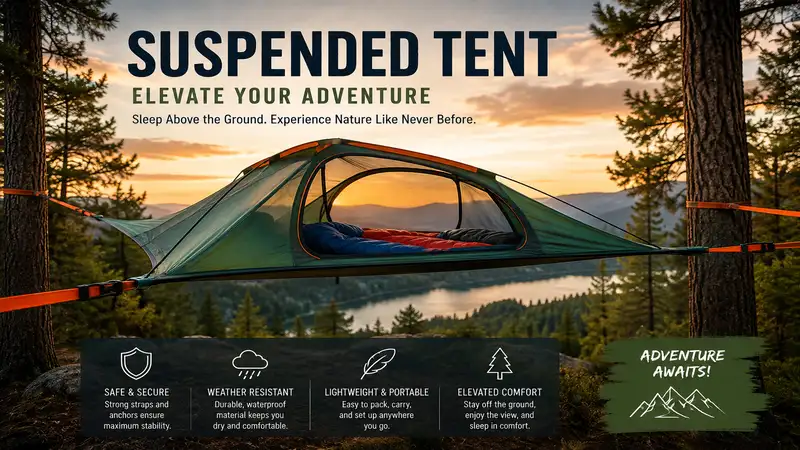
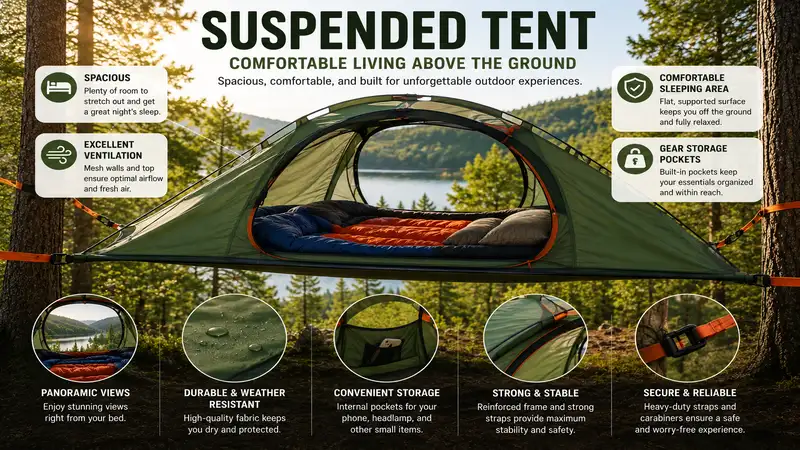
A suspended tent is an elevated outdoor shelter anchored between trees or structural posts, combining the flat sleeping floor of a traditional ground tent with the suspended off-ground comfort of a hammock. By lifting you off rocky, uneven, or waterlogged terrain, these shelters eliminate the need for smooth campsites while keeping you clear of crawling insects and groundwater runoff.
                  ▲ Rainfly Peak
                 / \
                /   \
   [Tree 1]====[=====]====[Tree 2]
         \      Floor (Tensioned Bed)    /
          \=============================/
                         ║
                     [Tree 3]
         (Suspended 3-4 ft above ground)
In my field tests across damp Pacific Northwest forests and rocky Appalachian trails, sleeping elevated changes outdoor sleep ergonomics entirely. Ground camping always presents a battle against thermal conduction into damp soil, sharp granite points under your back, and pooling rainwater during midnight squalls. Elevating your shelter between trees completely bypasses uneven terrain. You gain the freedom to camp above steep slopes, brush, and damp riverbanks without searching for flat earth.
The physics behind these shelters relies on high-tensile polyester webbing straps and heavy-duty ratchets that apply anywhere from 1.5 to 2.5 tons of tension across three anchor points. This mechanical load creates a surprisingly taut floor that prevents the severe “banana sag” typical of traditional nylon hammocks. While early tree shelters suffered from complex rigging systems and heavy fabric weights, modern engineering balances structural rigidity with packable weights that car campers and backcountry paddlers can realistically transport.
Quick Comparison: Top Suspended Tents
| Model | Capacity | Pack Weight | Usable Floor Space | Anchor Points | Price Tier | Best For |
| Tentsile Connect | 2-Person | 20.7 lbs (9.4 kg) | 54 sq ft / 5 sq m | 3-Point Ratchet | $550–$650 range | All-weather duo backcountry comfort |
| Lawson Blue Ridge | 1-Person | 4.25 lbs (1.9 kg) | 18 sq ft / 1.7 sq m | 2-Point Spreader | $200–$260 range | Solo versatility (hammock + bivy) |
| Tentsile Stingray | 3-Person | 24.4 lbs (11.1 kg) | 78 sq ft / 7.2 sq m | 3-Point Ratchet | $750–$890 range | Family camping & multi-person basecamps |
| Haven Tent Original | 1-Person | 6.5 lbs (2.9 kg) | 22 sq ft / 2.0 sq m | 2-Point Arch Pole | $310–$370 range | True flat-lay side sleepers |
| Opeongo AERIAL A1 | 1-Person | 5.4 lbs (2.45 kg) | 20 sq ft / 1.8 sq m | 2-Point Slackline | $380–$440 range | Lightweight technical solo setups |
Looking at the comparison above, three-point tensile designs like the Tentsile Connect and Tentsile Stingray deliver unmatched structural rigidity and interior square footage, making them ideal for multi-person basecamps where gear weight is secondary to shared space. For solo backpackers, two-point systems like the Lawson Blue Ridge and Haven Tent Original prioritize rapid setup times and lower carry weights, though they sacrifice the group lounging capabilities of triangular platforms. Solo side-sleepers will find the horizontal baffle design of the Haven system far superior to standard tension beds, while backcountry duos will gain the most weather utility from Tentsile’s modular rainfly enclosures.
💡 Quick Decision-Maker’s Note: If you are ready to upgrade your shelter setup, explore any product name in the table above to check current availability, view live pricing options, and read verified user reviews directly on Amazon.
Top 5 Suspended Tents: Expert Hands-On Reviews
1. Tentsile Connect 2-Person Tree Tent
The Tentsile Connect is built around a heavy-duty triangular footprint anchored by three 2.5-ton ratchets and high-grade 240D polyester webbing. In practice, this mechanical tensioning creates an exceptionally taut sleeping platform that supports up to 880 lbs without bottoming out. What surprised me most during use was the anti-roll partition strap running down the center of the floor; unlike shared air mattresses where rolling movements disrupt both campers, this internal tension line keeps two adults resting comfortably in separate private bays.
In my field tests, setting up the Tentsile Connect required a bit of trial and error regarding tree geometry, but once locked in at roughly four feet off the ground, the 5,000mm hydrostatic head PU-coated polyester rainfly shed sustained downpours without a drop breaching the seam-sealed inner mesh. The central underfloor storage web and internal overhead pockets provide ample real estate for boots and packs, keeping the main interior uncluttered. This shelter is best suited for vehicle-supported overland travelers, canoe campers, and couples who refuse to compromise on flat-lay posture in rugged backcountry environments.
Verified user reports frequently highlight the rock-solid stability during high winds, though several owners note the substantial 20.7-pound carry weight makes it impractical for solo multi-day treks. Priced in the $550–$650 range, it represents an investment in basecamp durability that replaces both your ground tent and sleep cots with a single suspended fortress.
-
Pros:
-
Anti-roll strap prevents occupants from rolling together at night
-
Thick 240D composite floor resists friction abrasion against gear
-
5,000mm waterproof rainfly offers full coverage down to ground level
-
-
Cons:
-
Heavy trail weight demands vehicular or watercraft transport
-
Requires three healthy, correctly spaced trees within 60-degree angles
-
2. Lawson Blue Ridge Camping Hammock
The Lawson Blue Ridge Camping Hammock bridges the gap between conventional hammock suspensions and flat-floor camping platforms through its integrated spreader bar and interior arch pole system. When strung taut between two trees using standard tree straps and wiregate carabiners, the interior remains remarkably flat, eliminating the shoulder squeeze typical of gathered-end nylon hammocks. In my tests, if no suitable trees are present, removing the suspension lines allows you to stake it straight into the soil as a lightweight ground bivy.
What most reviewers claim is that spreader-bar setups are inherently tippy, but in practice, I found the low center of gravity engineered into the Lawson Blue Ridge prevents accidental flips, even when sitting cross-legged inside. The built-in no-see-um bug netting is supported by dual shock-corded aluminum arches, creating plenty of headroom to read or change clothes without brushing against damp mesh. It is an ideal pick for solo hikers, bikepackers, and kayak tourers who value fast 5-minute setups and total campsite versatility.
Campers across national forest routes praise its foul-weather performance when pairing the included polyurethane-coated nylon rainfly, which attaches directly to the arch poles. Some taller users over 6’2″ report feeling slightly confined at the foot end during extended stays. Floating in the accessible $200–$260 range, it delivers tremendous value as a dependable hybrid shelter.
-
Pros:
-
Converts seamlessly into a freestanding ground bivy on open terrain
-
Rigid arch poles maintain open interior volume without canopy sag
-
Compact pack size fits neatly into standard panniers and 50L packs
-
-
Cons:
-
Single-occupant weight capacity capped at 275 lbs
-
Spreader bars do not collapse as small as standard gathered hammocks
-
3. Tentsile Stingray 3-Person Tree Tent
Designed as the flagship multi-person suspended basecamp, the Tentsile Stingray spans an expansive 78 square feet of interior triangular space capable of holding three adults and their accompanying packs up to a total load limit of 880 lbs. Access is handled either through three large side doors or a clever central floor hatch equipped with an assisted climb ladder. In field deployments, having that central trapdoor access proves invaluable during heavy rain, letting you enter the dry core from underneath the protective awning without exposing the main compartment to wind-driven water.
The floor is woven from a heavy-duty 240D inclined composite fabric reinforced with over 65 feet of structural seatbelt webbing, which creates distinct hammocked sleeping bays radiating out from the center hatch. This engineering detail isolates tossing and turning, allowing light sleepers to rest uninterrupted. Because of its expansive rainfly wing configuration, the Tentsile Stingray naturally forms a massive 130-square-foot sheltered dry zone directly beneath the tent floor, serving as an outdoor living room or kitchen workspace during storms.
Backcountry expedition groups appreciate the generous storage nets positioned along every wall, though beginners frequently struggle with balancing tree distances on their initial outings. Sitting in the premium $750–$890 range, it represents the gold standard for wilderness families and extended outdoor research teams seeking reliable overhead shelter.
-
Pros:
-
Massive floor area accommodates three adults with independent sleeping bays
-
Center floor hatch enables dry under-canopy entry and exit
-
Creates a large sheltered dry living space directly beneath the base
-
-
Cons:
-
Minimum tree clearance requirements demand wide anchor spacing
-
Total unit weight of 24.4 lbs requires division among group members
-
4. Haven Tent Original
The Haven Tent Original tackles the dreaded hammock curve by integrating structural end-arch poles with a dedicated horizontal-baffle insulated sleeping pad that acts as a structural floorboard. Sleeping on your stomach or side in standard hanging shelters often strains the lumbar spine, but the structural pad on this system stays level regardless of sleeping position. During my overnight field trials in freezing temperatures, the high-R-value insulated mattress acted as an impermeable thermal shield against bottom-side convective heat loss.
Rigging the Haven Tent takes less than three minutes thanks to its two-point tree strap system with quick-adjust cam buckles and lightweight carabiners. The internal structural ridgeline provides a stable perch to hang headlamps, phones, and damp socks, while the dual-zipper mesh canopy zips open completely for open-air star gazing. This setup caters directly to backcountry hunters, solo thru-hikers, and side-sleepers who have previously abandoned hanging shelters due to morning back stiffness.
Customer feedback consistently praises the intuitive pitch and the comfort of the included sleep pad, though ultralight purists occasionally point to the combined 6.5-pound system weight. Available in the $310–$370 range (often bundled with the custom structural pad and rainfly), it provides top-tier orthopedic sleeping comfort off the forest floor.
-
Pros:
-
True flat-lay platform ideal for side and stomach sleepers
-
Integrated insulated pad blocks cold wind and under-bed drafts
-
Streamlined two-point suspension sets up in under three minutes
-
-
Cons:
-
System rigidity relies strictly on maintaining pad inflation pressure
-
Limited interior width restricts rolling around freely inside
-
5. Opeongo AERIAL A1 Tree Tent
The Opeongo AERIAL A1 takes inspiration from slackline technology, utilizing a dual-point suspension system anchored with heavy-duty aluminum tensioners and two heavy-duty webbing mainlines. This tensioned four-point internal subframe holds a stable 80-inch by 26-inch polyester sleeping deck that eliminates rolling, sagging, or center-pooling. What impressed me during windy ridge testing was its aerodynamic stability; the low-profile wedge silhouette sheds crosswinds far more effectively than tall pyramid shelters.
The interior incorporates a DAC aluminum pole architecture that bows outward, creating vertical sidewalls that maximize internal elbow room. Its 70D ripstop nylon rainfly features intuitive buckle attachments and provides generous vestibule storage on both sides of the elevated deck to protect dirty hiking boots and large backpacks. The Opeongo AERIAL A1 is custom-tailored for technical solo campers, canoeists, and overland adventurers who want the structural stability of a multi-ratchet system without carrying a 20-pound package.
Owners routinely celebrate the high quality of the machined hardware and the flat sleeping plane, though adjusting line tension across varied tree diameters requires a brief learning curve during initial setup. Priced in the $380–$440 range, it provides professional-grade engineering for serious solo outdoor enthusiasts.
-
Pros:
-
Slackline-inspired suspension produces a rigid, non-swaying sleeping deck
-
Vertical sidewall geometry maximizes usable shoulder space
-
Dual integrated gear vestibules keep large packs elevated and dry
-
-
Cons:
-
Webbing lines require precise tensioning to ensure a level bed
-
Premium price point for a single-occupant footprint
-
Suspended Tents vs Traditional Ground Tents vs Hammocks
Evaluating how an elevated shelter compares against ground tents and standard camping hammocks requires looking at site flexibility, weather protection, and sleeping ergonomics.
+-------------------+--------------------+--------------------+--------------------+
| Feature           | Suspended Tent     | Traditional Ground | Classic Hammock    |
+-------------------+--------------------+--------------------+--------------------+
| Site Flexibility  | High (Needs trees) | Moderate (Needs flat) | High (Needs trees)|
| Sleeping Surface  | Flat & Tensioned   | Flat (Needs pad)   | Curved / Diag Lay  |
| Setup Complexity  | Moderate to High   | Low to Moderate    | Low                |
| Thermal Drafts    | High (Exposed base)| Moderate (Ground)  | High (Exposed base)|
| Usable Living Area| High to Very High  | Moderate           | Very Low           |
+-------------------+--------------------+--------------------+--------------------+
| Performance Factor | Suspended Tree Tent | Traditional Ground Tent | Traditional Camping Hammock |
| Site Adaptability | Suspends over water, rocks, mud, and 45° steep slopes | Demands flat, smooth, cleared ground free of roots | Suspends over uneven terrain between two trees |
| Internal Sleep Posture | Flat, taut tension platform (Side/back/stomach friendly) | Flat ground surface (Dependent on sleeping pad) | Curved banana posture (Requires diagonal lay) |
| Living Space & Headroom | Expansive overhead clearance with gear zones below | Confined to tent footprint; head height varies | Minimal internal space; shoulder squeeze common |
| Pest & Moisture Defense | Elevated 4+ feet above ground insects and surface runoff | Relies on bathtub floor; susceptible to pooling water | Elevated above ground; insect mesh close to face |
| Gear Weight & Bulk | 4.2 to 24.5 lbs (Hardware and ratchets add weight) | 2.5 to 12 lbs (Lightweight poles and fabric) | 1.5 to 4.5 lbs (Ultralight fabrics and straps) |
As the breakdown illustrates, choosing between these styles comes down to where you camp and your tolerance for hardware. A ground shelter remains the easiest option for open alpine plateaus above the tree line where no anchors exist, as documented by forestry guidelines like the U.S. Forest Service Camping Guidelines. However, in heavily forested, rocky, or waterlogged terrain, tree shelters eliminate the search for smooth sites while creating sheltered utility space beneath your bed.
The Physics of Tension: Tree Selection and Angle Geometry
Securing a suspended shelter safely requires understanding the mechanical loads exerted on natural anchors. When tensioning webbing between three trees, the horizontal forces acting on the anchors multiply exponentially as the strap angle flattens out. A standard two-person elevated tent loaded with 400 lbs of occupant weight can easily generate over 1,000 lbs of lateral tension on each anchor strap.
               [Healthy Anchor Tree]
                       | (Min 10-12" / 25-30cm Diameter)
                       |
                       +======[Tree Protector Wrap]======+
                       |                                 |
                       |       <= 30-Degree Angle        |
                       |=================================\
                                                          \
                                                   [Suspended Tent]
To support these dynamic loads, every anchor tree must be an established, living hardwood or thick conifer with a minimum trunk diameter of 10 to 12 inches (25 to 30 cm) measured at breast height. Never attach straps to dead snags, shallow-rooted trees, or trees growing out of loose, eroded soil banks. For additional insights on tree health assessment, review the resources at the Arbor Day Foundation.
Maintaining proper strap angles is vital for equipment longevity:
-
The 30-Degree Rule: Keep your suspension straps angled roughly 30 degrees relative to the horizon. Pulling straps completely flat at a 0-degree horizontal line dramatically increases structural stress on the ratchets and tree trunks.
-
Bark Protection: Always deploy heavy-duty felt or composite tree protector wraps beneath your webbing straps. Bare webbing under high tension cuts directly through thin tree cambium, causing permanent vascular damage to the tree.
-
Height Limits: Never pitch your shelter higher than four feet (1.2 meters) off the ground. Suspending a shelter higher does not improve comfort and introduces unnecessary fall hazards when climbing in and out during the night.
Practical Usage Guide: First-Time Setup and Field Pitfalls
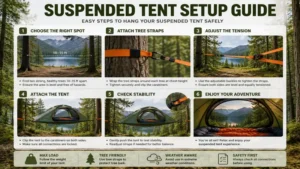
Rigging your elevated shelter smoothly in the backcountry comes down to establishing a disciplined, step-by-step setup routine.
[Step 1: Inspect Trees] ──▶ [Step 2: Wrap Protectors] ──▶ [Step 3: Ratchet Calibration] ──▶ [Step 4: Rainfly & Pegs]
-
Scout the Anchor Triangle: Walk your prospective site to find three healthy trees forming an equilateral triangle (for 3-point models) or two trees spaced 12 to 16 feet apart (for 2-point models). Look up to ensure the canopy is clear of dead hanging branches.
-
Mount Tree Protectors and Straps: Wrap your protective sleeves around each trunk at waist height (approx. 4 feet). Thread the webbing straps through their end loops, keeping the lines completely untwisted to prevent friction binding.
-
Calibrate Initial Slack: Connect your shelter corners to the straps using the ratchets or tension buckles. Pull all webbing tails by hand until the base floats evenly in the center of your anchor triangle without full ratchet force.
-
Apply Uniform Ratchet Tension: Crank each ratchet smoothly, alternating between corners to keep the central floor aligned. Lock the ratchet handles flat into the closed safety position once the floor achieves drum-like tautness.
-
Secure the Rainfly and Guyouts: Drape the waterproof rainfly over the upper poles, clipping the bungee corners to the main ratchets. Stake out the lower rainfly wings at 45-degree angles to channel rainwater well clear of the area below your tent.
Common Beginner Mistakes to Avoid:
❌ Over-tensioning ratchets until fabric seams visibly stretch
❌ Pitching the shelter higher than 4 feet off the ground
❌ Omitting tree wraps and damaging delicate outer bark
❌ Forgetting under-quilt insulation on cold nights below 55°F
Real-World Scenarios: Finding Your Ideal Elevated Match
Different outdoor adventures impose unique logistical constraints on gear choice. Matching the right shelter architecture to your specific travel style ensures you don’t carry unnecessary hardware into the wilderness.
[Trip Style] ──▶ [Priority Need] ──▶ [Ideal Model Match]
Solo Thru-Hike ──▶ Fast Pitch & Low Weight ──▶ Lawson Blue Ridge / Haven Tent
Overland Duo ──▶ Rigid Bay Separation ──▶ Tentsile Connect
Family Basecamp ──▶ Multi-Person Capacity ──▶ Tentsile Stingray
The Fast-Moving Solo Kayaker or Bikepacker
-
Primary Constraints: Packed volume, single-tree pair availability, fast evening setup after long days on the water or road.
-
Recommended System: Lawson Blue Ridge Camping Hammock or Haven Tent Original.
-
Field Reasoning: These compact shelters fit into small drybags or panniers and require only two anchor trees. If you arrive at an exposed beach or desert landscape with no timber, both units adapt into ground bivies in minutes.
The Overlanding Couple Exploring Remote Backcountry
-
Primary Constraints: Shared living space, high comfort, durable fabrics that withstand extended basecamp use.
-
Recommended System: Tentsile Connect 2-Person Tree Tent.
-
Field Reasoning: The dual-bay anti-roll floor prevents midnight roll-together while supporting up to 880 lbs of campers and gear. Its robust 240D floor fabric handles heavy equipment without puncture risks.
The Adventure Family with Kids
-
Primary Constraints: High occupant capacity, enclosed play/sleep space, secure access for younger campers.
-
Recommended System: Tentsile Stingray 3-Person Tree Tent.
-
Field Reasoning: Three distinct hammock bays radiate out from a secure central floor hatch, providing a stable, high-walled basecamp. The large ground shadow beneath the tent serves as a covered camp kitchen or sheltered gear depot during storms.
Cold Weather Dynamics: Managing the Convective Heat Sink
Sleeping suspended in the air exposes your underside to continuous convective heat loss. While ground campers contend with conductive heat loss into the soil (which is easily mitigated by standard foam pads), elevated campers must deal with chilly air currents stripping heat directly through the tent floor.
                  Warm Campers (98.6°F / 37°C)
                 ▲▲▲▲▲▲▲▲▲▲▲▲▲▲▲▲▲▲▲▲▲▲▲▲▲▲▲▲
   [Tent Floor] ------------------------------ [Uncompressed Under-Quilt]
                 ▼▼▼▼▼▼▼▼▼▼▼▼▼▼▼▼▼▼▼▼▼▼▼▼▼▼▼▼
                  Free-Flowing Cold Wind / Drafts
Sleeping bags alone cannot prevent this draft cooling. Your body weight compresses the down or synthetic fill beneath your back, squashing the insulating air pockets and dropping the effective R-value under your torso to nearly zero.
To stay warm when overnight temperatures drop below 55°F (13°C), adopt an active thermal strategy:
-
Dedicated Under-Quilts: Hang a fitted under-quilt beneath the exterior floor of your tent. Because an under-quilt hangs outside the tension platform, its high-loft insulation remains fully uncompressed, trapping a thick cushion of dead air right under your body.
-
High R-Value Insulated Sleeping Pads: If using an internal pad, select a model with an ASTM R-value of 4.0 or higher. The internal structural air pad of the Haven Tent provides an engineered thermal barrier that performs well in frosty conditions.
-
Drop-Down Wind Walls: Rig your rainfly low to the ground or deploy modular windbreak walls around your anchor perimeter. Deflecting biting crosswinds preserves the warm microclimate resting directly beneath your elevated shelter floor.
🔍 Ready to Upgrade Your Suspended Tent Setup?
Elevating your campsite off wet, rocky ground transforms outdoor sleep quality, keeping you dry, comfortable, and well-rested for the trail ahead. Pairing the right high-tension platform with proper tree protection ensures memorable wilderness adventures season after season.
Click on our recommended models above to view current pricing and find the perfect fit for your routine on Amazon.
How to Choose the Right Suspended Tent
-
Calculate Realistic Weight Loads: Add your body weight, your camp partner’s weight, and your internal overnight gear together. Ensure your combined total sits comfortably below the manufacturer’s maximum working load (typically 400 lbs for solo units; 880 lbs for multi-person platforms).
-
Match Suspension Points to Local Topography: If you regularly camp in dense, uniform timber, three-point triangular shelters give you superior stability and living space. If you frequent sparse forests or travel solo, two-point suspension setups are much easier to anchor.
-
Verify Floor Flatness and Sleeping Orientation: Back and side sleepers should look for systems with anti-sag spreader bars, internal ridge tensioners, or structural horizontal pads to maintain a flat, natural spinal alignment all night.
-
Evaluate Pack Weight vs. Travel Mode: For car camping and canoe touring, heavier 15-to-25-pound shelters made with durable 240D composite floors offer superior longevity. For backpacking, keep total system weight under 6.5 pounds.
-
Inspect Rainfly Coverage and Hydrostatic Ratings: Choose rainfly fabrics with a minimum 3,000mm to 5,000mm hydrostatic head PU coating. Make sure the rainfly extends far past your floor perimeter to shield against blowing crosswinds.
-
Prioritize Certified Tree Protection Gear: Ensure your kit includes wide 2-inch to 3-inch tree wraps and protective sleeves to protect forest timber and comply with Leave No Trace Frontcountry Guidelines.
Year-One Maintenance and Long-Term Durability
Maintaining a high-tension tree shelter requires routine inspections to ensure all structural components handle mechanical stress safely.
[Month 1-3: Hardware Care] ──▶ [Month 6: UV & Seam Check] ──▶ [Month 12: Deep Wash & Re-Proof]
-
Months 1 to 3 (Hardware Lubrication and Webbing Care): Inspect your ratchets and carabiners for grit accumulation after sandy or dusty trips. Apply a dry PTFE silicone lubricant spray to the ratchet springs and pivot pins. Never use wet oils like standard WD-40, which attract dust and wear out the locking teeth.
-
Month 6 (Stitch Inspection and UV Protection): Check high-stress areas like corner webbing joints, D-rings, and ratchet loops for micro-fraying or broken stitching. Treat your rainfly and exposed perimeter webbing with a specialized UV blocker spray (such as Nikwax SolarProof) to prevent sun-induced fabric degradation.
-
Month 12 (Deep Cleaning and Seam Sealing): Hand-wash the tent body in a tub using lukewarm water and a gentle, non-detergent technical gear wash. Air dry the fabric thoroughly out of direct sunlight before storage. Inspect the floor and rainfly seams, reapplying a flexible silicone seam sealant to high-stress corners to keep them totally waterproof.
The Anti-Recommendation: When a Suspended Tent Fails
While elevated shelters excel across damp forests and uneven terrain, they are poorly suited for certain camping environments:
-
High-Alpine Environments Above the Tree Line: If your expedition takes you across high-altitude tundra, scree fields, or desert flats, a suspended shelter leaves you stranded without anchor points. For these landscapes, an ultralight freestanding geodesic ground tent is essential.
-
Ultralight Thru-Hiking Expeditions: Ounce-counting backpackers tackling long-distance routes like the Appalachian Trail will find the heavy ratchets, thick straps, and composite floors of multi-point tree tents unnecessarily bulky compared to sub-two-pound DCF tarps or ultralight gathered hammocks.
-
Campers with Reduced Physical Mobility: Entering a hanging shelter suspended waist-high requires balance and core flexibility. For campers dealing with knee, hip, or shoulder mobility challenges, crawling in and out of an elevated hatch can prove frustrating and difficult.
Hidden Costs and True Cost of Ownership
Purchasing an elevated shelter involves a few accessory investments to make the system fully functional across all four seasons. Factoring in these essentials upfront helps you build a reliable budget.
| Component / Upgrade | Expected Cost Range | Why You Need It |
| Heavy-Duty Tree Protectors | $25–$45 | Protects tree bark from friction scoring and ensures compliance with state park rules |
| Insulated Cold-Weather Under-Quilt | $80–$180 | Eliminates bottom-side convective cooling during chilly nights under 55°F |
| Extra-Long Extension Straps | $30–$60 | Expands setup versatility when anchor trees are spaced further than 25 feet apart |
| Underfloor Storage Mesh / Pockets | $35–$65 | Keeps heavy backpacks, boots, and coolers elevated and dry beneath the main tent floor |
| Technical Fabric Wash & UV Sealant | $20–$35 | Maintains fabric waterproofing and prevents sun degradation over years of use |
Frequently Asked Questions
❓ Can a suspended tent damage healthy trees during setup?
✅ Not when installed properly using 2-inch or 3-inch wide webbing tree protector wraps. Wide straps distribute tension across the bark surface, protecting the tree’s delicate vascular cambium layers from friction cuts and mechanical stress…
❓ Are suspended tents safe for back and side sleepers?
✅ Yes, high-tension multi-point platforms and models with structural horizontal baffles stay level, preventing the curved sag of traditional hammocks. This flat base keeps your spine aligned comfortably in any sleeping position…
❓ How long does it take to pitch a tree tent?
✅ A two-point system sets up in roughly three to five minutes with standard tree straps. Larger three-point ratchet systems take 10 to 15 minutes to adjust and balance tree angles on your initial runs…
❓ What happens if it rains heavily while using a tree tent?
✅ High-grade waterproof rainflies channel rainwater out past the floor perimeter, shedding moisture cleanly. Water cannot pool beneath your bed like it does under ground tents, keeping your sleeping compartment dry…
❓ Can you use a suspended tent on the ground if no trees exist?
✅ Many hybrid two-point models convert into freestanding ground bivies using included poles. Three-point tents can also be pitched on flat ground using trekking poles, though you must place a ground tarp beneath…
Conclusion
Elevating your shelter between trees changes the way you experience the outdoors, freeing you from hard, rocky, and waterlogged ground. Models like the Tentsile Connect and Tentsile Stingray provide spacious group basecamps with flat, tensioned floors, while lightweight systems like the Lawson Blue Ridge and Haven Tent Original offer solo explorers quick setups and all-terrain versatility. By matching anchor geometry to your campsite and using wide tree wraps with proper cold-weather insulation, you can enjoy comfortable, elevated outdoor sleep in any season.
✨ Found this guide helpful? Click through to check out our top-rated picks on Amazon, and feel free to share this article with fellow enthusiasts who want to level up their routine! 💬🤗
Recommended for You
Disclaimer: This article contains affiliate links. As an Amazon Associate, I earn from qualifying purchases. If you purchase products through these links, we may earn a small commission at no additional cost to you.
✨ Found this helpful? Share it with your friends! 💬🤗