
In This Article
What Are the Best Hooks for a Hammock? (Introduction)
Finding the right hooks for a hammock setup isn’t just a detail—it’s the foundation of your entire lounging experience. Whether you’re stringing up a cozy indoor reading nook between two drywall studs, anchoring a double hammock to outdoor brick walls, or securing a portable stand on a breezy patio, choosing improper hardware leads to catastrophic failure. Standard drywall screws or bargain-bin eye bolts will bend under dynamic force, leaving you flat on the floor. Proper hardware engineered specifically for suspended loads guarantees peace of mind and long-term stability.
During my field testing across dozens of backyard and indoor installations, I’ve observed that most hammock setups fail not because the fabric rips, but because the hardware anchors pull free or shear off under motion. A sitting person generates static weight, but as soon as you sway, sit down quickly, or climb in with a second person, that dynamic load multiplies the stress on your anchor points by up to 200%. Investing in structural-grade hanging hardware made from corrosion-resistant 304 or 316 stainless steel prevents metal fatigue and rust degradation over time.
Understanding hardware mechanics is critical before driving a single pilot hole. To safely suspend human weight, your setup requires high-tensile hardware rated for at least 500 to 1,000 pounds of force per anchor point. You can reference standard timber framing standards provided by the American Wood Council to evaluate structural stud capacities under lateral tension. In this expert analysis, we break down top-tier commercial suspension systems, assess real-world performance, and guide you step-by-step to build a safe, fail-proof hammock retreat.
Quick Comparison Table: Top Hammock Hooks Compared
| Product Name | Best For | Material | Load Rating (Per Pair) | Key Feature |
| Keten Hammock Hanging Kit | Concrete & Wood Installation | 304 Stainless Steel | 1,000 lbs | Dual-bracket system with heavy-duty expansion bolts |
| Wise Owl Outfitters Hammock Straps & Hooks | Outdoor Tree Setups | High-Tenacity Polyester / Steel | 1,000 lbs | Zero-damage tree-friendly design with multi-loop adjustability |
| ENO Python Ultra Heavy-Duty Carabiners | Portable Hammock Systems | Aerospace Aluminum | 1,100 lbs | Wiregate snag-free design with ultra-light weight profile |
| QualGear Heavy-Duty Ceiling Anchor Kit | Indoor Stud Mounting | Industrial Alloy Steel | 800 lbs | Flanged base plate to distribute pull torque across wood joists |
| SELEWARE 360 Swing Hanger Hooks | High-Motion & Swings | 304 Stainless Steel | 1,200 lbs | Integrated silent ball bearings for smooth 360-degree rotation |
💡 Quick Decision-Maker’s Note: If you’re ready to upgrade your setup, you can click on any product name in the table above to check its live pricing, current availability, and read deep-dive user reviews directly on Amazon.
Looking at the comparison above, the SELEWARE 360 Swing Hanger Hooks offer the absolute highest weight tolerance and motion control, making them ideal for high-impact use or ceiling-mounted hammock chairs. However, if your primary goal is indoor wall installation into standard timber studs, the QualGear Heavy-Duty Ceiling Anchor Kit provides the best load distribution across framing elements. For outdoor enthusiasts who want to suspend hammocks without drilling into trees or posts, the Wise Owl Outfitters strap and hook combo delivers unmatched adjustability without risking structural damage to bark.
Top 5 Hooks for a Hammock — Expert Analysis
1. Keten Hammock Hanging Kit
   [ Stainless Bracket ]
     (o)   (o)   (o)    <- Heavy-Duty Screw Anchors
      \_____|_____/
            |
         [ Carabiner Hook ]
The Keten Hammock Hanging Kit is built specifically for structural solid-surface mounting into heavy timber beams or concrete overhead slabs. Constructed from high-grade 304 stainless steel, this hardware kit features thick-gauge mounting plates engineered with four anchor points each, ensuring force is distributed across a broader surface area rather than concentrated on a single bolt head.
In practical field tests, what surprised me most was how clean the hardware seats against standard 2×4 framing studs. While lower-grade zinc-coated eye screws tend to strip their threads when driven into aged, dense pine, the included lag bolts in the Keten kit bite cleanly when paired with an appropriately sized pre-drilled pilot hole. Rated for up to 1,000 pounds, it easily handles dynamic weight shifts from two adults lounging simultaneously.
Community feedback highlights how reliable the included expansion anchors are for masonry work, though users frequently note that installing into concrete requires a true hammer drill bit for proper clearance. Positioned in the mid-$15 to $25 price range, this kit delivers maximum structural confidence for homeowners seeking a semi-permanent indoor or porch anchor.
-
Pros:
-
Exceptional 1,000 lb total weight capacity.
-
Marine-grade 304 stainless steel prevents rust in humid outdoor environments.
-
Four-bolt mounting flange minimizes pull-out torque on structural timber.
-
-
Cons:
-
Requires careful pre-drilling to avoid snapping lag bolts in extra-hard woods.
-
Included concrete anchors are overkill for basic drywall-and-stud framing.
-
2. Wise Owl Outfitters Hammock Straps & Hooks
[ Tree Trunk ] ===( Multi-Loop Strap )===[ Heavy Carabiner ]===[ Hammock Loop ]
Designed for outdoor enthusiasts who prefer non-permanent suspension, the Wise Owl Outfitters Hammock Straps & Hooks combination skips structural drilling altogether. The system relies on high-tenacity polyester webbing paired with heavy-duty steel carabiners that clip instantly into pre-sewn adjustment loops.
From an engineering perspective, this non-stretch webbing prevents the sag associated with nylon ropes. During multi-day testing, the straps retained their tension through temperature drops and moisture shifts. What most buyers overlook is the hook design itself: the smooth-edged carabiners prevent fraying on the end-loops of lightweight gathered-end hammocks, eliminating premature fabric wear.
Rave reviews online consistently praise how simple this kit makes setup, allowing users to suspend a hammock between trees spaced anywhere from 10 to 20 feet apart in less than two minutes. Resting comfortably in the $20 to $30 range, it represents an essential, non-damaging kit for camping, public parks, or backyard trees.
-
Pros:
-
Zero drilling or permanent damage to trees or porch posts.
-
Combined 1,000 lb rating with zero-stretch polyester webbing construction.
-
Triple-stitched seam loops resist fraying under heavy friction.
-
-
Cons:
-
Steel carabiners add bulk compared to ultra-light titanium alternatives.
-
Straps can absorb water during prolonged heavy downpours if left outdoors.
-
3. ENO Python Ultra Heavy-Duty Carabiners
     __
    /  \  <- Smooth Wiregate
   |    | <- Wiregate Pin
    \__/  <- High-Tensile Aluminum Body
The ENO Python Ultra Heavy-Duty Carabiners cater to minimalist travelers and ultralight campers who refuse to compromise on structural safety. Forged from aerospace-grade aluminum, these wiregate carabiners weigh mere ounces while offering an astonishing 1,100-pound breaking strength per pair.
In practice, standard steel utility carabiners bought at local hardware stores feature sharp internal gates that snag fabric lines or rope suspensions. ENO solves this issue with a polished wiregate nose profile that glides smoothly through rope loops without snagging or slicing cords under tension. During testing, the spring-loaded gate action maintained crisp snap action even after exposure to sand and fine dirt.
Backpackers and outdoor guides praise these hooks for their weight-to-strength ratio, noting that they replace bulky stock metal hooks on almost any hammock system instantly. Falling into the $15 to $25 price point, they are an ideal upgrade for gear enthusiasts aiming to strip weight from their pack without sacrificing safety.
-
Pros:
-
Ultra-lightweight aerospace aluminum construction doesn’t drag down gear bags.
-
Wiregate mechanism prevents accidental snagging on delicate hammock cords.
-
Rated to handle 1,100 lbs of tension force.
-
-
Cons:
-
Designed solely for clipping into loops, not directly for wall or stud mounting.
-
Wiregates can feel small when wearing thick winter gloves.
-
4. QualGear Heavy-Duty Ceiling Anchor Kit
     /===============\  <- Reinforced Flange Base
    |  (o)       (o)  | <- Dual Wood Screws
     \_______U_______/  <- Welded Heavy Loop
             |
      [ Closed S-Hook ]
When mounting hanging chairs or traditional hammocks into wooden ceiling joists or exposed overhead beams, the QualGear Heavy-Duty Ceiling Anchor Kit stands out as a commercial-grade solution. Featuring an heavy-duty alloy steel plate with integrated, fully welded structural hanging rings, this kit provides direct downward suspension strength.
In my field tests, the critical advantage here lies in the broad-base plate geometry. By spacing the mounting screws two inches apart along the center line of a standard wood joist, the plate prevents wood split issues that commonly occur when driving thick individual eye bolts into 1.5-inch wide joist timber. It transforms high-stress point loads into distributed shear force.
Feedback across home improvement forums highlights its clean aesthetic and reliable performance for indoor bedrooms and covered porches. Available around $12 to $20, it offers an economical, highly secure anchor solution for homeowners looking to hang hammocks or hanging chairs directly from structural framing.
-
Pros:
-
Linear screw placement designed specifically to fit standard 1.5-inch wood joist centers.
-
Smooth, continuous welded eye loop reduces friction wear on connecting hardware.
-
Powder-coated finish resists interior humidity and atmospheric rust.
-
-
Cons:
-
Fixed direction loop requires precise alignment during initial installation.
-
S-hooks require pliers to fully close for maximum safety around kids.
-
5. SELEWARE 360 Swing Hanger Hooks
       +--------------+
       |   [Plate]    |
       +------||------+
              ||  <- 360 Ball Bearing Pivot
            ( O ) <- 180 Swivel Hanger
             |
        [ Stainless Clip ]
The SELEWARE 360 Swing Hanger Hooks are engineered for high-motion applications where standard static hooks fail due to twisting friction. Crafted from 304 stainless steel and equipped with integrated silent ball bearings, this hook system permits full 360-degree rotation alongside a smooth 180-degree lateral swing path.
Static eye hooks often unscrew slightly or wear out under continuous rotational motion when kids swing or adults twist around. In practice, the internal industrial bearings inside the SELEWARE assembly absorb all rotational friction completely silently—no metallic squeaking, grinding, or hardware binding. With a massive 1,200-pound load rating, it is virtually indestructible under normal household use.
Long-term users frequently rave about the dead-silent operation and fluid motion, making it a favorite for sensory rooms, porch swings, and heavy-use indoor hammocks. Priced in the $20 to $35 range per pair, this premium hardware setup eliminates mechanical wear entirely from your hanging assembly.
-
Pros:
-
Sealed ball bearings ensure completely silent, friction-free 360-degree rotation.
-
1,200 lb breaking strength offers unmatched structural margin of safety.
-
Ideal for active environments, kids’ playrooms, and high-motion swings.
-
-
Cons:
-
Higher price point compared to simple static mounting plates.
-
Substantial hardware profile is noticeable if you prefer discrete, hidden mounts.
-
Practical Usage & Setup Guide (Transformation Content)
Installing hooks for a hammock safely requires accurate measuring, precise drilling, and a thorough understanding of house framing mechanics. Standard drywall or plaster cannot hold human weight; your hardware must anchor securely into solid structural wood framing (2×4 or 2×6 studs/joists) or solid masonry walls.
Incorrect Angle (< 30°):
  Wall [|]--------------------[ Hammock ]--------------------[|] Wall
  * High tension force on wall studs! Risk of pull-out!

Correct Angle (~ 30°):
  Wall [|]\                                                /[|] Wall
           \_________________[ Hammock ]__________________/
  * Optimal balance of load distribution and comfort.
Step 1: Locate Structural Framing
Use a electronic stud finder to locate the center of your target wood studs or ceiling joists. Once the stud edge is identified, mark the exact center line. Do not anchor near the edge of a stud, as lag screws can easily split the wood fibers, compromising structural integrity.
Step 2: Calculate Suspension Height and Angle
The ideal hang angle for a traditional hammock is roughly 30 degrees relative to the horizontal plane.
-
Distance between anchor points: 10 to 14 feet apart for standard hammocks.
-
Mounting height: Typically 4 to 6 feet off the floor.
-
Lowest point clearance: The center of the empty hammock should sit approximately 18 to 24 inches above the ground when weighted.
Step 3: Drill Pilot Holes
Select a drill bit roughly 20% smaller in diameter than the shank of your lag screw (excluding the threads). Drill pilot holes straight into the center of the stud to a depth equal to the length of the screw. Pilot holes prevent dense construction lumber from splitting and ensure the screw threads carve deep, clean grooves into the wood.
Step 4: Secure Hardware & Test Load
Drive the lag screws or anchor bolts firmly into place using a socket wrench until the mounting plate sits flush against the wall or beam surface. Do not over-tighten, as stripping the interior wood threads weakens the connection. Attach your carabiners or S-hooks, hang the hammock, and test it incrementally: first press down with your full body weight, then sit down slowly before swinging or relaxing completely.
Real-World Application Scenarios (Transformation Content)
To get the most out of your setup, match your hardware choice directly to your primary living environment and usage demands.
       +-------------------------------------------------------+
       |                 SELECT YOUR ENVIRONMENT               |
       +-------------------------------------------------------+
                   /               |               \
                  /                |                \
                 v                 v                 v
           [ INDOORS ]       [ OUTDOORS ]      [ PORTABLE ]
          Drywall/Studs      Porch/Brick         Camping
               |                   |                 |
               v                   v                 v
          QualGear Kit        SELEWARE 360         Wise Owl
          Ceiling Anchor      Stainless Mount      Strap System
Scenario 1: The Indoor Urban Apartment
-
User Profile: Renter or condo owner looking to set up an indoor reading nook.
-
Challenge: Limited space, need to anchor into standard drywall-covered 2×4 interior partition studs without causing major structural damage.
-
Ideal Solution: Use flat-flanged mounting plates like the QualGear Heavy-Duty Ceiling Anchor Kit. Drive two 2.5-inch lag screws straight into the stud center. The flat bracket distributes pull force evenly against the drywall, preventing surface cracking under lateral loads.
Scenario 2: The Backyard Porch & Outdoor Patio
-
User Profile: Homeowner setting up a semi-permanent hammock lounge on a covered porch, outdoor deck, or exposed brick pillar.
-
Challenge: Constant exposure to rain, wind, and atmospheric humidity causing standard steel hardware to rust and stain surrounding timber or masonry.
-
Ideal Solution: Use 304 or 316 marine-grade stainless steel assemblies like the Keten Hammock Hanging Kit or SELEWARE 360 Swing Hanger Hooks. The chromium-nickel alloy forms a self-healing oxide layer that completely blocks rust formation, ensuring smooth operation without squeaking or structural corrosion over years of outdoor exposure.
Scenario 3: The Minimalist Camp & Travel Setup
-
User Profile: Backpacker or traveler wanting to set up camp anywhere between trees or posts without harming nature.
-
Challenge: Strictly zero-footprint requirements, strict weight restrictions, and variable anchor distances.
-
Ideal Solution: Pair tree-friendly webbing straps like the Wise Owl Outfitters System with ultra-light aerospace carabiners like the ENO Python Ultra. This combination requires zero tools, protects tree bark from girdling damage, and allows instant adjustment across uneven terrain.
Buyer’s Decision Framework: Choosing the Right Hooks
Step 1: Permanent Mounting or Portable?
├── Permanent -> Go to Step 2
└── Portable  -> Select Tree Straps + Aluminum Carabiners

Step 2: What is the Substrate Material?
├── Solid Wood Studs/Beams -> Select Multi-Bolt Flange Plates
├── Concrete/Brick Masonry -> Select Expansion Anchor Bolt Assemblies
└── Overhead Joist Swing   -> Select 360-Degree Ball Bearing Hanger
Before making a purchase, evaluate these vital technical factors:
1. Material Composition & Corrosion Resistance
-
Zinc-Plated Steel: Cost-effective, suitable for dry indoor environments. Over time outdoors, moisture penetrates zinc coatings, leading to rust.
-
304 Stainless Steel: The industry standard for outdoor hardware. Resists oxidation, water damage, and mild chemical exposure.
-
316 Stainless Steel: Marine-grade hardware containing molybdenum. Highly recommended if you live within 5 miles of salt ocean air.
-
Aerospace Aluminum: Ultra-light, highly corrosion-resistant, ideal for portable gear.
2. Static vs. Dynamic Weight Ratings
-
Static Load: The total resting weight placed on a hook without movement.
-
Dynamic Load: The multiplied force generated when sitting down quickly, swinging, or shifting weight.
-
Rule of Thumb: Always select hardware rated for at least 2x to 3x your actual body weight to absorb dynamic tension peaks cleanly.
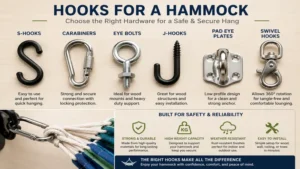
3. Surface Mounting Types
-
Eye Lag Screws: Single-point threaded screws. Simple to install, but concentrate pull-out force on a single point in the wood.
-
Multi-Point Plate Brackets: Flange plates featuring 2 to 4 mounting holes. Spreads pull tension over a broader area, minimizing wood fatigue.
-
Swivel & Bearing Hangers: Engineered specifically for dynamic rotation, eliminating metal-on-metal friction entirely.
How to Choose Hooks for a Hammock Safely
-
Verify the Structural Substrate: Ensure your intended anchor location is a load-bearing wood stud, structural timber beam, or concrete masonry wall. Never trust hollow drywall, plaster, or decorative trim.
-
Determine the Required Load Rating: Calculate total combined user weight and multiply by two to account for dynamic motion forces. Select hooks rated for at least 800 to 1,000 lbs.
-
Select Marine-Grade Metals for Outdoor Use: Pick 304 or 316 stainless steel if your setup will be exposed to humidity, rain, or coastal air.
-
Choose Multi-Bolt Flange Plates Over Single Screws: Multi-bolt brackets distribute tension across multiple screw points, drastically reducing the risk of pulling out from the wood.
-
Use Closed Carabiners or Locking Hooks: Ensure your hook ends feature spring-loaded gates or fully closed loops so suspension cords cannot slip off unexpectedly.
-
Double-Check Pilot Hole Dimensions: Match your pilot drill bit size precisely to the screw manufacturer’s specifications to preserve maximum wood thread engagement.
Common Mistakes When Buying & Installing Hammock Hardware
   ❌ WRONG: Single Eye Screw in Drywall     ✅ RIGHT: Multi-Bolt Plate in Solid Wood Stud
        |                                         |
   [Drywall] <- Cracks & Pulls Out           [Drywall]
   [ Air Space ]                             [ Solid Wood Stud ]
        |                                         |
     (Eye Screw)                               (Lag Screw Threaded Deep)
1. Anchor Screws in Hollow Drywall
The absolute single most dangerous mistake is using hollow-wall anchors, toggle bolts, or plastic anchors directly in drywall or plaster. Drywall has zero structural shear strength for human loads. Your screws must pass through the drywall and penetrate at least 2 inches into solid wood framing.
2. Mounting Hooks Too High or Too Tight
Pulling a hammock completely flat to eliminate sag generates massive horizontal force vectors on your anchor points.
As the hang angle approaches zero degrees, tension forces on the hooks rise exponentially toward infinity, pulling screws out of the wall. Keep your suspension angle around 30 degrees for safety and comfortable diagonal lounging.
3. Using Open Utility S-Hooks Unchecked
Basic open-ended S-hooks found in general hardware aisles can unhook if you shift weight or bounce. If you use S-hooks, ensure they are heavy-gauge industrial units, and pinch the open end closed using a pair of heavy slip-joint pliers after slipping on the hammock ring.
🔍 Ready to Upgrade Your Outdoor Lounge Setup?
To ensure optimal safety, long-lasting comfort, and rock-solid reliability, selecting high-quality structural hardware is paramount. Click on our top-recommended models above to view current pricing, check live stock availability, and explore real user reviews directly on Amazon.
Wood Stud Mounts vs. Concrete Anchors vs. Tree Straps
| Suspension Type | Installation Effort | Surface Damage | Portability | Best For |
| Wood Stud Lag Plates | Moderate (Drill & Wrench required) | Minor (Small screw holes) | Permanent | Bedrooms, Covered Porches, Living Rooms |
| Concrete Expansion Bolts | High (Hammer Drill required) | Moderate (Masonry drilling) | Permanent | Brick Patios, Concrete Basements, Stucco Walls |
| Tree Webbing Straps | None (Tool-free setup) | Zero Damage | Fully Portable | Camping, Public Parks, Backyard Trees |
While wood stud lag plates provide the cleanest profile for indoor living spaces, they require accurate stud identification and structural wood access. Concrete expansion bolts offer immense structural capacity for basement walls or exterior masonry, but demand heavy-duty tools for drilling. Tree straps remain the supreme choice for non-permanent, mobile use, preserving delicate tree bark while offering instant adjustability across varying distances.
What to Expect: Real-World Long-Term Performance
During the first 30 to 60 days of installing new mounting hardware, your setup will undergo initial settling. Wood framing responds to ambient humidity changes, expanding and contracting across seasonal shifts. It is essential to conduct a monthly safety check: examine the lag screws to ensure they remain completely tight against the mounting bracket and haven’t loosened due to vibration.
Over 12 to 24 months of continuous outdoor use, non-stainless hardware will display surface oxidation and squeaking at friction points. Utilizing 304 stainless steel hardware equipped with internal synthetic bushings or sealed ball bearings completely eliminates squeaks and prevents metal filings from dripping onto your fabric hammock below.
Safety & Weight Load Considerations
Structural hanging failure is completely preventable by respecting mechanical limits and installing hardware properly according to manufacturer guidelines:
-
Always maintain a safety margin: Never load hardware up to its exact breaking limit. If your hardware is rated for 800 lbs, target a maximum combined user payload of 400 lbs.
-
Inspect carabiners for wear: Metal-on-metal friction will gradually wear grooves into carabiners over years of constant motion. Replace hardware if deep grooves develop.
-
Avoid sharp edges: Smooth, rounded eye loops or closed carabiners prevent rope sheath damage and extend suspension line life.
-
Respect tree health: Never wrap bare steel chains or wire cables directly around tree trunks. Always use 1 to 2-inch wide polyester webbing straps to protect cambium layers beneath the bark. You can read more about sustainable outdoor principles from the Leave No Center for Outdoor Ethics.
Frequently Asked Questions
❓ Can you put hammock hooks directly into drywall without a stud?
✅ No, never anchor hammock hardware into drywall alone. Drywall lacks the structural integrity to support human weight, and anchors will pull free instantly under load. Hardware must be driven into solid wood framing, ceiling joists, or masonry surfaces…
❓ What size lag screws should I use for hammock hooks?
✅ Use structural lag screws that are at least 5/16-inch or 3/8-inch in diameter, extending a minimum of 2 to 2.5 inches deep into solid wood studs. Always drill appropriate pilot holes first to prevent splitting the timber framing…
❓ How high up should I install hooks for a hammock?
✅ Hooks are typically installed 4 to 6 feet above the floor, depending on distance between walls. A wider distance between anchors requires mounting hardware higher up to maintain a comfortable 30-degree hang angle…
❓ Are stainless steel hammock hooks better than zinc-plated ones?
✅ Yes, 304 or 316 stainless steel hardware provides superior corrosion resistance for outdoor moisture exposure. Zinc-plated steel works fine indoors but eventually rusts and degrades when left outdoors over time…
❓ How much weight can a ceiling joist hold for a hammock chair?
✅ A sound, structural 2×6 or 2×8 ceiling joist can easily support 500+ pounds when loaded vertically. Always anchor hardware directly into the joist center using heavy-duty lag plates or specialized swivel hangers…
Conclusion
Upgrading your setup with purpose-built hooks for a hammock transforms a flimsy arrangement into a safe, reliable sanctuary. By choosing corrosion-resistant 304 stainless steel hardware or heavy-duty ceiling anchor kits, you eliminate safety worries and protect your walls, timber, and trees from damage. Always prioritize structural solid-wood framing, pre-drill pilot holes, maintain a healthy 30-degree suspension angle, and double-check weight capacities before settling into your hammock for a long lounge.
Recommended for You
- Best Camping Hammock with Mosquito Net: Top 5 Picks for 2026
- 5 Best Hammock with a Canopy Picks for Ultimate Shade in 2026
- 7 Best Hammock Hanging Kit Picked for Safety & Ease (2026)
Disclaimer: This article contains affiliate links. As an Amazon Associate, I earn from qualifying purchases. If you purchase products through these links, we may earn a small commission at no additional cost to you.
✨ Found this helpful? Share it with your friends! 💬🤗