
In This Article
Why a Suspension Tent Changes the Way You Camp
Picture the classic campsite problem: the only flat patch is a puddle, the “dry” spot has a root exactly where your hip goes, and the ground at 2 a.m. is colder than your sleeping bag is rated for. A suspension tent sidesteps all of that by lifting your bed off the dirt entirely. Instead of pitching on the terrain, you hang above it—over slopes, rocks, roots, and soggy leaf litter.
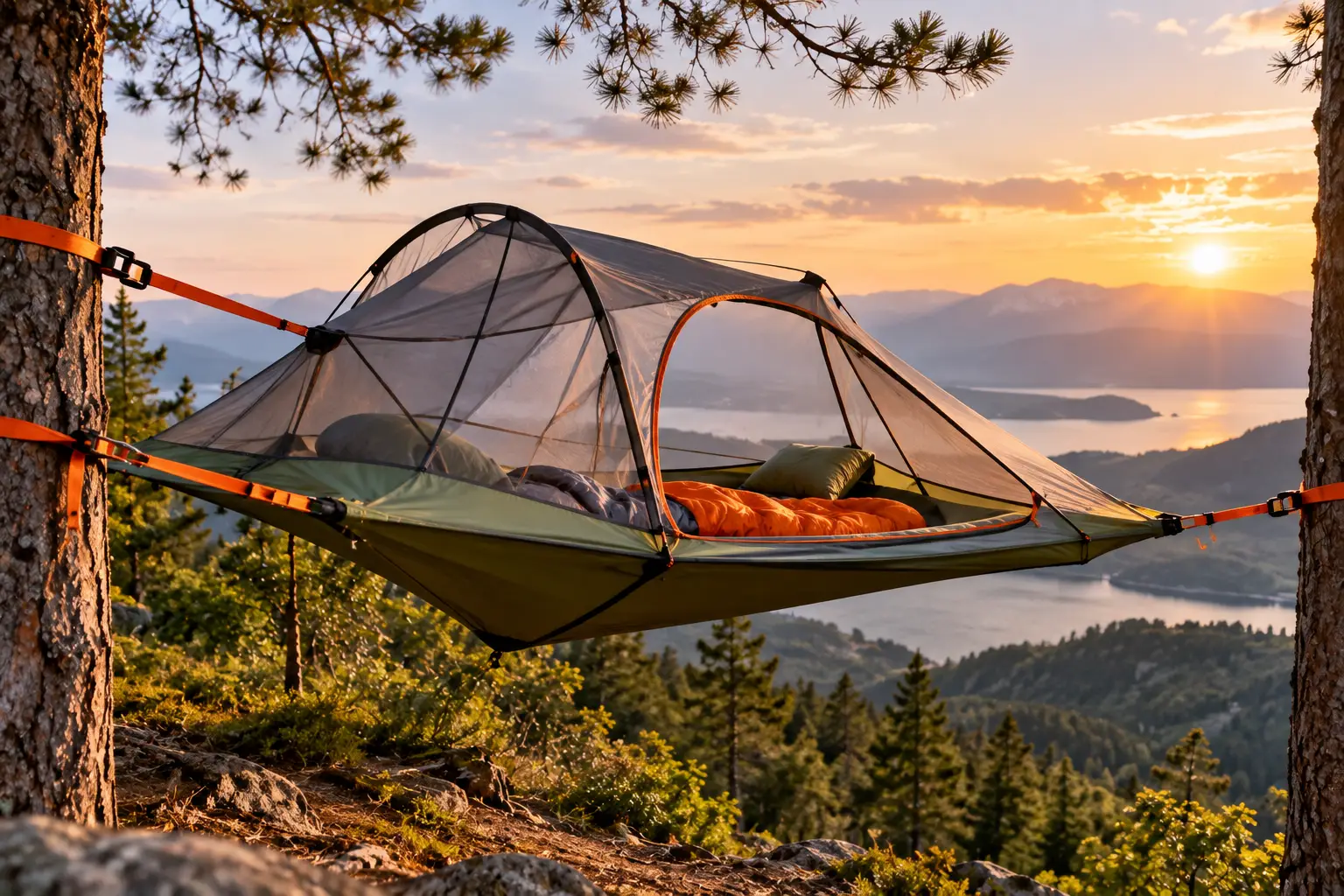
A suspension tent is a fully enclosed shelter that hangs from trees (or other solid anchors) rather than resting on the ground. The two main families are the three-anchor tree tent, which stretches a flat, taut floor between three trees, and the two-anchor hammock tent, which adds a bug net, rainfly, and sometimes spreader bars or a lay-flat frame to a hammock. The tree tent as a category is essentially a portable treehouse: a complete enclosure that houses you and your gear while suspended.
Here’s the catch most product pages skip: these shelters live or die by your campsite. The best suspension tent in the world is a heavy bag of fabric if you can’t find the right trees. That’s why this guide doesn’t just rank products—it explains the tree geometry, the weight trade-offs, and the setup habits that separate a dreamy night in the canopy from a saggy, swaying disappointment.
Below, you’ll find seven real models available to US shoppers, from budget three-point hammock tents to Tentsile’s flagship. Every pick is analyzed against its published specs and the recurring themes in real customer feedback—no invented test stories, just honest reasoning about who each one actually suits.
Quick Comparison: The 7 Best Suspension Tents at a Glance
| Model | Type | Sleeps | Max Load | Approx. Weight | Price Range | Best For |
|---|---|---|---|---|---|---|
| Tentsile Stingray | 3-tree platform | 3 adults | 880 lb | ~20 lb+ (listed) | $800–$900 | Tentsile Stingray: families & basecamps |
| Tentsile Connect V3 | 3-tree platform | 2 adults | 880 lb | ~21 lb packed | $600–$900 | Tentsile Connect V3: couples |
| Tentsile Flite+ | 3-tree platform | 2 adults | 485 lb | ~10.4 lb | $400–$450 | Tentsile Flite+: hiking pairs |
| Night Cat Triangle Hammock Tent | 3-tree hammock tent | 2 adults | 440 lb | ~13 lb packaged | Budget tier | Night Cat Triangle Hammock Tent: trying 3-point on a budget |
| Haven Tent | 2-tree lay-flat | 1 | 285 lb | ~6 lb kit | $320–$380 | Haven Tent: side & stomach sleepers |
| Lawson Blue Ridge | 2-tree hybrid | 1 | 275 lb | ~4.25 lb (no straps) | $250–$350 | Lawson Blue Ridge: hammock-or-ground flexibility |
| Kammok Mantis | 2-tree hammock tent | 1 | 500 lb (Recycled) / 300 lb (UL) | ~2–3 lb | $260–$330 | Kammok Mantis: backpackers |
Reading the table, the big split is obvious: the three Tentsile models plus the Night Cat Triangle Hammock Tent need three trees but give you a flat, multi-person floor, while the Haven Tent, Lawson Blue Ridge, and Kammok Mantis need only two trees and are built for one sleeper. If weight matters most, the Kammok Mantis is in a different league; if headcount matters most, the Tentsile Stingray is the only true three-adult enclosed tent here.
💬 One click helps other shoppers make an informed choice too! 😊
Top 7 Suspension Tents: Expert Analysis
1. Tentsile Stingray — the three-person flying treehouse
The Tentsile Stingray is the model that made the category famous, and it’s still the benchmark for group suspended camping. Its 880 lb (400 kg) capacity and roughly 13-foot triangular footprint mean three adults—or two adults and two kids—can sleep in separate bays instead of piling into a sagging middle. That anti-roll design is the feature that matters: the underfloor strap divides the floor so the heaviest sleeper doesn’t become a gravity well.
The Stingray gives each sleeper a dedicated door, so late-night bathroom trips don’t mean crawling over two people. Its rainfly is rated to 5,000 mm hydrostatic head, which on paper puts it firmly in three-season territory. The trade-off is bulk: Amazon’s listing puts the pack weight around 20 lb, and one outdoor publication weighed its full kit at 25.5 lb—car-camping weight, not backpacking weight.
Based on comparing the specs, this is a basecamp shelter for families, lakeside weekends, and anyone who wants a social “treehouse” at camp. Reviewers consistently mention two realities: kids (and adults) love it, and when one person shifts at night, everyone feels it. Tentsile also recommends trees at least 16 inches in diameter, which rules out many younger stands.
Pros:
- ✅ True three-adult enclosed sleeping with separate bays
- ✅ Three doors make entry and exit painless
- ✅ Strong 5,000 mm rainfly for wet climates
Cons:
- ❌ Heavy kit limits it to car or short-walk camping
- ❌ Needs three large, well-spaced trees
At the time of writing, the Stingray sits in the $800–$900 range (a lighter Stingray Lite variant runs closer to $600)—expensive, but unmatched value if you genuinely need three suspended beds.
2. Tentsile Connect V3 — built for couples who want space
The Tentsile Connect V3 takes the Stingray’s platform concept and tunes it for two. The Amazon listing specifies an 880 lb capacity, 52 sq ft of floor, a 36-inch peak height, and a 21 lb packed weight, with a 240D poly-composite floor and a 70D polyester fly.
In practice, that 10-foot-long bed is what tall campers will appreciate—you won’t be jamming your feet against the mesh. Tentsile’s seatbelt-webbing-reinforced floor creates two distinct sleeping bays, so a 130 lb partner and a 220 lb partner don’t end up rolling together. Four roll-back doors turn it into an open-air lounger on warm nights.
Here’s what to weigh: the Connect carries the same tree requirements as the Stingray (Tentsile cites a 16-inch minimum trunk diameter), yet only sleeps two. You’re paying for comfort and headroom, not versatility. It’s the right call for couples who car camp in mature forest and want the “cloud bed” experience without the Stingray’s extra footprint.
Aggregated buyer feedback is largely positive about comfort, with some reports of inconsistent zippers and occasional shipments missing a pole—worth inspecting your box the day it arrives.
Pros:
- ✅ Roomy 10-foot bed suits tall sleepers
- ✅ Anti-roll bays handle uneven partner weights
- ✅ Four doors for airflow and easy access
Cons:
- ❌ Heavy for a two-person shelter
- ❌ Premium price for two sleepers only
Expect roughly $600–$900 depending on version and seller—strong value for couples who’ll use it several weekends a year.
3. Tentsile Flite+ — the lightest way to share a tree tent
The Tentsile Flite+ exists for hikers who refuse to give up the flat-floor experience. Tentsile lists it at 10.4 lb with a 485 lb (220 kg) capacity—less than half the Stingray’s weight and still enough for two adults plus gear.
The weight savings come from smart subtraction: a single ratchet instead of three, a smaller triangle, and a 12-inch minimum tree diameter instead of 16. That last detail is underrated—it opens up younger forests that bigger Tentsiles can’t use. The rainfly is rated at 5,000 mm, and an adjustable strap lets you split the floor into one or two berths.
On paper, this is the pick for backpacking pairs, bikepackers, and canoe trippers who can split the load (one person carries the ratchet and straps, the other the body). Tentsile notes it fits campers under about 6’1″, so very tall hikers should look at the Connect instead.
Owner feedback praises build quality and sleep comfort, while a recurring complaint is that in heavy, sustained rain the fly can sag onto the mesh and let moisture through—tension your guylines carefully.
Pros:
- ✅ Lightest two-person true tree tent option
- ✅ Works with thinner 12-inch trees
- ✅ Load splits easily between two hikers
Cons:
- ❌ Snug for campers over about 6’1″
- ❌ Fly can sag in prolonged downpours
Around $400–$450 at the time of writing—the best price-to-weight ratio in Tentsile’s lineup.
4. Night Cat Triangle Hammock Tent — a budget door into three-point camping
The Night Cat Triangle Hammock Tent is the most affordable way on this list to try three-anchor suspended sleeping. The listing specifies a 440 lb capacity, 150D polyester construction, a bug net, a waterproof rainfly, and a 13-foot triangular layout sized for two adults.
What sets it apart is the kit: a ratchet, knotted straps, a strap ladder with carabiners, two aluminum poles, guylines, and stakes all arrive in a 13 lb package. That means no surprise purchases before your first night. Night Cat recommends trees forming a rough equilateral triangle roughly 16–23 feet (5–7 m) apart—a slightly wider spacing than Tentsile uses.
Here’s the honest analysis: 150D polyester and a single ratchet are adequate for recreation, but they aren’t in the same durability class as Tentsile’s reinforced floors. This is a smart “does my family even like this?” purchase before committing $800+. The listing also warns that kids must be supervised, which is sensible for any elevated shelter.
This listing has a relatively short, limited public review track record, so long-term durability isn’t well documented yet—treat it as an experiment, not a heirloom.
Pros:
- ✅ Complete three-point kit in one box
- ✅ Two-adult flat lay at a budget price
- ✅ Doubles as a 90 sq ft shade shelter
Cons:
- ❌ Limited long-term durability evidence
- ❌ Wider tree spacing is harder to find
Positioned in the budget tier, far below Tentsile pricing—check the current listing for the exact figure; strong value as a trial run.
5. Haven Tent — lay-flat comfort for side sleepers
The Haven Tent solves the single biggest complaint about hammocks: the banana curve. Its patented frame and spreader bars, combined with a structural insulated pad, create a genuinely flat 78 × 24-inch sleeping surface between two trees.
Haven rates both the tent body and fly at 4,000 mm waterproofing and lists a 285 lb capacity for both the Original and the Haven XL. The Original kit weighs about 6 lb 1 oz, and the XL adds room for tall sleepers at only a few ounces more. Crucially, the pad isn’t optional decoration—Haven says it’s part of the structure, so you can’t swap in your own lighter pad.
Based on comparing the specs, this is the best one-person option for side and stomach sleepers, and for campers with back issues who’ve given up on standard hammocks. Reviews repeatedly describe it as the first hammock-style shelter they could actually sleep in, while common critiques mention a first-setup learning curve and a narrow interior.
Pros:
- ✅ Truly flat surface for side and stomach sleepers
- ✅ Pad, fly, straps, and stakes all included
- ✅ Can pitch on the ground when trees fail
Cons:
- ❌ Heavy for a one-person shelter
- ❌ Narrow 24-inch width feels tight for some
Typically $320–$380 depending on model—excellent value if comfort is your top priority.
6. Lawson Blue Ridge — the original hammock-or-ground hybrid
The Lawson Blue Ridge has been around long enough to be the category’s veteran, and its trick is still clever: spreader bars flatten the bed while shock-corded aluminum arch poles lift the no-see-um canopy like a small dome. Lawson lists a 90 × 42-inch interior, a 275 lb limit, and 4 lb 4 oz without straps (4 lb 15 oz with).
In practice, those arch poles give you enough headroom to sit up and change clothes—something most hammock tents can’t offer. And because it stakes out as a ground tent, you’re never stranded in a treeless campground.
Here’s what most buyers overlook: the base “hammock only” version doesn’t include suspension straps, so check whether your listing is the strap bundle before you drive to the trailhead. Reviews consistently flag a “tippy” feel if you roll off-center, which is the cost of a flatter, wider bed on a two-point suspension.
Pros:
- ✅ Converts to a ground tent anywhere
- ✅ Arch poles give real sit-up headroom
- ✅ Long track record and US-based brand
Cons:
- ❌ Base version ships without tree straps
- ❌ Can feel tippy when you shift off-center
Roughly $250–$350 depending on bundle—fair value for the most versatile one-person option here.
7. Kammok Mantis — the backpacker’s all-in-one hammock tent
The Kammok Mantis is the lightest suspension tent on this list by a wide margin. It bundles a hammock body, integrated bug net, rainfly, and knotless suspension. The Recycled version is rated to 500 lb, while the Mantis UL trades capacity (300 lb) for less weight—both land in the roughly 2–3 lb range.
That weight is the whole story: it’s lighter than many one-person backpacking tents. Kammok’s structural ridgeline sets a consistent sag every time, which beginners will appreciate, and the modular design lets you leave the fly at home on clear nights.
The honest trade-off is comfort style. This is a traditional gathered-end hammock, so you’ll sleep on a diagonal rather than flat, and you’ll need your own pad or underquilt for cold nights. On REI’s site at the time of research, the Recycled version averaged 4.0 stars on a small review base, while the UL averaged lower, with some owners reporting fabric tears—a reminder that ultralight fabrics demand gentle handling.
Pros:
- ✅ Lightest complete system on this list
- ✅ Knotless suspension sets up fast
- ✅ Modular pieces let you shed weight
Cons:
- ❌ Diagonal lay, not a flat bed
- ❌ Insulation must be bought separately
Roughly $260–$330 depending on version—excellent value per ounce for thru-hikers and weekend backpackers.
Side-by-Side Specs: What the Numbers Really Mean
| Model | Anchors | Min. Tree Guidance | Rainfly Rating | Included Suspension | Best For |
|---|---|---|---|---|---|
| Tentsile Stingray | 3 | 16 in diameter | 5,000 mm | Ratchets + straps | Tentsile Stingray: groups |
| Tentsile Connect V3 | 3 | 16 in diameter | 70D PU fly | Ratchets + straps | Tentsile Connect V3: couples |
| Tentsile Flite+ | 3 | 12 in diameter | 5,000 mm | 1 ratchet + straps | Tentsile Flite+: hikers |
| Night Cat Triangle Hammock Tent | 3 | 16–23 ft spacing | Waterproof (unrated) | Ratchet + straps | Night Cat Triangle Hammock Tent: first-timers |
| Haven Tent | 2 | Standard hammock trees | 4,000 mm | Straps included | Haven Tent: comfort seekers |
| Lawson Blue Ridge | 2 | Standard hammock trees | Waterproof ripstop | Bundle-dependent | Lawson Blue Ridge: flexible campers |
| Kammok Mantis | 2 | Standard hammock trees | PU/silicone fly | Knotless straps | Kammok Mantis: backpackers |
The table reveals why “which is best?” depends on your forest. The Tentsile Flite+ is the only three-point tent that tolerates 12-inch trunks, which matters enormously in younger woods. Meanwhile, the Haven Tent posts the best-documented waterproof rating among the two-tree models, and the Lawson Blue Ridge is the one to double-check for missing straps.
✨ Don’t miss these top-rated picks!
🔍 Take your elevated camping to the next level with this carefully curated lineup. Click a highlighted model to check current pricing and availability. These picks will help you sleep dry, flat, and off the rocks—nights the whole family will remember! 🌲
How to Pitch a Suspended Tent: Your First-Night Walkthrough
A suspended tent rewards practice more than any ground tent. Here’s a routine that works for both three-point and two-point designs.
Before the trip
- ✅ Rehearse in your backyard or a local park. First pitches often take 20–30 minutes; practiced campers get well under 10.
- ✅ Check your suspension kit. Confirm ratchets, straps, poles, and tree protectors are in the bag—especially with the Lawson Blue Ridge, whose base version lacks straps.
- ✅ Scout satellite imagery. Look for mature, living trees with overlapping canopies near your campsite.
At camp
- Pick living, sturdy trees. Avoid dead trunks and look up for broken “widowmaker” limbs.
- Wrap straps low and wide. The Leave No Trace hammock camping guidance recommends webbing straps at least 1 inch wide, placed on the thickest part of the trunk.
- Find the center point. For three-point tents, Tentsile says its designs fit inside any acute triangle; stand in the middle and eyeball equal strap angles.
- Tension gradually. Ratchet each strap a little at a time, rotating between anchors, so the floor levels instead of twisting.
- Set a sensible height. Tentsile advises hanging only as high as you’d feel safe falling from—usually around waist height.
First 30 days
Keep a small spirit level or level app handy; a floor that looks flat can still tilt enough to slide you into the tent wall. Re-tension after the first 20 minutes, because new webbing stretches. Always pack the tent away clean and dry.
Which Suspension Tent Fits You? Three Real-World Scenarios
Scenario 1: The family of four at a wooded state park
A family with two kids under 10 camps six weekends a year, mostly at drive-in sites with mature oaks and maples. Budget: flexible, but the tent must last. Best match: Tentsile Stingray. The 880 lb capacity comfortably covers two adults and two children, and three doors keep bathroom runs from waking everyone. Because they drive in, the heavy kit is a non-issue. If they want to test the concept first, the Night Cat Triangle Hammock Tent is a lower-risk trial run.
Scenario 2: The couple hiking 5 miles to a lake
Two hikers want a shared suspended shelter for backcountry trips of two to three nights. Every pound counts, and they’re both under 6 feet. Best match: Tentsile Flite+. At roughly 10.4 lb, it’s splittable between two packs, and its 12-inch minimum tree diameter makes it more adaptable in younger forests.
Scenario 3: The solo side sleeper with a bad back
A 40-something camper has given up on ground pads and hates the curl of a traditional hammock. They car camp and occasionally hike short distances. Best match: Haven Tent. The lay-flat design is purpose-built for side and stomach sleeping, and the ground-pitch option provides a backup plan. If weight becomes the priority later, the Kammok Mantis is a logical second shelter for longer hikes.
Problem → Solution: Fixing the Most Common Suspension Tent Headaches
Problem 1: “I can’t find three trees in the right shape.” ✅ Solution: Accept that some sites won’t work. Pack a backup—the Lawson Blue Ridge and Haven Tent both pitch on the ground—or choose a two-anchor design for campgrounds with scattered trees.
Problem 2: “Everyone rolls into the middle.” ✅ Solution: Tighten the anti-roll or underfloor strap on Tentsile models. Uneven tension usually means one anchor is lower—re-level before adding more ratchet force.
Problem 3: “My back is freezing even in summer.” ✅ Solution: Air flows under suspended floors all night. Add an insulated pad or underquilt; the Haven Tent includes a pad, while the Kammok Mantis needs one bought separately.
Problem 4: “Rain is getting through the mesh.” ✅ Solution: Pitch the fly taut and stake out every guyline. Owners of the Tentsile Flite+ specifically report fly sag in heavy rain, so check tension before bed.
Problem 5: “The tent sways when my partner moves.” ✅ Solution: Increase overall tension and lower the height slightly. Some motion is inherent—it’s a trade-off you accept for off-the-ground sleeping.
How to Choose a Suspension Tent: 7 Steps
- Count your sleepers. One person points to two-tree hammock tents; two to three people point to three-tree platforms.
- Map your typical forest. Mature hardwoods suit Tentsile; mixed or young stands favor lighter three-point designs or two-tree models.
- Set a weight ceiling. Car campers can ignore weight; backpackers should stay near or under 10 lb per person.
- Decide flat vs. curved. Side and stomach sleepers should prioritize lay-flat systems or tree tent floors.
- Check the rainfly rating. Look for a published hydrostatic head (4,000–5,000 mm is strong) if you camp in wet regions.
- Audit the box contents. Straps, ratchets, tree protectors, and pads can add $30–$100 if missing.
- Plan a ground fallback. Hybrids that pitch on the ground save trips when trees don’t cooperate.
Tree Tent vs. Hammock Tent vs. Ground Tent
The terms get blurred, so let’s define them cleanly. A tree tent uses three anchors to stretch a taut, flat floor—think trampoline with walls. A hammock tent uses two anchors, like a classic hammock, and adds a bug net and fly. The broader practice of hammock camping relies on webbing “tree-huggers” that minimize bark damage, and hammock tents inherit that low-impact advantage.
| Factor | Tree Tent | Hammock Tent | Ground Tent |
|---|---|---|---|
| Anchors needed | 3 trees | 2 trees | None |
| Sleeping position | Flat | Curved or lay-flat | Flat |
| Typical capacity | 2–3 adults | 1 adult | 1–6+ |
| Terrain tolerance | Excellent | Excellent | Poor on slopes/rocks |
| Weight per person | Moderate–heavy | Light–moderate | Light–moderate |
| Best for | Tentsile Stingray | Kammok Mantis | Treeless areas |
The comparison shows why a tree tent is the social choice and a hammock tent is the solo, weight-conscious choice. Ground tents still win on flexibility, but suspended designs win decisively on slopes, roots, and wet ground—exactly where traditional tents struggle.
In short: if you camp in groups on established wooded sites, a tree tent’s flat floor is hard to beat. If you hike alone and move camp daily, a hammock tent’s two-tree simplicity is a smarter trade.
The Best 2 Person Suspension Tent Setups for Couples and Families
Sharing a suspended shelter is different from sharing a ground tent, and the gear choice shapes the experience.
For couples
A 2 person suspension tent needs independent sleeping bays—otherwise the heavier partner creates a dip and you both slide toward it. That’s precisely why the Tentsile Connect V3 and Tentsile Flite+ use adjustable anti-roll straps. The Connect prioritizes space and doors; the Flite+ prioritizes weight. Couples of very different heights should favor the Connect’s 10-foot bed.
For families with kids
Kids tend to love elevated tents, but they add safety responsibilities. Keep the floor low, supervise entry and exit, and pick a model with generous capacity margins. The Tentsile Stingray‘s 880 lb rating leaves room for two adults, two children, and gear. Budget families can test interest with the Night Cat Triangle Hammock Tent, whose listing explicitly calls for adult supervision of children.
Stacking for bigger groups
Tentsile designs can pair with a hammock hung underneath (within total load limits), creating an extra sleeping level—a clever way to add capacity without buying a second big tent.
Features That Actually Matter (and Ones That Don’t)
✅ Features that matter
- Anti-roll or lay-flat systems. This single feature determines sleep quality more than fabric denier.
- Published waterproof ratings. A number like 4,000 or 5,000 mm tells you more than vague “waterproof” marketing.
- Complete suspension kits. Ratchets and tree-friendly straps in the box prevent a wasted first trip.
- Minimum tree diameter. It’s a hidden spec that decides where you can actually camp.
❌ Features that matter less
- Extra interior pockets. Nice, but they don’t change your night.
- Color and camo options. Only relevant for hunters and wildlife photographers.
- “Four-season” labels on suspended tents. Wind underneath still steals heat; insulation matters more than the label.
The takeaway: spend your budget on sleep geometry, weather protection, and suspension quality—everything else is garnish.
Long-Term Cost and Maintenance
A suspension tent’s sticker price is only part of the cost. Add-ons such as insulation, tree protectors, and replacement straps can change the math.
| Model | Upfront Range | Likely Add-Ons | Value Verdict |
|---|---|---|---|
| Tentsile Stingray | $800–$900 | Underquilt/pads | Tentsile Stingray: high cost, high capacity |
| Tentsile Flite+ | $400–$450 | Pads | Tentsile Flite+: best per-pound value |
| Haven Tent | $320–$380 | Few (pad included) | Haven Tent: fewest hidden costs |
| Kammok Mantis | $260–$330 | Underquilt/pad | Kammok Mantis: cheap to carry, pricier to insulate |
The Haven Tent is the most “all-in” price because its pad is already included, while the Kammok Mantis looks cheaper until you add cold-weather insulation. Divide the Tentsile Stingray‘s price by three sleepers and it becomes surprisingly competitive per person.
Maintenance habits that extend lifespan
- Dry every component before storage to prevent mildew.
- Inspect straps, stitching, and ratchets before each use—Tentsile’s own manual recommends a visual and tactile check.
- Store out of sunlight; UV degrades nylon and polyester over time.
- Replace frayed webbing immediately—it’s inexpensive insurance.
Safety, Regulations, and Leave No Trace
Hanging off the ground introduces risks a ground tent doesn’t have, and public land rules vary.
Safety essentials
- Respect load limits. Every manufacturer here publishes a maximum—include gear in your total.
- Hang low. Waist height or lower keeps a fall survivable.
- Avoid hazard trees. Dead trunks and hanging limbs are the real danger, not the straps.
- Skip storms. Suspended tents catch wind; don’t pitch on exposed ridges during advisories.
Rules on public land
Not every park allows hanging from trees, and many that do require protection for bark. For example, the National Park Service’s Dry Gulch Campground guide at Curecanti asks hammock users to use tree-saver straps or padding, never use zip ties, and take hammocks down when leaving camp. Always check the specific park, forest, or state rules before your trip.
Tree-friendly habits
Use wide webbing, place straps on thick trunks, and use tree protector wraps (several Tentsile models include them). These small steps protect the bark layer trees rely on.
Common Mistakes to Avoid When Buying a Suspension Tent
- Buying a three-point tent for a treeless region. Deserts and open prairies make three-anchor tents nearly unusable.
- Ignoring minimum tree diameter. A 16-inch requirement quietly eliminates many campsites.
- Assuming straps are included. Double-check listings, especially bundle vs. base versions.
- Forgetting insulation. Suspended sleepers lose heat underneath, even in mild weather.
- Choosing capacity with no margin. Leave 10–15% headroom for gear and movement.
- Skipping a practice pitch. The first setup at dusk is the worst time to learn ratchets.
FAQs
❓ Is a suspension tent worth the money for occasional campers?
❓ Can you use a suspension tent without trees?
❓ What's the best suspension tent for 2 people?
❓ How high should I hang a tree tent?
❓ Do suspension tents stay warm in cold weather?
Conclusion: Sleep Above the Mess, Not On It
A suspension tent isn’t just a novelty—it’s a practical answer to rocky, sloped, soggy, or bug-heavy campsites. The key is matching the design to your forest, your headcount, and your pack weight.
For families and group basecamps, the Tentsile Stingray remains the gold standard. Couples who want space should look at the Tentsile Connect V3, while hiking pairs will appreciate the Tentsile Flite+‘s lighter build. If you’re curious but cautious, the Night Cat Triangle Hammock Tent is a low-risk experiment.
Solo campers have three strong paths: the Haven Tent for truly flat sleep, the Lawson Blue Ridge for hammock-or-ground flexibility, and the Kammok Mantis for ultralight backpacking.
Whatever you choose, practice at home, respect tree-protection rules, bring insulation, and stay within load limits. Do that, and your next campsite might just become your favorite bedroom in the woods.
🌲 Ready to sleep among the trees?
🏕️ Pick the suspension tent that fits your crew, your trail, and your budget. Click a highlighted model to check current pricing and availability—your flattest, driest night outdoors could be one trip away! ✨
Recommended for You
- 1 person hammock: 7 Best Picks That Actually Deliver in 2026
- One Person Hammock Guide 2026: 7 Best Picks, Honestly Ranked
- Loft Net Hammock: 7 Best Picks for Cozy, Safe Lofts (2026)
Disclaimer: This post contains affiliate links. As an Amazon Associate, I earn from qualifying purchases made through these links, at no additional cost to you.
✨ Found this article helpful? Share it with someone who needs it! 💬🤗