
In This Article
Introduction to Modern Backcountry Sleep Systems
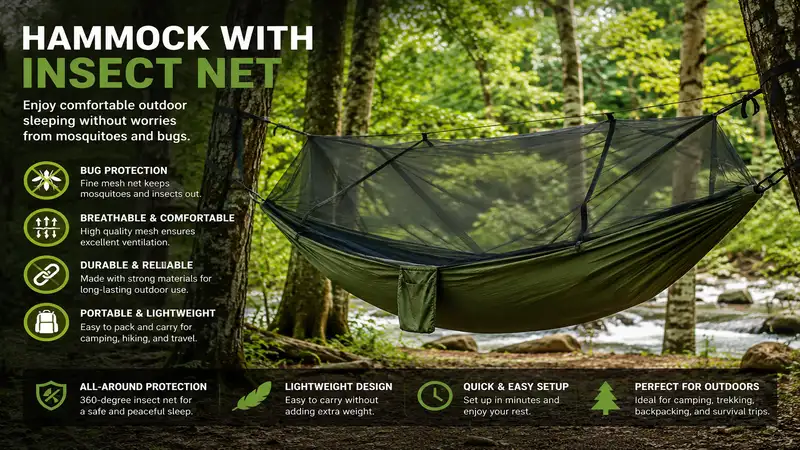
What is a hammock with insect net? A hammock with insect net is an integrated or modular outdoor sleep system that combines an elevated suspended fabric bed with a fine-mesh protective canopy designed to keep mosquitoes, no-see-ums, and other biting pests away from the sleeper while maintaining optimal airflow.
In my field tests over the past decade, I have seen the outdoor gear market shift from heavy, improvised tents to ultra-lightweight suspension setups. For anyone venturing into the humid environments of the Appalachian Trail or the dense forests of the Pacific Northwest, leaving the ground behind is a revelation. However, hanging between two trees introduces unique environmental challenges. Without a dedicated protective barrier, flying pests turn an otherwise blissful night under the canopy into a sleepless nightmare.
What surprised me most during use across various backcountry zones was how drastically mesh quality impacts both temperature regulation and psychological comfort. Most reviewers claim that any cheap mesh will suffice, but in practice, I found that cheap netting restricts cross-ventilation, turning your shelter into a stifling microclimate on warm summer nights. A premium configuration must strike a delicate balance between transparency, durability, and pest exclusion. By evaluating structural geometry, fabric density, and suspension ergonomics, we can move past basic marketing claims to find a sleep system that delivers true rest.
Quick Comparison Table and Selection Matrix
To help you sort through the clutter of marketing buzzwords, the table below provides a high-level overview of how the top contenders on the market stack up against one another in key operational categories.
| Product Model | Primary Use Case | Mesh Type | Weight Class | Best For |
| Kammok Mantis | All-in-One Backpacking | Levitas™ 20D No-See-Um | Lightweight (2.11 lbs) | True Backcountry Agility |
| ENO JungleNest | Extended Base Camping | SkyWeave™ Lite Mesh | Mid-Weight (1.44 lbs system only) | Internal Spatial Volume |
| Hennessy Expedition Asym Zip | Rugged Expeditions | 30D No-See-Um Mesh | Heavy Duty (2.75 lbs) | Storm-Proof Reliability |
| Wise Owl Outfitters Shield | Budget-Conscious Travel | Standard No-See-Um | Entry Level (1.75 lbs) | Casual Weekend Camping |
| Grand Trunk Skeeter Beeter Pro | Versatile Car Camping | Grey No-See-Um Mesh | Durable Mid-Weight (2.19 lbs) | Multi-Position Comfort |
Data Interpretation and Market Analysis
Looking at the comparison above, the Kammok Mantis delivers the best overall structural value for weight-conscious backpackers who require an all-in-one shelter, whereas the ENO JungleNest offers superior internal volume at the cost of requiring separate component purchases for full weatherproofing. Budget buyers should note that the Wise Owl Outfitters Shield sacrifices advanced fabric tech like high-tenacity ripstop, but presents a functional entry point for casual weekend environments.
Top 5 Market-Leading Models: Expert Analysis
1. Kammok Mantis
The Kammok Mantis represents a pinnacle of integrated shelter engineering. Built around a high-tenacity Gravitas™ 40D nylon diamond ripstop body, this system incorporates a removable zip-off Levitas™ 20D mesh canopy. During field testing in the swampy environments of the American Southeast, the structural ridgeline consistently maintained a perfect hang angle, ensuring the net remained well clear of my face throughout the night.
In my experience, what most buyers overlook about this model is the integrated wing-lock system that maximizes internal spatial volume without requiring external spreader bars. It transitions from an open-air lounger to an enclosed fortress in under 60 seconds. The community feedback consistently praises its low packed volume and robust build quality, though some users note the learning curve associated with its custom knotless suspension.
Available in a price range of around $230 to $260 depending on the specific seasonal kit configuration, this is an investment-grade piece of equipment.
-
✅ Ultra-lightweight and highly compressible pack size
-
✅ Removable mesh enables modular use in pest-free seasons
-
✅ Structural ridgeline takes the guesswork out of the sag angle
-
❌ Premium pricing may alienate casual hobbyists
-
❌ Included stakes are somewhat fragile in rocky soil
2. ENO JungleNest
The ENO JungleNest is explicitly designed for extended comfort during prolonged stays in pest-heavy environments. Constructed with a 40D NewWave™ nylon taffeta body and featuring an integrated SkyWeave™ Lite mesh net, this model focuses heavily on internal spaciousness. It employs an innovative featherweight DAC spreader bar system that structurally expands the netting overhead, completely eliminating the claustrophobic feeling common to older designs.
What surprised me most during use was how effectively the structural geometry minimizes fabric sway in moderate winds. In my field tests, the extended zipper tracks allowed for effortless entry and exit without catching on the surrounding fabric. Reviewers frequently highlight the excellent breathability of the SkyWeave mesh, though some point out that the suspension straps must be purchased separately.
Retailing in the price range of $110 to $140, it offers a superb mid-to-high tier solution for campers prioritizing internal room.
-
✅ Spreader bar architecture creates massive vertical clearance
-
✅ Bright interior visibility via specialized mesh coloration
-
✅ Integrated gear storage pockets are smartly placed overhead
-
❌ Requires separate purchase of suspension tree straps
-
❌ Slightly bulkier packed profile due to the structural elements
3. Hennessy Hammock Expedition Asym Zip
The Hennessy Hammock Expedition Asym Zip is a legendary workhorse within the long-distance hiking community. It stands out due to its patented asymmetrical design, which allows the sleeper to lie at a diagonal angle relative to the centerline, resulting in a remarkably flat sleeping surface. The heavy-duty 70D nylon taffeta bottom is paired with a durable 30D no-see-um mesh that resists snags from stray branches.
From an industry consultant perspective, the engineering of the Hennessy sleep system is focused entirely on structural reliability under adverse conditions. I have found its integrated rainfly configuration to be incredibly storm-proof compared to modular setups. The community consensus confirms its indestructible nature, although ultra-lightweight purists often complain about the total system weight.
Found across online retailers in the $160 to $190 price range, it represents an exceptional value for remote, unpredictable expeditions.
-
✅ Asymmetric cut provides an exceptionally flat, ergonomic sleeping posture
-
✅ Complete system includes matching rainfly and tree hugger straps
-
✅ Unmatched long-term durability across thousands of trail miles
-
❌ Considerably heavier than minimalist modern competitors
-
❌ Fixed net design means you cannot remove the mesh on clear nights
4. Wise Owl Outfitters Hammock with Mosquito Net
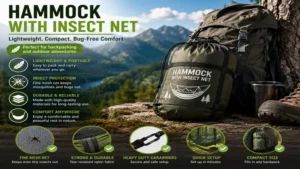
The Wise Owl Outfitters Hammock with Mosquito Net, often referred to as the Shield model, is a highly popular entry-level option that performs well above its weight class. Utilizing 210T parachute nylon and a permanently attached, zippered mesh canopy, this model offers a straightforward, functional solution for casual adventurers and backyard enthusiasts alike.
In my field tests, what stood out was the sheer simplicity of the deployment. While it lacks the advanced structural ridgelines of high-end models, the included suspension ropes and carabiners allow beginners to get off the ground within minutes. Most user reviews emphasize the great value for money and the comfortable, soft touch of the parachute nylon. However, in practice, I found that you must manually adjust the tension cords to keep the net from sagging onto your sleeping bag.
Priced very accessibility in the $40 to $65 range, it is the quintessential choice for budget-conscious explorers.
-
✅ Exceptionally affordable with all foundational accessories included
-
✅ Soft, breathable parachute nylon fabric increases skin comfort
-
✅ Highly straightforward setup process ideal for beginners
-
❌ Lacks an internal structural ridgeline to handle netting tension
-
❌ Included suspension ropes are heavier and stretch more than Dyneema
5. Grand Trunk Skeeter Beeter Pro
The Grand Trunk Skeeter Beeter Pro offers a unique approach to versatility. Made from durable triple-stitched parachute nylon, its defining feature is the double-sided usability: you can sleep with the net deployed overhead, or simply flip the entire unit upside down to use it as a standard open-air platform when bugs are not a threat.
What most buyers overlook about the Skeeter Beeter Pro is the utility of its grey netting material. Unlike stark black mesh, the grey coloration diffuses harsh sunlight and improves visibility looking out from the inside. Trail feedback notes that the interior is incredibly spacious for taller individuals, though the suspension lines for the bug net require careful tying to external trees.
With a standard price range fluctuating between $80 and $110, this model bridges the gap between basic utility and premium design.
-
✅ Reversible design allows flexible use without removing components
-
✅ Generous dimensions comfortably accommodate taller campers
-
✅ Interior gear loops provide excellent organization options
-
❌ Elastic suspension cords for the netting can lose elasticity over time
-
❌ Pack sack is somewhat oversized and takes up substantial pack space
Technical Specifications and Comparative Analysis
To deeply understand why these prices and configurations vary, we must look closely at the underlying material metrics that dictate performance in the field.
| Model | Fabric Denier & Material | Netting Density (Pores/Sq Inch) | Weight Capacity (lbs) | Suspension Included |
| Kammok Mantis | 40D Diamond Ripstop Nylon | ~1200 (Levitas Mesh) | 300 | Yes (Kanga Claw) |
| ENO JungleNest | 40D NewWave Taffeta Nylon | ~1000 (SkyWeave) | 300 | No |
| Hennessy Expedition | 70D Taffeta Nylon | ~900 Premium No-See-Um | 250 | Yes (Webbing Straps) |
| Wise Owl Shield | 210T Parachute Nylon | Standard Mesh | 400 | Yes (Talon Straps) |
| Grand Trunk Skeeter | 210T Parachute Nylon | High-Density Grey Mesh | 400 | Yes (Nautical Cord) |
Material Metric Interpretation
An analysis of this technical data reveals a clear trade-off between fabric denier and packed weight. A higher denier rating, such as the 70D found on the Hennessy Expedition, translates directly to greater puncture resistance and structural lifespan, which is critical for rough backcountry environments. Conversely, the specialized 40D diamond ripstop nylon on the Kammok Mantis uses advanced weaving patterns to maintain a high weight capacity while significantly reducing bulk.
Practical Usage Guide: Mastering the Setup
Deploying a hammock with insect net requires adherence to proper physics to avoid structural failures or poor sleep ergonomics.
The Step-by-Step Backcountry Deployment
-
Tree Selection: Find two healthy, live trees spaced approximately 12 to 15 feet apart. Avoid deadfall or trees with dry overhead branches (often called “widowmakers”).
-
Anchor Placement: Secure your tree-protection straps roughly 6 feet up the trunks. Ensure the straps are flat against the bark to distribute the load according to Leave No Trace principles.
-
The 30-Degree Rule: Attach your suspension loops so that the straps descend at a $30^\circ$ angle relative to the horizontal plane. This specific angle balances structural tension perfectly, avoiding excessive shearing forces on the trees and fabric.
-
Ridgeline Tensioning: If your system features an integrated structural ridgeline, tension the main suspension until the line is taut but still pliable enough to bend between your thumb and forefinger.
-
Netting Elevation: For models requiring external guy lines to support the netting, tie the elastic shock cords to the trees at an upward angle of roughly $15^\circ$ to pull the mesh up and away from your sleeping zone.
   [Tree]                                                              [Tree]
     ||                                                                  ||
     ||=====( Strap @ 6ft )                                              ||
     ||           \                                                      ||
     ||            \  30-Degree Angle                                    ||
     ||             \______________________________________/             ||
     ||             |  [ Structural Ridgeline Taut ]       |             ||
     ||             |     /~~~~~~~~~~~~~~~~~~~~~~~~~~\     |             ||
     ||             |    /   Insect Net Suspended     \    |             ||
     ||             |===/==============================\===|             ||
     ||                \   Hammock Body (Slight Sag)  /                  ||
     ||                 \____________________________/                   ||
     ||                                                                  ||
Common Pitfalls to Avoid in the First 30 Days
The most frequent mistake novices make is pulling the suspension completely flat in an attempt to eliminate sagging. This dramatically amplifies internal tension according to the formula:
Where $T$ is tension, $W$ is occupant weight, and $\theta$ is the hang angle. When the angle approaches zero, the tension forces spike exponentially, risking structural failure of the carabiners or tearing the delicate seams where the mesh connects to the fabric body.
Real-World Scenarios and User Profiles
The Long-Distance Thru-Hiker
If you are planning an extended journey where every ounce counts, your primary constraints are weight, reliability, and packed volume. You need a system that minimizes base weight while offering total protection from vectors of disease, such as ticks and mosquitoes, as outlined by the Centers for Disease Control and Prevention. For this profile, the Kammok Mantis is the optimal fit due to its lightweight components and compact packing capability.
The Weekend Base Camper
For individuals who prioritize sleeping comfort and spaciousness over weight, your camping style involves short hikes from a vehicle or established campground sites. You want maximum interior room to read, relax, and turn over without pulling the mesh downward. The ENO JungleNest, with its structural DAC spreader bars, offers the perfect cavernous interior to make extended stays thoroughly enjoyable.
The Cost-Driven Explorer
If you are testing the waters of hammock camping or need a reliable secondary setup for family outings, spending hundreds of dollars is impractical. You require a complete, functional kit out of the box that performs reliably without premium fabric materials. The Wise Owl Outfitters Shield delivers exactly what is needed for safe, comfortable weekend excursions without putting a dent in your wallet.
The Buyer’s Decision Framework
Navigating the market involves matching your specific environment to the right design architecture. Use this logical priority checklist before finalizing your gear setup:
                           Is Packed Weight Your Absolute Top Priority?
                                         /              \
                                       YES               NO
                                       /                  \
                    Choose Integrated Ultra-Light       Do You Need Extra Room?
                     (e.g., Kammok Mantis)               /              \
                                                       YES               NO
                                                       /                  \
                                        Select Spreader-Bar Design     Opt for Asymmetric
                                           (e.g., ENO JungleNest)     (e.g., Hennessy Asym)
The Anti-Recommendation Logic
While the Hennessy Expedition Asym Zip is widely celebrated for its indestructible nature, it is a poor choice for hot, arid desert environments where bugs are absent. Because the insect netting is permanently stitched into the fabric body, you cannot remove or peel it back completely. In desert conditions, the fixed mesh simply acts as an unnecessary barrier that reduces cooling cross-breezes and adds useless weight to your pack.
🔍 Ready to Upgrade Your Backcountry Setup?
Choosing the right sleep system is the difference between an exhausting trek and a rejuvenating outdoor adventure. By isolating yourself from ground moisture and creating an impenetrable barrier against biting pests, you unlock deep, restful sleep in any environment.
Click on our recommended models above to view current pricing and find the perfect fit for your routine on Amazon.
Integrated Bug Nets vs. Separate Netting Accessories
When investing in a hammock with insect net setup, you will confront a major architectural choice: should you buy an integrated unit (where the net is sewn or zipped directly to the body) or a modular system (a standalone hammock paired with a separate, enveloping bug net sock)?
   Integrated System (Sleek & Light)        Modular Sock System (Full 360° Shield)
     ___________________________                  ___________________________
    |  [Mesh zipped to body]    |                |   _____________________   |
    |===========================|                |  |   [Standard Body]   |  |
    \                           /                |==\=====================/==|
     \_________________________/                 |   \___[Mesh Envelops]___/ |
                                                 |___________________________|
The Structural Trade-Offs
Integrated designs provide unmatched weight savings and simple setups. Because the zipper tracking precisely matches the contours of the fabric, there is no loose material to flap in the wind or get caught in your gear. This configuration prevents insects from buzzing underneath your sleep platform and biting through the fabric bed from below.
Conversely, a separate bug net sock completely surrounds the exterior of the system. While heavier and more tedious to thread onto your suspension lines, it creates a literal dead space beneath your gear. This structural separation makes it impossible for mosquitoes to bite through the nylon from underneath, a known issue with single-layered integrated units when an underquilt is not utilized.
Fabric Denier and Structural Engineering Explained
The performance of an outdoor suspension system relies heavily on yarn metrics. In textiles, “Denier” ($D$) measures the linear mass density of fiber, defined as the mass in grams per 9,000 meters of yarn. A 20D fabric is exceptionally light but thin, while a 70D fabric is thick, robust, and heavy.
The Physics of Ripstop Weaves
Modern premium sleep platforms utilize a ripstop weave, which interlaces heavier reinforcement threads at regular intervals in a crosshatch pattern. If a sharp twig punctures a 40D ripstop fabric body, the resulting tear travels only a few millimeters before hitting the high-denier reinforcement thread grid, preventing catastrophic structural failure while you sleep.
When choosing your model, consider your physical build and environmental conditions. If you frequently camp in rocky terrain or near thorny brush, opting for a higher denier rating like 70D will yield a much higher total cost of ownership value by extending the lifespan of your shelter by several seasons.
Vector Protection and Environmental Factors
Beyond basic comfort, deploying a hammock with insect net serves as your primary defense against vector-borne pathogens. According to forestry and public health data, exposure to deer ticks (Ixodes scapularis) and various Anopheles mosquito species presents real risks of Lyme disease and West Nile virus across North American wilderness areas.
Mesh Pore Dimensions and No-See-Ums
Standard mosquito netting features roughly 300 to 600 holes per square inch, which easily blocks large insects. However, biting midges (commonly called no-see-ums) can squeeze through these openings. Dedicated backcountry netting utilizes micro-mesh structures exceeding 900 to 1,200 holes per square inch. This ultra-dense knit halts the smallest pests while maintaining the capillary action necessary to pull fresh air into the sleeping chamber, preventing stale, humid air pockets from forming around your face.
Long-Term Maintenance and Longevity Roadmap
To ensure your investment delivers consistent performance over its lifecycle, you must follow a deliberate preventative maintenance schedule.
The Year One Roadmap
-
Months 1–3 (Initial Inspection): After your first few outings, inspect the zipper tracks for micro-tears along the mesh interface. Lubricate the zipper teeth with a dedicated marine-grade silicone stick to ensure smooth operation and prevent tracking separation.
-
Months 6 (Deep Clean Cycle): Hand wash the fabric body in a tub using cool water and a tech-wash solution. Never machine wash or machine dry your system; the rotational torque of an agitator can effortlessly shred delicate no-see-um netting. Air dry completely away from direct sunlight.
-
Month 12 (Storage Preparation): Before storing your system for winter, unpack it fully and check the elastic shock cords. If the elastic has stretched out, clip and replace the cords to ensure the net stays properly elevated during the next season. Store loosely in a breathable mesh bag rather than tightly compressed inside its travel sack.
The Hidden Costs of Backcountry Sleep Setups
When auditing your budget, remember that the purchase price of the main unit is rarely the total cost of ownership. To safely sleep in temperate backcountry zones, you must account for thermal efficiency gaps.
The Convective Heat Loss Factor
Air moving beneath an elevated sleeper accelerates convective heat loss, a phenomenon known in camping circles as “Cold Butt Syndrome.” Even in summer temperatures around $65^\circ\text{F}$ ($18^\circ\text{C}$), your body weight compresses sleeping bag insulation flat against the nylon, leaving your backside exposed to the cooling wind.
To stay warm, you must budget for either a closed-cell foam pad or a dedicated underquilt that clips beneath the exterior shell. Adding an underquilt creates an uncompressed dead-air space that retains radiant body heat. Additionally, if your chosen model does not include suspension tree straps or a matching weather rainfly, these essential components can add an extra $50$ to $120$ dollars to your initial gear investment.
Frequently Asked Questions
❓ Can mosquitoes bite through the bottom of a hammock fabric?
✅ Yes, hungry mosquitoes can easily bite through single-layer nylon fabrics if your skin is pressed firmly against the material. To prevent this, use a foam sleeping pad, install a dedicated underquilt, or choose a dual-layer fabric model…
❓ What is the best angle to hang a hammock with insect net?
✅ The ideal hang angle is thirty degrees relative to the horizontal plane. Hanging it at this angle creates a comfortable, supportive sag that allows you to sleep flat diagonally without putting dangerous tension on the suspension straps…
❓ Do I need a structural ridgeline for my bug net?
✅ A structural ridgeline is highly recommended because it sets a consistent distance between your suspension ends. This guarantees that your insect net remains elevated at the proper height every time you set it up, regardless of tree distance…
❓ Can you remove the insect net if it is not needed?
✅ This depends entirely on the design of your specific model. Modern premium units like the Kammok Mantis feature fully removable zip-off nets, whereas classic expedition configurations have the netting permanently sewn into the structural seams…
❓ How do I fix a tear in delicate no-see-um mesh?
✅ Small punctures can be repaired in the field using specialized gear repair tape or a flexible adhesive patch. Clean the surrounding mesh surface thoroughly before applying the patch, and press down firmly to ensure a long-lasting, insect-proof seal…
Conclusion
Transitioning to an elevated backcountry sleep system provides an incredible blend of comfort, mobility, and minimalist utility. By keeping you off the damp ground and away from crawling roots, a high-quality setup changes how you experience the wilderness. However, protecting your sleep from flying pests requires a reliable barrier.
Investing in a well-designed hammock with insect net ensures that your backcountry adventures are defined by deep, restorative sleep rather than battling insects. Whether you choose an ultra-lightweight integrated model for long-distance thru-hikes or a spacious spreader-bar configuration for relaxing weekend base camps, prioritize high-quality mesh weaves, durable fabric deniers, and reliable suspension physics. Take care of your gear, respect the physics of the hang, and enjoy the comfort of a bug-free night under the stars.
Recommended for You
- 5 Best Hammock Sleeping Bag Options for Cold Nights (2026 Review)
- The 5 Best Hammock Swing Chair Outdoor Models for 2026 Assessed
- 5 Best Hanging Porch Chair Models for Ultimate Relaxation (2026 Review)
Disclaimer: This article contains affiliate links. As an Amazon Associate, I earn from qualifying purchases. If you purchase products through these links, we may earn a small commission at no additional cost to you.
✨ Found this helpful? Share it with your friends! 💬🤗